Book contents
- Frontmatter
- Contents
- Acknowledgements
- Introduction
- 1 Maulana Husain Ahmad Madani and the Jami'at ‘Ulama-i- Hind: Against Pakistan, against the Muslim League
- 2 The Partition Conundrum: Perspectives, Experiences and Ambiguities from qasbahs in India
- 3 Choudhary Rahmat Ali and his Political Imagination: Pak Plan and the Continent of Dinia
- 4 Differentiating between Pakistan and Napak-istan: Maulana Abul Ala Maududi's Critique of the Muslim League and Muhammad Ali Jinnah
- 5 Advising the Army of Allah: Ashraf Ali Thanawi's Critique of the Muslim League
- 6 The Illusory Promise of Freedom: Mian Iftikhar-ud-Din and the Movement for Pakistan
- 7 Visionary of Another Politics: Inayatullah Khan ‘al-Mashriqi’ and Pakistan
- 8 Nonviolence, Pukhtunwali and Decolonization: Abdul Ghaffar Khan and the Khuda'i Khidmatgar Politics of Friendship
- 9 Islam, Communism and the Search for a Fiction
- 10 Muslim Nationalist or Nationalist Muslim? Allah Bakhsh Soomro and Muslim Politics in 1930s and 1940s Sindh
- 11 Dancing with the Enemy: Sikander Hayat Khan, Jinnah and the Vexed Question of ‘Pakistan’ in a Punjabi Unionist Context
- 12 Religion between Region and Nation: Rezaul Karim, Bengal, and Muslim Politics at the End of Empire
- 13 ‘The Pakistan that is going to be Sunnistan’: Indian Shi'a Responses to the Pakistan Movement
- 14 The Baluch Qaum of Kalat State: Challenging the Ideological and Territorial Boundaries of Pakistan
- Contributors
- Index
Introduction
Published online by Cambridge University Press: 28 February 2018

Book contents
- Frontmatter
- Contents
- Acknowledgements
- Introduction
- 1 Maulana Husain Ahmad Madani and the Jami'at ‘Ulama-i- Hind: Against Pakistan, against the Muslim League
- 2 The Partition Conundrum: Perspectives, Experiences and Ambiguities from qasbahs in India
- 3 Choudhary Rahmat Ali and his Political Imagination: Pak Plan and the Continent of Dinia
- 4 Differentiating between Pakistan and Napak-istan: Maulana Abul Ala Maududi's Critique of the Muslim League and Muhammad Ali Jinnah
- 5 Advising the Army of Allah: Ashraf Ali Thanawi's Critique of the Muslim League
- 6 The Illusory Promise of Freedom: Mian Iftikhar-ud-Din and the Movement for Pakistan
- 7 Visionary of Another Politics: Inayatullah Khan ‘al-Mashriqi’ and Pakistan
- 8 Nonviolence, Pukhtunwali and Decolonization: Abdul Ghaffar Khan and the Khuda'i Khidmatgar Politics of Friendship
- 9 Islam, Communism and the Search for a Fiction
- 10 Muslim Nationalist or Nationalist Muslim? Allah Bakhsh Soomro and Muslim Politics in 1930s and 1940s Sindh
- 11 Dancing with the Enemy: Sikander Hayat Khan, Jinnah and the Vexed Question of ‘Pakistan’ in a Punjabi Unionist Context
- 12 Religion between Region and Nation: Rezaul Karim, Bengal, and Muslim Politics at the End of Empire
- 13 ‘The Pakistan that is going to be Sunnistan’: Indian Shi'a Responses to the Pakistan Movement
- 14 The Baluch Qaum of Kalat State: Challenging the Ideological and Territorial Boundaries of Pakistan
- Contributors
- Index

HTML view is not available for this content. However, as you have access to this content, a full PDF is available via the 'Save PDF' action button.
Summary
Speaking at a huge gathering in Delhi during the 1940s, Ata Ullah Shah Bukhari, the fiery leader of Majlis-i-Ahrar, a religio-political organization known for its radical anti-colonialism and as an ally of the Indian National Congress, narrated an anecdote. A mother gave 4 annas (a quarter of a rupee) to her son, Muhammad Ali, to fetch kerosene from the shop around the corner. The lad went to the shop and asked for 4 annas worth of kerosene. The shopkeeper filled the oval shaped clay pot to the brim. ‘Won't you give me a chunga with this?’ asked the boy. The shopkeeper replied, ‘The pot is full; where should I put the chunga?’ The boy upended the pot and pointed towards its opening. The shopkeeper obliged and put the chunga there. The boy went home and handed over the pot to his mother. Surprised that there was hardly any oil in the pot, the mother asked, ‘Beta [my son] Muhammad Ali, only this much oil for 4 annas?’ Muhammad Ali boasted: ‘No mother, look there is a chunga with it as well.’ A wry smile appeared on Bukhari's face as he concluded in front of the massive audience, held spellbound by his oratory: ‘This Pakistan triumphantly presented by Muhammad Ali Jinnah as a solution for Muslims who are a quarter of India's population is also like this chunga.’
This was Bukhari's rhetorical contribution to the debate on Pakistan. More seriously, he talked about the impracticality of the two wings of the proposed Muslim state being separated by thousands of miles of an ‘enemy territory’ of Hindus. Such a solution, he said, would divide the strength of South Asia's Muslim population, deprive them of their claims to the heartland of Indo- Islamic civilization in North India, and for the first time since the age of Ashoka give ownership of a vast empire to Hindus. Bukhari was not the only leader, nor Ahrar the only religious or political organization, to raise such concerns. The Azad Muslim Conference held in April 1940, just a month after the passage of the famous March resolution demanding separate Muslim states, was a massive gathering of Muslim organizations opposed to the Muslim League's demand for a Pakistan based on its two-nation theory.
Information
- Type
- Chapter
- Information
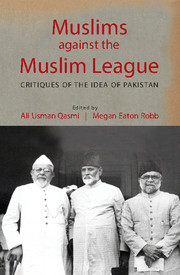
- Muslims against the Muslim LeagueCritiques of the Idea of Pakistan, pp. 1 - 34Publisher: Cambridge University PressPrint publication year: 2017
Accessibility standard: Unknown
Why this information is here
This section outlines the accessibility features of this content - including support for screen readers, full keyboard navigation and high-contrast display options. This may not be relevant for you.Accessibility Information
Accessibility compliance for the PDF of this chapter is currently unknown
and may be updated in the future.
 You have
Access
You have
Access
- 2
- Cited by