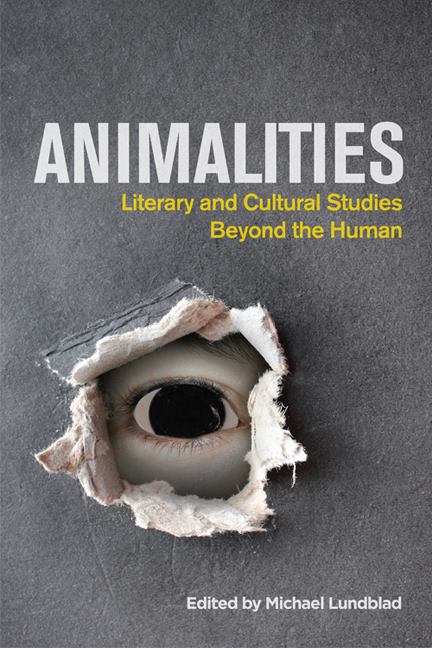
Book contents
- Frontmatter
- Contents
- List of Figures
- Acknowledgments
- Introduction: The End of the Animal – Literary and Cultural Animalities
- 1 Each Time Unique: The Poetics of Extinction
- 2 Posthuman New York: Ground Zero of the Anthropocene
- 3 J. G. Ballard's Dark Ecologies: Unsettling Nature, Animals, and Literary Tropes
- 4 Staging Humanimality: Patricia Piccinini and a Genealogy of Species Intermingling
- 5 “Sparks Would Fly”: Electricity and the Spectacle of Animality
- 6 The Nature of Birds, Women, and Cancer: Terry Tempest Williams's Refuge and When Women Were Birds
- 7 Animality, Biopolitics, and Umwelt in Amitav Ghosh's The Hungry Tide
- 8 Looking the Beast in the Eye: Re-animating Meat in Nordic and British Food Culture
- 9 Love Triangle with Dog: Whym Chow, the “Michael Fields,” and the Poetic Potential of Human-Animal Bonds
- 10 Bestial Humans and Sexual Animals: Zoophilia in Law and Literature
- Notes on Contributors
- Index
1 - Each Time Unique: The Poetics of Extinction
Published online by Cambridge University Press: 07 December 2017
By
Edited by

Book contents
- Frontmatter
- Contents
- List of Figures
- Acknowledgments
- Introduction: The End of the Animal – Literary and Cultural Animalities
- 1 Each Time Unique: The Poetics of Extinction
- 2 Posthuman New York: Ground Zero of the Anthropocene
- 3 J. G. Ballard's Dark Ecologies: Unsettling Nature, Animals, and Literary Tropes
- 4 Staging Humanimality: Patricia Piccinini and a Genealogy of Species Intermingling
- 5 “Sparks Would Fly”: Electricity and the Spectacle of Animality
- 6 The Nature of Birds, Women, and Cancer: Terry Tempest Williams's Refuge and When Women Were Birds
- 7 Animality, Biopolitics, and Umwelt in Amitav Ghosh's The Hungry Tide
- 8 Looking the Beast in the Eye: Re-animating Meat in Nordic and British Food Culture
- 9 Love Triangle with Dog: Whym Chow, the “Michael Fields,” and the Poetic Potential of Human-Animal Bonds
- 10 Bestial Humans and Sexual Animals: Zoophilia in Law and Literature
- Notes on Contributors
- Index
Summary
What kind of event is extinction? To answer that question, we have to begin with an assertion that will seem paradoxical to some and commonsensical to others: that extinction is both the most natural thing in the world and, at the same time, is never and never could be natural. On the one hand, 99.9 percent of all species that have ever existed in the history of this planet are extinct; on the other hand, extinction can hardly be regarded as “natural” in any simple sense, and not just because, as a number of people have argued, “nature,” conceived as some realm apart, untouched and unshaped by human affairs, ceased to exist a long time ago, as all the recent talk about climate change and the Anthropocene makes clear. Beyond this, the psychoanalytically inclined among us point out that any human registration of the so-called “fact” of nature is always already radically denaturalized because the symbolic and imaginary realms that make the presence of nature manifest to us in their different ways are anything but “natural.” As Slavoj Žižek put it, now twenty-five years ago, “the fact that man is a speaking being means precisely that he is, so to speak, constitutively ‘derailed,”” an “open wound of the world,” as Hegel put it, that “excludes man forever from the circular movement of life,” so that “all attempts to regain a new balance between man and nature” can only be a form of fetishistic disavowal.
One way to complicate this assertion is to realize that everything Žižek says does not apply only to human beings (because we are not the only “speaking beings” in the full sense intended here) even as we cannot say in any neat and simplistic way which nonhuman forms of life fall under the purview of this assertion and which do not – a desire for neat and tidy distinctions between different forms of life, different ways of being in the world, that would constitute its own form of fetishistic disavowal, as Jacques Derrida (among others) has pointed out.
Information
- Type
- Chapter
- Information
- AnimalitiesLiterary and Cultural Studies Beyond the Human, pp. 22 - 42Publisher: Edinburgh University PressPrint publication year: 2017
Accessibility standard: Unknown
Why this information is here
This section outlines the accessibility features of this content - including support for screen readers, full keyboard navigation and high-contrast display options. This may not be relevant for you.Accessibility Information
Accessibility compliance for the PDF of this chapter is currently unknown
and may be updated in the future.