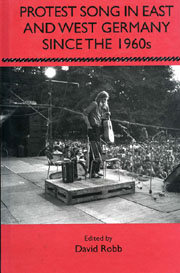
Book contents
- Frontmatter
- Contents
- Acknowledgments
- Introduction
- 1 The Reception of Vormärz and 1848 Revolutionary Song in West Germany and the GDR
- 2 Mühsam, Brecht, Eisler, and the Twentieth-Century Revolutionary Heritage
- 3 Narrative Role-Play as Communication Strategy in German Protest Song
- 4 The Burg Waldeck Festivals, 1964–1969
- 5 The Folk and Liedermacher Scene in the Federal Republic in the 1970s and 1980s
- 6 Konstantin Wecker: Political Songs between Anarchy and Humanity
- 7 Wolf Biermann: Die Heimat ist weit
- 8 Political Song in the GDR: The Cat-and-Mouse Game with Censorship and Institutions
- 9 The Demise of Political Song and the New Discourse of Techno in the Berlin Republic
- Works Cited
- Notes on the Editor and Contributors
- Index
2 - Mühsam, Brecht, Eisler, and the Twentieth-Century Revolutionary Heritage
Published online by Cambridge University Press: 05 February 2013
By

Book contents
- Frontmatter
- Contents
- Acknowledgments
- Introduction
- 1 The Reception of Vormärz and 1848 Revolutionary Song in West Germany and the GDR
- 2 Mühsam, Brecht, Eisler, and the Twentieth-Century Revolutionary Heritage
- 3 Narrative Role-Play as Communication Strategy in German Protest Song
- 4 The Burg Waldeck Festivals, 1964–1969
- 5 The Folk and Liedermacher Scene in the Federal Republic in the 1970s and 1980s
- 6 Konstantin Wecker: Political Songs between Anarchy and Humanity
- 7 Wolf Biermann: Die Heimat ist weit
- 8 Political Song in the GDR: The Cat-and-Mouse Game with Censorship and Institutions
- 9 The Demise of Political Song and the New Discourse of Techno in the Berlin Republic
- Works Cited
- Notes on the Editor and Contributors
- Index
Summary
In March 1873, two years after German unification, Georg Herwegh wrote the poem “Achtzehnter März” for the twenty-fifth anniversary of the 1848 revolution in Vienna. The poem laments the revolution's failure while simultaneously prophesizing that its legacy would live on in future revolutions:
Achtzehnhundert vierzig und acht,
Als im Lenze das Eis gekracht,
Tage des Februars, Tage des Märzen,
Waren es nicht Proletarierherzen,
Die voll Hoffnung zuerst erwacht,
Achtzehnhundert vierzig und acht?
Achtzehnhundert vierzig und acht,
Als du dich lange genug bedacht,
Mutter Germania, glücklich verpreußte,
Waren es nicht Proletarierfäuste,
Die sich ans Werk der Befreiung gemacht?
Achtzehnhundert vierzig und acht?
Achtzehnhundert vierzig und acht,
Als du geruht von der nächtlichen Schlacht,
Waren es nicht Proletarierleichen,
Die du, Berlin vor den Zitternden, bleichen,
Barhaupt grüßenden Cäsar gebraucht,
Achtzehnhundert vierzig und acht?
Achtzehnhundertsiebzig und drei,
Reich der Reichen, da stehst du, juchhei!
Aber wir Armen, verkauft und verraten,
Denken der Proletariertaten —
Noch sind nicht alle Märzen vorbei,
Achtzehnhundert siebzig und drei.
Yet again we see here the utopian sentiment alongside the disappointment of the deutsche Misere, the recurring failure of Germany to alter the political status quo from within. This double-edged condition would mark the German political song throughout the twentieth century, from the Spartakus movement in 1919 to the anti-fascist campaigns of the 1930s and from the 1968 student movement in West Germany to the 1989 Wende in the GDR.
Information
- Type
- Chapter
- Information
- Protest Song in East and West Germany since the 1960s , pp. 35 - 66Publisher: Boydell & BrewerPrint publication year: 2007
Accessibility standard: Unknown
Why this information is here
This section outlines the accessibility features of this content - including support for screen readers, full keyboard navigation and high-contrast display options. This may not be relevant for you.Accessibility Information
Accessibility compliance for the PDF of this chapter is currently unknown
and may be updated in the future.