Book contents
- Frontmatter
- Contents
- List of Illustrations
- List of Appendixes
- Acknowledgments
- Note on Translation, Spelling, and Transliteration
- Introduction
- 1 Archetypes: Sufi Phenomenology and the Semiosis of Landscape
- 2 Urban Design: The Spatial Configuration of a Spiritual Project
- 3 Marabout Republics Then and Now: Autonomous Muslim Towns in Senegal
- 4 The Pénc: Trees and Urban Design in West Africa
- Conclusion
- Appendix 1
- Appendix 2
- Appendix 3
- Appendix 4
- Appendix 5
- Appendix 6
- Appendix 7
- Notes
- Bibliography
- Index
- Rochester studies in African History and the Diaspora
2 - Urban Design: The Spatial Configuration of a Spiritual Project
Published online by Cambridge University Press: 12 September 2012

Book contents
- Frontmatter
- Contents
- List of Illustrations
- List of Appendixes
- Acknowledgments
- Note on Translation, Spelling, and Transliteration
- Introduction
- 1 Archetypes: Sufi Phenomenology and the Semiosis of Landscape
- 2 Urban Design: The Spatial Configuration of a Spiritual Project
- 3 Marabout Republics Then and Now: Autonomous Muslim Towns in Senegal
- 4 The Pénc: Trees and Urban Design in West Africa
- Conclusion
- Appendix 1
- Appendix 2
- Appendix 3
- Appendix 4
- Appendix 5
- Appendix 6
- Appendix 7
- Notes
- Bibliography
- Index
- Rochester studies in African History and the Diaspora
Summary
Cities concentrate a multitude of cultural, social, political, economic, and artistic activities and permit these to cross-fertilize each other in dynamic and creative ways. Moreover, cities are both the products and the agents of these processes. This is partly what makes them such attractive phenomena to study; urban geography, urban history, urban sociology, urban planning, and architectural history are among the myriad of disciplines and specializations that focus on some aspect of the city. Among these is the study of urban design, which aims at understanding the physical configuration of cities within broader human and social contexts. Housing, the layout of streets, the use of open spaces and monuments, building typologies, the relationship of public to private space, and other elements of city form are studied for what they reveal of the cultures and societies which have created them and which infuse them with meaning.
As the purpose of this second chapter is to analyze Touba's urban design to discern the city's essential, ontological, and formal relationship to the imaginal realm, some discussion of the cultural dimensions of urban design is necessary. For the architectural historian Spiro Kostof, urban forms are expressions of cultures and societies, but not in an immediately transparent sense: “we ‘read’ form correctly only to the extent that we are familiar with the precise cultural conditions that generated it. […] The more we know about cultures, about the structure of society in various periods of history in different parts of the world, the better we are able to read their built environment.
Information
- Type
- Chapter
- Information
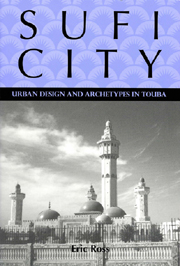
- Sufi CityUrban Design and Archetypes in Touba, pp. 43 - 116Publisher: Boydell & BrewerPrint publication year: 2006
Accessibility standard: Unknown
Why this information is here
This section outlines the accessibility features of this content - including support for screen readers, full keyboard navigation and high-contrast display options. This may not be relevant for you.Accessibility Information
Accessibility compliance for the PDF of this chapter is currently unknown
and may be updated in the future.