1 - The Lawn Discourse
Published online by Cambridge University Press: 29 October 2019

Summary
(n.) A grassy place in front of my house that you should stay the fuck off of.
— TenInchPlaya, urbandictionary.comIn Travels and Adventures in Southern Africa George Thompson describes his arrival at the residence of his friend Mr Thornhill in the Eastern Cape. He remarks that it is ‘one of the most beautiful spots in Albany, with lawns and copsewoods, laid out by the hand of Nature, that far surpass many a nobleman's park in England’ (1827: 20). The image of the lawn provides Thompson with a familiar convention by which to order the landscape and bring it within a British frame. He is not content simply to note that the lawns and copsewoods are thoroughly English; he stresses that they would ‘surpass’ an English landscape garden.
Thompson's comment provides insight into the logic of British imperial adjudication and ‘measurement’ and also reveals the way in which landscape is in the service of class. The naturalness of the lawn appears as a sign ‘of the aristocratic landowner's improving hand’ (Bunn 1994: 152). Even in England where the lawn was thoroughly naturalised, commentators were well aware that vast amounts of labour and capital were involved in making and keeping lawns, although this was often downplayed or even purposefully hidden, as in the American example of Andrew Jackson Downing, who in the 1840s had his lawns mowed at night by ‘invisible hands’ so that family and guests would not have to witness this ‘distasteful activity’ (Jenkins 1994a).
It seems to me that this impulse is more pronounced in the colony and serves not only to keep out of the frame the ‘invisible hands’ but further to assert that the ‘hand of Nature’ is responsible. If the English landscape garden of this period strived for an affected naturalness that served as evidence of the naturalness of its owners, a landscape garden discovered in Africa that actually required no labour must surpass that of a nobleman's.
This chapter defines the concept of the lawn as a transplanted concept that crosses the colonial threshold.
Information
- Type
- Chapter
- Information
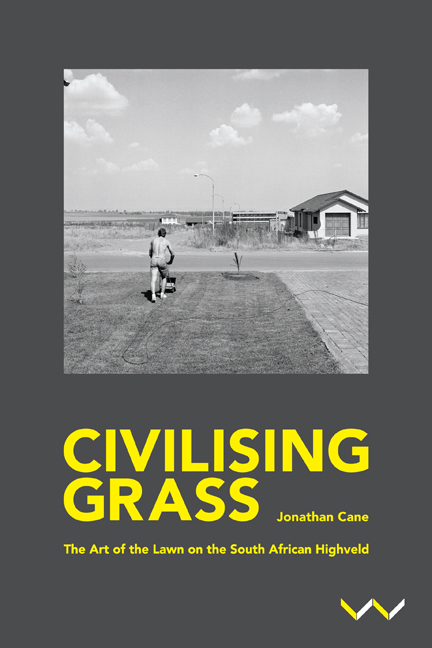
- Civilising GrassThe Art of the Lawn on the South African Highveld, pp. 21 - 46Publisher: Wits University PressPrint publication year: 2019
Accessibility standard: Unknown
Why this information is here
This section outlines the accessibility features of this content - including support for screen readers, full keyboard navigation and high-contrast display options. This may not be relevant for you.Accessibility Information
Accessibility compliance for the PDF of this chapter is currently unknown
and may be updated in the future.