Book contents
- Frontmatter
- Preface
- Contents
- List of Authors
- 1 Introduction
- PART I
- PART II
- 11 France: Foundational Importance of the Declaration of 1789
- 12 Sweden: Free Press as a First Fundamental Right
- 13 The Netherlands: The Batavian Staatsregeling as the First Fundamental Rights Document
- 14 Portugal: ‘Tropical Versailles’ in the Beginning of the Nineteenth Century
- 15 Luxembourg: Fundamental Rights in a Small State
- 16 Greece: Reflections from the Hellenic Legal Tradition
- 17 Denmark: In Love with Tradition
- 18 Germany: Fundamental Rights as an Instrument Towards the Rechtstaat
- 19 The Czech Republic: On the Road to Rights and Freedoms
- 20 Romania: The Birth of Fundamental Rights as a Form of Political Contention
- 21 Bulgaria: The Liberal Tarnovo Constitution
- 22 Finland: Rights to Facilitate Participation
- 23 Estonia: First Landmarks of Fundamental Rights
- 24 Slovakia: The Right of a Nation
- 25 Latvia: Second Part of the Constitution as a Project for Next Generations
- 26 The History of Fundamental Rights in Europe: A Long and Winding Road
- Index
26 - The History of Fundamental Rights in Europe: A Long and Winding Road
from PART II
Published online by Cambridge University Press: 15 December 2017

Book contents
- Frontmatter
- Preface
- Contents
- List of Authors
- 1 Introduction
- PART I
- PART II
- 11 France: Foundational Importance of the Declaration of 1789
- 12 Sweden: Free Press as a First Fundamental Right
- 13 The Netherlands: The Batavian Staatsregeling as the First Fundamental Rights Document
- 14 Portugal: ‘Tropical Versailles’ in the Beginning of the Nineteenth Century
- 15 Luxembourg: Fundamental Rights in a Small State
- 16 Greece: Reflections from the Hellenic Legal Tradition
- 17 Denmark: In Love with Tradition
- 18 Germany: Fundamental Rights as an Instrument Towards the Rechtstaat
- 19 The Czech Republic: On the Road to Rights and Freedoms
- 20 Romania: The Birth of Fundamental Rights as a Form of Political Contention
- 21 Bulgaria: The Liberal Tarnovo Constitution
- 22 Finland: Rights to Facilitate Participation
- 23 Estonia: First Landmarks of Fundamental Rights
- 24 Slovakia: The Right of a Nation
- 25 Latvia: Second Part of the Constitution as a Project for Next Generations
- 26 The History of Fundamental Rights in Europe: A Long and Winding Road
- Index
Summary
INTRODUCTION: AN IMPORTANT STEP IN THE NEW HISTORIOGRAPHY OF FUNDAMENTAL RIGHTS
To produce a volume about the first fundamental rights documents in the Member States of the European Union was a real challenge. It was clear from the beginning that it would be difficult to find a common methodology, common definitions and a common understanding of fundamental rights. The result is nonetheless convincing, although we have many different approaches, or perhaps the result is convincing precisely because we have these different approaches. The quality of the volume is indeed a consequence of the variety that can be found in the fundamental rights documents
This volume is not only an interesting overview of the early history of fundamental rights in Europe, providing new insights based on little studied documents or on new interpretations of well-known documents, but also a contribution to the discussion about the development of fundamental rights insofar as some ideas expressed in the early documents can still inspire us today. At the outset of the project, the risk of retrospective teleology was identified. Fortunately, almost all the contributors have avoided this, even though they are writing about the predecessors of modern fundamental rights.
The result of the collated endeavours of the authors feels like an important contribution to a new historiography of fundamental rights that avoids, as much as possible, the above-mentioned retrospective teleology, identifies new cleavages, and reflects on the (mis)use of history and memory for current political and ideological aims.
GENERAL OBSERVATIONS
It is possible to find ‘first’ fundamental rights documents across Europe. Each of the current Member States of the European Union included in this volume can refer to one or more documents of this kind in their constitutional or legal history. From this point of view, the review of the first fundamental rights documents in Europe has produced a definitive result by uncovering antecedent fundamental rights thinking that has not necessarily been generally known. The historical perspective of these documents is, however, very broad, because a good number of these first fundamental rights documents are ancient, while some of them are relatively recent.
Information
- Type
- Chapter
- Information
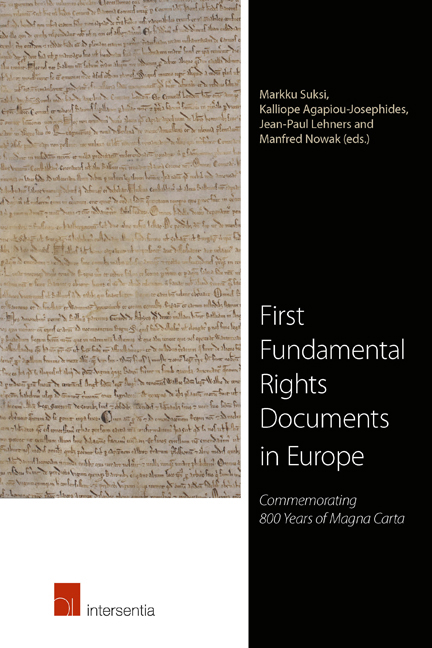
- First Fundamental Rights Documents in EuropeCommemorating 800 Years of Magna Carta, pp. 343 - 354Publisher: IntersentiaPrint publication year: 2015
Accessibility standard: Unknown
Why this information is here
This section outlines the accessibility features of this content - including support for screen readers, full keyboard navigation and high-contrast display options. This may not be relevant for you.Accessibility Information
Accessibility compliance for the PDF of this chapter is currently unknown
and may be updated in the future.