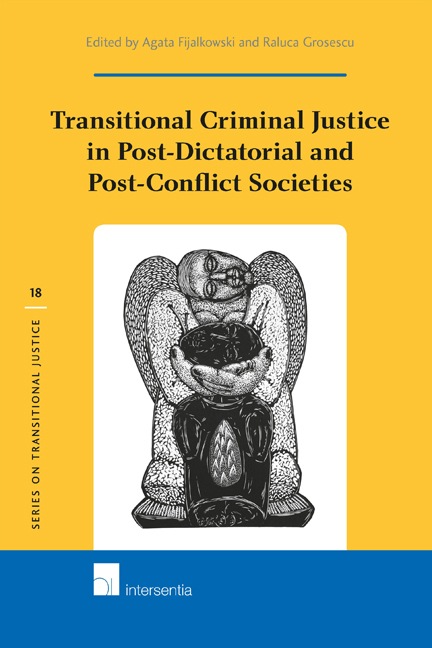
Book contents
- Frontmatter
- Contents
- Introduction
- PART I CRIMINAL JUSTICE AS A METHOD OF DEALING WITH THE PAST: OPPORTUNITIES, STRATEGIES, AND LEGAL AND POLITICAL CONSTRAINTS
- PART II UNIVERSAL PRINCIPLES V LOCAL PECULIARITIES: THE RELATIONSHIP BETWEEN NATIONAL JURISDICTIONS AND INTERNATIONAL LAW
- Chapter 7 International Politics of Justice: The Political Underpinnings of the Emergence of an International Regime
- Chapter 8 Positive Complementarity: Fine-Tuning the Transitional Justice Discourse? The Cases of the Democratic of Congo, Uganda and Kenya
- Chapter 9 Punishing Mass Atrocities: Penological Developments in the Aftermath of the Rwandan Genocide
- Chapter 10 International and National Legal Assessment of Crimes Committed by the Communist Regimes: Lithuanian Case Study
- Chapter 11 Conclusions
- About the Authors
Chapter 11 - Conclusions
from PART II - UNIVERSAL PRINCIPLES V LOCAL PECULIARITIES: THE RELATIONSHIP BETWEEN NATIONAL JURISDICTIONS AND INTERNATIONAL LAW
Published online by Cambridge University Press: 28 November 2017
By

Book contents
- Frontmatter
- Contents
- Introduction
- PART I CRIMINAL JUSTICE AS A METHOD OF DEALING WITH THE PAST: OPPORTUNITIES, STRATEGIES, AND LEGAL AND POLITICAL CONSTRAINTS
- PART II UNIVERSAL PRINCIPLES V LOCAL PECULIARITIES: THE RELATIONSHIP BETWEEN NATIONAL JURISDICTIONS AND INTERNATIONAL LAW
- Chapter 7 International Politics of Justice: The Political Underpinnings of the Emergence of an International Regime
- Chapter 8 Positive Complementarity: Fine-Tuning the Transitional Justice Discourse? The Cases of the Democratic of Congo, Uganda and Kenya
- Chapter 9 Punishing Mass Atrocities: Penological Developments in the Aftermath of the Rwandan Genocide
- Chapter 10 International and National Legal Assessment of Crimes Committed by the Communist Regimes: Lithuanian Case Study
- Chapter 11 Conclusions
- About the Authors
Summary
By bringing together scholars working in different fields and cases talking about countries in different regions marred by different dictatorial pasts that were eventually overcome by different types of regime changes and addressed within different post-dictatorial political contexts, this volume's editors offer us a collection that is important not only for the rich theoretical and empirical material it carefully presents, but also for the new and promising avenues it generously opens for future research. Although a number of recent publications have focused on the important role of courts in redressing the legacy of recent human rights violations, as the Introduction rightly points out, few of these fine studies have directed their theoretical lens systematically toward the contribution of domestic courts. This is precisely what the present volume seeks to accomplish.
The studies included here survey a wide array of countries and cases. Much of the material focuses on countries in the former Soviet bloc, which have had to deal with a number of competing criminal pasts after the collapse of the Communist regime. These past histories of transgression include the Nazi occupation regime of World War II in Eastern Europe and the Baltic region, the crimes perpetrated by the Yugoslav Communists and their loyal secret political police forces on the Slovenian territory, the Soviet occupation regime that obliterated the independence of formerly independent Baltic republics like Lithuania, the home-grown sultanist-cum-totalitarian dictatorship of Nicolae Ceauşescu and Enver Hoxha in Romania and Albania respectively, the martial law imposed by General Wojciech Jaruzelski in Poland, as well as the bloody revolution of December 1989 that affected several major Romanian towns and the country's capital. Chapters on Albania, Germany, Lithuania, Poland, Romania and Slovenia, which consider these countries by themselves or in comparison to each other, are supplemented by chapters detailing the transitional justice added value of courts in Nepal and Rwanda, which show not only that regular courts can work in addressing a wide range of dictatorial pasts, but also that in specific contexts revamped traditional courts can successfully complement and even substitute themselves for regular courts.
Information
- Type
- Chapter
- Information
- Publisher: IntersentiaPrint publication year: 2015
Accessibility standard: Unknown
Why this information is here
This section outlines the accessibility features of this content - including support for screen readers, full keyboard navigation and high-contrast display options. This may not be relevant for you.Accessibility Information
Accessibility compliance for the PDF of this chapter is currently unknown
and may be updated in the future.