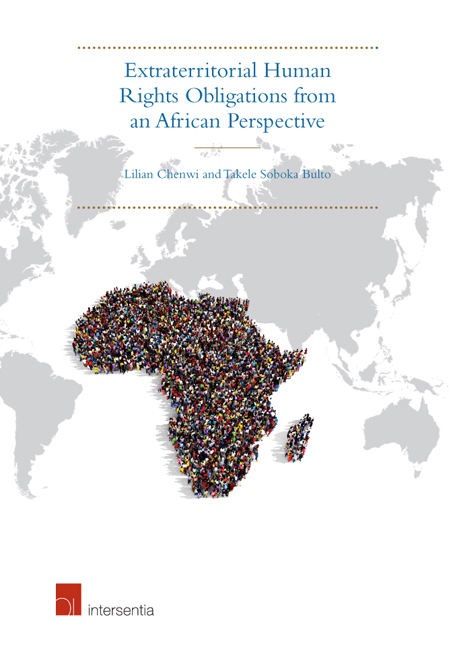
Book contents
- Frontmatter
- Dedication
- Foreword
- Preface
- Contents
- List of Cases, Advisory Opinions and Other Decisions
- List of Treaties and Other Instruments
- About the Contributors
- Introduction
- Extraterritoriality in the African Regional Human Rights System from a Comparative Perspective
- Commercialisation of Educational Services and Extraterritorial Human Rights Obligations
- Extraterritorial Human Rights Obligations in the Context of Development Assistance to African States
- The Right to Food Beyond Borders: The Extraterritorial Reach of the Right to Food in Africa
- Extraterritorial Application of the Right to Water under the African System for the Protection of Human Rights
- Tortured Unity: United States–Africa Relations in Extraordinary Renditions and States’ Extraterritorial Obligations
- Indigenous Communities Displaced by Climate Change and Extraterritorial Application of States’ Obligations in Africa
- Land Grabbing, Extraterritorial Obligations and the Failure of Justice in Uganda: The Mubende Case
- Extraterritorial Obligations of Uganda for its Military's Failure to Respect and Protect Civilians in Areas of the Lord's Resistance Army Activity
- Bibliography
- Index
Introduction
Published online by Cambridge University Press: 21 September 2018

Book contents
- Frontmatter
- Dedication
- Foreword
- Preface
- Contents
- List of Cases, Advisory Opinions and Other Decisions
- List of Treaties and Other Instruments
- About the Contributors
- Introduction
- Extraterritoriality in the African Regional Human Rights System from a Comparative Perspective
- Commercialisation of Educational Services and Extraterritorial Human Rights Obligations
- Extraterritorial Human Rights Obligations in the Context of Development Assistance to African States
- The Right to Food Beyond Borders: The Extraterritorial Reach of the Right to Food in Africa
- Extraterritorial Application of the Right to Water under the African System for the Protection of Human Rights
- Tortured Unity: United States–Africa Relations in Extraordinary Renditions and States’ Extraterritorial Obligations
- Indigenous Communities Displaced by Climate Change and Extraterritorial Application of States’ Obligations in Africa
- Land Grabbing, Extraterritorial Obligations and the Failure of Justice in Uganda: The Mubende Case
- Extraterritorial Obligations of Uganda for its Military's Failure to Respect and Protect Civilians in Areas of the Lord's Resistance Army Activity
- Bibliography
- Index
Summary
The initial stages of the development of international human rights law, in line with the notion of territorial sovereignty, focused on the mission of taming the powers of a state acting territorially. Thus, the human rights framework has so far been predominantly conceived of as entailing universal human rights and domestic or territorial state duties. As the protection and realisation of human rights has had to grapple with the idea of limiting the harms that the state can do to individuals and peoples in its own territory, emphasis has been placed on devising ways of enhancing domestic application of international human rights. The primary – indeed exclusive – focus of international human rights law and related scholarship has been to develop a framework within which state actors are held to account for domestic infractions of basic human rights. This invariably holds true in relation to the African human rights system.
Yet, the domestic-oriented approach to a state's human rights obligations has increasingly proved to be inadequate for the effective protection and realisation of individuals’ and groups’ rights and freedoms. Violations of human rights at the domestic level have come to be increasingly committed by extraterritorial actors, which could be state or non-state entities. For instance, the diversion or pollution of an international watercourse could cause scarcity of water or seriously compromise the quality of water available to populations of other co-riparian states; and the development aid activities of a state could result in rights violations in the process of implementation in another state.
Moreover, economic globalisation implies that'states, and in particular transnational corporations, may have an impact on the livelihood of persons (and thus on the realisation of their socio-economic rights) outside their territory or country of registration or incorporation’. Increased globalisation has thus given rise to the question whether the human rights obligations of states extend to persons outside of the sovereign territory of these states – that is, whether human rights obligations of states apply extraterritorially.
Information
- Type
- Chapter
- Information
- Publisher: IntersentiaPrint publication year: 2018
Accessibility standard: Unknown
Why this information is here
This section outlines the accessibility features of this content - including support for screen readers, full keyboard navigation and high-contrast display options. This may not be relevant for you.Accessibility Information
Accessibility compliance for the PDF of this chapter is currently unknown
and may be updated in the future.