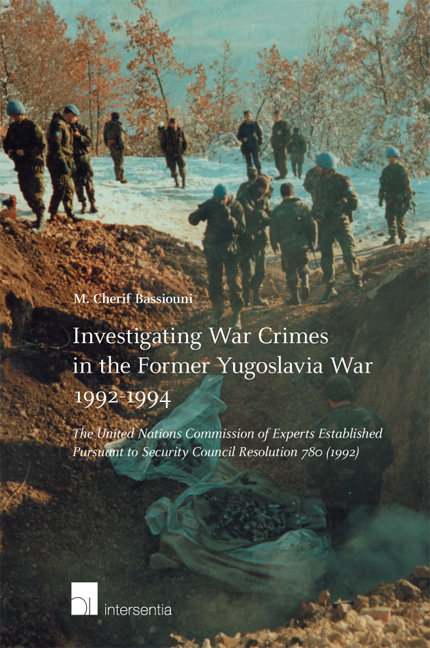
 Investigating War Crimes in the Former Yugoslavia War 1992–1994
 The United Nations Commission of Experts Established Pursuant to Security Council Resolution 780 (1992)
Book contents
- Frontmatter
- Contents
- Dedication
- About this Book
- About the Author
- Acknowledgement
- Table of Abbreviations
- Table of Authorities
- Chapter I Background on the Conflict in the Former Yugoslavia
- Chapter II Some Pictorial Descriptions
- Chapter III An Overview of the Realpolitik and the Workings of the Commission of Experts
- Chapter IV Precedents Leading to United Nations Security Council Resolution 780 (1992)
- Chapter V The Commission of Experts’ Establishment and Processes
- Chapter VI Final Report of the Commission of Experts Established Pursuant to Security Council Resolution 780 (1992) and Annex Summaries and Conclusions
- Chapter VII The Absence of a Transition between the Commission of Experts and the ICTY
- Chapter VIII Experiences that Affected Me the Most During My Tenure on the Commission of Experts
- Chapter IX Concluding Reflections
Chapter VII - The Absence of a Transition between the Commission of Experts and the ICTY
Published online by Cambridge University Press: 12 October 2018
Book contents
- Frontmatter
- Contents
- Dedication
- About this Book
- About the Author
- Acknowledgement
- Table of Abbreviations
- Table of Authorities
- Chapter I Background on the Conflict in the Former Yugoslavia
- Chapter II Some Pictorial Descriptions
- Chapter III An Overview of the Realpolitik and the Workings of the Commission of Experts
- Chapter IV Precedents Leading to United Nations Security Council Resolution 780 (1992)
- Chapter V The Commission of Experts’ Establishment and Processes
- Chapter VI Final Report of the Commission of Experts Established Pursuant to Security Council Resolution 780 (1992) and Annex Summaries and Conclusions
- Chapter VII The Absence of a Transition between the Commission of Experts and the ICTY
- Chapter VIII Experiences that Affected Me the Most During My Tenure on the Commission of Experts
- Chapter IX Concluding Reflections
Summary
INTRODUCTION
As referred to throughout this book, the work of the Commission of Experts directly resulted in the establishment of the International Criminal Tribunal for the Former Yugoslavia (ICTY) by the adoption of Security Council resolutions 808 and 827. The decision to establish the ICTY on February 22, 1993, was based an interim report produced by the Commission of Experts on February 9, 1993. The Security Council stated in its Resolution 808,
Having considered the interim report of the Commission of Experts established by resolution 780 (1992) (S/25274), in which the Commission observed that a decision to establish an ad hoc international tribunal in relation to events in the territory of the former Yugoslavia would be consistent with the direction of its work … Decides that an international tribunal shall be established for the prosecution of persons responsible for serious violations of international humanitarian law committed in the territory of the former Yugoslavia since 1991.
When the Security Council established the ICTY, it was the beginning of the end of the investigative track that had been pursued by the Commission of Experts. The transformation from the investigatory field process – involving people uncovering mass graves and collecting the stories of those who were tortured, mistreated, raped, and ethnically cleansed – to prosecutorial processes was a major one.
The investigatory process was to some extent sordid and painful to those who engaged in it, especially the investigators who had close contact with the victims and their suffering. But then suddenly that process ended, and the new process, involving decisions made at the highest political and institutional levels at the United Nations, began.
Unfortunately, the shift from the work of the Commission of Experts to the newly established ICTY, was anything but a transition. The complete lack of transition between the work of the Commission of Experts and the ICTY is evidenced by, the failure to consider the Commission of Experts’ explanation of nature of the conflict while drafting the ICTY's rules of procedure and evidence, the UN bureaucratic roadblocks intended to prevent communication between those at the ICTY and the Commission of Experts members, the attempt to bury the Commission of Experts’ Final Report and Annexes and the ICTY's lack of use of and reference to the Commission of Experts’ investigations.
Information
- Type
- Chapter
- Information
- Investigating War Crimes in the Former Yugoslavia War 1992–1994The United Nations Commission of Experts Established Pursuant to Security Council Resolution 780 (1992), pp. 395 - 416Publisher: IntersentiaPrint publication year: 2017
Accessibility standard: Unknown
Why this information is here
This section outlines the accessibility features of this content - including support for screen readers, full keyboard navigation and high-contrast display options. This may not be relevant for you.Accessibility Information
Accessibility compliance for the PDF of this chapter is currently unknown
and may be updated in the future.