Book contents
- Frontmatter
- Contents
- List of Illustrations
- Contributors
- List of Abbreviations
- Introduction The Civil War in Mozambique: A history still to be written
- Part I In the Northern Heart of the Civil War
- Part II In the South Another Kind of War?
- Part III Inside Out: New Perspectives & The World-System
- Conclusion New Perspectives on the Civil War in Mozambique
- Towards a Bibliography of the Mozambican Civil War
- Index
Conclusion New Perspectives on the Civil War in Mozambique
Published online by Cambridge University Press: 27 July 2018

Book contents
- Frontmatter
- Contents
- List of Illustrations
- Contributors
- List of Abbreviations
- Introduction The Civil War in Mozambique: A history still to be written
- Part I In the Northern Heart of the Civil War
- Part II In the South Another Kind of War?
- Part III Inside Out: New Perspectives & The World-System
- Conclusion New Perspectives on the Civil War in Mozambique
- Towards a Bibliography of the Mozambican Civil War
- Index
Summary
The literature on the war in Mozambique is quite extensive. Much of it, as we mentioned in the introduction, has focused on Renamo, its external connections and, to a lesser extent, its social roots. This has led to a bias in the historiography, which the present book has tried to redress by adopting a new angle, asking new questions and using new sources. The authors have, first, tried to cast their net wider by looking not only at Renamo but also the government and other military actors, and looking at non-military actors as well, including institutions of ‘civil society’ such as the church. Second, they have looked at the state, Frelimo and ‘the people’, not just as victims of a military aggression but as actors of the war as well. Third, to build their case, most chapters have used new primary sources, whether previously unused archives (provincial, district or church archives), actors’ documents or oral history. This has led to the uncovering of much new information and the development of new understandings about the war. This conclusion will try to systematize these findings and lay out areas still in need of research to write a new – thorough and encompassing – history of the civil war in Mozambique.
A first result of the present volume relates to our understanding of the beginning and the chronology of the civil war in Mozambique. At a first quite obvious level (but it remains an important point to make), the war started at different times in different areas of the country – in 1976 in Manica, Sofala and Zambézia, in 1981 in Inhambane, Gaza and Tete, and in 1983 in Nampula, Niassa and Cabo Delgado. At another more original level, the volume has shown that the civil war started in 1976, not so much with Renamo's single failed attack on a re-education camp as with the Partido Revolucionário de Moçambique (PRM), which started full military activities in western Zambézia. Contrary to what much of the literature has said, PRM was not just a marginal phenomenon, nor something linked to Renamo.
Information
- Type
- Chapter
- Information
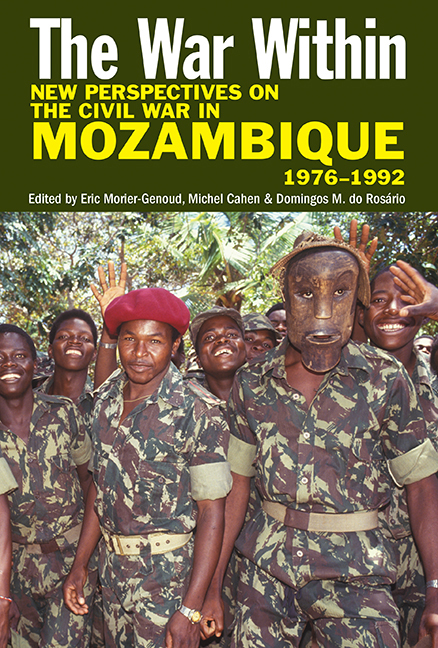
- The War WithinNew Perspectives on the Civil War in Mozambique 1976–1992, pp. 221 - 226Publisher: Boydell & BrewerPrint publication year: 2018
Accessibility standard: Unknown
Why this information is here
This section outlines the accessibility features of this content - including support for screen readers, full keyboard navigation and high-contrast display options. This may not be relevant for you.Accessibility Information
Accessibility compliance for the PDF of this chapter is currently unknown
and may be updated in the future.