Book contents
4 - The Peace Option
Published online by Cambridge University Press: 12 October 2019
Summary
President Wilson declared on 18 August 1914 that the United States would remain neutral in the European war. But before he established American neutrality, he had extended an offer to the belligerent nations to help bring an immediate end to the conflict, or to mediate ‘at any other time that might be thought more suitable’. Though none of the warring nations chose to accept his offer, leaders in Berlin and London quickly came to understand the importance Wilson placed on mediating an end to the war – in large part because Colonel House spent the balance of 1914 attempting to coax them into mediation.
Despite having had his offer refused, Wilson would hold on to the possibility of American-led mediation for the next three years. Having already attempted to prevent a general European war by sending House to Europe in the months preceding the assassination of the heir to the Austrian throne, the President was not entirely naïve to the difficulties of bringing nations to the negotiating table. Throughout the war, there would be ongoing discussions about bringing peace to Europe – all seemingly falling upon deaf ears, as one or the other belligerent government backed away from the mediation efforts of the United States. Despite the repeated attempts of the United States to end the war, and despite the repeated troubles between the belligerents and the United States – including blockade issues with Britain and submarine issues with Germany – Wilson and his cabinet continued to talk about peace with whoever would listen.
Historians in general, and diplomatic historians specifically, have not viewed mediation and peace offers as diplomatic tools. Instead, they discuss the peace proposals as a means of exploring the personalities of those involved, or as part of a larger, separate issue. For instance, Fritz Fischer is one of the earlier historians to examine the German motive for peace in his groundbreaking and controversial book, Germany's Aims in the First World War. But Fischer was describing what Germany wanted to gain when the war had come to a successful conclusion – one where the German armies were victorious – not what they would gain from a mediated peace or peace without victory.
Information
- Type
- Chapter
- Information
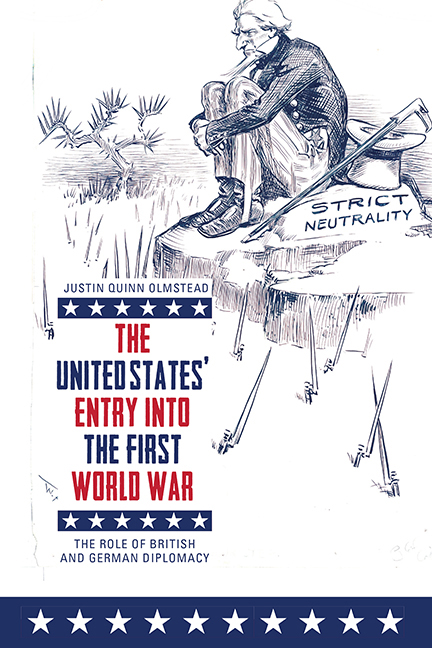
- The United States' Entry into the First World WarThe Role of British and German Diplomacy, pp. 102 - 130Publisher: Boydell & BrewerPrint publication year: 2018
Accessibility standard: Unknown
Why this information is here
This section outlines the accessibility features of this content - including support for screen readers, full keyboard navigation and high-contrast display options. This may not be relevant for you.Accessibility Information
Accessibility compliance for the PDF of this chapter is currently unknown
and may be updated in the future.