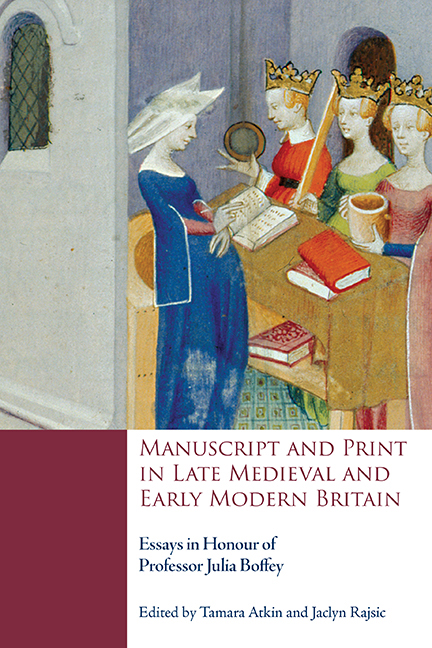
 Manuscript and Print in Late Medieval and Early Modern Britain
 Essays in Honour of Professor Julia Boffey
Book contents
- Frontmatter
- Contents
- List of Illustrations
- List of Contributors
- Acknowledgements
- List of Abbreviations
- Introduction
- PRODUCING TEXTS
- READING INFLUENCE
- 8 Writing Revelation: The Book of Margery Kempe
- 9 ‘What strange ruins’: Reading Back to Thebes
- 10 Tyre in Africa: Dido's Flight and Sallust's Jugurtha
- 11 Trinitarian Piety and Married Chastity in The Pistel of Swete Susan
- 12 True Image? Alternative Veronicas in Late Medieval England
- 13 The Curelesse Wound: Henry Howard, Earl of Surrey and the Poetry of Blood
- Afterword
- Julia Boffey: A Bibliography
- Manuscript Index
- General Index
- Tabula Gratulatoria
8 - Writing Revelation: The Book of Margery Kempe
from READING INFLUENCE
Published online by Cambridge University Press: 06 September 2019

Book contents
- Frontmatter
- Contents
- List of Illustrations
- List of Contributors
- Acknowledgements
- List of Abbreviations
- Introduction
- PRODUCING TEXTS
- READING INFLUENCE
- 8 Writing Revelation: The Book of Margery Kempe
- 9 ‘What strange ruins’: Reading Back to Thebes
- 10 Tyre in Africa: Dido's Flight and Sallust's Jugurtha
- 11 Trinitarian Piety and Married Chastity in The Pistel of Swete Susan
- 12 True Image? Alternative Veronicas in Late Medieval England
- 13 The Curelesse Wound: Henry Howard, Earl of Surrey and the Poetry of Blood
- Afterword
- Julia Boffey: A Bibliography
- Manuscript Index
- General Index
- Tabula Gratulatoria
Summary
THE MATERIAL AND LITERARY WORLDS of the medieval period remain richly alive in the twenty-first century. Can lived inner experience also speak across the centuries? Julia Boffey describes evocatively ‘the difficulty of writing about individual inner lives without many of the written sources available for more recent periods’; yet, she suggests, ‘the pendulum may be swinging the other way’. Boffey's recent research has extended her seminal work on the fifteenth century to chronicle and life-writing. The Book of Margery Kempe speaks in unique ways to the exploration of inner lives, as well as to Boffey's interests in the intellectual contexts of books. It is a book of feeling, shaped by but also startlingly different from the books Kempe knew. Its powerful affect has surprised, compelled and alienated its readers. ‘Wondirful revelacyons’, the moving of the soul through visionary experience, are the subject of Kempe's narrative. The Book is shaped by the struggle to discern the cause and meaning of such experience, and the challenge to interpret and convey it. Read as an inner life, it is newly animated.
Reading Kempe
The anxieties and risks of Kempe's book have coloured readers’ perceptions, sometimes evoking unease. When rediscovered in 1934, the Book proved startlingly different from the pamphlet of extracts printed by Wynkyn de Worde (c.1501, STC 14924), reprinted by Henry Pepwell as one of seven mystical treatises in The Cell of Self-Knowledge (1521, STC 20972). Pepwell's characterization of Margery as ‘devout ancress’ was difficult for Hope Emily Allen, one of her first editors, to sustain: ‘[the Book] does give remarkably elevated spiritual passages, but they are interspersed with others highly fanatical’. Allen uses theories of Kempe as neurotic to explain her ‘suggestibility’ and reflection of ‘the highly spiritualised ideals of piety in her world’. Twentiethcentury feminist scholarship, eager to discard the label ‘hysteric’, shifted the focus from interior to exterior, to claim Kempe as proto-feminist, a woman who refused to ‘go spynne and carde [wool] as other women don’ (4330–1).
Information
- Type
- Chapter
- Information
- Manuscript and Print in Late Medieval and Early Modern BritainEssays in Honour of Professor Julia Boffey, pp. 147 - 166Publisher: Boydell & BrewerPrint publication year: 2019
Accessibility standard: Unknown
Why this information is here
This section outlines the accessibility features of this content - including support for screen readers, full keyboard navigation and high-contrast display options. This may not be relevant for you.Accessibility Information
Accessibility compliance for the PDF of this chapter is currently unknown
and may be updated in the future.