Book contents
- Frontmatter
- Contents
- Notes on Contributors
- 1 Margins and Centres
- SECTION I Shifted Centres
- 2 ‘Speakers Concerning the Earth’: Ruskin's Geology After 1860
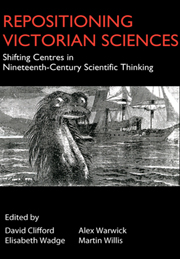
- 3 Swimming at the Edges of Scientific Respectability: Sea Serpents in the Victorian Era
- 4 ‘The Drugs, The Blister and the Lancet are all Laid Aside’: Hydropathy and Medical Orthodoxy in Scotland, 1840–1900
- 5 Anna Kingsford: Scientist and Sorceress
- 6 A Science for One or a Science for All? Physiognomy, Self-Help, and the Practical Benefits of Science
- SECTION II Contested Knowledges
- SECTION III Entering The Modern
- Notes
- Select Bibliography
5 - Anna Kingsford: Scientist and Sorceress
from SECTION I - Shifted Centres
Published online by Cambridge University Press: 05 March 2012

Book contents
- Frontmatter
- Contents
- Notes on Contributors
- 1 Margins and Centres
- SECTION I Shifted Centres
- 2 ‘Speakers Concerning the Earth’: Ruskin's Geology After 1860
- 3 Swimming at the Edges of Scientific Respectability: Sea Serpents in the Victorian Era
- 4 ‘The Drugs, The Blister and the Lancet are all Laid Aside’: Hydropathy and Medical Orthodoxy in Scotland, 1840–1900
- 5 Anna Kingsford: Scientist and Sorceress
- 6 A Science for One or a Science for All? Physiognomy, Self-Help, and the Practical Benefits of Science
- SECTION II Contested Knowledges
- SECTION III Entering The Modern
- Notes
- Select Bibliography
Summary
Victorian England witnessed the curious intellectual union of scientific naturalism and the belief in magic as these two seemingly opposed systems of thought rose to prominence in the second half of the nineteenth century. The doctrine of the former was formulated in part by the demands of scientists such as Thomas Huxley and John Tyndall. Naturalist thinkers wished to establish a scientifically directed culture and to eradicate religious belief and other such ‘superstitious’ thought entirely. Scientific naturalism maintained that belief in any non-physical agencies was superstitious and indicative of a culturally dysfunctional society. The doctrine of the latter was expressed in esoteric societies such as the Theosophical Society and the Hermetic Society and sought to establish, within the natural world and governed by natural laws, the mystery and spirituality traditionally associated with religious thinking and belief in magic. The people who belonged to these esoteric and magical societies that were springing up at the end of the century understood magic as the interaction of the human will and imagination with visible and invisible correspondences within the natural world in order to effect change.
Information
- Type
- Chapter
- Information
- Repositioning Victorian SciencesShifting Centres in Nineteenth-Century Thinking, pp. 59 - 70Publisher: Anthem PressPrint publication year: 2006
Accessibility standard: Unknown
Why this information is here
This section outlines the accessibility features of this content - including support for screen readers, full keyboard navigation and high-contrast display options. This may not be relevant for you.Accessibility Information
Accessibility compliance for the PDF of this chapter is currently unknown
and may be updated in the future.
- 1
- Cited by