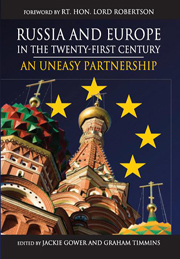
Book contents
- Frontmatter
- Contents
- List of Contributors
- Acknowledgements
- List of Abbreviations/Acronyms
- Foreword Russia and Europe
- Preface
- Introduction Russia and Europe: What Kind of Partnership?
- PART 1 Russia looking West
- PART 2 Europe looking East
- Chapter 7 The European Union's Policy on Russia: Rhetoric or Reality?
- Chapter 8 The Role of Norms and Values in the European Union's Russia Policy
- Chapter 9 NATO and Russia: Progress or Process?
- Chapter 10 German-Russian Bilateral Relations and EU Policy on Russia: Reconciling the Two-Level Game?
- Chapter 11 Shortcut to Great Power: France and Russia in Pursuit of Multipolarity
- Chapter 12 A Europe Divided by Russia?: The New Eastern Member States and the EU's Policy towards the East
- PART 3 Partnership in Practice
- Conclusion Russia and Europe: An Uneasy Partnership 289
- Index
- More Titles in this series
Chapter 7 - The European Union's Policy on Russia: Rhetoric or Reality?
from PART 2 - Europe looking East
Published online by Cambridge University Press: 05 March 2012

Book contents
- Frontmatter
- Contents
- List of Contributors
- Acknowledgements
- List of Abbreviations/Acronyms
- Foreword Russia and Europe
- Preface
- Introduction Russia and Europe: What Kind of Partnership?
- PART 1 Russia looking West
- PART 2 Europe looking East
- Chapter 7 The European Union's Policy on Russia: Rhetoric or Reality?
- Chapter 8 The Role of Norms and Values in the European Union's Russia Policy
- Chapter 9 NATO and Russia: Progress or Process?
- Chapter 10 German-Russian Bilateral Relations and EU Policy on Russia: Reconciling the Two-Level Game?
- Chapter 11 Shortcut to Great Power: France and Russia in Pursuit of Multipolarity
- Chapter 12 A Europe Divided by Russia?: The New Eastern Member States and the EU's Policy towards the East
- PART 3 Partnership in Practice
- Conclusion Russia and Europe: An Uneasy Partnership 289
- Index
- More Titles in this series
Summary
Introduction
In 1999 Javier Solana, the European Union (EU)'s newly appointed High Representative for the Common Foreign and Security Policy (CFSP), described developing a partnership with Russia as ‘the most important, the most urgent and the most challenging task that the European Union faces at the beginning of the 21st Century’. It has also proved the greatest test of its credibility as a foreign policy actor, raising critical questions about its capacity for coherent and effective action. Although it has aspirations to play a global role, it is in Europe that the EU's most immediate interests and ambitions lie and Russia is recognized as the other key player on the continent. It is the EU's largest neighbour both in terms of population and territory and has immense reserves of natural resources, including oil and gas. Despite its loss of ‘superpower’ status, it is still a major military power in both conventional and nuclear terms and remains a key actor at the global level with a permanent seat on the UN Security Council (UNSC) and membership of the Group of Eight (G8). It has strong interests and significant influence in regions central to the EU's security, such as eastern Europe, the Middle East, the Balkans and Central Asia. The long common border means that cooperation with Russia is extremely important in tackling soft security threats such as illegal immigration, international crime, terrorism, nuclear accidents and environmental pollution.
Information
- Type
- Chapter
- Information
- Russia and Europe in the Twenty-First CenturyAn Uneasy Partnership, pp. 111 - 132Publisher: Anthem PressPrint publication year: 2007
Accessibility standard: Unknown
Why this information is here
This section outlines the accessibility features of this content - including support for screen readers, full keyboard navigation and high-contrast display options. This may not be relevant for you.Accessibility Information
Accessibility compliance for the PDF of this chapter is currently unknown
and may be updated in the future.
- 4
- Cited by