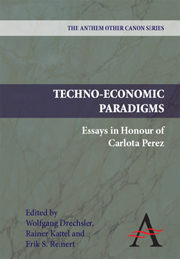
Book contents
- Frontmatter
- Contents
- Preface
- Techno-Economic Paradigms
- 1 Introduction: Carlota Perez and Evolutionary Economics
- 2 Developing Innovation Capability: Meeting the Policy Challenge
- 3 Slow Food, Slow Growth … Slow ICT: The Vision of Ambient Intelligence
- 4 Technical Change and Structural Inequalities: Converging Approaches to Problems of Underdevelopment
- 5 The New Techno-Economic Paradigm and its Impact on Industrial Structure
- 6 Governance in and of Techno-Economic Paradigm Shifts: Considerations for and from the Nanotechnology Surge
- 7 Innovation Policy and Incentives Structure: Learning from the Mexican Case
- 8 Schumpeter's Business Cycles and Techno-Economic Paradigms
- 9 Asian Innovation Experiences and Latin American Visions: Exploiting Shifts in Techno-Economic Paradigms
- 10 Doing Capitalism: Notes on the Practice of Venture Capitalism (Revised and Extended)
- 11 Small States, Innovation and Techno-Economic Paradigms
- 12 Financial Experimentation, Technological Paradigm Revolutions and Financial Crises
- 13 Why the New Economy is a Learning Economy
- 14 The Art of Macro-Qualitative Modelling: An Exploration of Perez' Sequence Model of Great Surges
- 15 Technology, Institutions and Economic Development
- 16 Techno-Economic Paradigms and the Migration (Relocation) of Industries to the Peripheries
- 17 On the Discreet Charm of the (Rentier) Bourgeoisie: The Contradictory Nature of the Installation Period of a New Techno-Economic Paradigm
- 18 Production-Based Economic Theory and the Stages of Economic Development: From Tacitus to Carlota Perez
- 19 Carlota Perez' Contribution to the Research Programme in Public Management: Understanding and Managing the Process of Creative Destruction in Public Institutions and Organizations
- 20 Carlota Perez – Her Biography and the Origins of her Ideas
- Notes
- Bibliography Carlota Perez
16 - Techno-Economic Paradigms and the Migration (Relocation) of Industries to the Peripheries
Published online by Cambridge University Press: 05 March 2012
By

Book contents
- Frontmatter
- Contents
- Preface
- Techno-Economic Paradigms
- 1 Introduction: Carlota Perez and Evolutionary Economics
- 2 Developing Innovation Capability: Meeting the Policy Challenge
- 3 Slow Food, Slow Growth … Slow ICT: The Vision of Ambient Intelligence
- 4 Technical Change and Structural Inequalities: Converging Approaches to Problems of Underdevelopment
- 5 The New Techno-Economic Paradigm and its Impact on Industrial Structure
- 6 Governance in and of Techno-Economic Paradigm Shifts: Considerations for and from the Nanotechnology Surge
- 7 Innovation Policy and Incentives Structure: Learning from the Mexican Case
- 8 Schumpeter's Business Cycles and Techno-Economic Paradigms
- 9 Asian Innovation Experiences and Latin American Visions: Exploiting Shifts in Techno-Economic Paradigms
- 10 Doing Capitalism: Notes on the Practice of Venture Capitalism (Revised and Extended)
- 11 Small States, Innovation and Techno-Economic Paradigms
- 12 Financial Experimentation, Technological Paradigm Revolutions and Financial Crises
- 13 Why the New Economy is a Learning Economy
- 14 The Art of Macro-Qualitative Modelling: An Exploration of Perez' Sequence Model of Great Surges
- 15 Technology, Institutions and Economic Development
- 16 Techno-Economic Paradigms and the Migration (Relocation) of Industries to the Peripheries
- 17 On the Discreet Charm of the (Rentier) Bourgeoisie: The Contradictory Nature of the Installation Period of a New Techno-Economic Paradigm
- 18 Production-Based Economic Theory and the Stages of Economic Development: From Tacitus to Carlota Perez
- 19 Carlota Perez' Contribution to the Research Programme in Public Management: Understanding and Managing the Process of Creative Destruction in Public Institutions and Organizations
- 20 Carlota Perez – Her Biography and the Origins of her Ideas
- Notes
- Bibliography Carlota Perez
Summary
Introduction
The development of capitalist world economy has exhibited discontinuous or wave-like patterns of rapid expansion (upswings), which in turn are followed by periods of relative stagnation or ‘crisis’ (downturns) and vice versa, in successive phases. This cyclical rhythm is captured in the theory of long cycles or waves of 40-60 years, first articulated by Nikolai Kondratiev. Kondratiev's theory on cyclical rhythms in capitalist development argues that these patterns are constitutive of the logic of the world economy, and that they are a response to the contradictions inherent in the endless pursuit of capital accumulation. This is most evident during periods of stagnation or downturn when the world economy faces ‘crises’ in accumulation. It is these periods of tension that gives capitalism its dynamic, or what Schumpeter has described so lucidly as the paradox of ‘creative destruction’.
Shifts in the techno-economic paradigms are a key feature of the long waves of the capitalist world economy in that they indicate the arrival of an innovationrich phase that gives rise not only to new leading sectors (e.g., product and process innovations), but also to new organizational and managerial innovations that ultimately have a pervasive effect on how business is conducted throughout the world economy (Freeman and Perez 1988; Perez 2002, 2004). The arrival of new techno-economic paradigms is not just economic and business phenomena, as it triggers transformations in socio-institutional and political structures both at the national, regional and global level.
Information
- Type
- Chapter
- Information
- Techno-Economic ParadigmsEssays in Honour of Carlota Perez, pp. 287 - 306Publisher: Anthem PressPrint publication year: 2009
Accessibility standard: Unknown
Why this information is here
This section outlines the accessibility features of this content - including support for screen readers, full keyboard navigation and high-contrast display options. This may not be relevant for you.Accessibility Information
Accessibility compliance for the PDF of this chapter is currently unknown
and may be updated in the future.