Book contents
- Frontmatter
- Dedication
- Contents
- Foreword
- Contributors
- Introduction
- 1 It's never too soon to start
- 2 How children begin to read
- 3 Creating young readers: teachers and librarians at work
- 4 The six dimensions of the ‘honeycomb’ model, and its implications for literacy, libraries and literature in New Zealand
- 5 The Summer Reading Challenge in libraries: a continuing success
- 6 Stockport does Book Idol! A case study linking libraries and schools to inspire reading for pleasure
- 7 There and back again: restoring reading to the classroom
- 8 Promoting excellence: shadowing the CILIP Carnegie and Kate Greenaway Medals
- 9 Choice and motivation: local book awards
- 10 The sport of reading
- 11 Adventures in the book trade: libraries and partnerships
- 12 The hard-to-reach reader in the 21st century
- 13 Creative reading and insideadog.com.au
- Index
- Miscellaneous Endmatter
- Miscellaneous Endmatter
- misc-endmatter
10 - The sport of reading
Published online by Cambridge University Press: 08 June 2018
Edited by

Book contents
- Frontmatter
- Dedication
- Contents
- Foreword
- Contributors
- Introduction
- 1 It's never too soon to start
- 2 How children begin to read
- 3 Creating young readers: teachers and librarians at work
- 4 The six dimensions of the ‘honeycomb’ model, and its implications for literacy, libraries and literature in New Zealand
- 5 The Summer Reading Challenge in libraries: a continuing success
- 6 Stockport does Book Idol! A case study linking libraries and schools to inspire reading for pleasure
- 7 There and back again: restoring reading to the classroom
- 8 Promoting excellence: shadowing the CILIP Carnegie and Kate Greenaway Medals
- 9 Choice and motivation: local book awards
- 10 The sport of reading
- 11 Adventures in the book trade: libraries and partnerships
- 12 The hard-to-reach reader in the 21st century
- 13 Creative reading and insideadog.com.au
- Index
- Miscellaneous Endmatter
- Miscellaneous Endmatter
- misc-endmatter
Summary
Introduction
With such an emphasis on reading today it seems unimaginable that 20 years ago good readers went largely unrecognized. Prowess in mathematics and sports was more often rewarded than any propensity for reading. With this as the backdrop, the International Kids’ Lit Quiz™ was created in 1991 when Wayne Mills, then a lecturer at Waikato University, realized that students were not being recognized for their reading ability and so formulated and designed the Kids’ Lit Quiz.™ The intention of the quiz was to formulate a series of general knowledge literary questions similar in format to Trivial Pursuit, except that all the wedges would be different literary genres. Of course in those early years the quiz was much smaller than it is today and was not internationally known. It has grown from 14 teams in 1991 to over 1000 teams on three continents. This chapter will examine just what factors make the Kids’ Lit Quiz™ so phenomenally successful in promoting reading and provides insight into the motivational aspects of an international literature quiz that brings readers in the 10–13 age range together from all over the world to participate in an international literary challenge
History and ethos
The Kids’ Lit Quiz™ is open to students aged from 10 to 13 years. School grade eligibility, however, is likely to vary from country to country. The National Endowment for the Arts (National Endowment for the Arts, 2004) found that this was the very age group at which reading began to decline (calamitously), and therefore it was vital to maintain students’ interest in reading. The age composition defines the scope of the books that are read for the quiz. This means that adult authors like Jodi Picoult, Dan Brown and Alice Sebold are not included in the quiz (although some students may be reading them). However, young adult novels such as The Knife of Never Letting Go, by Patrick Ness or The Graveyard Book, by Neil Gaiman may be included. The participants in the quizzes have all read picture books and junior fiction and thus have these literary experiences in common.
Information
- Type
- Chapter
- Information
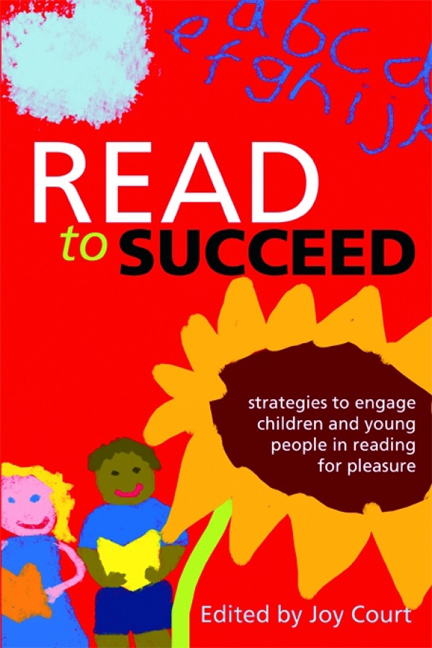
- Read to SucceedStrategies to Engage Children and Young People in Reading for Pleasure, pp. 171 - 186Publisher: FacetPrint publication year: 2011
Accessibility standard: Unknown
Why this information is here
This section outlines the accessibility features of this content - including support for screen readers, full keyboard navigation and high-contrast display options. This may not be relevant for you.Accessibility Information
Accessibility compliance for the PDF of this chapter is currently unknown
and may be updated in the future.