Book contents
- Frontmatter
- Contents
- List of illustrations
- Acknowledgements
- Foreword
- Introduction: Beginnings in South Africa
- Chapter 1 Ambiguous Visibility: Muslims and the making of visuality
- Chapter 2 “Kitchen Language”: Muslims and the culture of food
- Chapter 3 “The Sea Inside Us”: Parallel journeys in the African oceans
- Chapter 4 “Sexual Geographies of the Cape”: Slavery, race and sexual violence
- Chapter 5 Regarding Muslims: Pagad, masked men and veiled women
- Chapter 6 “The Trees Sway North-North-East”: Post-apartheid visions of Islam
- Conclusion
- Notes
- Glossary
- Bibliography
- Index
- Plate section
Foreword
Published online by Cambridge University Press: 21 April 2018
Book contents
- Frontmatter
- Contents
- List of illustrations
- Acknowledgements
- Foreword
- Introduction: Beginnings in South Africa
- Chapter 1 Ambiguous Visibility: Muslims and the making of visuality
- Chapter 2 “Kitchen Language”: Muslims and the culture of food
- Chapter 3 “The Sea Inside Us”: Parallel journeys in the African oceans
- Chapter 4 “Sexual Geographies of the Cape”: Slavery, race and sexual violence
- Chapter 5 Regarding Muslims: Pagad, masked men and veiled women
- Chapter 6 “The Trees Sway North-North-East”: Post-apartheid visions of Islam
- Conclusion
- Notes
- Glossary
- Bibliography
- Index
- Plate section
Summary
I first got to know Gabeba Baderoon in an English Literature Honours class at the University of Cape Town in 1990, where we were classmates in three seminars: one in feminist literary theory and criticism, led by Dorothy Driver; another in black South African literature of the 1970s and 1980s, led by Kelwyn Sole; and the other in the poetry of T. S. Eliot and D. H. Lawrence, led by Terry Boxall. I was struggling to find my feet in graduate literary studies – still learning its codes and protocols – in a cohort of students then considered one of the department's brightest groups.
I was constantly trying to decode other students’ approaches in their seminar papers, looking for that formula or method by which I could gain power over the discipline. Of course there wasn't a formula, but there was a series of “tricks” that were akin to paradigm shifts for me at the time. Nothing about critical method – how to go about writing a critical essay – was taught or made explicit in any way. The bright students seemed to have been born prepared, while I felt like a novice trying to uncover the sleight of hand of magicians.
One of the paradigm shifts for me occurred when Gabeba delivered a paper in the Eliot and Lawrence seminar. I cannot remember whether it was on an Eliot or Lawrence poem, or both, but her presentation was framed by what at first appeared an oblique angle. She was using an article about physics – perhaps it was on Heisenberg – from Time magazine. Not only was it an oblique angle, but she was using a non-literary source– and, to me, also a “non-scholarly” source – in a class that was very traditional in its scholarship. Of course I know now that this was nothing innovative or scandalous, but to me as a novice it represented a profound shift: knowledge across disciplinary boundaries, no matter how oblique it may appear, can illuminate things otherwise obscured.
Information
- Type
- Chapter
- Information
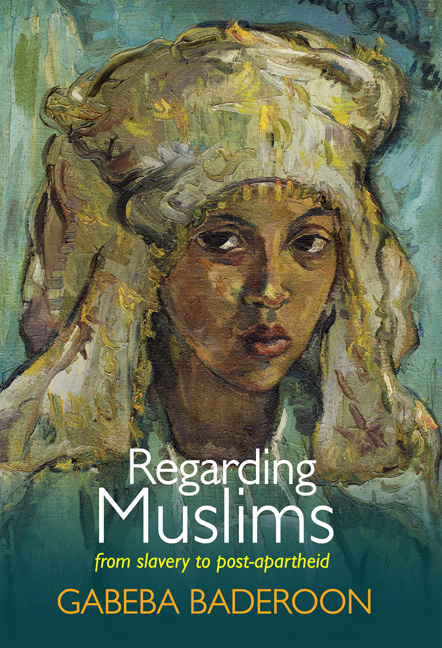
- Regarding Muslimsfrom slavery to post-apartheid, pp. xv - xxPublisher: Wits University PressPrint publication year: 2014
Accessibility standard: Unknown
Why this information is here
This section outlines the accessibility features of this content - including support for screen readers, full keyboard navigation and high-contrast display options. This may not be relevant for you.Accessibility Information
Accessibility compliance for the PDF of this chapter is currently unknown
and may be updated in the future.