Book contents
- Frontmatter
- Contents
- Preface
- Acknowledgments
- 1 Introduction
- 2 The Sri Lankan Elephant
- 3 The Captive Populations, Keeping Systems and Health
- 4 Food, Tool Use and Sleep
- 5 Musth, Reproduction, Social Integration and Stereotypy
- 6 Captive Elephants and Conservation
- 7 Base Lines and Proposals
- Appendix I
- Appendix II
- References
- Photo Gallery
- Index
2 - The Sri Lankan Elephant
Published online by Cambridge University Press: 05 February 2012

Book contents
- Frontmatter
- Contents
- Preface
- Acknowledgments
- 1 Introduction
- 2 The Sri Lankan Elephant
- 3 The Captive Populations, Keeping Systems and Health
- 4 Food, Tool Use and Sleep
- 5 Musth, Reproduction, Social Integration and Stereotypy
- 6 Captive Elephants and Conservation
- 7 Base Lines and Proposals
- Appendix I
- Appendix II
- References
- Photo Gallery
- Index
Summary
Tuskers and Tuskless Bulls in Asian Elephants
History and population genetics of a man-made phenomenon
In Asian elephants tuskless bulls or maknas (called ‘aliyas’ or ‘pussas’ in Sri Lanka) are generally rare and their frequency hardly exceeded 10% of the sub-adult and adult male population in the nineteenth century. The only exception is Sri Lanka, where between 90% to 95% of the subadult and adult bulls have been reported to be maknas since the late sixteenth century. In his Manual of the Mammals of Sri Lanka, Major W.W.A. Phillips has put forward three hypotheses to explain this phenomenon: (1) Tuskers and maknas belong to two different races present in Sri Lanka (2) Elephants from Sri Lanka and those on the Indian subcontinent belong to different races or subspecies. According to this hypothesis, all tuskers in Sri Lanka are supposed to be descendants of escaped or liberated tuskers imported from the Asian mainland. (3) The high frequency of maknas in Sri Lanka is a result of massive capture of tusk bearing bulls.
Modern studies have proven the first hypothesis to be invalid. In Sri Lanka there exists, if at all, only one separate subspecies, namely Elephas maximus. The second hypothesis that tuskers were introduced by man into a population originally characterised by a natural lack of tuskers is highly questionable. Tuskers from Myanmar and the Indian subcontinent have been donated to Sri Lankan kings and temples at least since the third century BC (e.g. Geiger, 1973; Digby, 1971).
Information
- Type
- Chapter
- Information
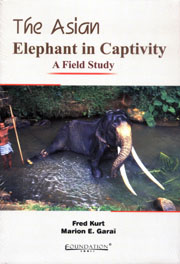
- The Asian Elephant in CaptivityA Field Study, pp. 4 - 47Publisher: Foundation BooksPrint publication year: 2006
Accessibility standard: Unknown
Why this information is here
This section outlines the accessibility features of this content - including support for screen readers, full keyboard navigation and high-contrast display options. This may not be relevant for you.Accessibility Information
Accessibility compliance for the PDF of this chapter is currently unknown
and may be updated in the future.