Book contents
- Frontmatter
- Contents
- Notes on Contributors
- Preface
- Introduction
- Part I Media and Gender (In)Justice
- 1 Wanted: A Gender Perspective on Media Globalisation
- 2 Media Texts for Women by Women
- 3 Media-ting ‘Patriarchy’
- 4 The Endangered Gender: Images of Women in Advertisements
- 5 Woman in Visual Media: The Spectator vs. the Spectacle
- 6 Two Faces of Women on Television: Need for a Gender Policy
- Part II Framing Women
5 - Woman in Visual Media: The Spectator vs. the Spectacle
from Part I - Media and Gender (In)Justice
Published online by Cambridge University Press: 05 November 2011

Book contents
- Frontmatter
- Contents
- Notes on Contributors
- Preface
- Introduction
- Part I Media and Gender (In)Justice
- 1 Wanted: A Gender Perspective on Media Globalisation
- 2 Media Texts for Women by Women
- 3 Media-ting ‘Patriarchy’
- 4 The Endangered Gender: Images of Women in Advertisements
- 5 Woman in Visual Media: The Spectator vs. the Spectacle
- 6 Two Faces of Women on Television: Need for a Gender Policy
- Part II Framing Women
Summary
There is a basic connection between a woman's experiences in real life and a woman's experiences in visual media, which essentially forms the relationship between the spectator and spectacle. It is assumed that women are generally taught to be objects of spectacle in their everyday life and they have something in common with the image of women on the screen/visual media. The woman enters into the mediated world of film or television with a context that is structured wholly for her absence/invisibility, which of course, often mirrors her real life. Feminist film critics Laura Mulvey has said that, “The woman is not visible in the audience which is perceived as the male” and Claire Johnston observes, “The woman is not visible on the screen, as she is merely a surrogate for the phallus, a signifier for something else.…” (Gamble, 79)
The visual media codes have manipulated the absence of the woman to such an extent that the limited choices allowed to her are – to identify firstly with the image of the woman (structured by the male) on the screen, secondly with the male audience sitting by her side in the theatre and finally with the heroes in the films and their super human actions. The narrative of the film places the woman spectator with the ‘hero’. The emotions of the women accepting ‘masculinization’ (a term used by Laura Mulvey, 1975) while watching the actions of the hero are enriched by the emotions of a heroine of a sentimental comedy.
Information
- Type
- Chapter
- Information
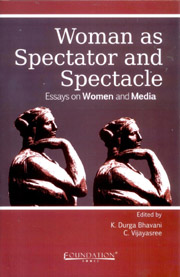
- Woman as Spectator and SpectacleEssays on Women and Media, pp. 40 - 49Publisher: Foundation BooksPrint publication year: 2010
Accessibility standard: Unknown
Why this information is here
This section outlines the accessibility features of this content - including support for screen readers, full keyboard navigation and high-contrast display options. This may not be relevant for you.Accessibility Information
Accessibility compliance for the PDF of this chapter is currently unknown
and may be updated in the future.