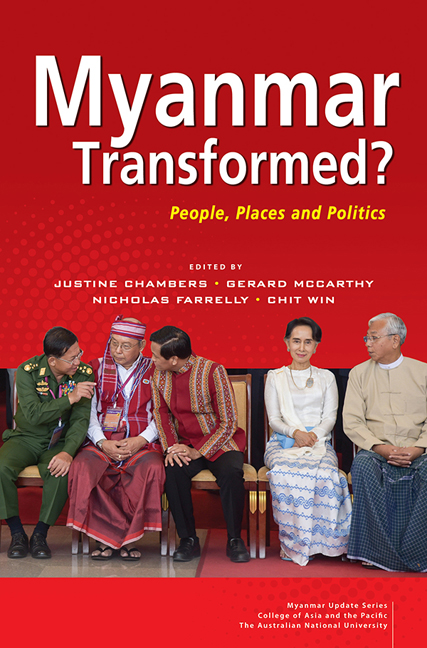
1 - Myanmar Transformed?
from Part I - Introduction
Published online by Cambridge University Press: 12 February 2019

Summary
In early February 2016 crowds gathered around televisions in tea shops across Myanmar to watch their new representatives be sworn in to positions in the Pyithu and Amyotha Parliaments, the lower and upper houses, in the capital Naypyitaw. In a country ruled by soldiers for over five decades, many doubted whether the military would hand legislative and executive power to a government led by Daw Aung San Suu Kyi's National League for Democracy, given its refusal to do so when the party won the elections in 1990. Watching NLD representatives take seats in Myanmar's parliament brought tears of cautious optimism to the eyes of many of these self-proclaimed democrats. Their hopeful sentiment was reinforced a few weeks later when U Htin Kyaw, a close aide of long-time democracy campaigner and opposition leader Aung San Suu Kyi, was made President. Soon after, Suu Kyi herself assumed the newly-created position of “State Counsellor”, a role she claimed would place her “above the President” (Marshall and Mclaughlin 2015).
Since the heady months of early 2016, the limits of Myanmar's transformation from military junta to alleged beacon of democratization have become tragically clear. Levels of poverty and household debt remain catastrophic for many households. Meanwhile, on-budget funding for the armed forces, or Tatmadaw, in 2017–18 almost exceeded financing for health, education and welfare combined. In contrast to the vibrant political environment and growth in civil society between 2011–15, hopes that the NLD's election would herald a more progressive and inclusive Myanmar have faded rapidly since 2015. Civil liberties have come under repeated attack, with Myanmar declared the “biggest backslider in press freedom” across the globe by the Committee to Protect Journalists as a result of the escalating imprisonment of reporters and social media users during Suu Kyi's tenure. Protests by students in support of education reform have been suppressed, and land disputes remain intractable with little hope for justice or compensation for those dispossessed over decades. Furthermore, the status of religious minorities and progressive activists has become increasingly precarious, as exposed by the blatant assassination of prominent Muslim lawyer and architect of Suu Kyi's “State Counsellor” position U Ko Ni in January 2017.
Information
- Type
- Chapter
- Information
- Myanmar Transformed?People, Places and Politics, pp. 3 - 20Publisher: ISEAS–Yusof Ishak InstitutePrint publication year: 2018
Accessibility standard: Unknown
Why this information is here
This section outlines the accessibility features of this content - including support for screen readers, full keyboard navigation and high-contrast display options. This may not be relevant for you.Accessibility Information
Accessibility compliance for the PDF of this chapter is currently unknown
and may be updated in the future.