Book contents
- Frontmatter
- Contents
- Contributors
- Introduction
- 1 James Fenimore Cooper
- 2 Nathaniel Hawthorne
- 3 Herman Melville
- 4 Harriet Beecher Stowe
- 5 Mark Twain
- 6 Henry James
- 7 Edith Wharton
- 8 Theodore Dreiser
- 9 Willa Cather
- 10 F. Scott Fitzgerald
- 11 Ernest Hemingway
- 12 William Faulkner
- 13 Henry Roth
- 14 Djuna Barnes
- 15 Zora Neale Hurston
- 16 Richard Wright
- 17 Raymond Chandler
- 18 Ralph Ellison
- 19 J. D. Salinger
- 20 Patricia Highsmith
- 21 Vladimir Nabokov
- 22 Jack Kerouac
- 23 Saul Bellow
- 24 Kurt Vonnegut
- 25 John Updike
- 26 Thomas Pynchon
- 27 Toni Morrison
- 28 Philip Roth
- 29 Don DeLillo
- 30 Cormac McCarthy
- Guide to Further Reading
- Index
- References
7 - Edith Wharton
Published online by Cambridge University Press: 05 December 2012
Edited by

Book contents
- Frontmatter
- Contents
- Contributors
- Introduction
- 1 James Fenimore Cooper
- 2 Nathaniel Hawthorne
- 3 Herman Melville
- 4 Harriet Beecher Stowe
- 5 Mark Twain
- 6 Henry James
- 7 Edith Wharton
- 8 Theodore Dreiser
- 9 Willa Cather
- 10 F. Scott Fitzgerald
- 11 Ernest Hemingway
- 12 William Faulkner
- 13 Henry Roth
- 14 Djuna Barnes
- 15 Zora Neale Hurston
- 16 Richard Wright
- 17 Raymond Chandler
- 18 Ralph Ellison
- 19 J. D. Salinger
- 20 Patricia Highsmith
- 21 Vladimir Nabokov
- 22 Jack Kerouac
- 23 Saul Bellow
- 24 Kurt Vonnegut
- 25 John Updike
- 26 Thomas Pynchon
- 27 Toni Morrison
- 28 Philip Roth
- 29 Don DeLillo
- 30 Cormac McCarthy
- Guide to Further Reading
- Index
- References
Summary
For readers across the United States in 1905, “The novel of the year, with the emphasis on the ‘The,’” was Edith Wharton’s (1862–1937) The House of Mirth: “Above the level of our modern novels it towers head and shoulders high.” Wharton was “alone in her own class … among that handful of English-speaking novelists … whose books are the chief literary events of our day.” While some considered her subject (fashionable high life) too narrow and modish, prophecies of her future standing proved just. After a slight dip of reputation, in the mid-twentieth century after her death in 1937, Wharton has continued to command a wide following and maintained her established status as one of the most important American novelists. No single text could possibly encapsulate her career (in forty years, she published more than forty volumes, any one of which rewards discussion), but with this novel as an entry point, this chapter will attempt simply to give a sense of her remarkable scope and diversity.
Launched in January 1905, as a monthly serial in the popular Scribner’s Magazine, Wharton’s story of the high-maintenance Miss Bart, a husband-hunting socialite, flirting, gambling, and, in private, smoking, her way through the Manhattan smart set, captured its audience from the start, and published as a book, in October, with the much-anticipated final installment looming, it became an instant bestseller, breaking all Scribner’s records, and making Wharton famous. The House of Mirth was Wharton’s second novel, and she herself would come to view it as her much delayed, professional breakthrough (the first episode appeared in the month of her forty-third birthday). Seeing her early chapters in print, when she was still working out the later ones, forced her, so she claimed, into the discipline essential to a writer; she learned how to bring complex materials under control, and to steer a work to its close.
Information
- Type
- Chapter
- Information
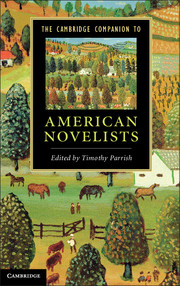
- The Cambridge Companion to American Novelists , pp. 61 - 71Publisher: Cambridge University PressPrint publication year: 2012
References
and , Edith Wharton: Sex, Satire and the Older Woman, Basingstoke, Palgrave Macmillan, 2011.Google Scholar
, The Cambridge Companion to Edith Wharton, New York, Cambridge University Press, 1995.CrossRefGoogle Scholar
, The Architectural Imagination of Edith Wharton: Gender, Class and Power in the Progressive Era, Madison, N.J., Fairleigh Dickinson University Press, 2007.Google Scholar
, Gender and the Gothic in the Fiction of Edith Wharton, Tuscaloosa, University of Alabama Press, 1995.Google Scholar
, Edith Wharton and the Making of Fashion, Lebanon, University of New Hampshire Press, 2009.Google Scholar
, Edith Wharton and the Politics of Race, Cambridge, Cambridge University Press, 2004.CrossRefGoogle Scholar
, The Cambridge Introduction to Edith Wharton, Cambridge, Cambridge University Press, 2009.Google Scholar
, Displaying Women: Spectacles of Leisure in Edith Wharton’s New York, New York, Routledge, 1998.Google Scholar
, Edith Wharton’s Writings from the Great War, Gainesville, University Press of Florida, 2004.Google Scholar
(ed.), A Historical Guide to Edith Wharton, Oxford, Oxford University Press, 2003.
, Edith Wharton’s Letters from the Underworld: Fictions of Women and Writing, Chapel Hill, University of North Carolina Press, 1991.Google Scholar
, Edith Wharton’s Travel Writing: The Making of a Connoisseur, Basingstoke, Macmillan, 1997.Google Scholar
Letter from Susan Hale to Caroline Weld, March 25, 1900, in Letters of Susan Hale, ed. Caroline Atkinson (Boston, Marshall Jones, 1919), p. 359
, “A Little Girl’s New York” (1934; published posthumously, 1938)
, (ed.), Edith Wharton: The Uncollected Critical Writings (Princeton, N.J., Princeton University Press, 1996)Google Scholar
Accessibility standard: Unknown
Why this information is here
This section outlines the accessibility features of this content - including support for screen readers, full keyboard navigation and high-contrast display options. This may not be relevant for you.Accessibility Information
Accessibility compliance for the PDF of this chapter is currently unknown
and may be updated in the future.