1. Introduction
Rayleigh–Taylor instability (RTI) (Rayleigh Reference Rayleigh1883; Taylor Reference Taylor1950) occurs when a heavier fluid is accelerated by a lighter one, forming bubbles (lighter fluid penetrating heavier fluid) and spikes (heavier fluid penetrating lighter fluid), often evolving into turbulence (Zhou et al. Reference Zhou, Clark, Clark, Glendinning, Skinner, Huntington, Hurricane, Dimits and Remington2019). The RTI critically impacts inertial confinement fusion (ICF) by hindering net energy gain (Lindl et al. Reference Lindl, Landen, Edwards and Moses2014; Zhou, Sadler & Hurricane Reference Zhou, Sadler and Hurricane2025) and plays a key role in astrophysical hydrodynamic mixing, such as in supernovae (Arnett Reference Arnett2000; Müller Reference Müller2020). In ICF, ignition relies on compression in a contracting geometry, whereas supernovae involve expansion-driven mass ejection. Compared with planar configurations, cylindrical geometry introduces added complexity due to radial contraction/expansion and variable acceleration, requiring precise control of geometry and acceleration history (Liang et al. Reference Liang, Alkindi, Alzeyoudi, Liu, Ali and Masmoudi2024). These challenges make cylindrical RTI a critical topic in fluid dynamics and plasma physics.
Theoretically, perturbations in contracting or expanding geometries exhibit distinct growth dynamics. The Bell–Plesset (BP) effect (Bell Reference Bell1951; Plesset Reference Plesset1954) describes compressible fluid behaviour under radial acceleration. Epstein (Reference Epstein2004) noted that ‘undriven growth’ more accurately describes convergence and compression effects in the absence of buoyancy-driven RTI. Their analysis revealed that BP effects depend on the RTI growth rate. Mikaelian (Reference Mikaelian2005) derived the linear solution for RTI in cylindrical geometry, where the interface amplitude $a$
follows
$a$
follows
 \begin{equation} \ddot {a}+2\frac {\dot {R}}{R}\dot {a}-(nA-1)\frac {\ddot {R}}{R}a=0, \end{equation}
with $n$
as the azimuthal wavenumber,
$n$
as the azimuthal wavenumber, $R$
as the interface radius, and
$R$
as the interface radius, and $A$
(the Atwood number,
$A$
(the Atwood number, $A=(\rho _h-\rho _l)/(\rho _h+\rho _l)$
, where
$A=(\rho _h-\rho _l)/(\rho _h+\rho _l)$
, where $\rho _h$
and
$\rho _h$
and $\rho _l$
are the densities of heavier and lighter fluids, respectively) characterising density contrast. Unlike planar RTI, cylindrical RTI depends on both acceleration and radius. Though ICF targets are spherical, cylindrical geometry effectively captures contraction/expansion effects, serving as a simplified model for spherical RTI (Zhou Reference Zhou2024).
$\rho _l$
are the densities of heavier and lighter fluids, respectively) characterising density contrast. Unlike planar RTI, cylindrical RTI depends on both acceleration and radius. Though ICF targets are spherical, cylindrical geometry effectively captures contraction/expansion effects, serving as a simplified model for spherical RTI (Zhou Reference Zhou2024).
Yu & Livescu (Reference Yu and Livescu2008) showed that acceleration direction strongly influences cylindrical RTI: on comparing with planar RTI, inward gravity (contraction) enhances growth, while outward gravity (expansion) suppresses it. Wang et al. (Reference Wang, Wu, Ye, Zhang and He2013) and Liu, Ma & Wang (Reference Liu, Ma and Wang2015) investigated the cylindrical RTI in weakly nonlinear regimes, quantifying the development of high-order modes on the interface deformation. Recently, Zhao et al. (Reference Zhao, Wang, Liu and Lu2020) extended the Layzer model to cylindrical geometry, developing a nonlinear model for two-dimensional (2-D) single-mode RTI. Their analysis revealed that unlike planar RTI where the bubble velocity $v_{{b}}$
approaches a constant, in cylindrical geometry the value of
$v_{{b}}$
approaches a constant, in cylindrical geometry the value of $v_{{b}}/\sqrt {a+R}$
asymptotically tends to a constant. In addition, Mikaelian (Reference Mikaelian2005) noted that the viscous RTI in cylindrical geometry is difficult to solve analytically and typically requires approximate methods. Furthermore, surface tension effects on cylindrical RTI are unexplored.
$v_{{b}}/\sqrt {a+R}$
asymptotically tends to a constant. In addition, Mikaelian (Reference Mikaelian2005) noted that the viscous RTI in cylindrical geometry is difficult to solve analytically and typically requires approximate methods. Furthermore, surface tension effects on cylindrical RTI are unexplored.
Experiments on cylindrical RTI were few due to the difficulty in forming a well-defined interface in cylindrical geometry and applying controlled acceleration. Weir, Chandler & Goodwin (Reference Weir, Chandler and Goodwin1998) experimentally investigated the growth of 2-D RTI in an imploding gelatine cylinder. Their study employed controlled initial perturbations and high-resolution photography to capture the instability evolution. Wang et al. (Reference Wang, Xue and Han2021b ) studied RTI on a single-mode interface between air and viscous liquid in a cylindrically divergent geometry. Their results showed that the RTI growth in divergent geometry is lower than in planar and convergent geometries. Viscous damping was found to be weaker under the BP effect. Wang et al. (Reference Wang, Li, Guo, Wang, Du, Wang, Abe and Huang2021a ) examined laser-induced cavitation in water droplets, identifying three deformation types (splashing, ventilating, stable) and modelling cylindrical RTI with bubble oscillations.
Experiments on cylindrical Richtmyer–Meshkov instability (RMI) (Richtmyer Reference Richtmyer1960; Meshkov Reference Meshkov1969), a special case of RTI driven by impulsive acceleration, are relatively abundant. In contrast to planar geometry, where only RMI growth is expected to occur, converging/diverging shock-accelerated interfaces can be RT unstable as they geometrically contract or expand (Lombardini, Pullin & Meiron Reference Lombardini, Pullin and Meiron2014). For instance, it was found that the balance between geometry contraction and nonlinear effect results in a longer linear regime in convergent geometry than planar geometry (Luo et al. Reference Luo, Li, Ding, Zhai and Si2019), and the coupling between geometry expansion and RT stabilisation leads to a slower instability in divergent geometry than planar geometry (Li et al. Reference Li, Ding, Zhai, Si, Liu, Huang and Luo2020).
Overall, two key challenges remain in the study on RTI in cylindrical geometry: (i) understanding surface tension’s role in cylindrical RTI and (ii) achieving precise experimental control over perturbations and driving forces. Here, we experimentally studied cylindrically divergent RTI on water–air interfaces, derive theoretical solutions and quantify surface tension effects, emphasising initial condition dependence and identifying distinct RTI growth trends.
2. Experimental method
The experiment was conducted in a device comprising two transparent acrylic sheets (spacing $h=3.0$
mm), as shown in figure 1(a). A 4.0 mm diameter hole was drilled at the centre of the top sheet. Precisely machined micro-channels (width, 1.0 mm; depth, 2.0 mm) with single-mode and circular patterns were engraved on opposing surfaces (marked in red), into which hydrophobic-coated acrylic rings (width, 0.9 mm; height, 2.0 mm) were embedded to constrain the water–air interface. The single-mode micro-channels are positioned at an inner radius (
$h=3.0$
mm), as shown in figure 1(a). A 4.0 mm diameter hole was drilled at the centre of the top sheet. Precisely machined micro-channels (width, 1.0 mm; depth, 2.0 mm) with single-mode and circular patterns were engraved on opposing surfaces (marked in red), into which hydrophobic-coated acrylic rings (width, 0.9 mm; height, 2.0 mm) were embedded to constrain the water–air interface. The single-mode micro-channels are positioned at an inner radius ( $R_0$
) of 25.0 mm, while the circular micro-channels are distributed at an outer radius (
$R_0$
) of 25.0 mm, while the circular micro-channels are distributed at an outer radius ( $R_{{L}}$
) of 100.0 mm. The hydrophobic-coated rings play a crucial role by increasing the water–air interface contact angle (typically
$R_{{L}}$
) of 100.0 mm. The hydrophobic-coated rings play a crucial role by increasing the water–air interface contact angle (typically $\gt 90^{\circ }$
), enabling precise control of the interface geometry. In our experiments, the hydrophobic rings effectively maintained the water–air interface in predetermined single-mode or circular patterns, as designed. Before experiments, the space between the inner single-mode ring and outer circular ring was filled with pure water (see figure 1
b). At the start of the experiments, high-pressure air was suddenly injected through the top hole at 25 l min−1 (regulated by a flowmeter) via a cable.
$\gt 90^{\circ }$
), enabling precise control of the interface geometry. In our experiments, the hydrophobic rings effectively maintained the water–air interface in predetermined single-mode or circular patterns, as designed. Before experiments, the space between the inner single-mode ring and outer circular ring was filled with pure water (see figure 1
b). At the start of the experiments, high-pressure air was suddenly injected through the top hole at 25 l min−1 (regulated by a flowmeter) via a cable.

Figure 1. (a) Experimental set-up schematic and (b) initial interface configuration.
The inner single-mode interface perturbation $\eta$
in polar coordinates is given by
$\eta$
in polar coordinates is given by
 \begin{equation} \eta =R_0+a_0\cos (n\theta ), \end{equation}
where $a_0$
is the initial amplitude and
$a_0$
is the initial amplitude and $\theta$
is the angle. Table 1 lists initial parameters for all cases, with the initial amplitude–wavelength ratio (
$\theta$
is the angle. Table 1 lists initial parameters for all cases, with the initial amplitude–wavelength ratio ( $na_0/(2\mathrm{\pi }R_0)$
) fixed at 0.076 (
$na_0/(2\mathrm{\pi }R_0)$
) fixed at 0.076 ( ${\lt }\, 0.1$
), ensuring linear regime evolution initially. A high-speed camera (FASTCAM MINI WX; 250 f.p.s., 1.0 ms shutter) captured the flow at 0.067 mm per pixel resolution, with backscatter illumination. The ambient pressure and temperature are 101.3 kPa and
${\lt }\, 0.1$
), ensuring linear regime evolution initially. A high-speed camera (FASTCAM MINI WX; 250 f.p.s., 1.0 ms shutter) captured the flow at 0.067 mm per pixel resolution, with backscatter illumination. The ambient pressure and temperature are 101.3 kPa and $293.5\pm 0.5$
K, respectively. The surface tension (
$293.5\pm 0.5$
K, respectively. The surface tension ( $\sigma$
) of the water–air interface is 67.5 mN m (measured with the tensiometer Kruss K20). The densities of air (
$\sigma$
) of the water–air interface is 67.5 mN m (measured with the tensiometer Kruss K20). The densities of air ( $\rho _l$
) and water (
$\rho _l$
) and water ( $\rho _h$
) are 1.2 kg m
$\rho _h$
) are 1.2 kg m $^{-3}$
and 997.0 kg m
$^{-3}$
and 997.0 kg m $^{-3}$
, respectively. The Atwood number
$^{-3}$
, respectively. The Atwood number $A$
is 1.0. The viscosities of air (
$A$
is 1.0. The viscosities of air ( $\mu _l$
) and water (
$\mu _l$
) and water ( $\mu _h$
) are 1.8
$\mu _h$
) are 1.8 $\times$
10
$\times$
10 $^{-2}$
mPa s and 1.0 mPa s, respectively. The weighted viscosity coefficient
$^{-2}$
mPa s and 1.0 mPa s, respectively. The weighted viscosity coefficient $\nu$
(
$\nu$
( $=(\mu _h+\mu _l)/(\rho _h+\rho _l)$
) is 1.02
$=(\mu _h+\mu _l)/(\rho _h+\rho _l)$
) is 1.02 $\times$
10
$\times$
10 $^{-6}$
N s m−
$^{-6}$
N s m− $^2$
.
$^2$
.
Table 1. Initial interface parameters, where $n$
,
$n$
, $a_0$
and
$a_0$
and $R_0$
denote the azimuthal wavenumber, initial amplitude and initial radius of the water–air interface, respectively.
$R_0$
denote the azimuthal wavenumber, initial amplitude and initial radius of the water–air interface, respectively.


Figure 2. (a) Unperturbed water–air interface evolution (dashed line, ideal circle) and (b) measured interface radius (symbols) with cubic fit (line) over time.
Figure 2(a) illustrates the evolution of an unperturbed water–air interface driven by a sudden of high-pressure air (case n0). The interface encloses air (white fluid) and is surrounded by water (blue fluid). The interface maintained perfect circularity during expansion, confirming uniformly circumferential external force imposed on the water–air interface. The time-dependent radius of the water interface $R$
is measured from experiments and shown as symbols in figure 2(b). The cubic fitting of the radius can be written as
$R$
is measured from experiments and shown as symbols in figure 2(b). The cubic fitting of the radius can be written as $R=R_0+0.118t+2.797t^2-11.643t^3$
with t representing time. The air–water flow constitutes an impulsive Poiseuille-type outward radial flow within the Hele-Shaw cell (Saffman & Taylor Reference Saffman and Taylor1958), which typically achieves full development after the characteristic viscous diffusion time scale across the cell gap,
$R=R_0+0.118t+2.797t^2-11.643t^3$
with t representing time. The air–water flow constitutes an impulsive Poiseuille-type outward radial flow within the Hele-Shaw cell (Saffman & Taylor Reference Saffman and Taylor1958), which typically achieves full development after the characteristic viscous diffusion time scale across the cell gap, $t_p \sim h^2/\nu$
(Carles et al. Reference Carles, Huang, Carbone and Rosenblatt2006; Wang et al. Reference Wang, Xue and Han2021b
). The system dynamics is primarily governed by RTI and BP effects for
$t_p \sim h^2/\nu$
(Carles et al. Reference Carles, Huang, Carbone and Rosenblatt2006; Wang et al. Reference Wang, Xue and Han2021b
). The system dynamics is primarily governed by RTI and BP effects for $t \lt t_p$
, as the Poiseuille-type flow becomes dominant at
$t \lt t_p$
, as the Poiseuille-type flow becomes dominant at $t \gt t_p$
. In the present study, this transitional time scale is calculated as
$t \gt t_p$
. In the present study, this transitional time scale is calculated as $t_p \approx 8.85$
s, far exceeding the experimental duration (120 ms). Therefore, the present system can be considered to be dominated by cylindrical RTI. Furthermore, the initial distance between the inner single-mode interface and outer circular interface may influence both interface dynamics and the feedback between the two interfaces. This interaction warrants further investigation, as such feedback mechanisms could potentially be utilised to manipulate hydrodynamic instabilities (Weir et al. Reference Weir, Chandler and Goodwin1998; Liang & Luo Reference Liang and Luo2023; Mikaelian Reference Mikaelian2025).
$t_p \approx 8.85$
s, far exceeding the experimental duration (120 ms). Therefore, the present system can be considered to be dominated by cylindrical RTI. Furthermore, the initial distance between the inner single-mode interface and outer circular interface may influence both interface dynamics and the feedback between the two interfaces. This interaction warrants further investigation, as such feedback mechanisms could potentially be utilised to manipulate hydrodynamic instabilities (Weir et al. Reference Weir, Chandler and Goodwin1998; Liang & Luo Reference Liang and Luo2023; Mikaelian Reference Mikaelian2025).
3. Results and discussion
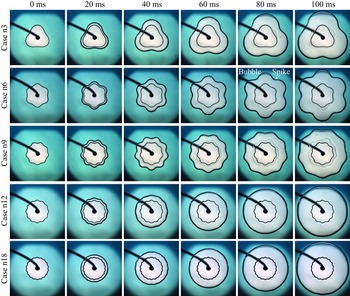
Figure 3 illustrates the evolution of a cylindrically divergent water–air interface under various initial conditions. During expansion, the RTI develops more rapidly at lower wavenumbers. While the perturbation wavenumber remains unvaried, the perturbation amplitude evolution follows distinct temporal regimes: (i) sustained growth for lower wavenumbers ( $n=3$
and 6), (ii) relative stability for moderate wavenumbers (
$n=3$
and 6), (ii) relative stability for moderate wavenumbers ( $n=9$
) and (iii) perturbation reversal and amplitude oscillation for higher wavenumbers (
$n=9$
) and (iii) perturbation reversal and amplitude oscillation for higher wavenumbers ( $n=12$
and 18). Specifically, the perturbation in the n12 case exhibits a single reversal at 76 ms, whereas the perturbation in the n18 case undergoes two reversals (16 and 68 ms). Notably, spikes narrow slightly while bubbles widen at a later time, as seen in the n6 case at
$n=12$
and 18). Specifically, the perturbation in the n12 case exhibits a single reversal at 76 ms, whereas the perturbation in the n18 case undergoes two reversals (16 and 68 ms). Notably, spikes narrow slightly while bubbles widen at a later time, as seen in the n6 case at $t=80$
ms, yet the bubble–spike symmetry remains largely preserved, indicating weak nonlinearity in the cylindrically divergent RTI. The well-defined interface morphology allows precise amplitude measurements via contour analysis.
$t=80$
ms, yet the bubble–spike symmetry remains largely preserved, indicating weak nonlinearity in the cylindrically divergent RTI. The well-defined interface morphology allows precise amplitude measurements via contour analysis.

Figure 3. Evolution of a cylindrically divergent water–air interface under various initial conditions.
The time-varying amplitudes across cases are shown in figure 4, revealing wavenumber-dependent RTI dynamics. For example, the amplitudes grow continuously in cases n3 and n6, the amplitudes peak at 35 ms before decaying in the case n9, the amplitudes decrease from the very beginning in the case n12, and the amplitudes exhibit oscillations in the case n18. These amplitude growth trends contrast with the exponential growth predicted by the linear solution for cylindrical RTI (1.1), suggesting suppression mechanisms such as viscosity or surface tension.

Figure 4. Time-varying amplitudes of the water–air interface. Solid and dash-dot lines represent the linear model predictions using (3.9) with $\beta =1.0$
and 0.7, respectively.
$\beta =1.0$
and 0.7, respectively.
The dimensionless analysis uses time-dependent Reynolds numbers ( $Re$
) and Weber numbers (
$Re$
) and Weber numbers ( $\textit{We}$
):
$\textit{We}$
):
 \begin{equation} Re=\frac {\dot {R}R}{n\nu }, \quad {\textit{We}}=\frac {(\rho _h+\rho _l)R}{\sigma n}A^2\dot {R}^2. \end{equation}
The time-dependent Reynolds numbers and Weber numbers measured from experiments in figures 5(a) and 5(b), respectively, exhibit a clear positive correlation with wavenumber $n$
instability. The experimental results for case n18 exhibit the minimal Reynolds and Weber numbers in our study, with
$n$
instability. The experimental results for case n18 exhibit the minimal Reynolds and Weber numbers in our study, with $Re$
ranging between 400 and 1000 and
$Re$
ranging between 400 and 1000 and ${\textit{We}}$
between 2 and 7. While the condition
${\textit{We}}$
between 2 and 7. While the condition $Re \gg 1$
generally indicates negligible viscous effects, our measured
$Re \gg 1$
generally indicates negligible viscous effects, our measured $Re$
values well exceed the critical threshold of 256 below which viscosity becomes important for interfacial instability, confirming the system operates in the inviscid regime (Walchli & Thornber Reference Walchli and Thornber2017). Conversely, while
$Re$
values well exceed the critical threshold of 256 below which viscosity becomes important for interfacial instability, confirming the system operates in the inviscid regime (Walchli & Thornber Reference Walchli and Thornber2017). Conversely, while ${\textit{We}} \gg 1$
would typically suggest negligible surface tension effects, our observed
${\textit{We}} \gg 1$
would typically suggest negligible surface tension effects, our observed $\textit{We}$
range of 2–7 falls within the transitional regime where surface tension significantly influences interface dynamics, as demonstrated by Hsiang & Faeth (Reference Hsiang and Faeth1992) for
$\textit{We}$
range of 2–7 falls within the transitional regime where surface tension significantly influences interface dynamics, as demonstrated by Hsiang & Faeth (Reference Hsiang and Faeth1992) for $1.1\lt \textit{We}\lt 80$
in droplet deformation studies. The experimental results demonstrate that viscous effects are negligible while surface tension plays a significant role in the development of cylindrical RTI.
$1.1\lt \textit{We}\lt 80$
in droplet deformation studies. The experimental results demonstrate that viscous effects are negligible while surface tension plays a significant role in the development of cylindrical RTI.

Figure 5. Time-varying (a) Reynolds number ( $Re$
) and (b) Weber number (
$Re$
) and (b) Weber number ( $\textit{We}$
) of the water–air interface.
$\textit{We}$
) of the water–air interface.
Through image processing, we extracted the $r{-}\theta$
coordinates of interface contours and applied fast Fourier transforms (FFTs) to quantify the temporal evolution of the amplitudes of the first-three modes (see figure 6). Spectral analysis shows different growth trends of the first-order modes (
$r{-}\theta$
coordinates of interface contours and applied fast Fourier transforms (FFTs) to quantify the temporal evolution of the amplitudes of the first-three modes (see figure 6). Spectral analysis shows different growth trends of the first-order modes ( $a_1$
). Moreover, Spectral analysis demonstrates pronounced negative growth of the second-order modes (
$a_1$
). Moreover, Spectral analysis demonstrates pronounced negative growth of the second-order modes ( $a_2$
) for lower wavenumbers (
$a_2$
) for lower wavenumbers ( $n=3$
and 6), while remaining negligible at higher wavenumbers (
$n=3$
and 6), while remaining negligible at higher wavenumbers ( $n=9$
, 12 and 18). Similarly, spectral analysis shows a slight positive growth of the third-order modes (
$n=9$
, 12 and 18). Similarly, spectral analysis shows a slight positive growth of the third-order modes ( $a_3$
) for the lowest wavenumber (
$a_3$
) for the lowest wavenumber ( $n=3$
) and minimal growth across other cases, confirming weakly nonlinear evolution of the cylindrically divergent RTI.
$n=3$
) and minimal growth across other cases, confirming weakly nonlinear evolution of the cylindrically divergent RTI.

Figure 6. Time-varying amplitudes of the (a) first-order, (b) second-order and (c) third-order harmonics. Predictions with $\beta =0.7$
from the linear model (dash-dot lines) (3.9) in (a), second-order nonlinear model (dashed lines) (A1) in (b), and third-order nonlinear model (dotted lines) (A2) in (c) are shown for comparison.
$\beta =0.7$
from the linear model (dash-dot lines) (3.9) in (a), second-order nonlinear model (dashed lines) (A1) in (b), and third-order nonlinear model (dotted lines) (A2) in (c) are shown for comparison.
Consider a system of two incompressible, inviscid and initially irrotational fluids separated by an interface with small perturbation $\eta$
in cylindrical geometry. The velocity potential for the lighter fluid (
$\eta$
in cylindrical geometry. The velocity potential for the lighter fluid ( $\phi _l$
) and heavier fluid (
$\phi _l$
) and heavier fluid ( $\phi _h$
) satisfies the kinematic continuity condition for normal velocity components across the interface (Wang et al. Reference Wang, Xue and Han2021b
):
$\phi _h$
) satisfies the kinematic continuity condition for normal velocity components across the interface (Wang et al. Reference Wang, Xue and Han2021b
):
 \begin{equation} -\left(\frac {\partial \phi _l}{\partial r} \right)_{\eta }=- \left(\frac {\partial \phi _h}{\partial r} \right)_{\eta }=\dot {R}+\dot {a}\cos (n\theta ). \end{equation}
Then, we can obtain the perturbed velocity potential for each side of the interface as
 \begin{align} \phi _l & =-R\dot {R}\ln r-\frac {1}{n}(\dot {a}R+a\dot {R})\frac {r^n}{R^n}\cos (n\theta ),\end{align}
 \begin{align} \phi _h & =-R\dot {R}\ln r+\frac {1}{n}(\dot {a}R+a\dot {R})\frac {R^n}{r^n}\cos (n\theta ).\end{align}
The expressions for the pressure in the lighter fluid ( $p_l$
) and heavier fluid (
$p_l$
) and heavier fluid ( $p_h$
) can be evaluated using the Bernoulli integral:
$p_h$
) can be evaluated using the Bernoulli integral:
 \begin{align} p_l=F_l+\rho _l\left [\left(\frac {\partial \phi _l}{\partial t} \right)_{\eta }-\frac {1}{2} \left(\frac {\partial \phi _l}{\partial r} \right)_{\eta }^2\right ],\end{align}
 \begin{align} p_h=F_h+\rho _h\left [\left(\frac {\partial \phi _h}{\partial t} \right)_{\eta }-\frac {1}{2} \left(\frac {\partial \phi _h}{\partial r} \right)_{\eta }^2\right ],\end{align}
where $F_l$
and
$F_l$
and $F_h$
are integration constants. The terms
$F_h$
are integration constants. The terms $({\partial \phi }/{\partial r})_{\eta }^2$
are of second order and are therefore to be neglected. At the interface, normal stress continuity including surface tension yields
$({\partial \phi }/{\partial r})_{\eta }^2$
are of second order and are therefore to be neglected. At the interface, normal stress continuity including surface tension yields
 \begin{equation} -p_l+\sigma \kappa =-p_h, \end{equation}
with interface curvature $\kappa$
approximated as
$\kappa$
approximated as
 \begin{equation} \kappa =\frac {\left|\dfrac {{\rm d}^2\eta }{ {\rm d}s^2} \right|}{ \left[1+ \left(\dfrac {\rm d\eta }{{\rm d}s} \right)^2 \right]^{\frac {3}{2}}}\approx \frac {1}{R}-\frac {an^2\cos (n\theta )}{R^2}, \end{equation}
where $s$
is the arclength parameter. Collecting terms proportional to
$s$
is the arclength parameter. Collecting terms proportional to $\cos (n\theta )$
in (3.7) gives the governing equation for cylindrical RTI considering surface tension:
$\cos (n\theta )$
in (3.7) gives the governing equation for cylindrical RTI considering surface tension:
 \begin{equation} \ddot {a}+2\frac {\dot {R}}{R}\dot {a}-\left [(nA-1)\frac {\ddot {R}}{R}-\frac {\beta \sigma n^3}{(\rho _h+\rho _l)R^3}\right ]a=0, \end{equation}
where $\beta$
is a coefficient introduced to moderate the effects of surface tension. The value of
$\beta$
is a coefficient introduced to moderate the effects of surface tension. The value of $\beta$
depends not only on the Weber number, but also on the wavenumber. Setting
$\beta$
depends not only on the Weber number, but also on the wavenumber. Setting $\beta =0$
eliminates surface tension effects, reducing (3.9) to (1.1). Moreover, (3.9) reveals surface tension’s stabilising influence on the cylindrical RTI growth. With decreasing
$\beta =0$
eliminates surface tension effects, reducing (3.9) to (1.1). Moreover, (3.9) reveals surface tension’s stabilising influence on the cylindrical RTI growth. With decreasing $n$
, the perturbation’s curvature radius reduces and the surface tension grows, leading to enhanced suppression of RTI by surface tension.
$n$
, the perturbation’s curvature radius reduces and the surface tension grows, leading to enhanced suppression of RTI by surface tension.
Figure 4 shows the linear solution predictions (solid lines) using $\beta =1.0$
. The initial amplitude growth rate
$\beta =1.0$
. The initial amplitude growth rate $\dot {a}_0=nAa_0\Delta v/R_0$
(where
$\dot {a}_0=nAa_0\Delta v/R_0$
(where $\Delta v=0.07$
m s
$\Delta v=0.07$
m s $^{-1}$
is the velocity jump of the interface measured from experiments at
$^{-1}$
is the velocity jump of the interface measured from experiments at $t=0$
) follows cylindrical RMI theory (Mikaelian Reference Mikaelian2005). While the prediction of the linear solution (3.9) matches case n3, it underestimates amplitudes for cases n6 and n9, suggesting overestimated surface tension effects. Through experimental fitting, we adjusted
$t=0$
) follows cylindrical RMI theory (Mikaelian Reference Mikaelian2005). While the prediction of the linear solution (3.9) matches case n3, it underestimates amplitudes for cases n6 and n9, suggesting overestimated surface tension effects. Through experimental fitting, we adjusted $\beta$
to 0.7, achieving excellent agreement with the interface and first-order mode amplitudes in all cases (dash-dot lines in figures 4 and 6
a), suggesting that the linear solution should account for weaker surface tension’s suppression.
$\beta$
to 0.7, achieving excellent agreement with the interface and first-order mode amplitudes in all cases (dash-dot lines in figures 4 and 6
a), suggesting that the linear solution should account for weaker surface tension’s suppression.
For cylindrical RTI, (3.9) gives an exponential growth of the interface, with the growth factor ( $\gamma$
) satisfying
$\gamma$
) satisfying
 \begin{equation} \gamma ^2+2\frac {\dot {R}}{R}\gamma -\left [(nA-1)\frac {\ddot {R}}{R}-\frac {\beta \sigma n^3}{(\rho _h+\rho _l)R^3}\right ]=0. \end{equation}
Then, the expression for $\gamma$
is derived as
$\gamma$
is derived as
 \begin{equation} \gamma =-\frac {\dot {R}}{R}+\sqrt {\left(\frac {\dot {R}}{R} \right)^2+(nA-1)\frac {\ddot {R}}{R}-\frac {\beta \sigma n^3}{(\rho _h+\rho _l)R^3}}. \end{equation}
There are three distinct solutions based on $\gamma$
values: unstable solution (
$\gamma$
values: unstable solution ( $\gamma \gt 0$
), freeze-out solution (
$\gamma \gt 0$
), freeze-out solution ( $\gamma =0$
) and oscillatory solution (
$\gamma =0$
) and oscillatory solution ( $\gamma \lt 0$
). In ICF experiments, achieving hydrodynamic instability freeze-out (
$\gamma \lt 0$
). In ICF experiments, achieving hydrodynamic instability freeze-out ( $\gamma =0$
) is crucial for minimising the mixing between the hot fuel with the cold pusher and improving the nuclear ignition efficiency. The critical azimuthal wavenumber
$\gamma =0$
) is crucial for minimising the mixing between the hot fuel with the cold pusher and improving the nuclear ignition efficiency. The critical azimuthal wavenumber $n_c$
, obtained by solving
$n_c$
, obtained by solving $\gamma =0$
, follows
$\gamma =0$
, follows
 \begin{equation} n_c=\sqrt [3]{-\frac {\xi }{2}+\sqrt {\frac {\xi ^2}{4}-\frac {A^3\xi ^3}{27}}}+\sqrt [3]{-\frac {\xi }{2}-\sqrt {\frac {\xi ^2}{4}-\frac {A^3\xi ^3}{27}}}. \end{equation}
where $\xi =(\rho _h+\rho _l)\ddot {R}R^2/\beta \sigma$
.
$\xi =(\rho _h+\rho _l)\ddot {R}R^2/\beta \sigma$
.
The time-varying $n_c$
and the radius acceleration
$n_c$
and the radius acceleration $\ddot {R}$
calculated from cubic fitting are shown in figure 7. The
$\ddot {R}$
calculated from cubic fitting are shown in figure 7. The $\ddot {R}$
decreases linearly to zero at 80 ms. During early stages (
$\ddot {R}$
decreases linearly to zero at 80 ms. During early stages ( $t\lt 40$
ms,
$t\lt 40$
ms, $n_c\approx 8$
), we observe (i) unstable perturbation growth for
$n_c\approx 8$
), we observe (i) unstable perturbation growth for $n\lt 8$
, (ii) instability freeze-out at
$n\lt 8$
, (ii) instability freeze-out at $n=8$
and (iii) oscillatory perturbation growth for
$n=8$
and (iii) oscillatory perturbation growth for $n\gt 8$
, all consistent with experimental observation (figure 4). Beyond 40 ms,
$n\gt 8$
, all consistent with experimental observation (figure 4). Beyond 40 ms, $n_c$
rapidly drops to
$n_c$
rapidly drops to $\approx 2$
as
$\approx 2$
as $\ddot {R}\rightarrow 0$
. Therefore, the growth behaviour of cylindrical RTI may evolve over time due to the varying radius histories (
$\ddot {R}\rightarrow 0$
. Therefore, the growth behaviour of cylindrical RTI may evolve over time due to the varying radius histories ( $R$
and
$R$
and $\ddot {R}$
). Taking case n6 as an example, the interface perturbation is initially unstable. As
$\ddot {R}$
). Taking case n6 as an example, the interface perturbation is initially unstable. As $R$
increases and
$R$
increases and $\ddot {R}$
decreases, the term
$\ddot {R}$
decreases, the term ${(nA-1)\ddot {R}}/{R}-{\beta \sigma n^3}/{[(\rho _h+\rho _l)R^3}]$
transitions from positive to negative, causing the perturbation to shift into oscillatory growth at approximately 65 ms. A similar oscillatory phenomenon was recently reported in 2-D planar magnetic RTI (Briard, Gréa & Nguyen ), where tangential magnetic fields generate a ‘magnetic tension’ effect that stabilises perturbations. Briard et al. (Reference Briard, Gréa and Nguyen2024) demonstrated that as the perturbation amplitude increases, the critical wavenumber (beyond which instability is suppressed) shifts dynamically. Consequently, a mode that is initially unstable may stabilise when the perturbation grows and decays, then destabilise again, repeating this cyclic pattern. Overall, our work provides new insights into manipulating hydrodynamic instabilities through surface tension effects and enables rapid assessment of instability growth trends via the critical parameter
${(nA-1)\ddot {R}}/{R}-{\beta \sigma n^3}/{[(\rho _h+\rho _l)R^3}]$
transitions from positive to negative, causing the perturbation to shift into oscillatory growth at approximately 65 ms. A similar oscillatory phenomenon was recently reported in 2-D planar magnetic RTI (Briard, Gréa & Nguyen ), where tangential magnetic fields generate a ‘magnetic tension’ effect that stabilises perturbations. Briard et al. (Reference Briard, Gréa and Nguyen2024) demonstrated that as the perturbation amplitude increases, the critical wavenumber (beyond which instability is suppressed) shifts dynamically. Consequently, a mode that is initially unstable may stabilise when the perturbation grows and decays, then destabilise again, repeating this cyclic pattern. Overall, our work provides new insights into manipulating hydrodynamic instabilities through surface tension effects and enables rapid assessment of instability growth trends via the critical parameter $n_c$
.
$n_c$
.

Figure 7. Time-varying freeze-out wavenumber (solid lines) and radius acceleration (dashed lines).
Last, weakly nonlinear solutions for the second-order mode (A1) and the third-order mode (A2) proposed by Wang et al. (Reference Wang, Wu, Guo, Ye, Liu, Zhang and He2015) can be found in Appendix A. The development of both second-order ( $a_2$
,
$a_2$
, $\dot {a}_2$
,
$\dot {a}_2$
, $\ddot {a}_2$
) and third-order (
$\ddot {a}_2$
) and third-order ( $a_3$
,
$a_3$
, $\dot {a}_3$
,
$\dot {a}_3$
, $\ddot {a}_3$
) modes can be fully determined from the first-order mode evolution (
$\ddot {a}_3$
) modes can be fully determined from the first-order mode evolution ( $a$
,
$a$
, $\dot {a}$
,
$\dot {a}$
, $\ddot {a}$
), which incorporates surface tension effects through the coefficient
$\ddot {a}$
), which incorporates surface tension effects through the coefficient $\beta$
. Since the first-order solutions directly enter the higher-order mode equations (A1) and (A2), the
$\beta$
. Since the first-order solutions directly enter the higher-order mode equations (A1) and (A2), the $\beta$
-dependence naturally propagates to these nonlinear terms. The theoretical predictions of (A1) with
$\beta$
-dependence naturally propagates to these nonlinear terms. The theoretical predictions of (A1) with $\beta =0.7$
for cases n3 and n6 are shown in figure 6(b), while those of (A2) with
$\beta =0.7$
for cases n3 and n6 are shown in figure 6(b), while those of (A2) with $\beta =0.7$
for case n3 are presented in figure 6(c), both demonstrating good agreement with experimental results. As a result, the suppression of surface tension on high-order modes of cylindrical RTI is quantified.
$\beta =0.7$
for case n3 are presented in figure 6(c), both demonstrating good agreement with experimental results. As a result, the suppression of surface tension on high-order modes of cylindrical RTI is quantified.
4. Conclusions
We conducted experimental studies of cylindrically divergent RTI at a liquid–gas interfaces using a novel hydrophobic approach. This method enabled precise formation of a 2-D water–air interface with single-mode perturbations. The experimental configuration utilised high-pressure air injection to produce uniform circumferential acceleration, while high-speed backscatter imaging captured the complete temporal evolution of interface deformation.
The experiments revealed that while perturbation wavenumbers remain constant during outward expansion, the amplitude evolution follows three distinct regimes: sustained growth, continuous decay and oscillatory behaviour. This demonstrates the strong dependence of cylindrical RTI on initial conditions – a phenomenon observed for the first time. Dimensionless analysis showed negligible viscous effects ( $Re \gt 500$
) but significant surface tension influence (
$Re \gt 500$
) but significant surface tension influence ( ${\textit{We}} \lt 25$
). Spectral analysis confirmed the weakly nonlinear evolution of RTI, with measurable second-order mode growth only at lower wavenumbers (
${\textit{We}} \lt 25$
). Spectral analysis confirmed the weakly nonlinear evolution of RTI, with measurable second-order mode growth only at lower wavenumbers ( $n=3$
and 6), and minimal third-order mode contributions across all cases.
$n=3$
and 6), and minimal third-order mode contributions across all cases.
With decreasing $n$
, the perturbation’s curvature radius reduces and the surface tension grows, leading to enhanced suppression of RTI by surface tension. The developed linear and weakly nonlinear models accurately predicted temporal evolution of the fundamental, second-order and third-order modes across all cases, quantitatively demonstrating surface tension’s stabilising effect. It is noted that a reduction factor
$n$
, the perturbation’s curvature radius reduces and the surface tension grows, leading to enhanced suppression of RTI by surface tension. The developed linear and weakly nonlinear models accurately predicted temporal evolution of the fundamental, second-order and third-order modes across all cases, quantitatively demonstrating surface tension’s stabilising effect. It is noted that a reduction factor $\beta$
was utilised in these models to reduce the surface tension’s suppression effect on RTI. Furthermore, the linear theory established clear criteria distinguishing unstable, freeze-out and oscillatory RTI regimes. The condition for the instability freeze-out is meaningful for the ICF target designing since it may minimise fuel-pusher mixing and maintain temperature stratification. These results provide critical new insights for understanding hydrodynamic instabilities in both convergent (e.g. ICF) and divergent (e.g. supernova) geometries.
$\beta$
was utilised in these models to reduce the surface tension’s suppression effect on RTI. Furthermore, the linear theory established clear criteria distinguishing unstable, freeze-out and oscillatory RTI regimes. The condition for the instability freeze-out is meaningful for the ICF target designing since it may minimise fuel-pusher mixing and maintain temperature stratification. These results provide critical new insights for understanding hydrodynamic instabilities in both convergent (e.g. ICF) and divergent (e.g. supernova) geometries.
Funding
This work was supported by the Natural Science Foundation of China (nos 12388101 and 24FAA00998).
Declaration of interests
The authors report no conflict of interest.
Appendix A. Weakly nonlinear solutions
Weakly nonlinear solutions for the second-order mode (A1) and the third-order mode (A2) proposed by Wang et al. (Reference Wang, Wu, Guo, Ye, Liu, Zhang and He2015) are, respectively, written as
 \begin{equation} \ddot {a}_2+2\frac {\dot {R}}{R}\dot {a}_2+(1-2nA)\frac {\ddot {R}}{R}a_2+nAa\frac {1}{R^2}(4\dot {R}\dot {a}+\ddot {R}a)+\frac {1}{2R}\left [\ddot {a}a+(1+2nA)\dot {a}^2\right ]=0, \end{equation}
 \begin{align} \ddot {a}_3&+2\frac {\dot {R}}{R}\dot {a}_3+(1-3nA)\frac {\ddot {R}}{R}a_3-\left [(nA-3n^2)\frac {\dot {R}^2}{4R^4}+nA\frac {\ddot {R}}{4R^3}\right ]a^3 \nonumber\\ &-(nA-n^2)\frac {3\dot {R}}{2R^3}a^2\dot {a}+\frac {3n^2}{4R^2}a\dot {a}^2+nA\frac {3\ddot {R}}{2R^2}aa_2+3nA\frac {\dot {R}}{R^2}aa_2^2 \nonumber\\ &+\frac {1}{2R}a\ddot {a}_2+3nA\frac {\dot {R}}{R^2}\dot {a}a_2+\frac {1}{2R}\ddot {a}a_2+(1+3nA)\frac {1}{R}\dot {a}\dot {a_2}=0. \end{align}