


Introduction
The Columbidae (pigeons and doves) are among the most threatened bird families globally (Walker, Reference Walker2007). Of the 352 extant species, 17% are threatened with extinction and nearly 70% have declining population trends (BirdLife International, 2025a). One analysis of the correlates of extinction highlighted that columbids with globally restricted ranges and those that occur on islands were most likely to be threatened with extinction (Walker, Reference Walker2007). Another study investigating correlates of decline found that, among columbids, species that are island-dwelling, forest specialists and non-migratory are more likely to be threatened with extinction or endangerment (Martínez-Rubio et al., Reference Martínez-Rubio, Sayol and Lapiedra2024). The main threats to Asian pigeons are habitat loss and hunting (Walker, Reference Walker2007), which are exacerbated in Indonesia by the small ranges of many species.
The Timor green pigeon Treron psittaceus is distributed in Indonesia on Rote Island, Semau Island and West Timor (Indonesia), and in Timor-Leste, the eastern part of Timor Island, including the island of Atauro (Baptista et al., Reference Baptista, Trail, Horblit, de Juana, Garcia, del Hoyo, Elliott, Sargatal, Christie and de Juana2020). The Timor green pigeon does not occur in Timor’s mountainous areas; on the north coast of Timor-Leste it is considered extant, on much of the south coast as possibly extant, in much of West Timor as possibly extinct, on Semau as possibly extant, on most of Rote as possibly extinct, and on only a small part of Rote’s northern peninsula as extant (BirdLife International, 2021). Despite having been categorized as threatened on the IUCN Red List since it was first assessed in 1988, and as Endangered since 2000 (BirdLife International, 2025a), the Timor green pigeon is one of many threatened pigeon species that remain poorly studied. The only systematic bird survey in West Timor (14 sites over 7 weeks) failed to record the species (Noske & Saleh, Reference Noske and Saleh1996). The authors highlighted the general absence of Timor endemic pigeon records during their survey, stated that ‘the fate of frugivorous pigeons on Timor is less certain because of …selective hunting’ (p. 71) and recommended studies to determine the extent of hunting. The Timor green pigeon has been considered ‘generally uncommon or rare… usually in small flocks of up to 20 birds’ in tropical forest and ‘quiet, inconspicuous and very wary’ (Coates & Bishop, Reference Coates and Bishop1997, p. 320), and a lowland specialist (White & Bruce, Reference White and Bruce1986), with records up to 160 m (Coates & Bishop, Reference Coates and Bishop1997). The record of a single Timor green pigeon on Semau in 1991 (Johnstone et al., Reference Johnstone, Hidayat, Darnell and Trainor2014) was the first on the island since A. R. Wallace collected specimens there in 1859 (BirdLife International, 2001) although there may have been no ornithological visits during the intervening years. As part of a review for the Threatened Birds of Asia Red Data Book, BirdLife International (2001) mapped 13 known localities (1829–1999), but only three had records of the species after 1980: Bipolo (including a flock of 60 birds in 1986), Camplong (320 m) and Mount Timau (600 m), all in West Timor. This review concluded that the Timor green pigeon was declining, as evidenced by the paucity and declining frequency of records at known sites for the species such as Bipolo and Camplong. Hunting was considered the main driver of decline because the species tends to concentrate at fruiting trees, making it potentially easy for hunters to shoot all birds in a flock (K. D. Bishop in BirdLife International, 2001). A series of Timor green pigeon records in Timor-Leste during 1974 was noted as evidence by one expert (J. McKean) that the species was more common there than in West Timor (BirdLife International, 2001).
Since 2000, there has been a marked increase in bird survey effort throughout the range of the Timor green pigeon by conservation workers, postgraduate students, recreational birders and commercial bird tour operators. Despite this, few field records have been published. A survey of remote south coastal and hill forests in Timor-Leste by Mauro (Reference Mauro2003) resulted in several records, and he considered the species to be ‘scarce to moderately common at all visited lowland localities, up to 700 m elevation’ (p. 4). Bird surveys over 12 days on Atauro Island (Timor-Leste) failed to record the Timor green pigeon but the species was nonetheless listed as present based on the report of a local hunter who had observed it (Trainor & Soares, Reference Trainor and Soares2004). A survey of the northern peninsula of Rote Island in 2004 resulted in the observation of one individual in a fruiting fig (Trainor, Reference Trainor2005), with a comment on its high desirability as wild meat. Brief reports from extensive surveys in Timor-Leste during 2002–2006 noted large flocks of Timor green pigeons, with up to 30–50 seen in the Vero River area and one flock of 130 birds at Wairoke (Trainor et al., Reference Trainor, Santana, Pinto, Xavier, Safford and Grimmett2008). Surveys on Rote over 25 days in 2009 and 2013 produced only two additional records, with the conclusion that the species must be close to extinction on the island (Verbelen & Cooleman, Reference Verbelen and Cooleman2015).
The IUCN Red List assessment of the species (Birdlife International, 2021) incorporated unpublished records and input by experts (including the authors of this study) to determine the conservation status of the Timor green pigeon. Currently the species is categorized as Endangered, with a declining population trend driven by hunting and habitat loss, and an estimated global population of 660–2,000 mature individuals (BirdLife International, 2021). Contributions by author CRT to the IUCN Red List process have chiefly comprised unpublished records collected during fieldwork in 2002–2006 in spatially concentrated regions of Timor-Leste (summarized in Trainor et al., Reference Trainor, Santana, Pinto, Xavier, Safford and Grimmett2008). Since 2016, we have searched for the Timor green pigeon during surveys totalling > 700 days on Rote, Semau, West Timor, Timor-Leste, Atauro and Jaco Island, including visits to some historical sites of occurrence. Here we provide a detailed analysis of recent records and survey effort to support an updated conservation assessment and to inform the species-specific actions needed to prevent the pigeon’s extinction. Our aims are to: (1) document our Timor green pigeon records and published literature records, and map the distribution of presence and absence records, (2) assess whether there is evidence of population declines by examining temporal patterns of frequency at known locations, and (3) calculate the parameters needed for an updated assessment.
Study area
We conducted field surveys and compiled literature records throughout the range of the Timor green pigeon. This range is dominated by Timor Island (c. 30,459 km2, 474 km long and up to 95 km wide), comprising Indonesian West Timor (14,513 km2, 0–2,427 m) and Timor-Leste (14,874 km2, 0–2,986 m). It further extends to Rote Island (Indonesia; 1,280 km2, 0–440 m), and the Timor satellite islands of Semau (Indonesia; 261 km2, 0–190 m), and Jaco (Timor-Leste; 11 km2, 0–80 m). Administratively West Timor and Rote are separated into Districts (kabupatens). Similarly, Timor-Leste is divided into 14 Municipalities (districts) including the Oecusse enclave, Atauro Island and Lautem (which also includes the small island of Jaco). The entire region has a highly seasonal dry tropical climate that is geographically variable depending on elevation and aspect. The wet season is generally November–April but runs through to June along the south coast and in the mountains, where rainfall may exceed 4,150 mm/year (RePPProT, 1989; Bacon et al., Reference Bacon, Neto, Pereira and Williams2014). Rote, Semau, Jaco and much of the north coast of Timor have shorter and drier wet seasons with rainfall of 800–1,500 mm/year. The smaller islands are relatively flat and dominated by uplifted coralline limestone, but Timor has complex mountainous terrain, particularly along the central spine of Timor-Leste. Broadly, forests in this region can be classified as Tropical–subtropical lowland rainforests or Tropical–subtropical dry forests and Thickets (Keith et al., Reference Keith, Ferrer-Paris, Nicholson and Kingsford2020). Most forests across the Timor green pigeon’s range have been heavily modified by long-term swidden agriculture. Remaining high-integrity forests occur on Rote’s northern peninsula (Verbelen et al., Reference Verbelen, Trainor and Dossche2017), the central-north coast of West Timor (Fisher, Reference Fisher2012), and in central-south and far-eastern Timor-Leste, including Jaco Island (Grantham et al., Reference Grantham, Duncan, Evans, Jones, Beyer and Schuster2020). Forest cover was 18% of Timor Island in 2020 (Fu et al., Reference Fu, Zhang, Chen and Yan2022), c. 95% on Jaco Island, 19% on Rote in 2017 (Verbelen, et al., Reference Verbelen, Trainor and Dossche2017) and 5–10% on Semau.
Methods
Surveys
CRT conducted extensive bird surveys across the potential range of the Timor green pigeon, accumulating 938 field days (Supplementary Table 1). These surveys during 2002–2025 covered Timor-Leste (783 days: 605 days in 2000–2009, 178 days in 2010–2023), Atauro Island (28 days in 2003–2017), Jaco Island (4 days in 2002–2003), West Timor (86 days: 8 days in 2000–2009, 78 days in 2010–2025), Rote Island (75 days: 8 days in 2000–2009; 67 days in 2010–2024), and Semau Island (10 days in 2012–2024).
The surveys, undertaken as part of postgraduate studies, conservation assessments, environmental consulting and recreational birdwatching, encompassed a range of habitats, including remote forests, degraded lands, shrublands and areas regenerating following swidden agriculture. Data collected during 2002–2016, using stationary point counts, 500 m transects and traveling bird checklists, were uploaded to eBird (2025). All data collected after 2016 were entered directly into eBird. Surveys comprised c. 5,000 km on foot, c. 500 km of road surveys with 5-minute point counts at 1 km intervals, yielding a total of 780 10-minute point counts, 533 5-minute point counts, and 536 500 m transects.
JPL surveyed birds in Timor-Leste for 497 field days from 5 May 2018 (the date of his first Timor green pigeon record) to 27 December 2023, generally entering bird records as checklists directly into eBird, covering c. 2,500 km on foot. During 2019–2023, CRT and JPL conducted joint surveys for c. 30 days in mountains, lowland forests and coastal areas throughout Timor-Leste, including remote parts (> 10 km from roads) of Nino Konis Santana National Park. During these remote surveys, they walked c. 100 km through the forest over 5 days, documenting birds using 5-minute point counts, 500 m line transects, and non-systematic eBird checklists. JPL also interviewed hunters regarding their primary targets. In addition, CRT surveyed Nino Konis Santana National Park during 2003–2006, often in collaboration with PP and AFX. In all fieldwork by CRT and JPL, a typical day comprised c. 8 h of survey effort (typically 06.00–11.00 and 15.30–18.30). Observations were documented with digital photographs of pigeons and habitats (uploaded to eBird Macaulay Library), sound recordings using a Sony recorder and Sennheiser microphone (deposited at Xeno-canto: Vellinga, Reference Vellinga2024), and limited video recordings of birds (uploaded to eBird Macaulay Library).
We use the number of field survey days as a metric of survey effort across countries, islands, administrative districts and locations, which is a simple quantification of effort that facilitates comparisons between our own surveys and secondary data observations documented from the Global Biodiversity Information Framework (GBIF; Auer et al., Reference Auer, Barker, Barry, Charnoky, Curtis and Davies2024) and published records.
Published records
We compiled dated field records and created distribution maps for the Timor green pigeon from several sources: field observations submitted to eBird by CRT; published articles (McKean et al., Reference McKean, Mason and O’Connor1975; Johnstone & Jepson, Reference Johnstone and Jepson1996; Trainor, Reference Trainor2005; Johnstone et al., Reference Johnstone, Hidayat, Darnell and Trainor2014; Verbelen & Cooleman, Reference Verbelen and Cooleman2015); GBIF data (Auer et al., Reference Auer, Barker, Barry, Charnoky, Curtis and Davies2024); records from Observation International and local partners (2024); grey literature, including field surveys by Mauro (Reference Mauro1999, Reference Mauro2003; Supplementary Table 2); data collated and mapped in BirdLife International (2001); and sound recordings in Xeno-canto (Vellinga, Reference Vellinga2024). During the process of adding records from notebooks, one overlooked Timor green pigeon record from Trainor (Reference Trainor2005) was subsequently added to eBird. Six records lacking geographical coordinates were manually georeferenced using site names from the source material and locating these sites in Google Earth (2024). We updated several 20th-century records from the BirdLife International (2001) assessment by obtaining further details (date and count) directly from the observers and updated the location of one historical Rote Island record by checking a map in Mees (Reference Mees1975). GBIF contained the most records, some of which also appeared in the original source material (e.g. Verbelen & Cooleman, Reference Verbelen and Cooleman2015; Observation International and local partners, 2024; Vellinga, Reference Vellinga2024). These records were manually checked for duplicates, including observations of Timor green pigeons made by both CRT and JPL when working together (these were attributed to a single observer for simplicity); GBIF also includes museum specimen records, but these were excluded due to their age (mostly > 100 years) and lack of precise location data. Following Leseberg et al. (Reference Leseberg, Murphy, Jackett, Webster, MacColl and Stoetzel2020), we assessed the veracity of several eBird sight records based on location, determining whether they were confirmed or unverified. This included records from locations where we are confident the species is genuinely absent (e.g. Atauro Island, Timor-Leste) and considering the likelihood of confusion with other green-coloured pigeons (e.g. female rose-crowned fruit-dove Ptilinopus regina). These unverified records were removed from further consideration. During the drafting of this article, at least two records were removed/updated from the original source (eBird, 2025) by the observers themselves. A single recent record from Semau Island, supported by a description of the bird provided by an experienced hunter, was deemed confirmed.
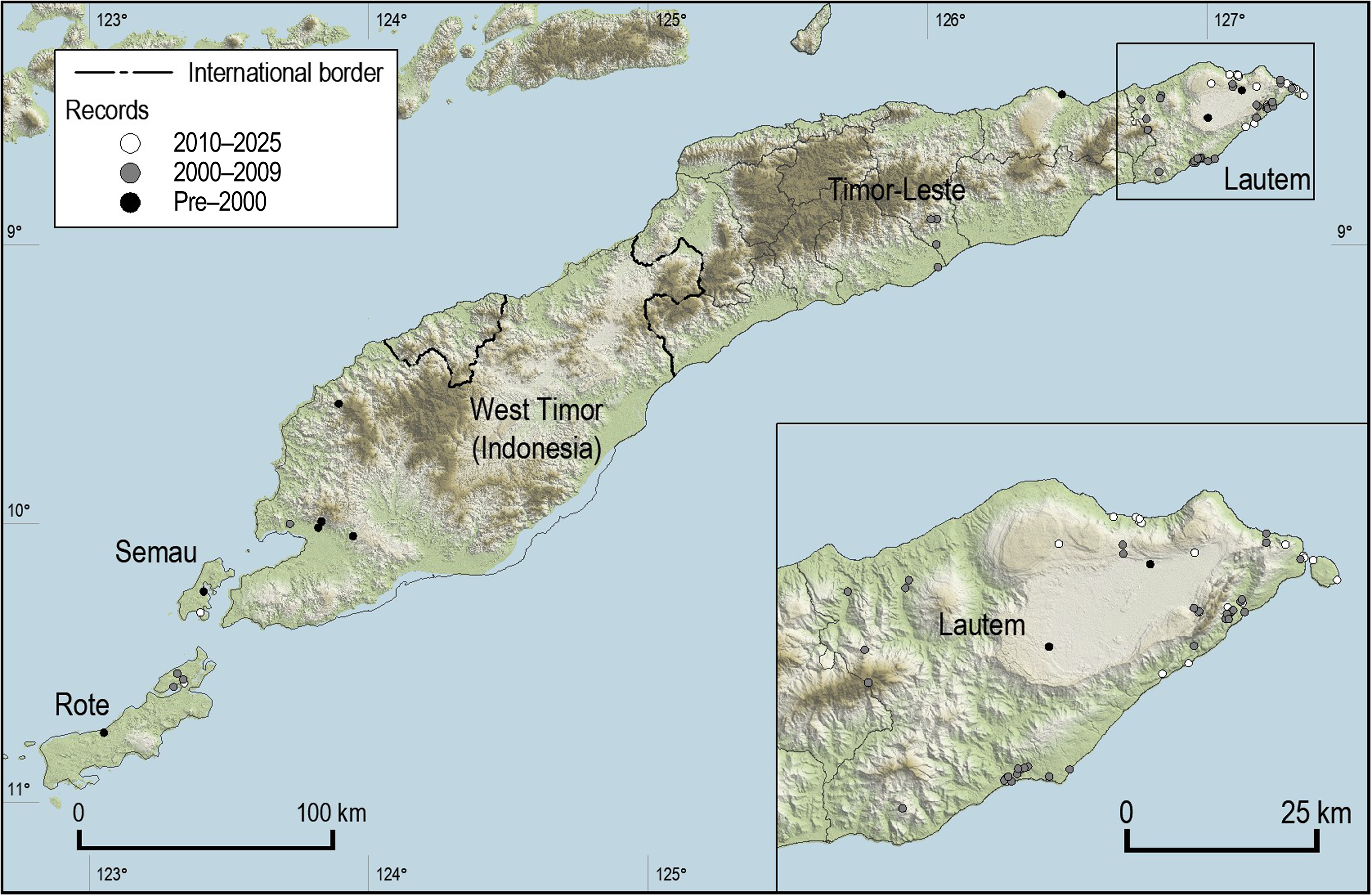
We summarized the distribution and frequency of Timor green pigeon records, categorized by source (CRT, JPL and secondary data), across countries, islands, administrative districts, locations, villages in Lautem District, and protected areas. We also compared patterns of occurrence before and after 2000. Pre- and post-2000 records were mapped by source, and a separate map shows survey effort where the species was not recorded (Fig. 1). Each record was assigned, where relevant, to a protected area (BirdLife International, 2025a), and elevation was determined to the nearest 20 m using Google Earth (2024) or from original record data.
Sites surveyed for the Timor green pigeon Treron psittaceus, throughout its range, before 2000, and in 2000–2009 and 2010–2025, with an inset map highlighting effort in Lautem District. Data sourced from GBIF (Auer et al., Reference Auer, Barker, Barry, Charnoky, Curtis and Davies2024) and eBird (2025).

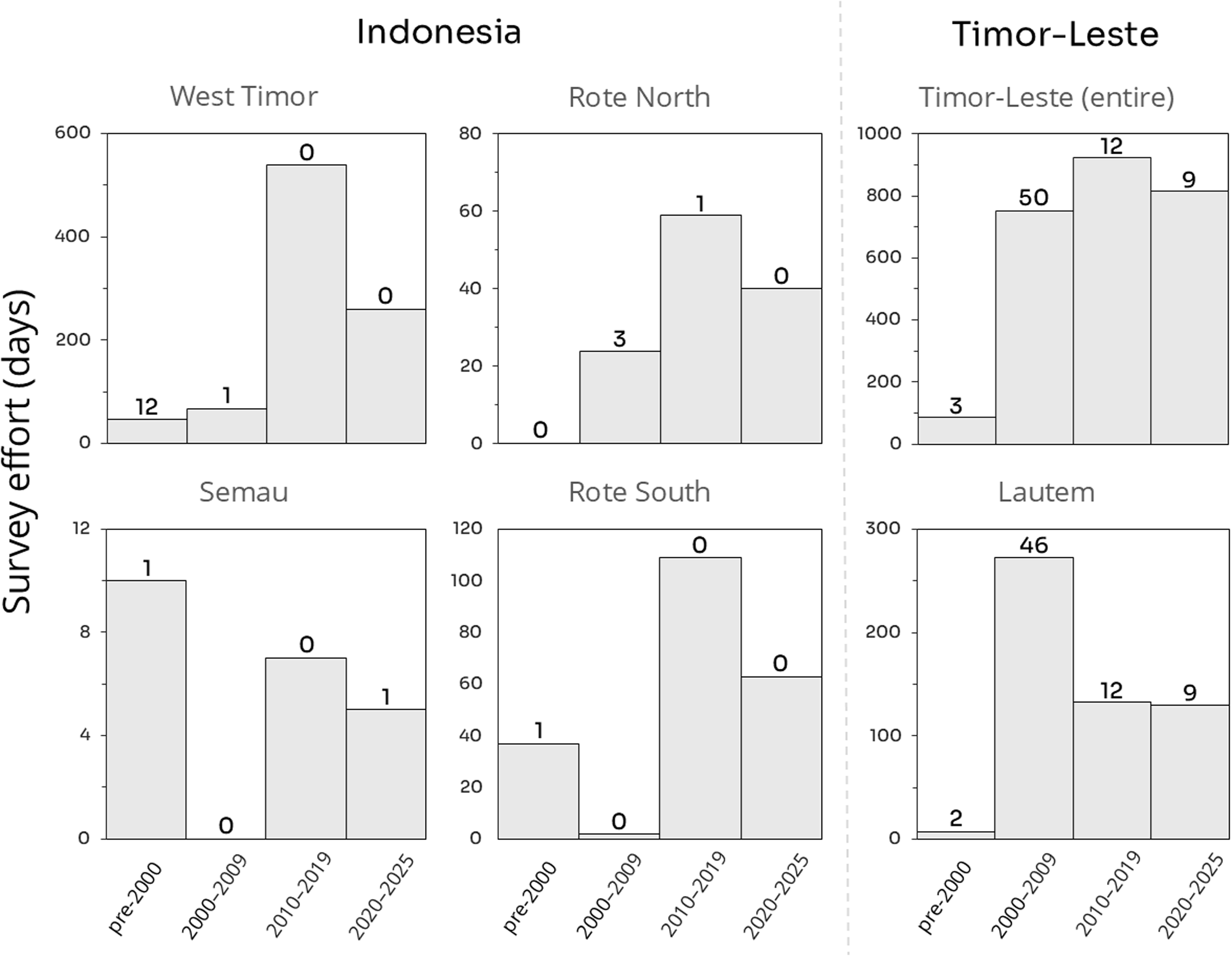
Survey effort in days was sourced from GBIF (Auer et al., Reference Auer, Barker, Barry, Charnoky, Curtis and Davies2024), with limited additional data sourced directly from literature (e.g. Verheijen, Reference Verheijen1976; Mauro, Reference Mauro1999, Reference Mauro2003; Johnstone et al., Reference Johnstone, Hidayat, Darnell and Trainor2014; Verbelen & Cooleman, Reference Verbelen and Cooleman2015).
In addition to documenting record data, we briefly describe observed Timor green pigeon behavior, including vocalizations and their influence on detectability. Assessing population trends with limited and often non-standardized data is challenging. Firstly, we compared broad patterns in Timor green pigeon records across regions (disaggregated by country, island, specific areas within Rote Island, and one district in Timor-Leste) with the amount of survey effort in 10-year periods. We measured survey effort using the number of survey dates reported by eBird users for each period. Although eBird data are less comprehensive before 2000, we partially compensated for this by manually compiling survey dates from published and grey literature. Secondly, we descriptively compared the number of pre-2000 records at Bipolo Nature Recreation Park (West Timor, Indonesia) with post-2000 records and survey effort (number of observers and survey dates) using eBird data (Auer et al., Reference Auer, Barker, Barry, Charnoky, Curtis and Davies2024). Thirdly, we used a χ 2 test to compare the proportion of surveys with Timor green pigeon records in the Vero River valley (Timor-Leste) during 2003–2006 (53 10-minute point counts) with a 2019 survey (29 5-minute point counts and 31 500 m line transects). Despite the differing survey methods, this comparison of occurrence frequency using systematic surveys across the two periods is valuable. Approximately 8–10 hours of systematic survey time were spent during each period. Finally, we assessed potential population change by examining the dates of last records from islands, locations and protected areas.
IUCN Red List parameters
To inform an updated IUCN Red List assessment of the species, we calculated metrics used in the IUCN Red List Categories and Criteria Guidelines (IUCN Standards and Petitions Committee, 2024). These include population size, population trend, extent of occurrence (EOO), area of occupancy (AOO), number of subpopulations and the population size of the largest subpopulation. All definitions and recommended methods follow IUCN guidelines; EOO was calculated as the area within a minimum convex polygon drawn around the range, and AOO was calculated using 2 × 2 km grid cells.
Results
We compiled 96 records of the Timor green pigeon across Timor and its surrounding islands for 1969–2025 (Fig. 2). These were from multiple sources, including: 62 field observations by the authors, 17 records from eBird, one from Observation International and local partners (2024), 15 from published literature, and one personal communication (Supplementary Table 2). Most records originated from Timor-Leste (74, including two from Jaco Island), followed by Indonesia (22, comprising 15 from West Timor, five from Rote Island, and two from Semau Island). The majority of records (77) occurred after 2000, with 19 records before 2000 (Fig. 2). A significant proportion of records (82%) were from protected areas, primarily Nino Konis Santana National Park (60 records), followed by Bipolo Nature Recreation Park (12), and a single record from Camplong Nature Recreation Park. Within Timor-Leste, records were concentrated in Lautem District (69 of 74 records), with single records from Baucau and Manufahi Districts, and three records from Manatuto District. The majority of records (85%) originated from two key areas: the forests of Lautem District (69 records) and the Bipolo–Camplong forest complex in West Timor (13 records).
Distribution of Timor green pigeon records before 2000, and in 2000–2009 and 2010–2025, with an inset map highlighting Lautem District (see Supplementary Table 2 for data sources).
During 2002–2023, CRT collected 46 records of the Timor green pigeon in Timor-Leste, all in Lautem District. In 2002–2009 there were 43 records of 1–131 individuals (mean 7.7 birds/record) over 605 field days, including 264 survey days across 30 of 38 village areas in Lautem; and in 2010–2023 CRT obtained three records of 1–5 individuals (mean 3.6 birds/record; 11 individuals in total) over 178 field days, including 21 days in Lautem. In Rote North, CRT made two records (one and two birds) during 2004 over 8 field days, but did not observe the species in Rote North during 2010–2024 over 10 field days, and neither in southern Rote during 57 days (2018–2024). During 2018–2021, JPL made 14 Timor green pigeon observations of 1–25 birds (mean 6.5 birds/record; 92 individuals in total). After 2000, 80% of all records, and 97% of all counted individual birds, were observed by CRT and JPL. Birds were generally conspicuous, and the species could readily be heard by CRT from up to 60 m away when calling with the standard see-saw ‘woo-goo…’ notes, but they were also heard to give a deep ‘ruck ruck’ call. When birds exited trees following disturbance, the distinctive noise made by wing flaps was audible for c. 40 m.
There were 34 records by others in literature and databases from 1969 to 2021: 19 records of 1–60 individuals before 2000 (mean 5.5 birds/record) that were dominated by one flock of 60 birds. Post-2000 there were 15 records by others, and for those with count data, the number of birds was 1–3 (mean 1.7 birds; a total of 15 individuals). The mean elevation of all records was 151 m but was substantially lower in Indonesia (mean 74 m) and higher in Timor-Leste (mean 174 m). The highest records were 600 m on Mt Timau (Indonesia), 700 m on Mt Sarim (Timor-Leste) and 1,100 m on Mt Legumau (Timor-Leste).
Before 2000, most Timor green pigeon records were from West Timor, but after 2000 the majority of records were from Timor-Leste, particularly during 2000–2009 (Fig. 2, Supplementary Table 2). There was a substantial decline in the number of records in West Timor post-2000 despite an increase in survey effort, totalling > 860 days, primarily by bird tours and birdwatchers (Fig. 3). There have been no records in West Timor since 2005. This pattern was also reflected in data from Rote, where there were three records in Rote North during 29 survey days in 2000–2009, but only one record after 2009 despite an increased number of 56 survey days (Fig. 3). In Rote South, the last record was in 1969 despite 175 days of survey effort in 2000–2025 (Fig. 3). Timor green pigeon records in Timor-Leste peaked during 2000–2009 and dropped off considerably after 2009 despite an overall increase in survey effort and much greater spatial coverage, including the first surveys of mountains, sites on the south coast, in the Oecusse enclave and new sites around Dili (Fig. 1). In Lautem, the district with the most Timor-Leste records, both records and survey effort declined after 2009 (Fig. 3).

There was no statistical difference between the frequency of records in systematic bird surveys in the Vero River and Ira-Caupiti area (Lautem) during 2003–2006 (six records in 53 surveys) compared to the three records in 60 surveys in 2019 (χ 2 = 1.53, P = 0.21). Despite the lack of difference in frequency of effort, the maximum flock size halved from 50 birds in 2003–2006 to 25 birds in 2019.
IUCN Red List parameters
Population size
Our data suggest that the current global population estimate (660–2,000 mature individuals; BirdLife International, 2021) is likely to be overly optimistic. We suggest instead an estimate of 100–500 mature individuals, most likely on the lower end of this estimate. This low estimate is based on our survey results and past records, combined with evidence of intense hunting and the absence of management across the species’ range over decades. It also reflects the long-term disappearance of the species from known sites as a result of hunting, and the limited extent of unsurveyed forests that could support unknown populations, as most are close to villages and subject to ongoing hunting pressure. In Indonesia, despite substantial survey effort (structured surveys 2018–2024 and ongoing citizen science projects), we have obtained only six records this century. On Rote, the population of the Timor green pigeon is probably now negligible, and the species is almost certainly at least functionally extinct. There have been only four records of seven individuals across c. 33 field days during 2004–2013, and no records since, despite extensive bird surveys (e.g. 103 field days on the island since 2020). Optimistically, the species may persist in the remote, intact forests of northern Rote but numbers are probably extremely low because the birds continue to be hunted. Forest areas beyond c. 4 h of walking from villages are limited, making it highly likely that the few scattered individuals that could remain continue to be exposed to ongoing hunting. On Semau Island, the species’ status is equally precarious, with only two single-bird records over 33 years. Given Semau’s limited remote forest, the persistence of a viable population is unlikely. In West Timor, the population size is difficult to estimate, but the lack of records since 2005, despite 800 field days since 2010, suggests the population must now be extremely small. Overall, therefore, we consider the Indonesian population to be extremely small (0–50 mature individuals) and probably functionally extinct. The last documented observation of ≥ 10 individuals in Indonesia was in 1986; since then, records have consisted only of a few scattered individuals.
In Timor-Leste, our data support a marginally more optimistic view. We estimate that the population is probably 100–450 mature individuals, mostly within Nino Konis Santana National Park. Our surveys have revealed that the species is absent from the majority of the National Park, with scattered single birds or pairs remaining in accessible lowland areas, apart from the more remote Vero River valley. Therefore, we consider it possible that the Timor-Leste population size of this species is now as low as 100 mature individuals. However, undersurveyed forests in Lautem (e.g. Iliomar, Lore and Afabubu/Wairoke, the site of the largest flock record, in 2005) offer potential for further populations. There has also been limited follow-up on early 2000s records outside Lautem, despite potentially extensive habitat in Manatuto, Manufahi and the Irabere River catchment (Viqueque District). The largest count from these records was only three birds, suggesting small populations, over 22 years ago, but further surveys are needed for confirmation. The high intensity of hunting across Timor-Leste, coupled with the species’ vulnerability to shooting, significantly reduces the likelihood of a substantial population persisting.
Population trend
Given the apparent collapse of the Timor green pigeon population in West Timor and its imminent extinction in Indonesia, the species must be declining. As adequate protection from hunting and forest loss is lacking in its range, declines should be expected to continue unless conservation action is implemented urgently and effectively.
Extent of occurrence
The area of the minimum convex polygon around the entire species’ range is 26,800 km2. However, this area declined from 22,100 km2 (pre-2000) to 16,350 km2 (2000–2009) and further to 10,452 km2 (2010–2025), based on record localities. This trend in the EOO largely reflects the decline of the species in Indonesia.
Area of occupancy
The calculated minimum AOO (using confirmed records only) is 204 km2. However, this masks a dramatic change over time: an initial 36 km² before 2000 (an artefactually small value as a result of limited recorded survey effort), a substantial increase to 172 km² during 2000–2009, followed by a reduction to 72 km² from 2010 to 2025. This most recent figure is likely to be an underestimate given not every patch of suitable habitat has been surveyed, but the reduction in AOO since 2000–2009 is probably real given the increase in survey effort. However, this effort primarily focused on accessible areas and the Dili District, leaving remote areas in Lautem District under-surveyed.
Discussion
Although the Timor green pigeon has been considered Endangered since 2000, our analysis of all available recent records indicates that it is extremely close to extinction, if not already functionally extinct, in Indonesia. There have been just six Indonesian records in the 21st century, with no more than two individuals per record (Supplementary Table 2). Most of the remaining population is in Timor-Leste, primarily in Nino Konis Santana National Park in Lautem District. In the 21st century, only eight flocks of > 10 birds have been recorded, all in Lautem. Although > 80% of all known records are from protected areas, none of these currently has adequate funding or resources for effective management to mitigate hunting pressure on the species. Testimonies from local hunters and our guides on Rote and Lautem suggest that the Timor green pigeon is hunted intensely because the oily meat is considered delicious. Most of the hunting is carried out by the local community, but as economic circumstances have improved in both West Timor and Timor-Leste, recreational hunting by residents of towns and cities also occurs. In Lautem, the fruiting phenology of trees frequented by the Timor green pigeon is well-known by hunters, who target those trees (mainly Ficus) seasonally. Hunters in Lautem reported that the Timor green pigeon is tule (deaf). When one bird is shot and falls, the rest of the flock often stays in the canopy, making it easy to shoot most of them. Detailed data on hunting of the Timor green pigeon are not available, but the results of intense bird hunting in Timor-Leste are illustrated by Siregar et al. (Reference Siregar, Hasudungan, Widyasari, Lopes, Trainor and Jain2023). The species has persisted in some protected areas as a result of several factors: the difficulty of hunting in larger, more remote forest areas; the distance of these areas from villages; and the topographically complex terrain, which is largely unsuitable for agriculture. Populations have apparently vanished from protected areas surrounded by villages (e.g. Bipolo and Camplong). Even within Nino Konis Santana National Park, the largest known population is in the most remote forests along the south coast, furthest from roads and villages.
Timor-Leste hosts possibly the only remaining viable population of the Timor green pigeon. The species is concentrated in the Vero River valley and the nearby Ira-Caupiti site, with smaller numbers (scattered single birds and pairs) recorded in more accessible areas such as Tutuala, Valu beach and Jaco Island over the past 2 decades (Supplementary Table 2). The Paicau Range in Nino Konis Santana National Park contains the most extensive and well-developed evergreen forest on Timor, yet observations of the species there are of single individuals. This pattern may reflect habitat selection but is more plausibly explained by the proximity of villages and consequent hunting pressure. Although survey effort has been generally higher in Timor-Leste, and particularly in Lautem District, significant gaps remain. These include the coastal forest strip (c. 12 km) between the Aramaco River and Lore, the forests inland of Lore, and the Iliomar area west of the Namulutu River. At the Aramaco River there have been just two records of single individuals, in 2019 and 2021, a substantial difference from the Vero River, 10 km to the east, where flocks of 5–25 birds were recorded daily as recently as 2019. Although unsurveyed sites remain, we have strong evidence for the absence of the Timor green pigeon from some of the best quality forest in Timor-Leste. Extensive lowland forest in the Tilomar area of Suai District that supports the Wetar ground dove Pampusana hoedtii (the only Timor island population) yielded no Timor green pigeons during surveys over 12 person-days in 2005 (Lambert et al., Reference Lambert, Trainor and Xavier2006), nor over 6 days in 2023 (CRT & JPL). There has been no follow-up on the 2005 records of the largest flock ever observed (131 birds) at Afabubu/Wairoke, although no birds were present 4 days before this observation, nor on the highest-elevation records from the Mount Legumau area (which were of single individuals). Although village leaders informed CRT in 2005 that hunting pressure was limited in the Mount Legumau area, recent information is lacking. Outside Lautem District, follow-up surveys on records reported by Mauro (Reference Mauro2003) have been minimal, except for repeated visits to Lake Modo Mahut. Despite c. 10 subsequent surveys, the Timor green pigeon has not been recorded at this site since Mauro’s observation, indicating both limited survey coverage elsewhere and a potential local decline. Although Mauro’s (Reference Mauro2003) expedition did not encounter large flocks (the largest count was three individuals), it did record the species at several sites in the rugged hills north of Natarbora; this area, and unsurveyed forests of Manatuto and Manufahi Districts, warrant further investigation.
Based on information from a local hunter, Trainor & Soares (Reference Trainor and Soares2004) listed the Timor green pigeon as occurring on Atauro Island, but this record should be revoked and corrected in global syntheses such as Baptista et al. (Reference Baptista, Trail, Horblit, de Juana, Garcia, del Hoyo, Elliott, Sargatal, Christie and de Juana2020) and BirdLife International (2021). It is almost certainly a misidentification of female rose-crowned fruit-dove. We have observed similar misidentifications in several citizen science records from Atauro (probably also triggered by our listing) and mainland Timor, including a record from Dili and records near Assailaino (Timor-Leste). Although female rose-crowned fruit-doves are smaller, have shorter tails, and a different tone of green, they are predominantly green and could be confused with the Timor green pigeons. These misidentifications likely stem from brief views of predominantly green pigeons in flight. Such fleeting glimpses can be challenging, especially for inexperienced birders visiting the Timor region for the first time. Despite identification challenges, the value of citizen science records to our analysis cannot be overstated. We encourage ornithologists to document and submit observations to public citizen science databases such as eBird, to help inform the distribution and trends of the Timor green pigeon and other poorly known but highly threatened bird species.
The conservation assessment by BirdLife International (2001) was hopeful that the Timor green pigeon could have been widely overlooked by fieldworkers because it was considered by Coates & Bishop (Reference Coates and Bishop1997) to be quiet, inconspicuous and wary. Our observations suggest otherwise. We found the Timor green pigeon to be highly vocal and relatively easy to flush from trees when feeding below canopy level. Considering the lack of recent observations (BirdLife International, 2001), the declining rate of records from Rote Island and Bipolo, along with its apparent extirpation from Camplong, and the thousands of site absence records across its range, the evidence overwhelmingly points to a genuine absence of the Timor green pigeon throughout most of its historical distribution.
The decline of birds in West Timor, including the Timor green pigeon, was documented by BirdLife International (2001), who noted the last records of the species at Camplong (1991) and Bipolo (1999) despite over 270 field days of effort at these sites in the intervening years. These two forests, popular with recreational birdwatching visitors to West Timor (Noske, Reference Noske1997), provide baseline data on bird species occurrence, but represent a highly spatially biased survey effort skewed towards readily accessible locations. The only post-2000 record of the Timor green pigeon in West Timor was at a previously unsurveyed location c. 11 km west of Bipolo (Observation International and local partners, 2024). Although we attempted a broader survey effort, many parts of West Timor remain unsurveyed, particularly those at greater distances from Kupang, hindering a comprehensive assessment of the species’ current distribution (Fig. 1). Nevertheless, small and fragmented forests close to settlements are unlikely to retain populations of the species, although occasionally birds are attracted to village fig trees. The efforts of Lesmana et al. (Reference Lesmana, Trainor and Gatur2000) are therefore noteworthy, surveying a remote part of West Timor and recording the Timor green pigeon on the mid-slopes of Mount Timau. Subsequent visits to Mount Timau by CRT and other birdwatchers have focused on the easily accessible upper slopes at 1,100–1,300 m, where the Timor green pigeon is unlikely to occur.
This conservation assessment combines our field observations with a comprehensive collation of other field records to provide a detailed picture of the Timor green pigeon’s precarious status. Although acknowledging significant data limitations, including a lack of surveys in key areas, the sporadic nature of records spanning 56 years, and limited quantitative data on hunting pressure, we are confident that hunting has driven the population to critically low levels, continuing a decline already evident by the 1980s (BirdLife International, 2001). Since 2000, only eight of 75 records have documented ≥ 10 Timor green pigeons (Supplementary Table 2). The last new site with > 20 birds was recorded in October 2005. Optimism regarding a large, unsurveyed population is unwarranted until such populations are documented. On this basis, the most recent global population estimate (660–2,000 mature individuals; BirdLife International, 2021) is far too high. We estimate the population is 100–500 and recommend recategorizing the Timor green pigeon’s IUCN Red List status from Endangered to Critically Endangered under Criterion C2a(ii); i.e. population estimated to number < 250 mature individuals, with a continuing decline (2) and at least 90% of mature individuals in one subpopulation (a(ii)). In the 21st century, the species has been recorded at only five areas, and over the past decade, records are restricted to just two: Semau Island and Lautem District.
Conservation
Indonesia
Biodiversity conservation efforts in Indonesia are attracting renewed attention, driven by a new generation of conservation workers and initiatives such as a nationwide citizen science bird survey and monitoring project (Squires et al., Reference Squires, Yuda, Akbar, Collar, Devenish and Taufiqurrahman2021), a renewed commitment to the IUCN Red List assessment process, the creation of species Action Plans, and improved collaboration among local and foreign researchers (Bolam et al., Reference Bolam, Ahumada, Akçakaya, Brooks, Elliott and Hoban2023; Sheherazade et al., Reference Kusrini, Sunarto, Oktaviani, Hadiprakarsa and Felicity2023). Encouragingly, a growing number of highly skilled bird observers are honing their skills as guides for local and international commercial bird tours. Several challenges hinder threatened bird conservation in Indonesia, including the vast and archipelagic nature of the country, and the large number of threatened species (152), which strain limited funds and human resources (BirdLife International, 2025b). Consequently, much bird and mammal conservation work has focused on the developed and populous region of western Indonesia (Taufiqurrahman et al., Reference Taufiqurrahman, Budi, Baskoro, Iqbal and Rahmat2016; Ardiantiono et al., Reference Pinondang, Chandradewi, Semiadi, Pattiselanno and Supriatna2024), likely because of greater accessibility and funding opportunities, with substantially less effort directed towards remote and less populated provinces such as Nusa Tenggara. Brief summaries of threatened Nusa Tenggara birds, including the Timor green pigeon, have been published by local workers but conservation action for threatened birds is limited to population monitoring of two cockatoo species and mention of relevant legislation (Hidayat & Pramatana, Reference Hidayat and Pramatana2022).
Although the creation of protected areas has long been recommended within the range off the Timor green pigeon (FAO/UNDP, 1982), no species-specific conservation actions have been implemented in Indonesia. The official designation of Bipolo as a Tourist Recreation Park in 1999 may have been too late, as this coincided with the last record of the species at that location. Although most Indonesian records of the species during the 20th century were from protected areas, there have been no such records in the 21st century, highlighting the inadequacy of the current protected area network for this species. Field surveys and conservation management outside protected areas are essential. However, given the pervasiveness of hunting, effective conservation management is most likely to succeed in remote landscapes. No specific surveys for the Timor green pigeon by Indonesian government agencies, universities, NGOs or commercial bird tours are known to us, but these gaps create potential field research opportunities. The September 2024 gazetting of Mount Timau National Park (together with Mount Mutis; Novarina, Reference Novarina2024), which includes a Timor green pigeon record without follow-up field surveys, should prompt renewed efforts to understand the species’ population status in Indonesia.
The precarious status of this species in Indonesia demands urgent action. We recommend: (1) Surveys of Mount Timau within the Mount Mutis-Timau National Park, specifically targeting the approximate location and elevation (600 m) where birds were observed by Lesmana et al. (Reference Lesmana, Trainor and Gatur2000), and more broadly through the Lelogama–Timau–Naikliu region. (2) Intensive surveys of the northern peninsula of Rote Island, including Harlu Nature Reserve and surrounding forests distant from settlements, as well as the small remaining forests in northern and southern Semau Island. (3) Development of a species Action Plan for the Timor green pigeon, potentially in collaboration with researchers in Timor-Leste.
Timor-Leste
Timor-Leste’s conservation efforts have encompassed several key initiatives since independence in 2002: identifying Important Bird Areas within remaining forest habitats (Trainor et al., Reference Trainor, Coates, Bishop and Gardner2007), conducting subsequent bird surveys (Trainor et al., Reference Trainor, Santana, Pinto, Xavier, Safford and Grimmett2008), establishing 46 national parks and protected areas (Jornal da República, 2016), and creating a national protected wildlife list, which includes the Timor green pigeon (Jornal da República, 2020). Under this law it is illegal to hunt and kill protected species, with some flexibility for subsistence, but the government can permanently prohibit hunting if the survival of a species requires it. As a relatively young nation, Timor-Leste faces significant conservation challenges, particularly concerning funding, training, data access and human resource availability (PP, pers. obs.). Training is crucial for field survey methods, data analysis and reporting, but the impact of such training may be limited without sustained investment by governmental and non-governmental agencies in dedicated positions, such as conservation ecologists and field officers, to conserve threatened species. The Department of Protected Areas and National Parks had a budget of just USD 500,000 in 2024–2025. Similar to Indonesia, developing national Action Plans for all threatened species could help prioritize conservation efforts.
The exceptional hunting skills of local communities present potential for survey and conservation work, provided hunters are retrained and engaged in such efforts. In islands of eastern Indonesia adjacent to the range of the Timor green pigeon, Village Resource Management Agreements have successfully protected threatened species from hunting and bird trade (Burung Indonesia, 2022) and could be of value to trial in Timor-Leste. Further bird surveys are essential to identify and monitor Important Bird Areas and to better understand the status of threatened species in Timor-Leste.
We recommend the following actions: (1) Further surveys in the Vero Valley and Ira-Caupiti area to establish baseline population data using systematic surveys and, ideally, monitoring of this population every 3–5 years. (2) Interviews with local hunters in key locations to understand the intensity of pigeon hunting, raise awareness about the status of these threatened birds, explain relevant wildlife protection laws, and emphasize the reasons for protection. (3) Surveys for the Timor green pigeon in the Natarbora region, revisiting at least the sites visited by Mauro (Reference Mauro2003); broader surveys throughout remote Manatuto and Manufahi should also be a priority. (4) Development and publication of a Timor-Leste Action Plan to guide conservation efforts for the Timor green pigeon.
Author contributions
Study design, fieldwork: CRT, JPL, PP; data analysis, writing: CRT, RMDSP, AJB.
Acknowledgements
This analysis stemmed from discussions between John Pilgrim, CRT and AJB. We thank John for his insights on the Timor green pigeon’s status in Timor-Leste. This article builds upon fieldwork in Timor-Leste (2002–2008) by CRT, PP and colleagues, and data from the Timor-Leste government’s protected area establishment programme. We received support from BirdLife International and funding from the Keidanren Nature Conservation Fund, the UK Darwin Initiative, and Vogelbescherming Nederland, under the management of Richard Grimmett and Roger Safford (BirdLife International). During 2002–2008, CRT’s fieldwork was supported by a Charles Darwin University scholarship, with additional funding from the Cooperative Research Centre for Tropical Savannas at Charles Darwin University and the UK Parrot Society. This work depended on the collaboration and permissions of the Ministry of Agriculture and Fisheries’ Department of National Parks and Protected Areas (Estanislau da Silva, the late Manuel da Silva, Manuel Mendes, Adelino Rogario and Cathy Molnar), the National Directorate of Environmental Services (Jose Teixeira, Rui Pires and Flaminio Xavier), the Lautem District Administration, and numerous local villages. Field assistance was provided by Almeida F. Xavier, Alcantra F. Xavier, the late João dos Santos, Fernando Santana, Lourenço dos Santos, Filomeno Soares Ferreira, Constantino Hornay, Flaminio Xavier and over 100 local community members. Since 2008, fieldwork by CRT has been mostly self-funded, targeting unsurveyed forest areas of Timor-Leste with permissions from the Department of National Parks and Protected Areas. In 2019, a BirdLife International Asia project on bird hunting partially funded further fieldwork. CRT and JPL thank Ding Li Yong and Anuj Jain for the invitation to participate. CRT’s observations in West Timor began in 1999 through forest surveys to identify priority protected areas by BirdLife International–Indonesia Programme and Yayasan WWF Indonesia, funded by The Ford Foundation and WWF Netherlands, with support from The Directorate General of Nature Resources and Ecosystem Conservation. These early surveys led to birding trips to Rote Island in 2004 and Semau in 2012 (with Oki Hidayat, National Research and Innovation Agency). We thank Ritno Paluleo for details of a Timor green pigeon record from Semau, David van den Schoor and David Gibbs for details of their 20th-century records, and the anonymous reviewers for their critiques. We acknowledge the importance of the databases GBIF, eBird and Xeno-canto.
Competing interests
None.
Ethical standards
This research abided by the Oryx guidelines on ethical standards and complied with ethical research standards in both Timor-Leste and Indonesia. In Timor-Leste, fieldwork was conducted with formal government approval and, at the village level, with the explicit permission and collaboration of traditional landowners. In Indonesia, bird field observations were carried out through formal government collaborations (see Acknowledgments) or during informal citizen-science birding trips. Other data was obtained from publicly accessible databases.
Data availability
The data supporting the findings of this study are publicly available on GBIF (with most being from eBird), and specific summaries are available within the Supplementary Material.
Supplementary material
The supplementary material for this article is available at doi.org/10.1017/S0030605326102877




 Open access

