

Introduction
Throughout the history of Quranic studies, a general unease about the date of the codification of the textus receptus ne varietur can be perceived. Traditionally, it is believed that it was the third caliph ʿUthmān b. ʿAffān who codified the rasm, or consonantal skeleton, of the text as we have it today. This was famously challenged by Wansbrough (Reference Wansbrough1977), who posited that the collection of the canonical text can only have taken place as late as two or three centuries after the date traditionally assigned to it.
With the discovery and description of many early Quranic manuscripts that are clearly earlier than the late date proposed by Wansbrough, it is now clear that this position in its most extreme form is to be discarded. Nevertheless, many of the reasons for scepticism about an early date for the compilation of the text have not been dispelled, and a general unease remains in the field of Quranic studies.
This paper aims to show not only that all the early Quran manuscripts descend from a single written archetype, but also that the text was clearly spread through the copying of a written exemplar, and not by copying through dictation or transcriptions of an oral tradition. Considering the early date of some of the many Quranic manuscripts discussed here (many of which must date from the early Umayyad period), it seems highly unlikely that this written archetype was standardized much later than the time of ʿUthmān's reign, and therefore the data can be seen to corroborate very precisely the traditional Muslim account.
The Uthmanic text type
The pioneering work on the Sanaa palimpsest by Sadeghi and Bergmann (Reference Sadeghi and Bergmann2010), and later Sadeghi and Goudarzi (Reference Sadeghi and Goudarzi2012), has significantly contributed to a better understanding of the textual history of the Quran. Their use of stemmatics to look at the lower text of the Sanaa palimpsest allowed them to demonstrate that its text must descend from a different text type from that which is generally considered to be the Uthmanic text typeFootnote 2 and, moreover, to assert that some of the Quranic text attributed to “companion muṣḥafs”Footnote 3 can be considered to constitute alternative text types. The Sanaa palimpsest, with its many striking variants (which often agree with the non-Uthmanic companion muṣḥafs), should likewise be thought of as a separate text type.
Sadeghi defines the Uthmanic text type as agreeing with the text of the 1924 Cairo Edition of the Quran, a tradition that “reportedly began with the codices ʿUthmān disseminated as the ancestors of all the manuscripts in the textual tradition”. These codices all agree on: 1. the order of the surahs; 2. the order of the verses within each surah; and 3. the content of these verses in terms of individual words (Sadeghi and Bergmann Reference Sadeghi and Bergmann2010: 347).
The vast majority of known Quranic manuscripts (all but the Sanaa palimpsest, in fact) are of the Uthmanic text type, and only minor variations are present in this text type. Larger disagreements on how to read the consonantal skeleton of the Quran have developed in the reading traditions, but these have little consequence in the overall clear and consistent unity of the Uthmanic text type. The question of how ancient this uniform text type is, however, has led to contentious discussions among academics in recent decades, and a general unease as to when exactly the text was completed permeates much of the writing on this subject.
Donner (Reference Donner and Reynolds2008: 31) suggested that one of the five most consequential questions currently presented to Quran scholars is whether or not there was an early textual archetype for the present Quran. Wansbrough (Reference Wansbrough1977) famously argued that the Quran was not compiled until two or three hundred years after the Prophet's death, whereas Burton (Reference Burton1977) argued that it had been compiled by the Prophet himself rather than by ʿUthmān. Since then many authors have weighed in on these questions, but no clear consensus has emerged. Sinai (Reference Sinai2014a: 276) speaks of an “emergent canon model”, which prefers a closure of the received Quranic text at around 700 ce, rather than the traditional date of around 650 ce. He presents several counter-arguments that have been proposed, but in his defence of the traditional date, in the second part of the article (Sinai Reference Sinai2014b: especially 520 f.) he admits that it is difficult to tell whether some parts were not corrected or added until around 700 ce.
Neuwirth expresses a similar uncertainty, and suggests that the traditional scenario of the Uthmanic redaction is “… plausible though not possible to prove” (Neuwirth Reference Neuwirth2003: 11).
Motzki (Reference Motzki2001) set out to prove the traditional narrative by tracing back the accounts of this collection through the isnad-cum-matn method, and expresses pessimism about the usefulness of manuscripts in helping to date the codification of the Quran, asserting that “the fragmentary character of most of the oldest Qurʾānic manuscripts does not allow us to conclude with certainty that the earliest Qurʾāns must have had the exact same form, size and content as the later ones. Thus manuscripts do not seem to be helpful (as yet) concerning our issue” (Motzki Reference Motzki2001: 2).
In recent years authors have advanced several strong arguments that speak in favour of an early redaction of the Uthmanic text type. The traditional literature on the rasm of the Uthmanic codex is right about many minute details. According to Sadeghi, it is highly unlikely that it is wrong about its main underlying assumption: the compilation of the Quran by ʿUthmān (Sadeghi and Bergmann Reference Sadeghi and Bergmann2010: 366 f.). This argument relies largely on the path-breaking article by Cook (Reference Cook and Lividas2004), which shows that the variants in the rasm reported for the different regional codices of Kufa, Basra, Damascus and Medina by al-Dānī in his al-Muqniʿ fī Rasm Maṣāḥif al-ʾAmṣār form a stemma. Cook shows, for example, that the Damascene muṣḥaf has several unique readings, and shares several others with the Medinan Muṣḥaf, but never shares variants with the Kufan or Basran. These patterns clearly indicate that the transmission and introduction of these variants point to only about seven different possible stemmata, and that they agree with the account of the transmission of the text. As medieval Muslim scholars had no concept of stemmatics, the very fact that such a pattern arises leads Cook to conclude that “we have to do with genuine transmission from an archetype” (2004: 104).
Since they are not based on actual manuscripts and Cook does not compare them to the manuscrpts, the reports al-Dānī produced could be about any group of interdependent manuscripts copied from each other, and may not necessarily have had anything to do with the actual maṣāḥif al-ʾamṣār, if these existed at all. However, that the archetype posited by Cook must have been very early is certainly clear from Dutton's work on the Codex Parisino-Petropolitanus and Or. 2165, both early Hijazi Quranic manuscripts which show all the variants of the Syrian muṣḥaf, but none attributed to the other muṣḥafs, as reported by al-Dānī (Dutton Reference Dutton2001; Reference Dutton2004). Al-Dānī’s report must, therefore, be based on a reality that can be confirmed in the manuscript tradition.
Cook's arguments, combined with their confirmation in the manuscript evidence, make a strong case for an extremely early codification and distribution of the Uthmanic text type. It is then consistent with the traditional account of the codification and distribution of the four regional codices. While I find Cook's arguments convincing, they seem to have gone to a large extent unnoticed, or have not been found to be fully convincing. I would therefore like to offer yet another argument that points to a written archetype of the Uthmanic text type which, moreover, shows that this text type was consistently copied from a written exemplar and not transmitted, as may be imagined, through dictation or oral transmission.
Orthographic idiosyncrasies
As noted in the previous section, in terms of surah order, verse order and even the specific wording, all Quranic manuscripts, with one exception, belong to the same Uthmanic text type. What remains unclear, however, is how this text type was transmitted and when it was established in its fixed form. A definitive answer to this question cannot be found by examining the Muslim tradition, but should rather be based on a study of the text of the early Quranic manuscripts. Careful examination of these manuscripts shows that even the specific rasm with all its orthographic idiosyncrasies points to a single written archetype, which was copied from one muṣḥaf to the other through copying from a written exemplar.
Even a cursory examination of the Cairo edition of the Quran reveals many spellings which do not conform to Classical Arabic orthography. These spellings in the Cairo edition could simply be reproducing fossilized orthographic idiosyncrasies that originate in pre-classical orthographic practices. But some such non-standard, pre-classical spellings are in seemingly free variation. These include pairs such as raḥmat aḷḷāh (spelled both as  رحمت and
  رحمه) niʿmat aḷḷāh (
 نعمت
نعمت  نعمه), jazāʾu sayyiʾatin (جزوا سييه، جزا سييه), and al-malaʾu (الملوا، الملا). Such orthographic idiosyncrasies occur rather frequently in the Quran. When we find such variations in spelling, we must conclude that they carry no linguistic value, as they express the exact same phrase with the same meaning. Such spelling variations then appear to have been attributable to the discretion of the scribe.
But there is much more to these orthographic idiosyncrasies than merely reflecting the whims of a scribe. Such orthographic idiosyncrasies allow us to show that the Quranic manuscripts go back to a single written archetype from which all of these documents were copied. If two manuscripts do not descend from copies of a single archetype, we would not expect the same spelling to occur in the exact same location time and time again. However, this is exactly what we find: highly idiosyncratic spellings occur again and again in the same spelling in the exact same location across all early Quranic manuscripts. Such variation can only be the result of precise written transmission.
An example: Niʿmat Allāh
A good place to show that the orthographic idiosyncrasies point to a single written archetype is through the feminine nouns in the construct state. While in Quranic orthography, feminine nouns in construct are usually written with a final ـه, as is the case in Classical Arabic orthography, a rather large proportion (about 22 per cent) of the feminine constructs are written with ـت instead. For some common phrases, the distribution between these two forms is almost equal, and for some lexical items ـت is the only attested spelling. The items where the two forms are equally predominant are a particularly good place to show that orthographic idiosyncrasies are consistently reproduced. Table 1 gives an overview of the feminine nouns in construct that have alternation between ـه and ـت spellings, or have only a ـت spelling.
Feminine construct phrases with ت in the Quran
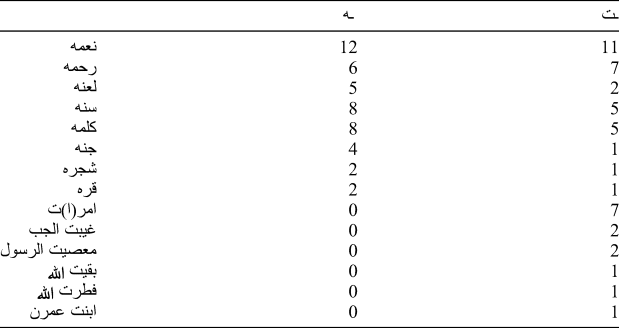
I will focus here on the lexical item that is most common and, moreover, has an almost completely equal distribution of the two spellings, namely niʿmah نعمه “grace”. This word occurs in construct either with allāh or rabbi-ka/-kum/-ī “your/my lord”. The noun with which niʿmah is in construct is irrelevant for the choice of the two spellings, and it occurs spelled in both ways in front of either noun in the Cairo edition.
The manuscripts
The spelling of niʿmah in construct in its 23 occurrences in the Quran has been examined across 14 Quranic manuscripts. In Table 1, abbreviations for these manuscripts have been used. The following overview gives some information about these manuscripts; this information has been taken from the Corpus Coranicum website (www.corpuscoranicum.de) unless specifically indicated otherwise.
SU = Codex Ṣanʿāʾ I, upper text = Sanaa, Dār al-Makhṭūṭāt, DAM 01-27.01 + Ḥamdūn Reference Ḥamdūn2004 + auctioned folios Christie's 2008; Bonhams 2000; Sotheby's 1992 and Sotheby's 1993Footnote 4
80 folios; 578–669 ce 2σ (95.4%)/606–649, σ2 (95.4%) (Coranica); Hijazi I.Footnote 5
The upper text of the Sanaa palimpsest must of course post-date the lower text, but can still be considered an early Quranic manuscript from the first or early second century on the basis of its orthography.
BL = British Library, Or. 2165 + BnF Arabe 328e + Dār al-ʾĀthār al-ʾIslāmiyyah, Kuwait 1 LNS 19 CAab (bifolio),
128 folios; second half of the first century (Dutton Reference Dutton2004: 66); Hijazi II (Déroche Reference Déroche1983: 62, no 7).
A3 = Arabe 331 + Ms. Leiden Or. 14.545b + Ms. Leiden Or. 14.545c
58 folios; first century, 14C: 652–763, σ2 (95.4%); Kufi B Ia (Déroche Reference Déroche1983: 67, no 14).
CA1 = Codex Amrensis 1
75 folios; c. first half second/eighth century(?) (Cellard Reference Cellard2017: 15); late Hijazi (Cellard Reference Cellard2017: 7)/Hijazi I (Déroche Reference Déroche1983: 59, no 1).
Edited and published by Cellard (Reference Cellard2017).
Q = Ms. Qāf 47 + Ms. Or. Fol. 4313
36 folios; first century, 14C: 606–652, σ2 (95.4%); Hijazi.
S = Berlin, Staatsbibliothek: Samarkand Kodex (Faksimiledruck)
353 folios; dated to about 700–850. Kufi D I.Footnote 6
I have based my readings on the facsimile reproduction available on the Corpus Coranicum website.
W = Berlin, Staatsbibliothek: Wetzstein II 1913 (Ahlwardt 305) + BnF Arabe 6087
210 folios + 6 ff.; Second half first century/early second century, 14C: 662–765, σ2 (95.4%); Kufi B Ia (Déroche Reference Déroche1983: 67, no 160).
The text contains insertions and corrections by later hands, but none of them are corrections of the feminine ending. The six folios of Arabe 6087 have been identified by Corpus Coranicum as belonging to this manuscript.
Zid = Gotthelf-Bergsträßer-Archiv: Meknes, Privatbibliothek des Scherifen ʿAbdarraḥmān b. Zīdān: kufischer Korankodex
380 folios; c. eighth/ninth century; Kufi B II.Footnote 7
Rather damaged, and frequently difficult to read due to the low quality of the pictures.
K = Kairo, al-Maktaba al-Markaziyya li-l-Makhṭūṭāt al-ʾIslāmiyya: Großer Korankodex
1087 folios; not before 700; Kufi B I b or B II.
CP = Codex Parisino-Petropolitanus
98 folios; c. third quarter of the first/seventh century (Déroche Reference Déroche2009: 177); a fairly large Quranic manuscript, edited and published by Déroche (Reference Déroche2009); Hijazi I (Déroche Reference Déroche1983: 59 f., no 2/3).
B = Mingana Islamic Arabic 1572b
7 folios; before 750?; Kufi B Ia.
The folios of the St. Petersburg collection Marcel 17 belong to this document as well. I have been unable to consult these.
SM = Istanbul, Saray Medina 1a
308 folios; late first/early second century; mixed.
T = Tübingen, Universitätsbibliothek, Ma VI 165
77 folios; 14C: 649–675, σ2 (95.4%); Kufi B Ia.
M = Cambridge, Cambridge University Library, Mingana-Lewis Palimpsest (small Quranic leaves)
32 folios; later seventh/early eighth century; Hijazi.
This palimpsest, overwritten by Christian Arabic writing, was published at the beginning of the previous century by Alphonse Mingana and Agnes Smith Lewis (1914), and has recently been uploaded to the digital repository of the Cambridge University Library, wonderfully digitally retouched by Alba Fedeli.Footnote 8
The results
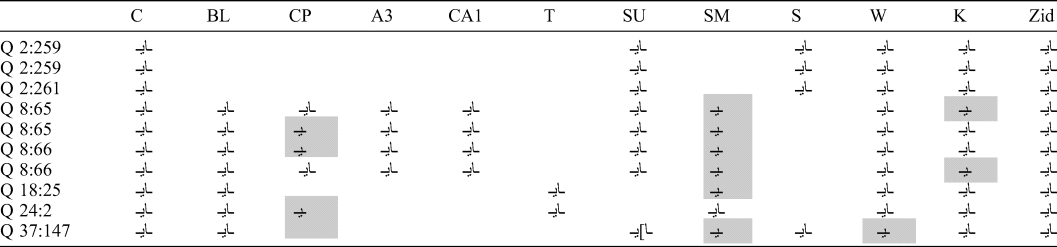
Table 2 shows the spellings of niʿmat as attested in the manuscripts examined. The sigla of the Quran manuscripts are given on the horizontal axis, where C stands for the Cairo edition, and vertically are the 15 locations of the spelling of niʿmat. ـه and ـت denote the spellings نعمه and نعمت respectively.
The distribution of the two spellings of Niʿmat aḷḷāh

As can be seen in Table 2, there is an extremely strong correlation between the position of the idiosyncratic spellings in the Cairo edition and earlier Quranic manuscripts. With only two locations, Q 16:144 and Q 37:57, showing any disagreement at all. This great consistency cannot be attributable to chance.
For Q 16:114, only one manuscript disagrees with the general pattern, while the other seven manuscripts examined that have this form attested all employ the spelling found in the Cairo edition.
As for Q 37:57, two manuscripts have the same pattern as the Cairo edition, but the four others all have the spelling  نعمت. It seems that here the Cairo edition is innovative along with W and Zid.Footnote 9
There is a further problem: K has a spelling for Q 2:231 that disagrees with the rest of the manuscripts. But this page is clearly written by a much later hand than other pages of this Codex, so this should not concern us. Zid has the same issue of a much later hand at Q 35:3, but in this case its spelling does agree with the other manuscripts.
Implications
There is only one possible explanation for the strong agreement across the many different Quran manuscripts with the two possible spellings of niʿmat: there must have been a single written archetype from which all Quranic manuscripts of the Uthmanic text type are descended. Considering the early likely date of many of these manuscripts (second half of the seventh century), it is unlikely that the archetype of the “Uthmanic” text type postdates the canonical date assigned to it in the tradition – during ʿUthmān's reign (24–34 ah). Even an attribution of the Uthmanic text type to the so-called “second maṣāḥif project”Footnote 10 during the governorship of al-Ḥajjāj (75–95 ah) is difficult to accept. None of the narratives suggest such a radical change during this project, and several of the manuscripts examined here have upper date ranges in their carbon dating that precede al-Ḥajjāj's governorship by several decades.Footnote 11 While it is of course impossible to prove that the standardization did not take place before ʿUthmān's reign on the basis of this data, the data is absolutely consistent with the traditional account.
A second implication of these results is that, from the very beginning of the text's standardization, every single manuscript that belongs to the Uthmanic text type must have been copied from a written exemplar. It is exactly these kinds of orthographic idiosyncrasies that would be impossible to reproduce through a process of writing down from dictation. And this general pattern of copying based on written exemplars from one manuscript to the next must have continued for centuries. While in this paper I have focused on the earliest possible Quranic manuscripts, these patterns clearly continue in later times, only markedly deviating from it, and using classicized spellings, in the Ottoman period. The Cairo edition is an intentional and quite successful return to form of the original rasm.
Other orthographic idiosyncrasies
We have examined the idiosyncratic distribution of the spelling of  نعمت/نعمه, and have shown that this distribution is strongly correlated across many different Quranic manuscripts. This example gives more than enough evidence that there is an original written copy from which all other Quranic manuscripts stem, and that all Quranic manuscripts of the Uthmanic text type have been committed to writing not from memory, or copying from dictation, but copied from a previous written copy.
 نعمت/نعمه is not the only phrase whose spelling correlates strongly across many different Quranic manuscripts. All other phrases with the construct feminine that have either spelling likewise correlate consistently, e.g. ،
 رحمت/رحمه etc. لعنه/لعنت
There are other types of orthographic idiosyncrasies such as the spelling of jazāʾu in construct, which is normally spelled جزا, but appears spelled as جزاو time and time again in five specific places: Q 5:29, 33, Q 42:40, Q 20:76 and Q 39:34.Footnote 12 This specific distribution is likewise impossible to understand without the assumption of the copying of the Qurans from written exemplars.
Another point of orthographic variation is al-malaʾu, spelled as الملا twelve times, but in four places in the Cairo edition is spelled الملوا (Q 23:24, Q 27:29, Q 27:32, Q 27:38). Every single early Quranic manuscript that I have examined is in agreement that those are to be spelled as such, while the remaining are spelled in the regular way الملا.
It is important to note, however, that not all orthographic idiosyncrasies as encountered in the Cairo edition can be traced back to these early manuscripts, e.g. Q 40:50 duʿāʾu l-kāfirīna دعوا الكفرين is spelled identically to Q 13:14 دعا الكفرين in all the early Quranic manuscripts that I have examined. The spelling with wāw-ʾalif thus seems to be a later innovation.
Moreover, not all orthographic idiosyncrasies of the Uthmanic text type have been accurately transmitted up until the Cairo edition. For example, ابرهم/ابرهيم for ʾibrāhīm is only spelled as ابرهم in Q 2 in the Cairo edition, while this spelling is much more haphazard but internally highly correlated in all early Quranic manuscripts.Footnote 13
The identification of such orthographic idiosyncrasies that are shared across these early Quranic manuscripts is an indispensable step in the study of the Quranic text, and essential for the creation of a critical edition of the Quranic rasm, and the reconstruction of the Uthmanic archetype. The identification of such idiosyncrasies and, perhaps, finding places where later manuscripts clearly deviate from earlier norms will allow us to reconstruct the trends and developments in the orthography of later Quranic manuscripts, and may even allow us to corroborate and/or further specify the stemmata of the early Quranic manuscripts identified by Cook (Reference Cook and Lividas2004) in order to gain a better understanding of the spread and development of the Quranic text.
The issue of scriptio plena of word-internal ā
A final problem that comes into focus because of the examination of the highly consistent reproduction of orthographic idiosyncrasies in early Quranic manuscripts is the issue of the scriptio plena and scriptio defectiva of word-internal ā. As we have seen in this article, not only does the Uthmanic text type retain its word-order, verse order and surah order perfectly, it also consistently retains highly idiosyncratic spelling variations that must have existed in the Uthmanic archetype. Due to the strikingly consistent transmission of these idiosyncratic features, it is all the more surprising that when it comes to the plene or defective spelling of ā, there appears to be a fairly free variation of the two possibilities across Quranic manuscripts in certain environments.
This free variation captured the attention of Déroche (Reference Déroche2009; Reference Déroche2014: 25 f.), who examined the internal spelling variations of several lexical items in the Codex Parisino-Petropolitanus and several other early Quranic manuscripts. He concludes that the inconsistent treatment across scribes suggests that the scribes of the Codex Parisino-Petropolitanus were upgrading the orthography towards a scriptio plena in comparison to the exemplar they were working from. It is unclear whether the exemplar from which the Codex Parisino-Petropolitanus was copied employed scriptio plena irregularly, and was subsequently accurately reproduced by the scribes, or whether the scribes were indeed upgrading the rasm, as Déroche suggests, towards having more scriptio plena. It should be noted that at least some degree of scriptio plena must have been part of the Uthmanic archetype.
For example, there is universal agreement that all stems with the shape CāCFootnote 14 are spelled plene.Footnote 15 No other stem shape displays such consistent spelling of the word-internal ā. This distribution is convincingly explained by Diem (Reference Diem1976: 258 f.; Reference Diem1979: 251 f.). He points out that in the Nabataean Aramaic scriptFootnote 16 – the predecessor of the Arabic script – there was no way of writing ā word-internally. He therefore argues that the plene spelling of ā is an innovation of the Hijazi (= Quranic) orthography. He suggests that this has happened due to the loss of the word-internal hamzah followed by compensatory lengthening. As a result, nouns with the original shape CaʾC would shift to CāC, and would thus end up having a similar shape to nouns that already had the historical shape CāC. As such, there were nouns with the shape CāC, some of which had a spelling with ʾalif while others lacked it. The spelling with ʾalif was subsequently generalized to all nouns of this shape, regardless of whether they originally contained a hamzah or not. This can be represented schematically as follows:
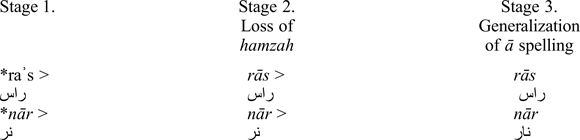
In stage 3, the spelling of nār with an ʾalif should essentially be considered pseudo-historical. As there was no way to distinguish historical CaʾC words from CāC nouns, simply every word with this shape was written with an ʾalif.
Only after the generalization was complete (with the exception of the verb qāla) did this new orthographic device of writing word-internal ā spread to forms that could never have had a hamzah in that position, such as noun shapes like CaCāC, CaC̄āC and CāCiC. The orthography we find in the early Quranic manuscripts as well as in the Cairo edition of the Quran seems to be in a transitional period towards the plene writing of such nouns, where it seems to be essentially optional whether ā is written plene or not. When we compare such spellings across early Quranic manuscripts, e.g. one of the nouns that Déroche studied for the Codex Parisino-Petropolitanus, ʿibād, we find that even manuscripts that are all part of the Syrian manuscript type (i.e. Codex Parisino-Petropolitanus, Or. 2165 and We II 1913) there appears to be free variation across the manuscripts, and the positions where they show up do not seem to correlate at all.
Table 3 tabulates all occurrences of ʿibād across all three manuscripts.Footnote 17 As can be seen there is no clear agreement or trend between these three manuscripts, showing that the presence or absence of the ʾalif does not seem to be unique to Syrian manuscripts. This trend remains the same when we include codices of the Kufan, Basran, or Medinan type.
The spelling of ʿibād
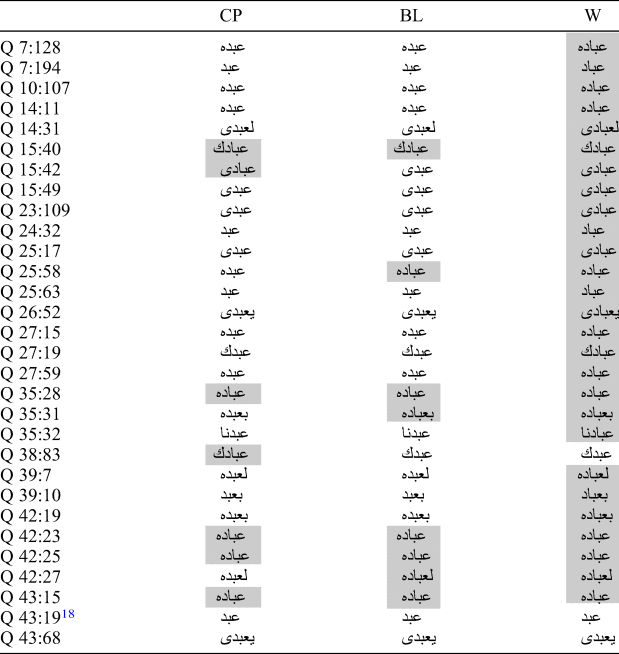
So while there are many examples of orthographic idiosyncrasies which were faithfully reproduced for hundreds of years in Quranic codices, it appears that the scribal tradition that produced these copies placed no value on the accurate reproduction of the specific orthographic idiosyncrasy of writing a word ā with an ʾalif or not.Footnote 19
Even if we assume that Déroche is correct and that scribes were essentially “upgrading” the orthography of the exemplar from which they were copying, we cannot assume that, whenever early manuscripts are in disagreement with each other, the spelling without the ʾalif is the older one. There seems to be a more general “carelessness” when it comes to word-internal ʾalifs also when they do not denote ā. For example, مايه miʾah “hundred” and شاى shayʾ “thing” are quite often spelled ميه and شى respectively. Here too one cannot speak of any faithful reproduction of the orthographic idiosyncrasies across multiple early Quranic manuscripts. Table 4 examines the spelling of مايه “hundred” (and مايتين “two hundred”) across the early Quranic manuscripts examined above. Here it is clear that no consistent pattern emerges between the orthography of different Quran manuscripts.
The spelling of miʾah
In other words, word-internal ʿalifs that do not obviously denote ā are not controlled for in the scribal tradition that produced these early Quranic manuscripts. However, scholars are in general agreement that the spelling with the ʾalif in miʾah and shayʾ is the more archaic spelling, while the one without is innovative (e.g. Diem Reference Diem1980: 103 f.). So the addition and the removal of word-internal ʾalifs appears to have been dependent on the scribe's own discretion. It does not therefore seem productive, when discussing Quranic orthography, to think in absolute terms of archaic and innovative spellings of the ʾalif; clearly, at the time of the earliest Quranic manuscripts available to us both the archaic and innovative spellings were co-existent. There is no reason to assume that this situation was any different at the time of the writing of the Uthmanic archetype several decades earlier. Nor is there a reason to believe that when one spelling or the other is attested, the Uthmanic archetype must have had the more archaic form. Until further evidence appears, or a better understanding of the vacillation of the word-internal ʾalif is reached, it is certainly premature to speak of an upgrading of the orthography from a scriptio defectiva towards a scriptio plena.
While this issue of plene and defective writing presents a problem for the reconstruction of the rasm of the Uthmanic archetype it should be stressed that this issue affects only a minority of words that contain a word-internal ā. A majority of words with word-internal ā have a predictable spelling across all early Quranic manuscripts as well as in the Cairo edition. Some of these orthographic principles were set out by Diem (Reference Diem1979: 255 f.), and I summarize them here. In some places I have provided additions to Diem's generalizations. As Diem based his generalizations exclusively on the Cairo edition, manuscript evidence occasionally disagrees with these generalizations.
1. CāC and CāC̄ are invariably written plene (with the exception of qāla).
2. Active participles in the sound plural masculine, feminine or dual are always spelled defective: فعلون fāʿilūna, فعلين fāʿilīna, فعلت fāʿilātu/in, فعلن/فعلان fāʿilāni, فعلين fāʿilayni.Footnote 20
3. The feminine plural ending -āt is spelled defectively, but if this means the word consists of only three letters, it is spelled plene, e.g. مسلمت muslimāt but بنات banāt, جنات jannāt, Footnote 21 سيات sayyiʾāt.
4. The nominal ending -ān is spelled defectively, e.g. رحمن raḥmān.
5. The proclitic vocative particle yā- is always defective.
6. The proclitic demonstrative hā- is always defective.
7. The 1pl. pf. ending -nā word-internally is always defective.
8. Words that are spelled defectively in Classical Arabic are also spelled defectively in the Quran, e.g. لكن lākin(na), اوليك ʾulāʾika, ذلك dhālika, etc.
9. Many words are simply always spelled defectively, e.g. سلم salām; صرط ṣirāṭ; المليكه al-malāʾikah; ثلث thalāth; Many names are always spelled defectively: اسريل ʾisrāʾīl; اسمعيل ʾismāʿīl, اسحق ʾisḥāq.Footnote 23
Whenever exceptions to the rules formulated above appear, these seem to form consistent orthographic idiosyncrasies which can therefore be reconstructed for the Uthmanic archetype despite involving a word-internal ʾalif. One such an example is يابست yābisātin in Q 12:43 and Q 12:46. If we examine the spelling of this word in old Quranic manuscripts, we find the exact same pattern. The general orthographic rule clearly predicts a defective spelling, but it is not found for this one word in any early Quranic manuscript, as can be seen in Table 5. Therefore, one should conclude that the Uthmanic archetype certainly had يابست, as there is no way of accounting for such an idiosyncratic spelling otherwise.
The spelling of yābisāt

As such, we should also conclude that for this word, a plene spelling was present in the Uthmanic archetype, and that we cannot simply assume that the Uthmanic archetype was spelled completely defectively.
This clearly shows why spellings should not be subjected to an ad hoc per manuscript study, but rather should be placed within a systematic comparative study. Only once we have established the general orthographic principles we can start making reasonable inferences about which ʾalif may be a later addition and which may not, and why.
Conclusion
This paper has shown that idiosyncratic spellings of certain words are not due to the whims of the scribe, but are reproduced with the same spelling in all early Quranic manuscripts. The only way that such a consistent reproduction can be explained is by assuming that all the documents that belong to the Uthmanic text type go back to a single written archetype whose spelling was strictly copied from one copy to the next, showing that these copies were based on a written exemplar.
The manuscripts examined in this study are sufficiently early that a codification of the Uthmanic text type is perfectly consistent with an attribution to its traditional source: ʿUthmān b. ʿAffān.
Moreover, this article has discussed the perplexing case of the alternation between scriptio plena and scriptio defectiva. There seems to be no clearly accurate transmission when it comes to the writing of the medial ʾalif for ā. Nevertheless, the patterns and generalizable rules make it clear that the Uthmanic archetype was not written completely scriptio defectiva. Certain words would have surely been written plene while others would have been written defectively, even in the Uthmanic archetype. Close examination of the patterns across different Quranic manuscripts may give us a better sense of the patterns and development of the plene spelling of ā in early Quranic manuscripts.


 Open access

