





Highlights
-
• We investigated the effects of bilingualism and sleep on executive performance
-
• Experiment 1 focused on sleep quality, Experiment 2 on insomnia symptoms
-
• Bilingualism affects performance for poor, but not for good sleep-quality participants
-
• The magnitude of bilingual effects increased with increased severity of insomnia
-
• Bilingualism may mitigate the detriments of poor sleep on executive function
1. Introduction
Various lifestyle factors and everyday activities such as nutrition, physical exercise, memory and technology training have been shown to affect cognitive processing (Dresler et al., Reference Dresler, Sandberg, Ohla, Bublitz, Trenado, Mroczko-Wąsowicz, Kühn and Repantis2013). Two of such everyday activities – sleep and bilingualism – are known to influence similar cognitive and neural mechanisms (see Gallo et al., Reference Gallo, Myachykov, Abutalebi, DeLuca, Ellis, Rothman and Wheeldon2025, for a review). Nonetheless, the joint effects of sleep and bilingualism on cognition have never been addressed together. This study is the first attempt to fill this gap. Before we introduce the present study in more detail, we will briefly consider each of these two factors’ implications for cognitive functioning.
1.1. Bilingualism and cognition
Research on the cognitive consequences of bilingualism is gaining increasing interest due to how widespread this life experience is, with more than half of the world’s population currently estimated to be bilingual (Grosjean, Reference Grosjean2021). Moreover, recent research indicates that, alongside other sociodemographic variables, bilingualism plays a significant role in promoting higher levels of well-being (Wang & Wei, Reference Wang and Wei2023) across various age groups and bilingual contexts (Müller et al., Reference Müller, Howard, Wilson, Gibson and Katsos2020; Sari et al., Reference Sari, Chasiotis, Van De Vijver and Bender2019). Existing research provides ample evidence suggesting that bilingualism and multilingualismFootnote 1 influence neural and cognitive functioning (DeLuca et al., Reference DeLuca, Rothman, Bialystok and Pliatsikas2019a; Green & Abutalebi, Reference Green and Abutalebi2013; Valian, Reference Valian2015). One of the mechanisms underlying these effects is the constant co-activation of all languages in the bilingual brain, as demonstrated by behavioral and neuroimaging research (Abutalebi et al., Reference Abutalebi, Annoni, Zimine, Pegna, Seghier, Lee-Jahnke, Lazeyras, Cappa and Khateb2007; Bialystok & Craik, Reference Bialystok and Craik2022; Bialystok et al., Reference Bialystok, Craik and Luk2012; Kroll et al., Reference Kroll, Dussias, Bice and Perrotti2015). As a result, language processing in bilinguals heavily relies upon a ‘language control’ mechanism (Abutalebi & Green, Reference Abutalebi and Green2007), which ensures that only the target language is selected and any intrusions from the non-relevant language(s) are successfully inhibited. Language control requires the engagement of cognitive mechanisms of selection, inhibition and switching, which are continuously required to manage potential interferences between different language codes (Abutalebi & Green, Reference Abutalebi and Green2007). The language control system is underpinned by a network of cortico-subcortical regions at least partially related to domain-general executive functions (Abutalebi & Green, Reference Abutalebi and Green2007, Reference Abutalebi and Green2016; Green & Abutalebi, Reference Green and Abutalebi2013).
The term executive functions (EF) refers to the higher-order, top-down cognitive processes essential for control and coordination of lower-level processes, which enable self-regulation and contribute to successful goal-directed behavior. EF comprise several cognitive abilities, including working memory, inhibitory control, cognitive flexibility, planning, reasoning and problem-solving (Diamond, Reference Diamond2013). It is argued that due to the overlap between the cognitive mechanisms and the brain networks implicated in bilingual language control and general executive control, the constant necessity for language selection has consequences for domain-general executive functioning across a wide range of activities, both at the behavioral and at the neural level (Abutalebi et al., Reference Abutalebi, Della Rosa, Green, Hernández, Scifo, Keim, Cappa and Costa2011; Bialystok et al., Reference Bialystok, Craik, Green and Gollan2009; Bialystok, Reference Bialystok2017; Kroll et al., Reference Kroll, Dussias, Bice and Perrotti2015).
Experimental findings have shown that bilingual experience exerts pronounced effects on EF at the behavioral level, with effects emerging in various EF tasks across different age groups, including children, young and older adults (for a review, see Bialystok, Reference Bialystok2017; Grundy, Reference Grundy2020). At the neural level, it has been shown that bilingual experience is linked to modifications in grey matter density and white matter integrity in regions of the domain-general executive control network (for a review, see Taylor et al., Reference Taylor, Hall, Manivannan, Mundil and Border2022). Importantly, it has also been suggested that because of these neuroplastic changes, the bilingual brain is more resistant to cognitive decline (Gallo et al., Reference Gallo, DeLuca, Prystauka, Voits, Rothman and Abutalebi2022).
However, findings supporting bilingual cognitive effects have not always been replicated and have been contested in some research (for a review, see Paap, Reference Paap2022). Debate continues regarding the nature and the magnitude of the bilingualism-related effects on EF, with some meta-analyses suggesting that this advantage could either be task- (Ware et al., Reference Ware, Kirkovski and Lum2020) or age-specific (Lehtonen et al., Reference Lehtonen, Soveri, Laine, Järvenpää, De Bruin and Antfolk2018; Lowe et al., Reference Lowe, Cho, Goldsmith and Morton2021). Particularly inconsistent are the studies using young adult populations (Valian, Reference Valian2015). One of the potential explanations is that young adults are at their cognitive efficiency peak (Kroll & Bialystok, Reference Kroll and Bialystok2013): Young adults have faster average reaction times than either children or older adults. The performance of young adults in simple EF tasks could easily reach ceiling levels, which may conceal the cognitive contributions of bilingualism (Bialystok, Reference Bialystok2016). Nonetheless, ceiling effects can be overcome in high-demand tasks; when task demands were increased, bilinguals showed a clear advantage in executive control (Kuipers &Westphal, Reference Kuipers and Westphal2020). Moreover, cognition and EF are themselves influenced by various lifestyle factors, and it is possible that (some of) the previous research has failed to properly control for the full range of experiences that might affect EF, thereby diluting the putative positive effects of bilingualism (Valian, Reference Valian2015). Importantly, however, other meta-analyses and systematic reviews support the general conclusion that bilingualism has an effect on aspects of EF (Grundy, Reference Grundy2020; Van Den Noort et al., Reference Van Den Noort, Struys, Bosch, Jaswetz, Perriard, Yeo, Barisch, Vermeire, Lee and Lim2019). Furthermore, numerous studies have documented neurocognitive consequences of bilingualism (Tao et al., Reference Tao, Wang, Zhu and Cai2021), including delay of the onset of Alzheimer’s disease and dementia (Anderson et al., Reference Anderson, Hawrylewicz and Grundy2020; Brini et al., Reference Brini, Sohrabi, Hebert, Forrest, Laine, Hämäläinen, Karrasch, Peiffer, Martins and Fairchild2020). So overall, while existing controversies may be partially due to task and age-specific sample differences and/or a publication bias (De Bruin et al., Reference De Bruin, Treccani and Della Sala2014; Leivada, Reference Leivada2023), the exact and dynamic nature of the bilingualism effects on both mind and brain requires further investigation.
1.2. Sleep quality and cognition
Another factor known to have massive effects on cognitive functioning is sleep. Sleep constitutes a large proportion of the human lifetime, with around one-third of our entire life spent sleeping. Sleep has been extensively shown to play an essential role in day-to-day functioning across a range of physiological and cognitive functions (Tai et al., Reference Tai, Chen, Manohar and Husain2022), and sleep quality, duration and consistency have all been linked by numerous studies to well-being (e.g., Jean-Louis et al., Reference Jean-Louis, Kripke and Ancoli-Israel2000). Indeed, insufficient or poor-quality sleep impairs a wide variety of cognitive functions, including attention, language use, reasoning, learning and memory (Barclay & Myachykov, Reference Barclay and Myachykov2016; Barclay et al., Reference Barclay, Rowley, Robson, Akram and Myachykov2020; Durmer & Dinges, Reference Durmer and Dinges2005; Guttesen et al., Reference Guttesen, Gaskell, Madden, Appleby, Cross and Cairney2022; Jackson et al., Reference Jackson, Gunzelmann, Whitney, Hinson, Belenky, Rabat and Van Dongen2013). Importantly, sleep quality, consistency and duration have been simultaneously associated with various aspects of cognitive functioning, on one hand, and with the success of language learning and use, on the other hand (Gallo et al., Reference Gallo, Myachykov, Abutalebi, DeLuca, Ellis, Rothman and Wheeldon2025).
One of the most common disturbances associated with sleep is insomnia. Recent reports estimate that 10–15% of individuals suffer from insomnia disorder, i.e., persistent insomnia that lasts for more than three months (Fortier-Brochu et al., Reference Fortier-Brochu, Beaulieu-Bonneau, Ivers and Morin2012; Nguyen et al., Reference Nguyen, George and Brewster2019). Individuals with insomnia commonly report various subjective difficulties in different cognitive functions (Harris et al., Reference Harris, Spiegelhalder, Espie, Macmahon, Woods and Kyle2015), including working and episodic memory as well as some aspects of EF (Cellini, Reference Cellini2017). Importantly, these results cannot be explained simply by fatigue or boredom, appearing to be the direct effects of sleep loss. Indeed, several studies reveal detrimental effects of insomnia on the integrity and functionality of prefrontal and frontal lobes – areas underpinning EF, among other cognitive processes (Krause et al., Reference Krause, Simon, Mander, Greer, Saletin, Goldstein-Piekarski and Walker2017; Lowe et al., Reference Lowe, Safati and Hall2017). A neurobiological explanation for this negative effect of insomnia can be individuated in reduced electroencephalographic slow-wave activity (0.5–4 Hz) during non-rapid eye-movement sleep, normally associated with cortical reorganization. The loss of slow-wave sleep occurring in insomnia is thought to affect the prefrontal and frontal cortices and may thus underpin the negative relationship between sleep deprivation and EF (Wilckens et al., Reference Wilckens, Ferrarelli, Walker and Buysse2018). Nonetheless, difficulties in capturing EF deficits linked to subjective and objective assessments of sleep have so far prevented researchers from obtaining consistent patterns of results (Zavecz et al., Reference Zavecz, Nagy, Galkó, Németh and Janacsek2020). Some studies report that individuals with insomnia, as compared to controls, have impaired performance in reaction-time tasks assessing inhibitory control (Haimov et al., Reference Haimov, Hanuka and Horowitz2008; Joo et al., Reference Joo, Noh, Kim, Koo, Kim, Hwang, Kim, Kim, Kim and Hong2013; Liu et al., Reference Liu, Wang, Li, Li, Zhang, Lei, Du and Tang2014), while others report that insomnia does not substantially affect the inhibitory function (Perrier et al., Reference Perrier, Chavoix and Bocca2015; Sivertsen et al., Reference Sivertsen, Hysing, Wehling, Pallesen, Nordhus, Espeseth and Lundervold2013). This inconsistency may, potentially, be explained in that sleep loss does not always lead to a global degradation of cognitive performance; rather, it impacts various components of cognitive functioning in different ways (Aidman et al., Reference Aidman, Jackson and Kleitman2018). Similarly, results from structural neuroanatomical studies demonstrate that poor sleep quality (Koo et al., Reference Koo, Shin, Lim, Seong and Joo2017; Stoffers et al., Reference Stoffers, Altena, Van Der Werf, Sanz-Arigita, Voorn, Astill, Strijers, Waterman and Van Someren2013; Van et al., Reference Van, Pozzobon, Fang, Al-Kuwatli, Toor, Ray and Fogel2021) and insomnia (Altena et al., Reference Altena, Vrenken, Van Der Werf, Van Den Heuvel and Van Someren2010; Falgàs et al., Reference Falgàs, Illán-Gala, Allen, Mumford, Essanaa, Le, You, Grinberg, Rosen, Neylan, Kramer and Walsh2021; Winkelman et al., Reference Winkelman, Plante, Schoerning, Benson, Buxton, O’Connor, Jensen, Renshaw and Gönenç2013) are associated with volume loss in cortical and subcortical areas associated with EF.
1.3. The present study
As summarized above, both ‘how well we speak another language’ and ‘how well we sleep’ represent two everyday experiences with a potentially significant impact on general cognition and the underlying neural substrate. However, research in both fields has produced inconsistent results, which may be due to the failure to control other factors that influence EF, resulting in specific effects potentially being obfuscated or insufficiently manifested. Thus, it can be hypothesized that the points of intersection between sleep and bilingualism may be significant at a theoretical and functional level (Gallo et al., Reference Gallo, Myachykov, Abutalebi, DeLuca, Ellis, Rothman and Wheeldon2025). Specifically, it can be assumed that these two lifetime experiences may modulate each other’s impact on cognitive functioning. Based on the evidence from the two research strands reviewed above, our primary hypothesis, therefore, is that bilingualism may overcome the detrimental effects of poor sleep quality upon EF. Conversely, poor sleep quality could potentially exert a mitigating effect on the beneficial consequences of bilingualism. Thus, for theoretical reasons, a simultaneous analysis of the effects of different factors on cognitive functioning may provide further clarity in both fields. As a practical implication, such studies may lay the groundwork for using knowledge of sleep quality to enhance the impact of language use in old age, or simply to improve language learning at any age. The aim of the present study is, for the first time, to test the interlinked consequences of bilingualism and sleep for cognition. To this end, we investigated, in two separate experiments, the effects of bilingualism and sleep on executive performance. We used two distinct samples of late unbalanced bilinguals with varying levels of sleep quality but without any clinical insomnia diagnosis or obvious self-reported sleep dysfunctions at the time of testing.
2. Experiment 1
2.1. Participants
Forty bilinguals (first language, L1: Russian; second language, L2: English; 10 males; mean age = 21.93, SD ± 2.75) were recruited from the population of students at HSE University, Moscow, Russian Federation. All participants acquired English as an L2 formally through instruction at school. Note that our participants resided in a predominantly L1-speaking environment, thus their engagement with L2 was regular but limited in terms of daily percentage. Requirements to participate in the study included absence of psychiatric or neurological conditions and normal or corrected-to-normal vision. All participants were interviewed about their age, educational level, and socioeconomic status (SES) using the MacArthur Scale of Subjective Social Status (MacArthur Foundation, 2007). Monthly household income, used as a proxy of SES, was calculated as the sum of incomes of all household members divided by the number of residents; this ensured incomes were more comparable across families of different sizes. An estimation of participants’ general intelligence was based on their performance on an abridged version of the Colored Progressive Matrices (Raven, Reference Raven1958) consisting of five elements from each of the three subsets, for a total of 15 elements. Descriptive statistics for sociodemographic and linguistic background profiles are reported in Table 1. The study was approved by the local research ethics committee at HSE University, and written informed consent was obtained from each participant.
Sociodemographic and L2 background profiles of participants

Note: Mean, standard deviation (SD) and range are provided for each measure.
2.2. Procedure
Participants were tested using behavioral testing facilities at the Institute for Cognitive Neuroscience, HSE University. All participants completed the experiment session in an acoustically insulated cubicle using the same equipment. Participants filled out the Russian version of the Pittsburgh Sleep Quality Index (PSQI; Buysse et al., Reference Buysse, Reynolds, Monk, Berman and Kupfer1989) questionnaire, Raven’s Colored Progressive Matrices, and the Russian version of the Language Experience and Proficiency Questionnaire (LEAP-Q; Marian et al., Reference Marian, Blumenfeld and Kaushanskaya2007). As an EF test, we used the Flanker task (Eriksen & Eriksen, Reference Eriksen and Eriksen1974; see below) in an experiment designed using the OpenSesame software (v. 3.3.7). Responses were recorded using a 5-button response pad (RB-740, Cedrus Inc.). The Cambridge General English Test for Adult Learners (https://www.cambridgeenglish.org/test-your-english/general-english/) was also administered in the laboratory setting without time limits. All tasks were performed in the same experimental session, which lasted around 60 minutes.
2.3. Sleep quality assessment
The Russian version of the Pittsburgh Sleep Quality Index (PSQI – Buysse et al., Reference Buysse, Reynolds, Monk, Berman and Kupfer1989) was used to examine individual sleep quality. The PSQI consists of 19 individual items, forming 7 component scores and one ‘global’ composite score assessing sleep quality retrospectively over the preceding one-month period. In our analyses, we focused on the global composite score, providing a general overview of an individual’s recent sleep quality.
2.4. Bilingual experience assessment
The Russian version of the LEAP-Q (Marian et al., Reference Marian, Blumenfeld and Kaushanskaya2007) assessed several dimensions of individual bilingual experience, including L2 age of acquisition (AoA) and L2 exposure in various modalities (i.e., writing, reading, speaking, listening). To obtain an objective measure of L2 proficiency, we administered the Cambridge General English Language Test for Adult Learners, containing 25 questions addressing various aspects of English proficiency (https://www.cambridgeenglish.org/test-your-english/general-english/).
2.5. Executive performance assessment
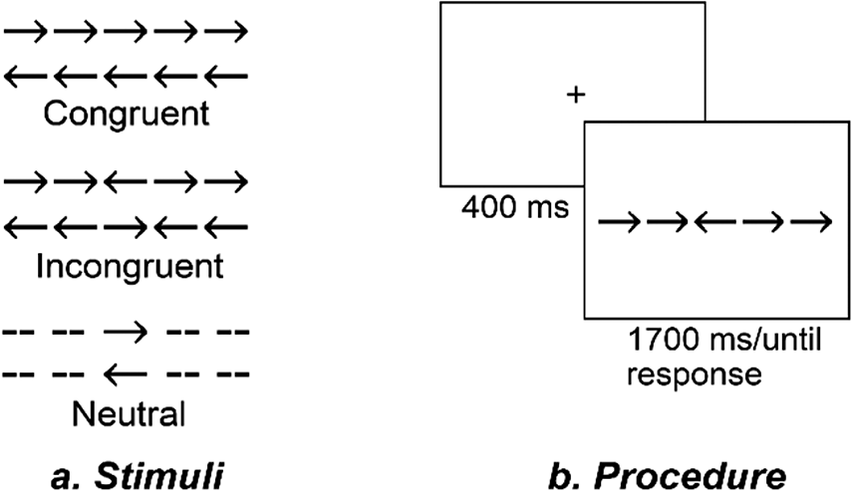
To assess executive performance, we used a version of the Flanker task (Eriksen & Eriksen, Reference Eriksen and Eriksen1974). In this task, participants are instructed to identify the direction of a central target arrow by pressing the left or right arrow button on the response box as fast and as correctly as possible (the leftmost key on the response pad was used for responses to left-pointing targets and the rightmost key for right-pointing ones). The task includes three different conditions: congruent, where the target arrow is flanked by arrows pointing to the same direction; incongruent, where the target and flankers point in opposite directions; and neutral, where the target is flanked by dashes rather than arrows (Figure 1A). In each trial, an initial central fixation point (400 ms duration) was followed by an array of five arrows (1700 ms duration) (Figure 1B). Participants had a practice run consisting of 24 pseudo-randomized trials, followed by two experimental runs with 96 items per run (32 items of each condition) presented in a pseudo-randomized order.
(A) Schematic overview for stimuli in the Flanker task. (B) Schematic diagram showing the procedure of the Flanker task.

2.6. Statistical analyses
All statistical analyses were conducted using Stata 17 (StataCorp, 2021). In order to conduct analysis on the Flanker task’s reaction times (RTs), we removed error trials, false-start trials with RTs below 200 ms, and outlier trials, i.e., those falling outside 3 standard deviations from the individual participants’ mean RT values. This preprocessing procedure resulted in the discarding of 1.13% of the total data. Neutral trials were also removed. Subsequently, we calculated the Flanker conflict effect for each participant as the difference between the average RTs in incongruent and congruent trials (Eriksen & Eriksen, Reference Eriksen and Eriksen1974). The conflict effect is taken as an individual measure of the ‘cognitive cost’ of processing the conflicting information contained in the incongruent trials, as compared to the congruent ones.
To examine the individual effects of bilingual experience, sleep quality, and their interactive effect on executive inhibitory performance, we first built a full linear regression model with Flanker conflict effect as the dependent variable. The independent variables included main effects of L2 exposure, L2 AoA, L2 proficiency and PSQI score, as well as interactions between each bilingual experience factor and PSQI score. Covariates included age, sex, general intelligence, SES and maximal educational attainment – all factors known to affect executive performance. We applied a backward stepwise search via Stata’s stepwise command starting from the full model and aiming to identify the most parsimonious model – by sequentially removing variables that did not contribute significantly to the model fit (p value > 0.2).
3. Results
The best fitting model included main effects of L2 AoA, L2 exposure and PSQI score, as well as interactions between L2 AoA and PSQI score, L2 exposure and PSQI score, and L2 proficiency and PSQI score. Covariates for age, SES, sex and education were also retained. Significant interactions emerged between PSQI score and each of the three bilingual experience exponents, L2 AoA (β = 1.307; p = 0.005), L2 proficiency (β = −0.824; p = 0.028) and L2 exposure (β = 0.26; p = 0.014). After model estimation, we estimated the marginal effect of each of the three interactions via Stata’s margins command. For L2 proficiency and L2 AoA, the effect plot revealed that the beneficial effect of bilingual experience on Flanker performance (i.e., smaller conflict effect) was limited to poor sleepers (see Figure 2, panels a and b). For L2 exposure, the opposite trend emerged, with increasing exposure predicting a smaller conflict effect only for good sleepers (see Figure 2, panel c). Full model estimates are reported in Table 2.
Interaction plot for the two-way interaction between bilingual experience factors*sleep quality predicting Flanker conflict effect (in ms). The conflict effect was calculated as the difference between the average individual RTs in the incongruent and congruent conditions. (A) L2 proficiency, (B) L2 age of acquisition, (C) L2 exposure. For graphical representation purposes, here we selected three representative values of PSQI score, i.e., 1 SD below the mean, mean and 1 SD above the mean, to represent three levels of sleep quality in our sample, i.e., good, medium and bad, respectively. Please note that the PSQI score was inserted as a continuous variable in the statistical model.

Estimates from the best-fitting linear model predicting Flanker conflict effect (in ms) based on the interaction between bilingual experience factors and PSQI score
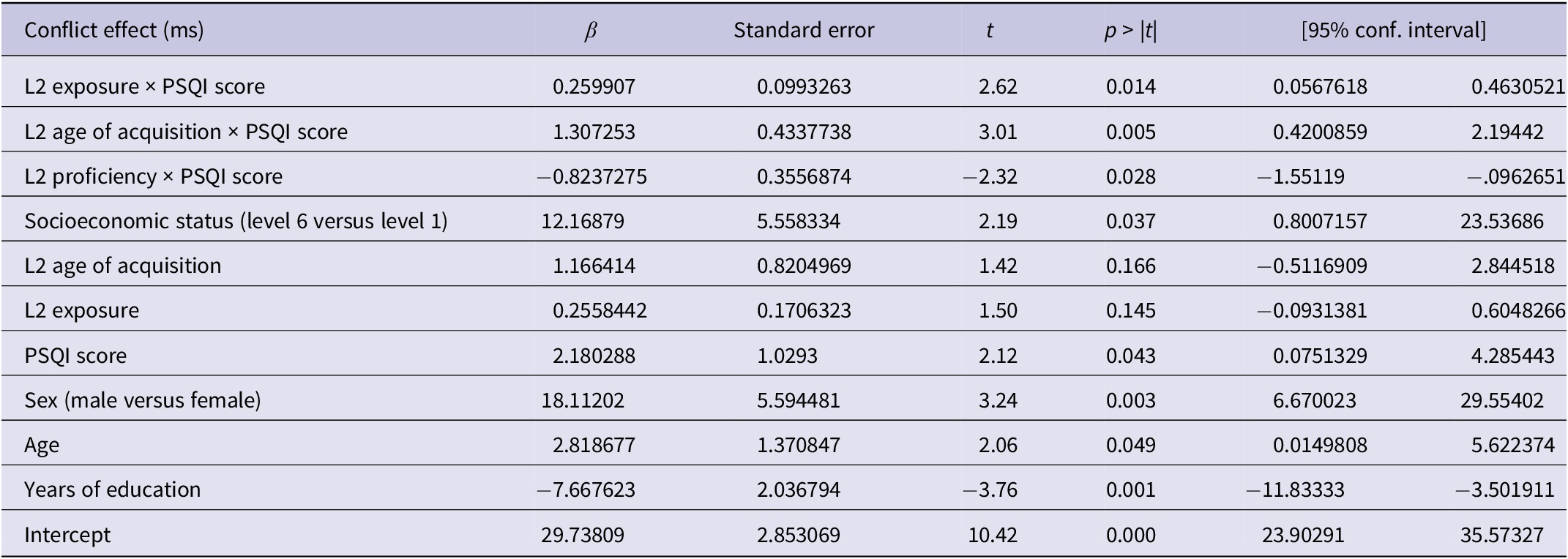
Note: All variables are mean-centered.
4. Experiment 2
Relying on the PSQI as a questionnaire for subjective sleep quality provides numerous advantages. It is the most widely used tool and has been shown to be reliable and valid. Nevertheless, questions regarding the factor model, large recall period and scoring system are the main controversial issues that cause debate on the value of the global PSQI score when it comes to distinguishing between poor and good sleepers. Besides that, it is important to note that poor sleep quality can be a crucial symptom of many sleep disorders, in particular, insomnia (Fabbri et al., Reference Fabbri, Beracci, Martoni, Meneo, Tonetti and Natale2021). Considering the findings from Experiment 1, as well as the potential disadvantages of the PSQI, we designed another experiment (Experiment 2) using a more specific and sensitive measure of insomnia – the Insomnia Severity Index (ISI). The ISI measures perceived insomnia severity, focusing on the level of disturbance to the sleep pattern and on the consequences of insomnia (Bastien et al., Reference Bastien, Vallières and Morin2001). The ISI is a widely used instrument for insomnia screening and treatment, as well as for research focusing on insomnia. It has been productively employed in both clinical settings and sleep research across a range of populations (Jun et al., Reference Jun, Park and Kapella2022). In order to make results comparable, in Experiment 2, we followed the same procedure as in Experiment 1.
4.1. Participants
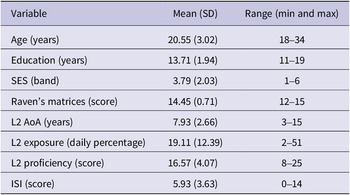
A different cohort of 42 Russian-English bilinguals (13 males; mean age = 20.55, SD ± 3.02) was recruited from the HSE University student population. All participants acquired English as an L2 formally through formal instruction at school and use it regularly but to a limited extent, due to residing in a predominantly L1-speaking environment. As for Experiment 1, the requirements to participate included the absence of psychiatric or neurological conditions and normal or corrected-to-normal vision. The same type of sociodemographic and linguistic background data as in Experiment 1 were collected (see Table 3). The study was approved by the local research ethics committee at HSE University, and written informed consent was obtained from each participant.
Sociodemographic and L2 background profiles of participants

Note: Mean, standard deviation (SD) and range are provided for each measure.
4.2. Procedure
The procedure for bilingual experience and executive performance assessments, as well as various questionnaires, was the same as in Experiment 1, except that participants filled out the Russian version of the ISI questionnaire instead of the PSQI, as detailed below. All tasks were performed in one experimental session, which lasted around 60 min.
4.3. Insomnia assessment
To obtain a more sensitive and specific measure of insomnia, we used the ISI – a seven-item questionnaire related to subjective qualities of the respondent’s sleep, including the severity of symptoms, the respondent’s satisfaction with their sleep patterns, the degree to which insomnia interferes with daily functioning, how noticeable the respondent perceives their insomnia is to others and the overall level of distress caused by the sleep problem (Morin et al., Reference Morin, Belleville, Bélanger and Ivers2011). Its content overlaps with the diagnostic criteria of insomnia listed in the Diagnostic and Statistical Manual of Mental Disorders (DSM-V). Additionally, the ISI is a powerful measure for research purposes due to its high reliability, validity and sensitivity (Bastien et al., Reference Bastien, Vallières and Morin2001).
4.4. Statistical analyses
The same approach to data filtering as well as statistical analyses as in Experiment 1 was used in Experiment 2. Here, we built a full linear regression model with Flanker conflict effect as the dependent variable and main effects of L2 exposure, L2 AoA, L2 proficiency and ISI score, as well as interactions between each bilingual experience factor and ISI score, as predictors. As in Experiment 1, covariates included age, sex, general intelligence, SES and maximal educational attainment.
5. Results
The best-fitting model in Experiment 2 included SES and the interaction term between L2 AoA and ISI. While following the expected direction and in line with results from Experiment 1 (see Figure 3, panel a), this interaction only showed a trend towards significance, but did not reach the alpha level of 0.05 (β = 0.935; p = 0.092; full model estimates reported in Table 4).
(A) Interaction plot for the two-way interaction between L2 age of acquisition*insomnia-related symptoms predicting Flanker conflict effect (in ms). The conflict effect was calculated as the difference between the average individual RTs in the incongruent and congruent conditions. For graphical representation purposes, the three levels of ISI selected for plotting (low, medium, high) are represented as 1 SD below the mean, mean, and 1 SD above the mean of our sample, respectively. Please note that ISI score was inserted as a continuous variable in the statistical model. (B) Interaction plot for the three-way interaction between L2 age of acquisition*insomnia-related symptoms*task condition predicting Flanker RTs (in ms). For graphical representation purposes, the three levels of ISI selected for plotting (low, medium, high) are represented as 1 SD below the mean, mean, and 1 SD above the mean of our sample, respectively. Please note that ISI score was inserted as a continuous variable in the statistical model.

Estimates from the best-fitting linear model predicting Flanker conflict effect (in ms) based on the interaction between bilingual experience factors and ISI score

Note: All variables are mean-centered.
As discussed in the Introduction, the effects of insomnia on cognitive performance are more difficult to observe at the behavioral level than effects related to general sleep quality. As a result, we hypothesize that the effect of interest might not have been sufficiently strong to emerge in our sample of 42 participants. For this reason, we conducted an additional exploratory analysis using a single-trial linear mixed regression focusing on the interaction between L2 AoA and ISI, to increase the statistical power of our model (see Baayen et al., Reference Baayen, Davidson and Bates2008). Indeed, this approach allowed us to increase the number of data points per participant from 1 (one measure of the conflict effect) to 128 (one for each individual trial). However, it prevented us from using the Flanker conflict effect as a dependent variable, since averages had been substituted with single-trial RTs. To overcome this issue, we included an interaction term for trial type (congruent versus incongruent) in our model, to ensure that our effect of interest was observed independently in the congruent and incongruent conditions. Thus, we tested the model with single-trial Flanker RTs as the dependent variable, main effects of trial type, L2 AoA, ISI score and their interaction as independent variables, as well as covariates for age, sex, general intelligence, SES and maximal educational attainment. Random effects included random intercepts for individual participants and random slopes for single trials. Our analysis revealed a significant interaction between L2 AoA, ISI score and Flanker trial type (β = 0.884; p < 0.001). After model estimation, we estimated the marginal effect of the interaction via Stata’s margins command. The interaction plot shows that, for all levels of insomnia severity, earlier L2 AoA predicted improved Flanker performance (i.e., lower RTs), differentially for congruent and incongruent trials. Importantly, the strength of this relationship increased with increasing insomnia severity (see Figure 3, panel b). Full model estimates are reported in Table 5.
Estimates from the single-trial linear mixed model predicting Flanker RTs (in ms) based on the interaction between L2 age of acquisition and ISI

6. Discussion
The two experiments presented here aimed at investigating the putative relationship between bilingualism and sleep quality/insomnia-related symptoms in their capacity to affect cognitive performance. For this purpose, we tested the interactive contribution of these two factors on EF performance at the behavioral level. Our results, for the first time, reveal an interplay between bilingualism and sleep quality in their capacity to affect EF performance by showing that the degree of bilingualism (as indexed by L2 proficiency and L2 AoA) may compensate for the detrimental effects of poor sleep quality upon EF. On the other hand, no such L2 effects were present for those reporting good sleep quality. This tendency was further corroborated for insomnia-related symptoms, known to deplete cognitive resources. This novel finding supports the argument by Valian (Reference Valian2015), suggesting that since young adults are at cognitive peak, to observe bilingualism-induced cognitive effects in this population, cognitive resources must be effectively depleted. Our data support this view by showing that, in young bilinguals, bilingualism-induced effects on EF only emerged when poor sleep quality and insomnia symptoms negatively affected cognitive resources. This result suggests that we should be more cautious in interpreting null results with regard to the effects of bilingualism on cognitive performance, especially in young population samples. Among other things, we would like to emphasize that we do not determine these relationships as causal, but rather as mediated relationships that appear as a byproduct of the intersection of bilingualism and sleep, which have an impact on the same cognitive functions. Furthermore, our study sheds light on the fact that previously reported inconsistent findings can be a consequence of the failure to control for the effects of confounding factors, which might affect cognition. Indeed, had we not controlled for the sleep-related effects observed in our samples, we might have reported the absence of any bilingualism-induced cognitive effects in our study, which would clearly constitute a Type 2 error. This suggests that future bilingualism studies should control for individual sleep quality/disturbances profiles, aiming to establish a balance between testing efficiency and testing adequacy. For similar reasons, future studies investigating the cognitive effects of sleep quality/disturbances should also control for the language background of participants.
Another important finding from Experiment 1 is that L2 exposure’s effect followed an inverse trend as compared to the L2 proficiency and L2 AoA effects. Indeed, while the beneficial effect of increasing proficiency and AoA on Flanker performance emerged for poor sleepers, that of exposure emerged for good sleepers. This is a somewhat unexpected finding; nevertheless, we think it deserves a putative mechanistic explanation.
Note that our analyses used several partially overlapping yet distinct bilingual experience factors that tap into different aspects of bilingual experience. One interpretation is that the sociolinguistic setting – with participants being primarily dominant in their L1 and living in an environment that reflected this dominance – underscored the multifaceted nature of bilingual experience. First of all, exposure on the one hand, and AoA and proficiency on the other, might index different facets of bilingual experience. While exposure per se most clearly indexes quantity of engagement with an L2, earlier AoA (i.e., contact with L2 beginning in more ‘plastic’ stages of neurocognitive development) and achieved higher proficiency go beyond, indexing qualitative aspects of opportunities for meaningful engagement with individual bilingual experience. Indeed, in an L1-dominant environment, the relationship between a degree of engagement and resulting level of L2 fluency may vary as a function of individual factors such as the meaningfulness (i.e., quality and timing) of engagement and the individual propensity to (language) learning. As such, one could expect exposure and proficiency/AoA to produce different cognitive consequences in a sociolinguistic context like the one sampled in the current investigation.
A different pattern, instead, could be expected in L2-immersive contexts, where individuals experience more consistent engagement with L2. In such a context, the cognitive adaptations associated with bilingualism may go beyond what can be accounted for by L2 proficiency alone (see DeLuca et al., Reference DeLuca, Rothman and Pliatsikas2019b; Pereira Soares et al., Reference Pereira Soares, Prystauka, DeLuca and Rothman2022). To evaluate this possibility, further research is necessary that directly compares bilingual experiences across diverse sociolinguistic settings. Indeed, existing research supports the notion of partially differential contributions of proficiency and exposure to bilinguals’ cognitive functioning (Bonfieni et al., Reference Bonfieni, Branigan, Pickering and Sorace2019; DeLuca et al., Reference DeLuca, Rothman and Pliatsikas2019b; Pereira Soares et al., Reference Pereira Soares, Prystauka, DeLuca and Rothman2022). Similarly, our own research, both published and under review, reports a similar dissociation between different exponents of bilingual experience emerging in the same type of sociolinguistic context (Gallo et al., Reference Gallo, Novitskiy, Myachykov and Shtyrov2021, Reference Gallo, Terekhina, Abutalebi, Shtyrov and Myachykov2025, Reference Gallo, DeLuca, Rothman, Abutalebi, Shtyrov and Myachykovunder review). Most importantly, our results confirm that bilingual experience can still affect cognition, though the average exposure in our participants across various modalities in both experiments was relatively low – ranging roughly between 2% and 60% of daily time, since they resided in a predominantly L1-speaking environment. Further research is needed to clarify the specific contribution of different aspects of bilingual experience in various bilingual populations, as well as their detailed relationship with sleep quality.
It is also important to note that our results have several practical implications. First, they may inform our understanding of how bilingualism mitigates the effects of cognitive aging. Of note, high degrees of bilingualism have been shown to be associated with cognitive reserve accrual and, as such, to act as a neuroprotective factor (Gallo et al., Reference Gallo, DeLuca, Prystauka, Voits, Rothman and Abutalebi2022). Previous studies emphasized that the build-up of this cognitive reserve begins in youth (e.g., Gallo et al., Reference Gallo, Terekhina, Shtyrov and Myachykov2024). Thus, we can hypothesize that under the right conditions, bilingualism can compensate for cognitive detriments stemming from poor sleep quality. In addition, our findings draw attention to sleep as an important factor to consider when investigating language learning and general memory functioning: Although research is available on the topic of sleep and language learning (see e.g., Rasch, Reference Rasch2017), future studies will need to examine in more detail how sleep quality/deprivation is associated with learning additional languages (Dumay & Gaskell, Reference Dumay and Gaskell2007). The results presented here highlight the potential of a broader empirical study at the intersection of bilingual language learning and usage, sleep and cognitive science to identify behavioral consequences and to uncover the underlying neurocognitive architecture of the interactions between sleep and bilingualism.
Finally, it is important to highlight methodological issues that may limit the generalizability of our findings. While subjective sleep quality assessment instruments like PSQI and ISI are useful due to their affordability and ease of use, they do not offer a full and objective picture of participants’ profiles. The dissociation between subjective and objective sleep quality has been shown to lead to inconsistent results (Zavecz et al., Reference Zavecz, Nagy, Galkó, Németh and Janacsek2020). Consequently, our findings need to be considered with a degree of caution. Future studies should include objective sleep quality assessments, such as electrophysiological measures.
Data availability statement
The data that support the findings of this study are available on request.
Acknowledgments
This article is an output of a research project implemented as part of the Basic Research Program at the National Research University Higher School of Economics (HSE University). JA was supported by the Center for Language, Brain and Learning (C-LaBL), UiT the Arctic University of Norway.
Competing interests
The authors declare that they have no competing interests.






 Open access

