





Highlights
-
• At 3;0, early-onset bilinguals displayed reduced grammatical complexity in L1.
-
• But they were only weaker than matched monolinguals in a subset of structures.
-
• Quality of L1 input accounts for variation among the bilinguals after input amount.
-
• At 5;8, early-onset bilinguals converge with later-onset peers in L1 grammar.
-
• L1 development in early bilinguals benefited from L1 support in bilingual contexts.
1. Introduction
Compared to monolingual peers, infants and toddlers who regularly hear two languages from caretakers necessarily receive reduced input proportions in each language (‘input reduction’). This can lead to later-than-monolingual development in both languages (Byers-Heinlein et al., Reference Byers-Heinlein, Gonzalez-Barrero, Schott and Killam2023; Cote & Bornstein, Reference Cote and Bornstein2014; Hoff et al., Reference Hoff, Core, Place, Rumiche, Señor and Parra2012). Yet bilingual children’s linguistic environments and acquisition outcomes vary. Abundant research has examined bilingual development in ‘minority–majority language contexts’, in which the child’s first language (L1) is a minority language not widely used outside the home and with lower social status, while the child’s L2 (or another L1) is the societal majority language. Such bilingual children display later-than-monolingual development in the minority language (e.g., heritage languages of immigrant children, Cote & Bornstein, Reference Cote and Bornstein2014; Hoff et al., Reference Hoff, Core, Place, Rumiche, Señor and Parra2012; Montrul, Reference Montrul2016). The development of early bilinguals’ L1 in contexts where the L1 enjoys high social status is less studied. In such contexts, caretakers proactively promote early additive bilingualism (the learning of an additional language, aiming for high proficiency in both languages) by addressing children in the majority language (L1) and an additional language from a young age.
This linguistic environment is exemplified in Cantonese–English bilingual children raised by Cantonese-dominant parents in Hong Kong SAR, where both English and Chinese are official languages. High proficiency in both languages is promoted by the government, prized by local parents, and aimed for in education. Cantonese is the societal-dominant language, spoken by around 85% of the population as the primary language. Approximately 49.9% of adults regularly speak English to their children aged below 6 (Census & Statistics Department of the Government of Hong Kong Special Administrative Region, 2022). Although Cantonese acquisition in a bilingual setting is the norm for Hong Kong children, different types of bilingualism occur. A small group of children develop simultaneous bilingualism under the one-parent-one-language practice with one native Cantonese-speaking and one native English-speaking parent (e.g., Yip & Matthews, Reference Yip and Matthews2007), while the majority are raised in Cantonese-speaking homes and develop bilingualism through English exposure from preschool. Others are raised under a third input model, differing from the above two groups in that these children receive both native Cantonese and non-native English input during naturalistic interactions with caretakers before the age of 3. Their Cantonese input providers are (grand)parents who speak Cantonese as their first and dominant language, and English input providers are parents or live-in foreign domestic helpers who speak English as an additional and (usually) weaker language. Many of them acquire Cantonese and English almost simultaneously from birth. Whether English can be considered an L1 alongside Cantonese in this scenario remains debatable. Our study focuses on the development of Cantonese in this third group of bilingual children, who have not hitherto been studied systematically, and will refer to Cantonese as their ‘native L1’ for clarity of reference. We focused on bilingual children’s L1 Cantonese grammar development in a bilingual society where Cantonese is one of the widely spoken languages. These children, like those raised by immigrant parents in the US and UK, develop their L1 under reduced-input conditions, yet they differ from immigrant children, as their L1 is the societal-dominant language supported by mainstream education.
2. Lexical and grammatical development of L1 in bilingual toddlers and preschoolers
Compared to monolingual children, bilingual toddlers learning a minority L1 in an English-dominant society consistently show weaker lexical skills, especially in production, due to input reduction in the native L1. Cote and Bornstein (Reference Cote and Bornstein2014) found that bilingual 20-month-olds in the US acquiring Spanish or Korean had smaller vocabularies than monolingual peers. Miękisz et al. (Reference Miękisz, Haman, Łuniewska, Kuś, O’Toole and Katsos2019) discovered that, despite a strong presence of L1 at home, Polish–English toddlers (23–27 months) in the UK displayed lower vocabulary scores than monolingual Polish children. Similar findings have been reported for bilingual toddlers in societies with two dominant languages. French–English bilingual toddlers in Montréal showed reduced productive vocabulary sizes and slower development rates than monolinguals even in their dominant language, be it French or English (Byers-Heinlein et al., Reference Byers-Heinlein, Gonzalez-Barrero, Schott and Killam2023). Overall, robust evidence indicates input reduction effects on bilingual toddlers’ L1 lexical development across bilingual contexts.
Whether input reduction affects grammatical development to the same extent as in lexical development in toddlerhood is less clear. Prior research has examined grammatical development in the majority L2 (e.g., Foursha-Stevenson et al., Reference Foursha-Stevenson, Nicoladis, Trombley, Hablado, Phung and Dallaire2023; Hoff et al., Reference Hoff, Core, Place, Rumiche, Señor and Parra2012) or the native L1 in older children (e.g., preschool/school age in Hao & Chondrogianni, Reference Hao and Chondrogianni2023; school age in Jia & Paradis, Reference Jia and Paradis2015; Mai et al., Reference Mai, Zhao and Yip2022), but findings are mixed (e.g., Thordardottir, Reference Thordardottir, Grüter and Paradis2014; Unsworth, Reference Unsworth, Grüter and Paradis2014). Few studies have directly examined grammatical development in bilingual toddlers’ L1, factoring in variations in the input. The most relevant study is Blom (Reference Blom2010), which investigated grammatical development in four bilingual children (2;0–3;6) learning Turkish in Dutch-speaking Netherlands using a general measure of syntactic complexity (i.e., mean length of utterance in words, MLUw). Two of the bilingual children showed lower MLUw and less steady development than Turkish monolinguals, while the other two bilinguals demonstrated baseline-like performance.
From preschool onwards, language learning increasingly takes place outside the home. The societal linguistic environment (e.g., language spoken in the larger community and as the medium of instruction) progressively influences the rate, path and balance of bilingual development. Existing bilingual–monolingual comparisons have shown that immigrant children lacking consistent access to L1 education at preschool usually show weaker L1 linguistic abilities than monolingual children from the country of origin in the L1. For example, 66-month-old Polish-L1 immigrant children in the UK had smaller expressive vocabularies than age-matched monolinguals in Poland (Mieszkowska et al., Reference Mieszkowska, Łuniewska, Kołak, Kacprzak, Wodniecka and Haman2017). They also had lower productive vocabulary and grammar scores (aged 4–7, Haman et al., Reference Haman, Wodniecka, Marecka, Szewczyk, Białecka-Pikul, Otwinowska, Mieszkowska, Łuniewska, Kołak, Miękisz, Kacprzak, Banasik and Foryś-Nogala2017). Notably, bilingual children with an earlier onset of bilingual exposure (EB) tend to perform worse in their native L1 than those with a later onset of bilingualism (LB). Armon-Lotem et al. (Reference Armon-Lotem, Rose and Altman2021) compared English (L1)–Hebrew EB children (onset before 2;0) who attended Hebrew-speaking preschools and their LB peers (onset between 2;1–4;0) from similar preschools. EB children performed lower than LB children in English expressive vocabulary and sentence repetition. Similarly, in a study on US heritage Arabic–English preschoolers, Albirini (Reference Albirini2018) found that, compared to LB children, EB children had lower accuracy rates in subject–verb agreement, plural morphology and relative clauses in Arabic. Conversely, simultaneous bilingual preschoolers (aged 3–5) with French as one of their L1s who attended French daycare in English-dominant Edmonton, Canada, performed comparably to monolingual peers in French receptive vocabulary (Smithson et al., Reference Smithson, Paradis and Nicoladis2014). Whether EB children with L1 support at preschool can catch up with LB peers in grammatical development, in addition to vocabulary development, remains an open question; the effects of onset age have been investigated much more intensively in the development of the L2 than in that of the L1 (e.g., Roesch & Chondrogianni, Reference Roesch and Chondrogianni2016; Unsworth et al., Reference Unsworth, Grüter and Paradis2014).
Across studies, bilingual children who lack sustained L1 support at preschool consistently display early plateau, at least in vocabulary (e.g., Hmong–English bilinguals in the US in Kan & Kohnert, Reference Kan and Kohnert2005; Chinese–English bilinguals in the US in Sheng, Reference Sheng2014; Sheng et al., Reference Sheng, Lu and Kan2011; Song et al., Reference Song, Sheng and Luo2022). However, those with L1 support from preschools continue to develop morphosyntactic abilities and new vocabulary. For example, Rodina et al. (Reference Rodina, Kupisch, Meir, Mitrofanova, Urek and Westergaard2020) found that bilingual children (aged 3;0–10;0) who received more instruction in Russian, their heritage language, performed better in grammatical gender than those with less Russian instruction. Armon-Lotem and Ohana (Reference Armon-Lotem and Ohana2017) found that among English-L1 children in Hebrew-speaking Israel, older children (36–45 months) understood significantly more English words than younger children (24–35 months), indexing growth in English receptive vocabulary from toddlerhood to preschool. Although English is not the majority language in Israel, it assumes a high status with strong institutional support in government and education. The continuous growth observed in L1 English and L1 Russian in these studies is likely to be extendable to the L1 Cantonese of Hong Kong Cantonese–English bilingual children. Our study aims to test this hypothesis.
3. Input–outcome relations in early bilingual development and Chinese–English bilinguals
In early bilingual development, the proportion of input in a language out of the child’s total input (i.e., input proportion) strongly predicts skills in the same language (e.g., Pearson et al., Reference Pearson, Fernández, Lewedeg and Oller1997; Place & Hoff, Reference Place and Hoff2011). Most research examines vocabulary development in bilingual toddlers or preschoolers, leaving aside grammatical outcomes (e.g., Cote & Bornstein, Reference Cote and Bornstein2014; Dijkstra et al., Reference Dijkstra, Kuiken, Jorna and Klinkenberg2016). An exception is Hoff et al. (Reference Hoff, Core, Place, Rumiche, Señor and Parra2012), who found a strong link between input proportion and grammatical complexity (measured by MLU). Albeit valid and reliable, MLU and similar measures such as mean length of the three longest utterances in words (MLU3) are general, coarse-grained measures. The extent to which individual grammatical structures are affected differentially by input reduction within a group of bilingual toddlers is unclear.
Importantly, Thordardottir (Reference Thordardottir2011, Reference Thordardottir2015) discovered that English–French bilingual preschoolers receiving at least 70% input in either language scored within the ‘monolingual normal range’ (defined as monolingual mean ± 1 standard deviation) in expressive vocabulary in the same language and that those with close-to-equal exposure to both languages (40%–60%) were similar to corresponding monolinguals in MLU. However, French and English are closely related languages with many cognates and shared grammatical structures. Since children learning closely related language pairs need less input to attain monolingual levels than those learning distant language pairs (Blom et al., Reference Blom, Boerma, Bosma, Cornips, van den Heuij and Timmermeister2020), it remains to be tested whether the input thresholds reported for English–French children can also be extended to bilingual children learning distant languages like Cantonese and English.
Apart from input proportion, input quality also accounts for individual differences in language development outcomes (see reviews in Paradis, Reference Paradis2023; Rowe & Snow, Reference Rowe and Snow2020). For monolingual toddlers and preschoolers, lexical diversity (word type) and syntactic complexity in the input are robust predictors (e.g., Anderson et al., Reference Anderson, Graham, Prime, Jenkins and Madigan2021; Hsu et al., Reference Hsu, Hadley and Rispoli2017; Huttenlocher et al., Reference Huttenlocher, Waterfall, Vasilyeva, Vevea and Hedges2010). Rowe (Reference Rowe2012) found that the number of word types in input at 30 months significantly predicted vocabulary scores at 42 months, after controlling for input amount (number of words). In a longitudinal study (2–60 months), Vernon-Feagans et al. (Reference Vernon-Feagans, Bratsch-Hines, Reynolds and Willoughby2020) found that maternal MLU partially mediates the relation between maternal education and language skills in American children.
Despite the bulk of research on input–outcome relations in bilingual development, studies tend to examine input quality through indirect measures such as the number of input providers (e.g., Place & Hoff, Reference Place and Hoff2016), the frequency of language and literacy activities like storytelling and reading (e.g., Jia & Paradis, Reference Jia and Paradis2015; Song et al., 2022), and media exposure (e.g., Sun et al., Reference Sun, S, O’brien and Fritzsche2020). Few have directly examined the samples of child-directed input and correlated input quality with bilingual outcomes (but see Paradis & Navarro, Reference Paradis and Navarro2003, for an examination of specific constructions in the input). An exception is David and Wei (Reference David and Wei2008), who found that young bilingual children whose parents produced longer sentences or richer vocabulary possessed a larger expressive vocabulary. However, whether fine-grained input features (e.g., lexical diversity and syntactic complexity) make additional contributions to bilingual development beyond input proportion has not been thoroughly investigated.
Research has shown that Chinese–English bilingual children do not necessarily perform weaker than monolinguals across all grammatical structures. Structures that are crosslinguistic translation equivalents and appear in similar syntactic positions in both languages might benefit from positive transfer, such that bilinguals demonstrate monolingual-like or even accelerated acquisition. This is exemplified by earlier and more productive usage of pronominal right-dislocation constructions (Ge et al., Reference Ge, Matthews, Cheung and Yip2017) and the progressive aspect marker -gan in Cantonese–English bilingual children (Luk & Shirai, Reference Luk and Shirai2018). Note that the translation equivalents do not have to be identical across all linguistic levels to induce crosslinguistic mapping and transfer in bilingual children. Although progressive -gan in Cantonese and progressive -ing in English are similar, in that both express imperfective meanings and appear postverbally, they differ in many morphosyntactic and semantic aspects (e.g., telicity of co-occurring verbs). Crosslinguistic mappings between similar (rather than identical) structures also occur between the Mandarin perfective aspect marker -le and the English past tense marker -ed in Mandarin–English bilingual preschoolers (Nicoladis et al., Reference Nicoladis, Yang and Jiang2020). Conversely, properties specific to Chinese appear to be particularly problematic for bilinguals. For instance, nominal classifiers and postverbal resultative/directional particles (also termed resultative verb compounds) are widely attested in Chinese but not in English (Matthews & Yip, Reference Matthews and Yip2011). The inventory of such structures is significantly reduced in older Chinese–English bilingual children (Kan, Reference Kan2019; Shang et al., Reference Shang, Zhao, Yip and Mai2024; Wei & Lee, Reference Wei and Lee2001). How similar two grammatical structures need to be to induce crosslinguistic transfer is an unresolved question (Unsworth, Reference Unsworth2023).
4. This study
4.1. Research questions and predictions
Robust and consistent evidence suggests that input reduction from bilingual exposure can result in early costs to native L1 development, particularly in vocabulary. How specific grammatical structures are differentially affected by input reduction among toddlers, however, awaits systematic investigation. Recent cross-sectional studies have begun to show that bilingual children with out-of-home L1 support continue gaining vocabulary and morphosyntax (e.g., Armon-Lotem & Ohana, Reference Armon-Lotem and Ohana2017; Rodina et al., Reference Rodina, Kupisch, Meir, Mitrofanova, Urek and Westergaard2020) and might converge with the monolinguals (e.g., Smithson et al., Reference Smithson, Paradis and Nicoladis2014), at least in European language pairs acquired in Western contexts. Longitudinal studies tracking the same group of bilingual children developing their native L1 alongside a linguistically distant language in toddlerhood and the preschool age are scarce. Among bilingual children, while input proportion robustly predicts development, it is unclear how fine-grained qualitative aspects of caretaker input influence bilingual outcomes.
This study addresses multiple research gaps by investigating input and outcomes in the development of Cantonese grammar in Cantonese–English bilingual children who received substantial naturalistic input in both languages at home from infancy (earlier-onset bilingual, EB) at two critical time points (Time 1: end of toddlerhood before entering kindergarten at 3;0 and Time 2: approaching end of kindergarten at 5;8). As a comparison baseline, we included children who were raised in close-to-monolingual Cantonese households with little exposure to English by Time 1 and had developed bilingual proficiency to varying degrees through English exposure at kindergarten by Time 2. This group of later-onset bilingual (LB) children, rather than monolingual Cantonese children, was adopted as the baseline for this study because LB children represent the norm in Hong Kong – English is integral to kindergarten curricula (Curriculum Development Council, 2017) and strictly monolingual Cantonese kindergarteners do not exist. For ease of reference, this group is hereafter called the LB baseline (or simply ‘the baseline’). We adopted the newly published Grammatical Analysis of Cantonese Samples (GACS; Wong et al., Reference Wong and Wong2022) as a novel method for a comprehensive analysis of Cantonese grammatical structures. The following are our research questions and predictions:
-
1) Early development of L1 Cantonese in toddlerhood: At 3;0, to what extent did EB children perform lower than the baseline (LB children still at the monolingual stage) in Cantonese productive grammar?
Based on previous research, we predicted that the EB group would exhibit, as a group, lower-than-baseline Cantonese in general grammatical complexity. Given the absence of studies examining bilingual toddlers’ L1 grammar in a comprehensive and systematic manner, and the intricate relations between input reduction and crosslinguistic transfer, we do not have precise predictions for all major grammatical structures in Cantonese. However, based on previous studies with older Chinese–English bilingual children, we predict that bilingual toddlers should perform comparably to the baseline in producing aspect markers and perform lower than the baseline in producing nominal classifiers and postverbal particles. The full set of grammatical structures will be introduced later.
-
2) Continued development of L1 Cantonese at preschool age: At 5;8, did the EB children still perform lower than the LB children in grammatical complexity, and in the structures in which they had lower-than-monolingual performance at 3;0 (if any)? Did the EB children show significant growth in grammatical complexity from 3;0 to 5;8?
Since the EB children in our study should have had substantial exposure to Cantonese in education and society at preschool age, we predict that they will show converging performance with the LB children and significant growth across time points.
-
3) Input–outcome associations and individual differences: How much input in Cantonese was needed by 3;0 for individual EB children to perform within the normal range of the baseline children (LB children at the monolingual stage) in grammatical complexity? To what extent can qualitative aspects of Cantonese input at 3;0 account for the variance in outcomes in Cantonese at 3;0 and 5;8, respectively, after controlling for Cantonese input proportion and other background variables?
Since Cantonese is more distant from English than French is from English, we predict that Cantonese–English EB children needed more than 40%–60% of the input in Cantonese to reach the normal range of the baseline at 3;0. We predict that caretaker input quality measures will account for a significant amount of variance in outcomes, in addition to input proportion.
4.2. Methods
4.2.1. Participants
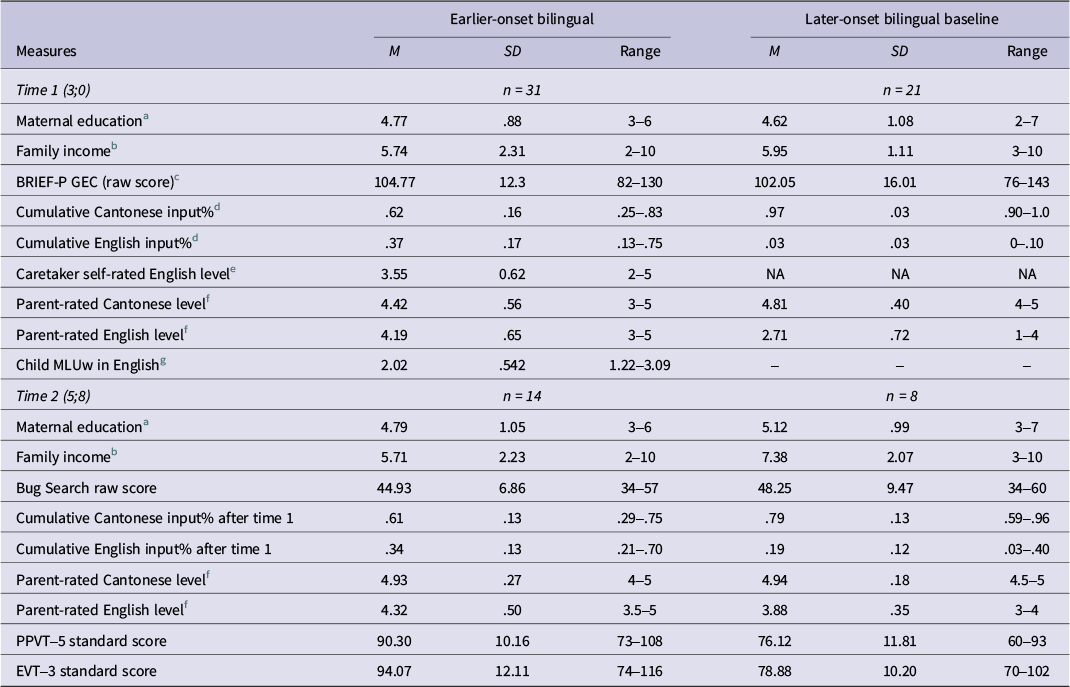
This study was part of a larger longitudinal study investigating input–outcome relations in early multilingual development involving Chinese languages and English (Mai et al., Reference Mai, Liang, Wu and Yip2025). The EB group selected for this study included 31 bilingual toddlers (16 girls and 15 boys). They received Cantonese input from their (grand)parents, who were native Cantonese speakers, and English input from parents or domestic helpers, who spoke English as a non-dominant language. The EB children’s main English input providers had medium-to-high proficiency in English (self-ratings in Table 1). By 3;0, the children had accumulated substantial input in Cantonese and English (mean English input proportion: 37%, ranging from 13% to 75%).
Descriptive statistics of participants’ background variables at 3;0 and 5;8

a On a 7-point scale (1 = primary/elementary school and below; 7 = doctorate).
b On a 10-point scale (1 = below 9,000HKD; 10 = 121,001HKD & above).
c GEC = global executive composite.
d Formula:
 $$ \%\hskip0.3em \mathrm{of}\ \mathrm{caretaker}\ \mathrm{in}\mathrm{put}\ \mathrm{in}\ \mathrm{language}\hskip0.3em X=\frac{\mathrm{Sum}\hskip0.3em \mathrm{of}\ \mathrm{in}\mathrm{put}\ \mathrm{hours}\ \mathrm{in}\hskip0.3em \mathrm{X}\hskip0.3em \mathrm{by}\hskip0.3em \mathrm{all}\hskip0.3em \mathrm{main}\ \mathrm{caretaker}\mathrm{s}}{\mathrm{Total}\ \mathrm{caretaker}\ \mathrm{in}\mathrm{put}\ \mathrm{hours}+\mathrm{other}\ \mathrm{in}\mathrm{put}\ \mathrm{hours}}. $$
e On a 5-point scale (1 = cannot understand; 2 = very limited; 3 = conversational on everyday topics; 4 = proficient; 5 = (near-)native).
f On a 5-point scale (1 = cannot comprehend this language yet; 5 = can say complex sentences and respond fluently).
g Derived from 10-minute caretaker–child standard toy play.
The LB baseline included 21 toddlers (10 girls and 11 boys). They were raised in close-to-monolingual Cantonese environments with no more than 10% input in English by 3;0 (mean English input proportion: 3%), but had regular English exposure at kindergarten after 3;0. All children were born full term without known or suspected language or neurobiological disorders. To control for the effects of birth order and sibling input, only firstborns were recruited. To ensure that the adult input samples collected in this study were representative of the children’s main sources of input, children who had spent more than 20% of their time outside home (e.g., daycare, playgroup sessions, etc.) by age 3 were not included. This did not exclude many children due to the suspension of childcare services and social distancing during the COVID-19 pandemic. Parents and children of both groups completed a battery of tasks online through Zoom, assisted by the research team, during the pandemic (Time 1).
After the pandemic, all children received an invitation to a follow-up study at 5;8 (Time 2). A total of 22 children (14 EB, 9 girls; 8 LB baseline, 4 girls) returned and completed the tasks in our child-friendly laboratories. At 5;8, all children were attending kindergartens following the curriculum recommended by the Education Bureau of HKSAR, with a strong emphasis on oral and literacy skills in both Chinese and English. More details of the bilingual exposure and proficiency of the participants are reported in the next section.
4.2.2. Procedures and tasks
Caretaker and Input Questionnaire (CIQ). At 3;0, a parental questionnaire elicited information about family, child characteristics and language exposure. Parents identified the child’s main caretakers from birth to 3 and reported the duration of care each caretaker provided (in months). Parents then reflected on daily routines of caretaker–child interaction for each main caretaker (‘input hours’, excluding sleeping and napping time, which involved limited verbal interaction) and the relative proportion(s) of language(s) used in caretaker–child interactions (‘language proportion’). Based on the reported caretaking duration, input hours and language proportion, we calculated both the child’s total input hours from all main caretakers (‘total caretaker input hours’) and the child’s total input hours with each caretaker in each language (‘caretaker input hours in X’). Parents also reported the child’s language exposure beyond caretaker–child interactions (‘other input hours’, e.g., media, playgroup sessions) from birth to age 3. We computed the proportion of caretaker input in language X using the formula in (1) as follows:
 $$ \frac{\%\ \mathrm{of}\ \mathrm{caretaker}\ \mathrm{in}\mathrm{put}}{\mathrm{in}\ \mathrm{Language}\hskip0.3em \mathrm{X}}=\frac{\mathrm{Sum}\hskip0.3em \mathrm{of}\ \mathrm{in}\mathrm{put}\ \mathrm{hours}\ \mathrm{in}\hskip0.3em \mathrm{X}\hskip0.3em \mathrm{by}\hskip0.3em \mathrm{all}\hskip0.3em \mathrm{main}\ \mathrm{caretaker}\mathrm{s}}{\mathrm{Total}\ \mathrm{caretaker}\ \mathrm{in}\mathrm{put}\ \mathrm{hours}+\mathrm{other}\ \mathrm{in}\mathrm{put}\ \mathrm{hours}} $$
Caretakers who provided the highest proportion of input in Cantonese were identified as the ‘main Cantonese input providers’ (49 mothers, 3 fathers). At 5;8, another interview with the parents gathered information about the children’s language exposure after Time 1 (from 3;0 to 5;8), including language and hours of interaction with individual caretakers and peers, extracurricular activities and media exposure.
Executive function and cognitive ability. At 3;0, executive function was assessed using the Behavior Rating Inventory of Executive Function – Preschool Version (BRIEF-P; Gioia et al., Reference Gioia, Espy and Isquith2003); parents indicated ‘problematic behaviours’ of the children in the past six months. At 5;8, the children completed Bug Search, a non-verbal processing speed task from the Wechsler Preschool and Primary Scales of Intelligence – Fourth Edition (WPPSI-IV, Wechsler, Reference Wechsler2012).
Grammatical development in Cantonese. At 3;0, the main Cantonese input provider filled in the long form of the Communicative Developmental Inventory (CDI) in Cantonese (Tardif & Fletcher, Reference Tardif and Fletcher2008) in a Zoom interview with the research team. Dale (Reference Dale1991) reported that CDI is highly correlated with the results of direct tests and with measures derived from spontaneous child speech samples. Although CDI is intended for monolingual children under 30 months, previous studies support its validity and utility for bilingual children up to 36 months (Mancilla-Martinez et al., Reference Mancilla-Martinez, Pan and Vagh2011). CDI measures were excluded from group comparisons because the baseline group, who were monolinguals at 3;0, were expected to perform at ceiling. CDI measures were, however, used to address the final research question about individual differences within the EB group, as the bilinguals were not expected to perform at ceiling.
Additionally, caretaker–child dyads played cooking games for 10 minutes at 3;0, using prescribed identical kitchen toy sets delivered to their homes. The main input provider was instructed to play with the child ‘in the way they usually do’. The interactions were video-recorded through Zoom by a research assistant who remained muted and invisible and audio-recorded by the caretaker using their smartphones at home. Details of the setup were described in Zhou et al. (Reference Zhou, Mai, Cai, Liang and Yip2022). At 5;8, children told stories based on the Cat and Baby Goats pictures from the Multilingual Assessment Instrument for Narratives (MAIN; Gagarina et al., Reference Gagarina, Klop, Kunnari, Tantele, Välimaa, Bohnacker and Walters2019) and answered 20 comprehension questions about the two stories. Narration was chosen as a quick and comprehensive measure of productive abilities in Cantonese, based on known associations between narrative skills and later language and academic achievements (e.g., Griffin et al., Reference Griffin, Hemphill, Camp and Wolf2004).
The procedures of the study were approved by the research ethics committee of the Chinese University of Hong Kong. Written parental informed consent was obtained prior to data collection. The authors assert that all procedures contributing to this work comply with the ethical standards of relevant national and institutional committees on human experimentation and with the Helsinki Declaration of 1975 (revised in 2008).
Table 1 presents children’s demographic information at two time points. There were no significant differences in maternal education or family income between EB and baseline groups at either time point (ps > .05). At Time 1, the EB children had lower cumulative input in Cantonese than the baseline (EB: M = 62%, range: 25%–83%; baseline: M = 97%, range: 90%–100%). At Time 2, the EB group’s cumulative input in Cantonese between Time 1 and Time 2 was similar to that in Time 1 (M = 61%, range: 29%–75%), whereas that of the baseline group dropped (M = 79%, range: 59%–96%) due to increased exposure to English at kindergarten, although it was still significantly higher than that of the EB children (p = .006). The two groups did not differ in the global executive composite of the BRIEF-P at 3;0 or in Bug Search raw score at 5;8 (ps > .05).
4.2.3. Transcription, coding and measures
Caretaker–child toy play at Time 1 and the children’s narratives at Time 2 were manually transcribed in CHAT format (MacWhinney, Reference MacWhinney2000) by trained research assistants and revised for accuracy and consistency by the first author. Child utterances in caretaker–child interactions at 3;0 and narratives at 5;8 were coded based on a scheme adapted from the Grammatical Analysis of Cantonese Samples (GACS, Wong et al., Reference Wong and Wong2022). GACS comprises a list of 62 prominent Cantonese grammatical structures, subsumed under five subscales (noun phrase; verb phrase; sentence structure; questions; and sentence adverbs, conjunction and sentence final particles). A child receives one point for a structure when a unique and felicitous token of the structure is recorded (i.e., type-based scoring), with a maximum of four points per structure. Wong (Reference Wong and Wong2022) showed that GACS positively correlates with MLUw and age in typically developing Cantonese children. Our adapted scheme includes specific descriptions of what counts as a unique token for each structure and representative examples from child utterances to ensure coding consistency and efficiency. The transcripts were coded by the first author, and 10% of the transcripts were second-coded by the corresponding author. Discrepancies were discussed, and relevant entries in the coding scheme were revised and improved. After several rounds of fine-tuning, the inter-coder reliability based on the current version of the coding scheme reached 83.8%. The full scheme is included in Appendix S1 and Table S1 in the supplementary materials.
Notice that in the original, larger study, the EB children also completed a parallel set of tasks in English in separate sessions at 3;0. As shown in the child MLUw in the caretaker–child interaction with English as the intended language (M = 2.02), EB children had developed productive English abilities by 3;0. At 5;8, standardized vocabulary tests in English (Peabody Picture Vocabulary Test – Fifth Edition, PPVT-5, Dunn, Reference Dunn2019; Expressive Vocabulary Test – Third Edition, EVT-3, Williams, Reference Williams2018) were administered to both groups. The EB group outperformed the LB group in the standard scores of both tests (PPVT-5: M = 90.30 versus 76.12, t(12.92) = 2.86, p = .014; EVT-3: M = 94.07 versus 78.88, w = 96, p = .007). For this study, these English measures serve as indicators of the children’s general English ability and of the degree of bilingualism at the two time points; they will not be further analysed in the results section. The children’s development in English will be further investigated in another article.
Measures of Cantonese were derived from four data sources, summarized in (1). Different combinations of the measures were chosen to address each research question (see next section).
-
(1) Summary of tasks and derived measures
-
i. Parental questionnaire: input proportion;
-
ii. CDI form at 3;0: sentence complexity score;
-
iii. Caretaker–child 10-min standard toy play at 3;0: word type, word token and MLUw in the input; MLUw and MLU3 of child utterances; GACS subscore (points of a specific GACS grammatical structure, max = 4); and GACS total score (sum of the subscores of the 62 GACS grammatical structures in individual children); and
-
iv. Child narration task at 5;8: MLU3, total utterance (indicator of productivity), comprehension score (total number of correctly answered questions to index children’s understanding of macro-structure, following Lindgren, Reference Lindgren2019; Sheng et al., Reference Sheng, Shi, Wang, Hao and Zheng2020, max. = 10 per story) and GACS subscore (a selective subset of GACS structures that showed EB versus baseline differences at 3;0; details below)
-
5. Results
5.1. Performance at 3;0 (Time 1)
General measures. Table 2 presents the descriptive statistics of the two general measures (MLUw and GACS total) at 3;0, among others. The EB group displayed lower means than the baseline in both measures (MLUw: M = 2.72 versus 3.13, GACS total: M = 45.65 versus 62.57). To examine group effects, we conducted multiple regressions in R (version 4.3.0; R Core Team, 2023), with MLUw and GACS as dependent variables. To control for cognitive development and socioeconomic status (SES), BRIEF-P GEC scores and maternal education were entered together with group as independent variables, and the baseline as the reference. Maternal education was chosen over family income to index SES due to its wider acceptance in similar studies (e.g., Lauro et al., Reference Lauro, Core and Hoff2020; Unsworth et al., Reference Unsworth, Brouwer, De Bree and Verhagen2019). Spearman’s correlation revealed a moderate correlation between maternal education level and family income (r = .51, p < .001). Given that a lower BRIEF-P score indicates better performance, the BRIEF-P GEC scores were reversed by multiplying −1 before entering the models. Two children (one per group) did not provide BRIEF-P measures; the sample size for this regression analysis was reduced to 50. To correct for multiple comparisons, we controlled for false discovery rate (FDR) through the Benjamini–Hochberg procedure. Results revealed a significant group effect in MLUw (B = −0.41, SE = 0.14, $ \beta $
= − .39, t = −2.94, p = .033) and GACS (B = −15.87, SE = 5.17,
$ \beta $
= − .39, t = −2.94, p = .033) and GACS (B = −15.87, SE = 5.17, $ \beta $
= − .41, t = −3.07, p = .033) at Time 1 after controlling for maternal education and cognitive measures, indicating that the EB group displayed reduced grammatical complexity in their Cantonese utterances compared to the baseline.
$ \beta $
= − .41, t = −3.07, p = .033) at Time 1 after controlling for maternal education and cognitive measures, indicating that the EB group displayed reduced grammatical complexity in their Cantonese utterances compared to the baseline.
Descriptive statistics of group performance at 3;0 and 5;8
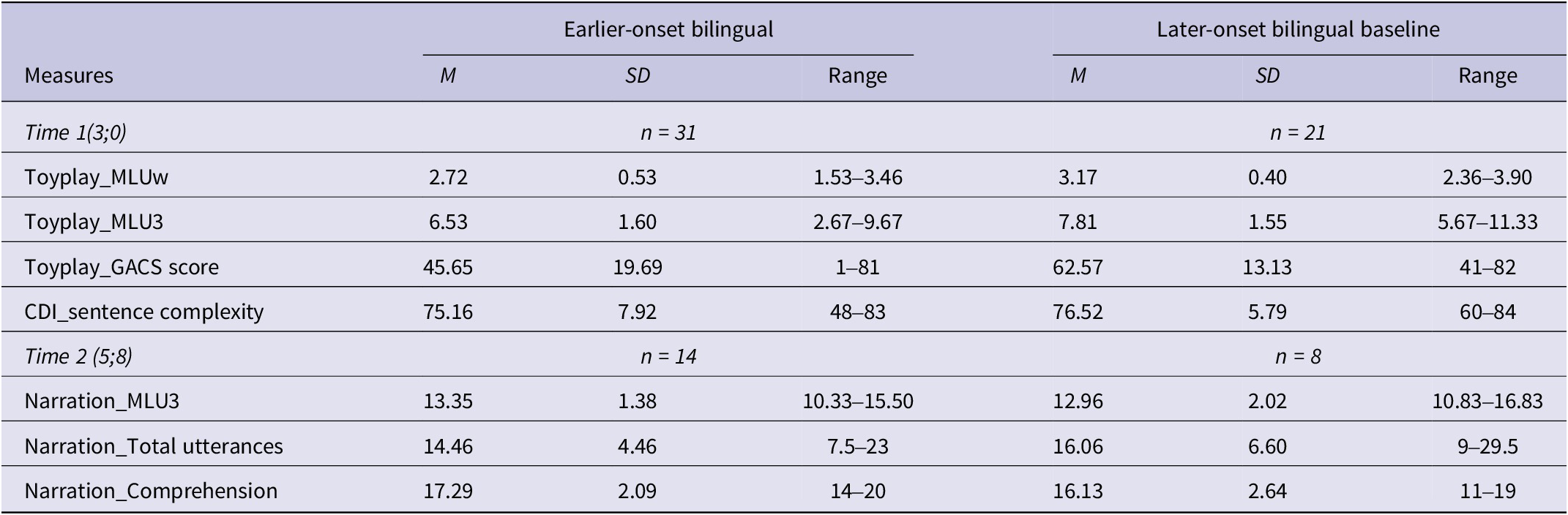
Note: ToyPlay = caretaker–child 10-minute standard toy play with Cantonese as the intended language; narration = storytelling in Cantonese (Cat and Baby Goats stories in MAIN). Narrative measures at Time 2 averaged across two stories.
GACS subscores. Mean scores of the 62 GACS structures in both groups of children are presented in Table S2 in the supplementary materials. Forty-three of the structures showed either ceiling or floor effects (mean scores of both groups below 1 or above 3.5 out of 4). These structures were not informative for examining group differences and were excluded in the between-group comparison of grammatical structures.
Figure 1 shows the means of the remaining 19 structures for both groups. A Shapiro–Wilk test showed that the assumption of multivariate normality was violated. Following Choi and Marden (Reference Choi and Marden1997), we conducted a MANOVA on the ranked data using the cmanova() function in R (Wilcox & Schönbrodt, Reference Wilcox and Schönbrodt2014) on our full sample (n = 52), with GACS item scores as dependent variables. Results revealed a significant group effect (H(19) = 80.16, p < .001). Follow-up Wilcoxon signed-rank tests revealed significant group differences in eight structures: classifiers (W = 134, p = .0002, r = −.51), possessive constructions (W = 448.5, p = .008, r = −.37), directional particles (W = 184, p = .007, r = −.38), postverbal modal particles (W = 131.5, p <. 000, r = −.56), resultative particles (W = 193.5, p = .01, r = −.35), completive particles (i.e., adversative can1, quantifying saai3 and maai3, W = 193, p = .007, r = −.38), particle questions in the form of [declarative clause-particle] (W = 193, p = .01, r = −.35) and wh-questions (W = 191, p = .01, r = −.36). All tests survived FDR control (ps < .05). EB children performed higher than the baseline in possessive constructions and lower than the baseline in seven other constructions. No significant group effects were found in the other 11 structures, namely aspect markers, degree adverbs, modal auxiliaries, negation, simple serial verb constructions, hai-constructions (prepositional phrases headed by hai), object topicalization, word orders (SVO, SV and VO) and sentential temporal adverbs.
Subscores of 19 grammatical structures of the earlier-onset bilingual (EB) children and the baseline children (later-onset bilingual children at monolingual stage) at 3;0. (1,2 originally termed ‘other verbal particle’ and ‘potential particle’ in the Grammatical Analysis of Cantonese Samples, Wong et al., Reference Wong and Wong2022).

5.2. Performance at 5;8 (Time 2) and growth from 3;0 to 5;8
General measures. Table 2 reports descriptive statistics of performance measures at Time 2, among others. Each child told two stories in Cantonese (Cat and Baby Goats); all measures at Time 2 were averaged across the two stories within each subject. Group means were very close across measures, including MLU3 (EB: 13.35, LB: 12.96), total utterance (EB: 14.46, LB: 16.06) and comprehension score (EB: 17.29, LB: 16.12). Multiple regressions revealed no group effects across these general measures (MLU3: B = 0.48, SE = 0.78, $ \beta $
= .15, t = 0.62, p = .54; total utterance: B = −1.31, SE = 2.52,
$ \beta $
= .15, t = 0.62, p = .54; total utterance: B = −1.31, SE = 2.52, $ \beta $
= − .12, t = −0.52, p = .61; comprehension score: B = 1.52, SE = 1.03,
$ \beta $
= − .12, t = −0.52, p = .61; comprehension score: B = 1.52, SE = 1.03, $ \beta $
= .32, t = 1.48, p = .16), suggesting the EB children had caught up with LB peers by 5;8.
$ \beta $
= .32, t = 1.48, p = .16), suggesting the EB children had caught up with LB peers by 5;8.
GACS subscores. We coded the children’s utterances in narratives for the subset of GACS structures found to be weaker in the EB children at Time 1. Seven structures were analysed for this purpose: classifiers; postverbal resultative, directional, modal and completive (can1, saai3 and maai4) particles; particle questions; and wh-questions (see Supplementary Table S2 for mean scores of each structure). We found that both groups showed floor effects (mean scores lower than 1) in four structures (postverbal modal and completive particles, particle questions and wh-questions), likely due to a lack of felicitous contexts in the short narration tasks; these four structures were excluded from subsequent analyses. Like the general measures at Time 2, the group means were numerically very close for noun classifiers (EB: 2.71, LB: 3.06), postverbal resultative particles (EB: 1.32, LB: 1.62) and postverbal directional particles (EB: 3.00, LB: 3.06). We conducted a MANOVA on the ranked data through cmanova() in R (Wilcox & Schönbrodt, Reference Wilcox and Schönbrodt2014) with a sample of 22, with GACS item scores as dependent variables. Results revealed no significant group effects (H(3) = 4.486, p = .214).
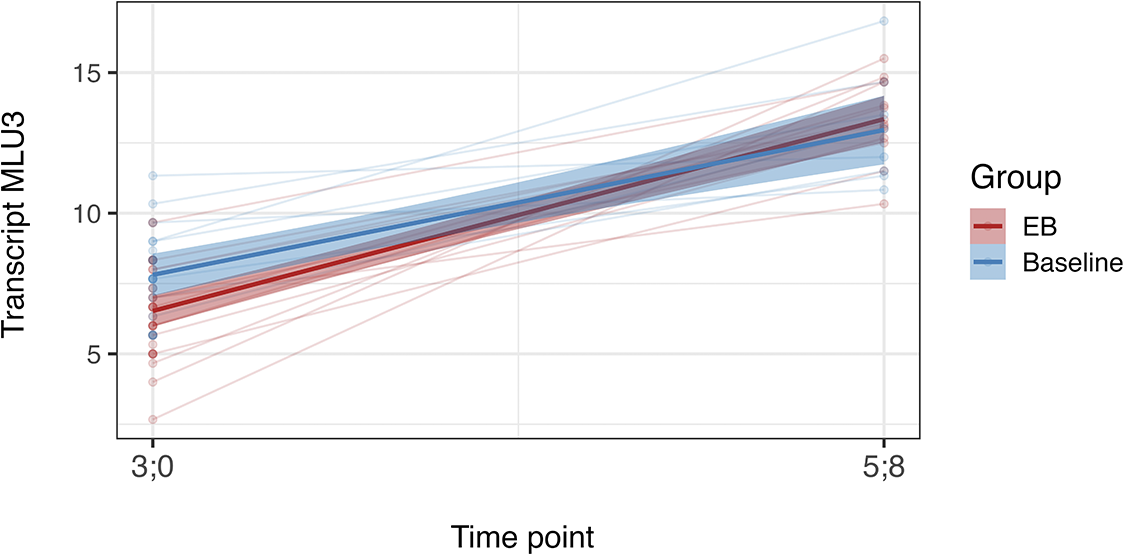
Growth between 3;0 and 5;8. As shown in Figure 2, both groups showed increased MLU3 at 5;8 (EB: 13.35; LB: 12.96), compared with 3;0 (EB: 6.53; LB: 7.81). Using the nlme package in R (Pinheiro et al., Reference Pinheiro and Bates2023), we ran a linear mixed-effect model with time point as the independent variable and by-subject random intercepts and random slope if it improved the model fit as indicated by the Akaike Information Criterion. Results showed significant time point effects in MLU3 (B = 6.82, SE = 0.50, $ \beta $
= .9, t = 13.77, p < .001), suggesting EB children had significant gains in syntactic complexity across time points.
$ \beta $
= .9, t = 13.77, p < .001), suggesting EB children had significant gains in syntactic complexity across time points.
Growth in mean length of the three longest utterances in words (MLU3) from 3;0 to 5;8 in the earlier- and later-onset bilingual (EB and baseline) children.

5.3. Input at 3;0 as predictors of outcomes in the earlier-onset bilinguals (EB)
Input measures. We calculated Cantonese input proportion from parental questionnaires and derived three input measures (word token, word type and MLUw) from transcripts of 10-min caretaker–child toy play. On average, caretakers of the EB children produced 1023.55 words and 199.48 unique words in Cantonese during the sessions, with a mean MLUw of 4.65.
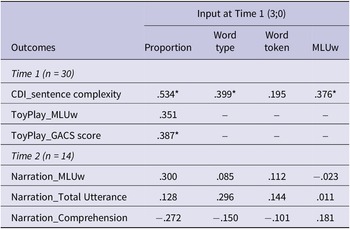
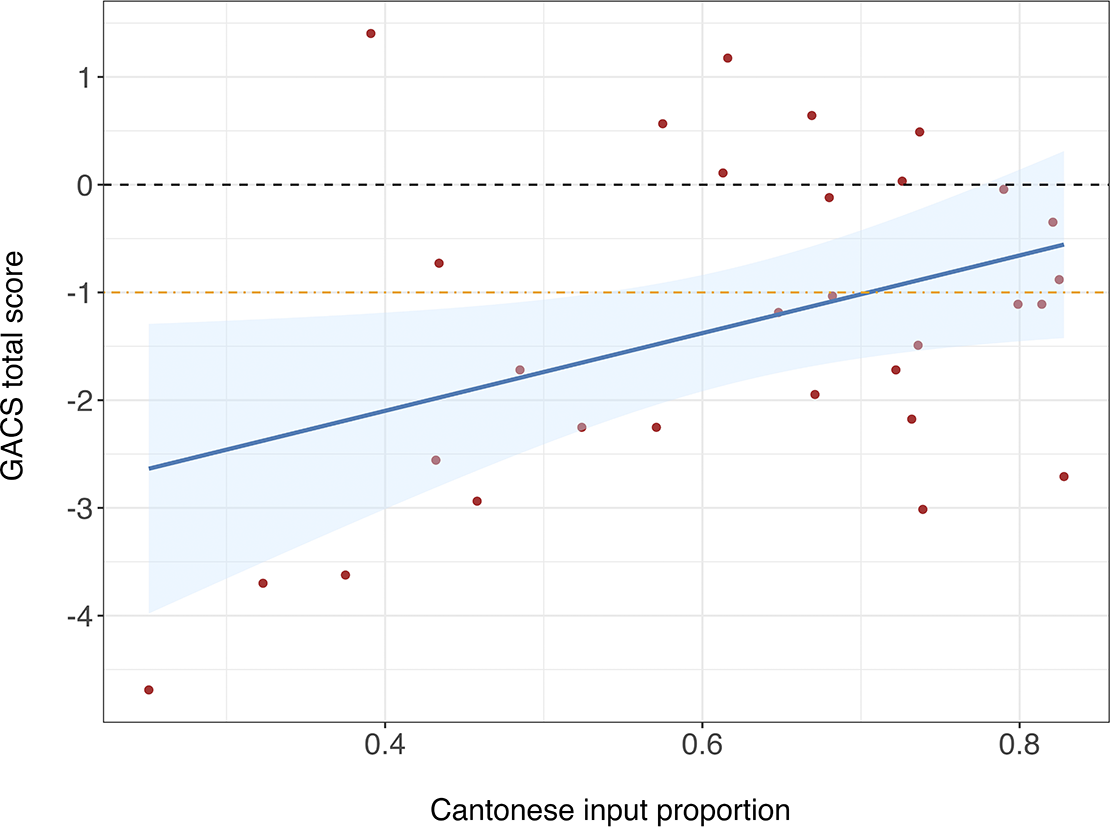
Input proportion at 3;0 ~ outcomes at 3;0 and 5;8. Zero-order correlations were run between Cantonese input proportion at 3;0 and transcript-derived performance measures. Input proportion at 3;0 was significantly correlated with two grammatical complexity measures at 3;0 (CDI sentence complexity and GACS scores, rs = .534 and .387, ps < .05) but not with any of the outcome measures at 5;8 (see Table 3). Following Thordardottir (Reference Thordardottir2011), we then transformed the EB group’s performance measures into z-scores using the means and standard deviations of the baseline group, allowing us to examine how EB children with varying Cantonese input proportions performed relative to the normal range (defined with reference to the baseline group). Note that CDI sentence complexity was excluded from this analysis due to expected ceiling effects in the baseline group at 3;0; only GACS scores were transformed. A linear fit was performed for GACS scores, with Cantonese input proportion as the predictor. The model returned a significant result (GACS: R2 = .15, p = .03). Figure 3 plots the linear fit for GACS as a function of Cantonese input proportion. Visual examination of the plot shows that the proportion of Cantonese input needed to reach the lower bound of the baseline’s normal range (1 SD below baseline mean) was approximately 70%.
Zero-order correlations between input properties at 3;0 and acquisition outcomes in Cantonese at 3;0 and 5;8 in the earlier-onset bilingual (EB) children

Note: ToyPlay = caretaker–child 10-minute standard toy play with Cantonese as the intended language; narration = storytelling in Cantonese (Cat and Baby Goats stories); *p < .05.
Distribution of GACS total score in Cantonese against input proportion of Cantonese in earlier-onset bilingual (EB) children at 3;0. Scores are standardized using the mean of the baseline children (later-onset bilingual (LB) at the monolingual stage) at 3;0. The grey and orange dashed lines indicate the mean and lower bound of the baseline normal range, respectively.

Input quality at 3;0 ~ outcomes at 3;0. CDI sentence complexity score, rather than transcript-based measures, was chosen to index child outcomes at 3;0 in this correlation analysis, because properties in child utterances are expected to correlate with the same properties in child-directed speech (CDS) in the same task due to alignment between interlocutors. Examining associations between transcript-based input measures and independent CDI-based outcome measures bypasses this methodological limitation. Since this part of the analysis involved only EB children, we did not expect ceiling effects in CDI measures as we did for LB children (see below). Zero-order correlations between input quality measures (word type, word token and MLUw) and CDI sentence complexity score at 3;0 are presented in Table 3. Both word type and MLUw in the input correlated with CDI sentence complexity score (r = .399 and .375, respectively, ps < .05), but word token in the input did not correlate with the outcome. Based on these correlations, we performed hierarchical linear regressions to determine the extent to which input properties at 3;0 accounted for individual variation in grammatical complexity among EB children at 3;0. In step 1, we built a base model with BRIEF-P, maternal education (SES) and input proportion as control variables. In step 2, MLUw and word type in the input were entered into the model one at a time. As shown in Table 4, the base model accounted for 40% of the variance, and MLUw and word type in the input accounted for an additional 15% and 8% variance of CDI sentence complexity, respectively, after input proportion, SES and cognition.
Hierarchical regression with input quality measures as predictors and child grammatical complexity at 3;0 as the response variable within the earlier-onset bilingual (EB) children (n = 30)

Note: *p < .05.
Input at 3;0 ~ outcomes at 5;8. Zero-order correlations revealed no significant correlations between input measures at 3;0 and narration outcomes at 5;8, suggesting little direct influence of input in toddlerhood on Cantonese outcomes at preschool age for the EB children (see Table 3).Footnote 1
6. Discussion
6.1. Summary of findings
This study investigated the grammatical development of Cantonese as an L1/societal language in children exposed to Cantonese and English before age 3 (EB group). Through dual language input provided by caretakers at home, these children developed productive skills in both languages before age 3. Using parental questionnaire, CDI report, caretaker–child standard toy play, elicited narrations and standardized assessments, we measured bilingual children’s performance at 3;0 and 5;8, with reference to a baseline group of LB children who had been raised monolingually in Cantonese until 3;0 and were exposed to English after 3;0. We adopted stringent inclusion criteria, recruiting EB and baseline firstborns matched on demographic factors known to be influential (e.g., SES and executive function at 3;0) and on the type of bilingual kindergarten programme between 3;0 and 5;8.
We first asked whether EB three-year-olds lagged behind the baseline in productive Cantonese grammar at 3;0. Note that the baseline children were monolingual at this point. Our regression analyses found that the EB children, as a group, exhibited reduced grammatical complexity in their utterances (measured by MLUw) and smaller inventories of grammatical structures (operationalized as the total score of 62 grammatical structures based on the adapted GACS scheme) than the baseline. Among the 19 specific grammatical structures that did not display ceiling or floor effects, the EB children showed lower type frequency (lower subscore) in seven structures, including classifiers, four sets of postverbal verb particles, wh-questions and particle questions. Meanwhile, EB children performed similarly to baseline children in many other structures (e.g., basic word orders, degree adverbs). Surprisingly, EB children produced possessive constructions more frequently than the baseline. We will discuss these structures in the next section.
Next, we examined continued L1 development in the EB children between 3;0 and 5;8. We hypothesized that EB children would benefit from social and educational L1 support and catch up with LB children by 5;8. A linear mixed-effect model showed that the EB children who returned at Time 2 (n = 14) exhibited considerable growth in grammatical complexity across time points, with MLU3 doubling from 6.53 to 13.35. Multiple regressions showed that the two groups were comparable across all production and comprehension measures (MLU3, total utterance and comprehension score) derived from the MAIN narration task at 5;8. This suggests that EB children’s growth in Cantonese grammar was steeper than that of LB children between 3;0 and 5;8.
Finally, we asked how much Cantonese input is needed for EB children to reach the normal range of the baseline group (defined as baseline group mean minus one standard deviation). Figure 3 shows that the meeting point is around 70% for GACS total score at 3;0, which is higher than the input proportion threshold for monolingual-like performance in morphosyntax identified by Thordardottir (Reference Thordardottir2015, 40%–60%), possibly due to Cantonese and English being linguistically more distant than English and French. We also asked how input quality contributes to outcomes in addition to input proportion. Our regression analyses showed that at 3;0, grammatical complexity (MLUw) and lexical diversity (word type) in the input, rather than caretaker talkativeness (word token), significantly predicted children’s grammatical complexity (CDI sentence complexity scores), accounting for an additional 15% and 8% variance, respectively, after controlling for input proportion, SES and cognitive abilities. However, none of the input measures at 3;0 correlated with outcomes at 5;8.
6.2. The costs to the L1 and the ‘costly’ grammatical structures
Measured by monolingual standards, developing the L1 alongside other language(s) comes with direct ‘costs’ to the L1, since time spent learning additional language(s) diminishes time spent learning the L1. Those costs were found in the grammatical development of L1 Cantonese in the Cantonese–English bilingual 3-year-olds in our study. Although there have been few prior studies of Cantonese–English toddlers in a bilingual society, our finding comes as no surprise, given previous studies with bilingual toddlers with other language pairs (e.g., Cote & Bornstein, Reference Cote and Bornstein2014; Miękisz et al., Reference Miękisz, Haman, Łuniewska, Kuś, O’Toole and Katsos2019) and the universality of input reduction effects – at least proportionally – in early bilingualism. Our study replicated previous findings with a new language pair.
Nonetheless, input reduction costs to the L1 are not equally extendable to all grammatical structures. By adopting a fine-grained approach, we identified the structures most susceptible to input reduction and thus most ‘costly’ in early bilingual development. Previous studies have suggested that structural overlaps or shared features between languages enable crosslinguistic transfer, thereby mitigating input reduction effects. The underlying psycholinguistic mechanism may well be that similar structures across languages are paired up (or grouped together) and co-activated in processing through between-language priming, increasing the combined frequency of the similar structures and enhancing learning (e.g., Baroncini & Torregrossa, Reference Baroncini and Torregrossa2025; Unsworth, Reference Unsworth2023). Structures that are unique to Cantonese, however, are less likely to be consistently mapped onto similar English structures and co-activated when processing English. They benefit less from crosslinguistic co-activation, and their acquisition is more reliant on their Cantonese experience. When the amount of Cantonese input is reduced to the extent that it provides insufficient cues for meaningful statistical learning (whether internally guided or not), lower-than-monolingual performance occurs.
Yet crosslinguistic similarity is best conceptualized as a continuum rather than as a binary. How similar must two grammatical structures be to induce crosslinguistic transfer in toddlers? This is a non-trivial question, also raised by Unsworth (Reference Unsworth2023). Many structures can be straightforwardly positioned at either end of the similarity continuum. For example, both Cantonese and English are SVO languages instantiating SVO, SV and VO sequences, and both have a range of verbal or adverbial elements that frequently appear preverbally to select or modify the lexical verb (e.g., modal auxiliaries, negators, degree and temporal adverbs). The EB children showed monolingual-like scores in producing such ‘similar’ structures (Figure 1). At the other end of the continuum, nominal classifiers, in-situ wh-questions and particle questions ([Declarative-SFP]) are three undoubtedly ‘dissimilar’ structures, so EB children showed below-monolingual type frequency across these structures unique to Cantonese. We propose that the contrasting degrees of crosslinguistic similarity of these structures and their correspondingly contrasting acquisition outcomes in the bilinguals in our study indicate cause-and-effect relations between the two.
Structural similarity as a causal factor in bilingual outcomes can be disentangled from frequency effects. Theoretically, structures that are similar crosslinguistically tend to be less marked and are more frequent in the language and hence in input, which may impact children’s order of acquisition of individual structures. (We thank an anonymous reviewer for raising this point.) However, we expect frequency effects in Cantonese input to impact both the EB and LB children, as both groups received Cantonese input from native Cantonese speakers and were matched in demographic and cognitive factors (Table 1). Note that the ‘affected’ structures were identified based on EB versus LB differences after screening out ceiling and floor structures, not on the relative ranking of structural scores within the EB children. The differential vulnerability of the structures in the EB children should thus be attributed to linguistic properties uniquely accessible to EB children, but not to monolinguals. The most plausible factor is therefore crosslinguistic similarity, rather than structural frequency in Cantonese.
What about structures that lie further from the poles of the continuum? Possessive constructions, for example, are realized through [possessor-ge3/classifier-possessee] in Cantonese and can be loosely mapped onto either or both of possessive’s and of-structures in English. Our findings show that the EB 3-year-olds were not weaker than the baseline in the possessive constructions, a pattern also found in Babatsouli and Nicoladis (Reference Babatsouli and Nicoladis2019), who report a Greek–English child having similar accuracy in English possessives as age-matched monolinguals. The OSV order (object topicalization) is another case of debatable crosslinguistic similarity. OSV is frequent in Cantonese and yet highly restricted in spoken English (e.g., this pot, you use). Our EB children were not significantly less productive in OSV than the monolingual children. This differs from previous findings that heritage Mandarin children in English-dominant societies (aged 5–9) performed lower than monolinguals in the OSV order (aged 5–9, Hao & Chondrogianni, Reference Hao and Chondrogianni2023), likely because our EB children had qualitatively and quantitatively higher input in their native L1 than the heritage children. Another set of structures with debatable crosslinguistic similarity are the four types of postverbal particles ([V1V2], sometimes termed resultative verb compounds or rvc). They encode rich temporal, spatial and modality meanings (e.g., completive, directional, resultative, potential), which are expressed by a variety of linguistic units ranging from words and phrases to clauses in English (see crosslinguistic comparison and bilingual acquisition findings in Yuan & Zhao, Reference Yuan and Zhao2011; Shang et al., Reference Shang, Zhao, Yip and Mai2024). Our EB bilinguals performed weaker than monolinguals across these postverbal particles, consistent with previous findings with older bilingual children in English-dominant societies (Shang et al., Reference Shang, Zhao, Yip and Mai2024).
Overall, crosslinguistic similarity accurately predicts bilingual–monolingual differences in grammatical structures that are straightforwardly ‘similar’ or ‘dissimilar’. Our findings suggest that bilingual children draw upon crosslinguistic overlaps in a bootstrapping manner to form a shared grammatical representation, mitigating input reduction. Structural similarity is thus an important factor modulating relative vulnerability among L1 structures in early bilingualism. Yet for structures with less straightforward crosslinguistic correspondences, the extent to which translation counterparts in the other language contribute to explaining outcomes remains unclear. As the first study exploring differential vulnerability in a range of grammatical structures within one group of bilingual toddlers, the degree of crosslinguistic similarity was not included as a pre-determined predictor. However, our findings have identified 19 Cantonese grammatical structures from 62 structures for future investigation. In Supplementary Table S4, we present a post-hoc analysis of crosslinguistic correspondences across the 19 structures, including their typical forms in our speech samples and potential candidates for English counterparts, to provide testable hypotheses for further research on crosslinguistic correspondence in bilingual toddlers.
6.3. Individual differences and the roles of amount and quality of early input
The proportion of Cantonese input among total language input varied across the EB children in our study, ranging from 25% to 83% (Table 1). Although the EB children, as a group, were outperformed by the baseline children at Time 1, they exhibited vast individual differences across measures, which were larger than those among the baseline group (see standard deviations in Table 2). Investigating these individual differences by controlling for SES and cognition, we showed that costs to L1 development are not inevitable at the individual level. Our analysis revealed that bilinguals with 70% input in Cantonese were able to reach the baseline in grammatical complexity and that input quality (utterance length and lexical diversity) explained 15% and 8% additional variance, respectively, in grammatical development after input proportion. However, caution is warranted in generalizing this finding to other bilingual populations. The 70% threshold was identified in the L1 of bilingual toddlers growing up in a L1-majority context; it may not apply to L1-minority contexts, namely immigrant situations. Nevertheless, for communities and societies pursuing early additive bilingualism, our findings highlight the value of investing in home input packages offering 70% of input in the native L1 to reach that goal. Where this ideal amount cannot be achieved, coaching caretakers to provide high-quality input can mitigate the costs of input reduction to L1 development.
The influence of home input, however, decreases upon the onset of formal schooling. None of the performance measures of the EB children at 5;8 was correlated with home input quality or amount at 3;0. It is logical that, as children spend more time at kindergarten, the impact of caretaker input during infancy and early childhood becomes outweighed by school exposure. Yet sustained educational support in native L1 might not be accessible to heritage children, who typically experience a substantial decrease in L1 input upon schooling. In such cases, home input, which remains their main L1 input source, might still exert a strong influence on L1 outcomes (e.g., Mai et al., Reference Mai, Zhao and Yip2022).
6.4. L1 acquisition from a longer-term perspective and methodological contributions
Developing and maintaining a native L1 is a lifelong endeavour, with numerous opportunities for learners to acquire, automatize and, in some cases, ‘lose’ L1 knowledge. The growing literature on immigrant children acquiring heritage L1 has demonstrated that the course and attainment of L1 development in these populations are characterized by large variation, moderated by child-internal and child-external factors (e.g., Cote & Bornstein, Reference Cote and Bornstein2014; Hoff et al., Reference Hoff, Core, Place, Rumiche, Señor and Parra2012; Paradis, Reference Paradis2023). Whether and to what extent home and institutional L1 support is provided continuously at preschool and school ages (e.g., Armon-Lotem & Ohana, Reference Armon-Lotem and Ohana2017; Gathercole, Reference Gathercole, Oller and Eilers2002; Mai et al., Reference Mai, Zhao and Yip2022) is a critical external factor for L1 development. In our study, although the EB children performed lower than the baseline children in their native L1 at Time 1 (‘early costs’), they demonstrated continued (and likely faster) growth afterwards, catching up with the baseline group across macro- and micro-measures of L1 narrative skills in Cantonese while demonstrating superior performance in English at Time 2 (‘long-term gains’). As such, whether and to what extent L1 development suffers ‘costs’ from infant and toddler bilingualism largely depends on the developmental time point selected for comparisons.
A number of caveats should be noted when interpreting the longer-term gains in both languages in our EB children at 5;8. Although results showed continuous growth and convergence with the baseline children at the group level, this pattern might not be applicable to each individual EB child due to wide variations in bilingual development (see Figure 3). Moreover, our EB children had at least 25% Cantonese input during toddlerhood. Convergence with baseline proficiency might not extend to bilinguals with lower proportions of L1 input. Additionally, the EB children’s advantage in English at 5;8 may be explained by the early English input they received from relatively proficient L2 English speakers, but whether and for how long such advantages in English will last after 5;8 depends on many input-related and child-internal factors after 5;8.
Our findings reveal a distinctive velocity of L1 development in additive bilinguals raised in a bilingual society at the early stages. Our inclusion of a baseline group that was monolingual at Time 1 and bilingual at Time 2 distinguishes our study from many others. Admittedly, this design prevents us from generalizing bilingual–monolingual differences at Time 2. Nevertheless, our comparison is appropriate and ecologically valid, since acquiring Cantonese in a bilingual setting is the norm, rather than a rarity, among Cantonese-learning children both in Hong Kong and in many overseas Chinese communities. Bilingual acquisition of Mandarin is also the norm for many children in mainland China. Clinicians and practitioners may consider the different developmental patterns of EB and LB children when making recommendations to parents and screening for language disorders. Specifically, the resilient and vulnerable grammatical structures identified in our analysis provide an important empirical base for further identification of clinical markers of language disorders in bilingual children.
Our study is observational and correlational by nature. However, thanks to the longitudinal design, we were able to compare the same group of EB children with the same group of baseline children across two time points. We can thus attribute the rapid growth of L1 Cantonese after 3;0 in EB children to the rich and diverse exposure to both spoken and written Cantonese in kindergarten, which closed the gap between EB and LB Cantonese development by 5;8. Formal education has been shown to promote grammatical development of the native L1 effectively in school-age heritage bilinguals (e.g., Bayram et al., Reference Bayram, Rothman, Iverson, Kupisch, Miller, Puig-Mayenco and Westergaard2017; Gathercole, Reference Gathercole, Oller and Eilers2002; Rodina et al., Reference Rodina, Kupisch, Meir, Mitrofanova, Urek and Westergaard2020); recently, Montrul and Armstrong (Reference Montrul, Armstrong and Babatsouli2024) proposed that textual exposure in formal education promotes L1 growth in a minoritized context (‘Literacy Enhancement Hypothesis’). Although our study did not test this hypothesis directly, our results are consistent with it, suggesting that it may apply to bilingual children of a much younger age in an L1-majority context.
Due to the sudden outbreak of the pandemic, we could not assess the children directly at Time 1 as originally planned, constituting a methodological limitation. However, this prompted us to develop reliable and responsible web-based remote data collection protocols. When following a standard protocol, the 10-minute caretaker–child standard play sessions recorded through Zoom in fact offer greater scheduling flexibility and document interactions in a physical environment familiar to the dyads. We recommend this new data collection format for future studies facing physical constraints.
7. Conclusions
Our study has its novelty in examining the grammatical development of the native L1 at two critical time points of early bilingual development through a combination of direct and indirect measures, with a baseline group matched for important demographic and cognitive variables. Methodologically, we innovated a web-based pipeline for recording caretaker–child play sessions, and we analysed a comprehensive set of grammatical structures from child speech samples. Our findings revealed both ‘costs’ of early bilingualism to the grammatical development of the native L1 around kindergarten entry and ‘gains’ in both languages 32 months later. By showing the significant yet different roles of input proportion and input quality in the L1 development of bilingual toddlers and the differential vulnerability of specific grammatical structures, our study sheds new light on the intricate and dynamic relations between input and outcomes in language acquisition and provides an empirical basis for future clinical applications and educational interventions. Our study has two important limitations: a relatively small sample size and a lack of direct in-person assessment at Time 1 to examine bilingual versus monolingual differences at the comprehension level. Overall, our study suggests additive bilingualism in Cantonese–English bilingual children in L1-majority contexts, in contrast to the subtractive bilingualism typically observed in L1-minority settings. Our study calls for a longer-term perspective on L1 grammatical development when, for many populations, early additive bilingualism is both the goal and the norm.
Supplementary material
The supplementary material for this article can be found at http://doi.org/10.1017/S1366728925100412.
Data availability statement
The full coding scheme of the speech samples is described in Appendix S1 and Table S1 in the supplementary materials. Transcripts of the speech samples are included in the Early Additive Child Multilingual Corpus in the Child Language Data Exchange System (CHILDES, doi:10.21415/JEFY-9F39). The data that support the findings of this study are available in OSF at https://osf.io/ujqyt/.
Acknowledgements
This study is derived from the doctoral thesis work of Yuqing Liang, supervised by Ziyin Mai. The larger study was funded by research grants from the Research Grants Council of HKSAR, awarded to Ziyin Mai (GRF/RGC #14615820, ECS/RGC #21604522). We express our deep gratitude to our colleagues for their tremendous support since the beginning of the project: Virginia Yip, Stephen Matthews, Zhuang Wu, Peggy Mok, Cecilia Chan, Jiangling Zhou, Jingyao Liu, Xuening Zhang and Mengyao Shang. The following research assistants participated in data collection and transcription in the larger project: Shiyu He, Lu Zou, Lu Zhao, Lean Luo, Ashley Chan, Katherine Chang, Yingyu Su, Haoxuan Hou, Jiaqi Nie, Yue Cao, Yue Chen, Ranee Cheng, Qiuyun Cai, Mingwei Liang and Elena Vermeer. Some of the findings were presented at the Seventh International Conference on Chinese as a Second Language Research (CASLAR-7) in Beijing, China, and the Child Language Symposium 2024 (CLS2024) in Newcastle, UK. We also thank the editors and reviewers of Bilingualism: Language and Cognition, who provided insightful comments, and Elena Vermeer, who proofread the manuscript. All remaining errors are our own.
Competing interests
The author(s) declare none.



 Open access

