To save content items to your account,
please confirm that you agree to abide by our usage policies.
If this is the first time you use this feature, you will be asked to authorise Cambridge Core to connect with your account.
Find out more about saving content to .
To save content items to your Kindle, first ensure no-reply@cambridge.org
is added to your Approved Personal Document E-mail List under your Personal Document Settings
on the Manage Your Content and Devices page of your Amazon account. Then enter the ‘name’ part
of your Kindle email address below.
Find out more about saving to your Kindle.
Note you can select to save to either the @free.kindle.com or @kindle.com variations.
‘@free.kindle.com’ emails are free but can only be saved to your device when it is connected to wi-fi.
‘@kindle.com’ emails can be delivered even when you are not connected to wi-fi, but note that service fees apply.
In this chapter we treat law as inextricably connected to a text. We examine the ways in which laws and other elements of the legal process, including documents, procedural records, and judicial opinions and commentaries, are produced, preserved, transmitted and communicated to various audiences in ancient Greece and Rome, the ancient Near East and Egypt, ancient India and ancient China. We include discussions of when and how texts first emerged in these societies, the materials on which they were written and preserved, and other special features of their written texts, such as language, syntax, degree of precision, and organization and codification. We also examine these aspects of secondary legal texts, including historical accounts and reports, literature, philosophical, religious and other intellectual works, non-legal documents, instructional materials and visual ‘texts’, to see how these contributed to the understanding of law as text.
Chapter 4 surveys a wide range of friendly and hostile interstate relations in ancient societies, where war was often the normal state of affairs. Notwithstanding the numerous conflicts, polities tried in the end, through alliances and diplomatic relations, to establish peaceful relations in view of political stability and economic prosperity. The chapter analyses hospitality rules regarding foreigners, treaties between polities and the establishment of diplomatic relations, which emerged as an international system in the ancient Near East during the mid-fourteenth century bce. An alternative to diplomacy in conflict management, typical of the Greek world, was arbitration and mediation with the help of a third party. In a final section, the chapter outlines how states, when diplomacy failed, started a war procedurally. In conclusion, the chapter argues that, in the absence of an international court, the enforcement of diplomatic rules and treaties was in many ancient societies ensured by the supranational authority of the gods.
Chapter 12 concludes the Cambridge Comparative History of Ancient Law by drawing out a set of fundamental comparisons, both differences and similarities, from the volume’s previous chapters, in addition to offering further reflections on the field of ‘ancient law’ itself. The chapter opens by comparing and contrasting the Cambridge Comparative History of Ancient Law to earlier historiography, underscoring its unique contribution to existing scholarship: developed through collaborative work and drawing upon numerous specialist traditions and technical expertise, across a pan-Eurasian research field. The chapter then moves on to a broader discussion of ‘Mapping the Ancient Legal Cosmos’ and ‘Ordering Ancient Associations’, pinpointing the specific connections between ethics, law and statecraft that can be observed across the ancient source material. The chapter concludes by suggesting several answers to a provocative, but fundamental, question: What is ‘Ancient’ about ‘Ancient Law’?.
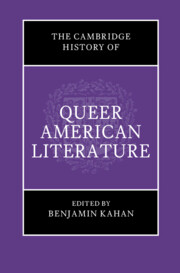
Moby-Dick's Ishmael and Queequeg share a bed, Janie in Zora Neale Hurston's Their Eyes Were Watching God imagines her tongue in another woman's mouth. And yet for too long there has not been a volume that provides an account of the breadth and depth of queer American literature. This landmark volume provides the first expansive history of this literature from its inception to the present day, offering a narrative of how American literary studies and sexuality studies became deeply entwined and what they can teach each other. It examines how American literature produces and is in turn woven out of sexualities, gender pluralities, trans-ness, erotic subjectivities, and alternative ways of inhabiting bodily morphology. In so doing, the volume aims to do nothing less than revise the ways in which we understand the whole of American literature. It will be an indispensable resource for scholars, graduate students, and undergraduates.
Through the energetic work of the reformer John Calvin, the small city-state of Geneva became the so-called Protestant Rome in the sixteenth century. Calvin created a morals court, the Consistory, which worked in conjunction with the city council to attack a wide range of ‘sins’, including illicit sexuality, defined as all sexual activity outside of marriage. In Calvin’s time, authorities pursued male and female fornicators (including fiancés) with the same rigour and on rare occasions sentenced adulterers to death. After Calvin’s death a double standard appeared in the treatment of adultery, most blatant in the fact that sexual relations between female servants and their married masters resulted in more severe penalties for the former than the latter. Same-sex relations were considered crimes against nature, but authorities adjudged those involving men much more severely than those involving women, probably based on a belief that sexual relations between male partners degraded them to the level of women. Although a few men were prosecuted for rape, religious and political authorities largely enhanced patriarchy; given the persistent numbers of people who were summoned, they clearly were also less successful in nurturing self-control among Genevans in their sex lives than in other areas of behaviour.
This chapter surveys the culture, knowledge, practice, and experience of sex in Chang’an (modern Xi’an), capital of Tang dynasty China, during the eighth and ninth centuries. It discusses courtesans and candidates, medical and religious texts, sex in literature, and ideals and practices of marriage. The era coincided with the height of the examination culture, whereby all government officials were expected to demonstrate high literacy skills and knowledge of Confucian classics. As the Tang administration increasingly relied on the civil service examinations to recruit high-ranking officials, so Chang’an became the site where examination candidates and graduates mingled with courtesans and flaunted their sensual pleasures. The changing religious landscape throughout China also reshaped how sex was understood and experienced in Chang’an in the Tang era: while Daoist sexologists continued to produce writings about the art of the bedchamber, Tantric Buddhist ideals of sexuality as a source of spiritual energy took root. Meanwhile Tang medical texts discussed sex extensively, providing a theoretical basis for treating symptoms related to intercourse and pregnancy and prescribing aphrodisiacs. The very first wave of erotica in Chinese history appeared. Aspects of Chang’an sexuality exerted a strong influence on sexuality in China for centuries to come.
In the Afro-Atlantic city of Lagos, Africans birthed sexualities in slavery and colonialism. Sex undergirded the politics of emancipation, imperial subjecthood, urbanization, and social differentiation. Africans navigated sexual politics as an afterlife of slavery, living a spectrum of gendered unfreedoms ranging from the persistence of slavery to reinventions of Atlantic slavery’s hierarchies under the guise of abolition. Where old slaving and neo-imperial African and European elites exploited African bodies for labour, sex, and power, discourses about the potency and danger of sexed bodies, including slaves, redeemed and adopted children, ‘wives’, soldiers, ‘prostitutes’, ‘delinquent youth’, domesticated and politically marginalized women, and ‘sexually perverse’ subjects, constituted the polysemic production of sexualities. Sexual politics drove British imperial compromises over abolition as well as colonialist conceptions of male bodies capable of wage labour, sports, and political leadership, as distinct from female bodies best suited for social and biological reproduction. Local resistance entailed age- and gender-distinctive conceptions of bodily autonomy to repudiate elite theft of bodily potency and escape the surveillance state. In Lagos the state policed Black youth mobility, criminalized ‘carnal knowledge against the order of nature’, and used military violence to restrain nonconformist sexuality because it asserted power through sex governance.
Human trafficking is a juridical concept invented in the nineteenth century that reappeared in the late twentieth century. The concept was created amid discussions about policing of national borders and reflected panics concerning the ideal of feminine purity, when women were seen in the discourse of the time as needing protection. In this chapter we will show how discourse in support of combating human trafficking for sexual exploitation has used ideas about gender and raciality to justify policies to contain migration. The twentieth century was marked by conquests of women”s rights, and white women are no longer seen as being in need of protection as were those of the nineteenth century. However, attributes that are both accusatory and victimizing still weigh on non-white women, especially when they are involved in sex work across national borders. In these terms, there is no space for women understood as victims of trafficking for sexual exploitation to be able to affirm their labour demands based on their own understandings about what constitutes sex work, violence, and exploitation.
and sex between women. The history of female homoerotic relations throughout time and in different places is widely varied, shaped by the societies and cultures in which women lived. How women act on their desires, what kinds of acts they engage in and with whom, what kinds of meanings they attribute to those desires and acts, how they think about the relationship between love and sexuality, whether they think of sexuality as having meaning for identities, whether they form communities with people with like desires—all of this differs across time and place. Yet there are discernible patterns, both in the ways that homoerotic relations have been conceived within persistently male-dominated social arrangements and in the forms of desire and intimacy experienced by women. A global historical view makes clear that emergence into public is not everywhere significant, that desire and love between women can flourish within heteronormative social arrangements, and that the emergence of a lesbian identity is a minor part of the whole story of female homoerotic relations.
This chapter presents an overview of key views on erotic desire and its management as well as common practices and norms in the Greek and Roman worlds from the seventh century BCE to the third century CE. No single canonical text or religious moral code existed that prescribed sexual relations. Instead, we rely on their rich textual and visual culture to reconstruct standards, attitudes, and practices. We know most about the sexuality of elite male citizens since most texts and visual objects were created by and for them. Gender and status were key components in any sexual relations, with the citizen male having the greatest access to partners: wives, sex labourers, other free men and boys, and enslaved people. Sexual virtue was expected of free citizen women and girls, but it may not have excluded sexual relations with other females, at least in the Greek world. The chapter surveys concepts of desire in literature (by genre) and sexual imagery in art (including male, female, and transgender bodies), and considers the everyday practices and experiences of sexuality for free, enslaved, elite, and non-elite. What emerges is a complex and even conflicting view of desire and sexual relations. Rather than a belief system, we more accurately talk about discourses of ancient sexualities.
Ancient Egyptian ideas about sex changed over time in close relation to changes in gender power relations. The comprehensive overview of textual and iconographic sources in this chapter indicates that discourses on sex did exist. Desirable bodies were either depicted or described in poetry. Pleasures could be sought in different sexscapes such as e.g., houses, gardens, streets, festivals, marshes and bathhouses. Festival sex had long history and was connected to the celebration of the return of the wondering Sun Eye goddess. She was pacified through consumption of alcohol and sexual intercourse. Sex-work is also attested, but its closer regulation through taxation does not predate Roman occupation. This is also the period when classical authors such as Strabo, formed the orientalist trope of sacred prostitution in Egyptian temples. However, contrary to this trope, sex is rarely depicted in state sponsored art and is found in media such as ostraca or rock art. Similarly, same-sex intercourse is attested throughout Egyptian history but rarely depicted. Passivity in intercourse between men was looked down upon. It even served as a metaphor to designate enemies of Egypt. Sexual violence was punishable but easily confused with adultery, putting women in precarious positions.
This chapter is a comprehensive history of sexually-explicit literature drawn from books banned and prosecuted in Asia and Europe, sixteenth to twentieth centuries. The prurient treatment of sexual violence and the lewd mockery of authority form part of this discourse, yet law and censorship denied its literary value, reduced all erotica to the most basic “obscenity” or mere “pornography” (literally, “whore-writing”), and sometimes put the author to death. (Paradoxically the cultures richest in sex-writing also suppressed it most fiercely.) Here is a more complex history, hybridizing multiple genres: manuals of sexual positions, courtesans” autobiography, satire against hypocrisy and repression, philosophies of mind, body, and desire – normally homoerotic, though in China and the West true knowledge of sexuality is represented as female, passed down by mistresses of the secret arts providing instructions for the wedding night (and beyond). The phallus was even gendered female. Libertinism continued to explore same-sex desire (especially in Italy and Japan), while its heteronormative branch dissociated sexuality from procreation, insisting that biological sex should be transformed into an art of aesthetic “transmutation”, urging women to pursue erotic pleasure as a supreme end in itself – centuries before contraception made this realistic. Feminocentric and masculinist perspectives intertwine.
This chapter discusses the contribution of anthropology to the understanding of the diversity of practices and attitudes towards sexualized bodies developed by different human cultures, beginning with the works of classical anthropologists, including E.E. Evans-Pritchard, Margaret Mead and Bronisław Malinowski. It discusses Marxist, feminist, and postmodern anthropology, and reflects on the influence of Michel Foucault, particularly his notion of the dispositif, the device of sexuality. The chapter argues that the device of sexuality—that is, that there is such a thing as “sexuality”—is modern and Western. The sexual life of the peoples studied by anthropologists is an inseparable part of their social order and its reproduction, and in no way constitutes a separate sphere of existence that can be studied as such, nor does it constitute the core of any identity, either personal or collective. The task of anthropology consists in restoring how these peoples deal with the sexual in their own social and cultural terms, respecting their radical otherness.
This chapter discusses social concepts, notions and assumptions that prevailed in the ancient Near East concerning human sexuality. Its introduction supplies chronological, geographical, and cultural definitions to explicate what is meant by the term ‘ancient Near East’, and expands on the sources of information used in the chapter, their contributions and limitations. The introduction also elaborates on the categories and aspects of human sexuality discussed in the chapter. Subsequently, the chapter is organized thematically. Each theme focuses on a specific category of sexuality, which is discussed according to the pertinent sources of information available to us, including legal, literary, cultic, and others. The categories surveyed in the chapter are: Sex and Reproduction, Sex and the Body, Gender Norms and Inequality, Sex and Marriage, Sex and Slavery, Sex and Politics, Sex and Religious and Cultic Practices, and Sex and Criminal Law. The chapter demonstrates how different textual genres reflect the role of sexuality in ancient Near Eastern societies: official law regulated sexual behaviour, literary texts echoed social norms, and cultic texts related to a variety of matters that involved human sexuality. The chapter highlights topics such as male privilege and gender inequality, social hierarchy, and cultural differentiation.