A collection of out-of-copyright and rare books from the Cambridge University Library and other world-class institutions that have been digitally scanned, made available online, and reprinted in paperback.
To save content items to your account,
please confirm that you agree to abide by our usage policies.
If this is the first time you use this feature, you will be asked to authorise Cambridge Core to connect with your account.
Find out more about saving content to .
To save content items to your Kindle, first ensure no-reply@cambridge.org
is added to your Approved Personal Document E-mail List under your Personal Document Settings
on the Manage Your Content and Devices page of your Amazon account. Then enter the ‘name’ part
of your Kindle email address below.
Find out more about saving to your Kindle.
Note you can select to save to either the @free.kindle.com or @kindle.com variations.
‘@free.kindle.com’ emails are free but can only be saved to your device when it is connected to wi-fi.
‘@kindle.com’ emails can be delivered even when you are not connected to wi-fi, but note that service fees apply.
Sir James Prescott Joule (1818–1889) became one of the most significant physicists of the nineteenth century, although his original interest in science was as a hobby and for practical business purposes. The son of a brewer, he began studying heat while investigating how to increase the efficiency of electric motors. His discovery of the relationship between heat and energy contributed to the discovery of the conservation of energy and the first law of thermodynamics. Volume 2 of his collected papers, published in 1887, contains those which he co-authored with other noted physicists, such as Scoresby, Playfair and William Thomson, later Lord Kelvin. Because he was based in Manchester, and was not an academic, Joule's work was at first ignored by the scientific establishment, but Thomson's approval helped him gain acceptance. His joint work with Thomson on thermodynamics was fundamental to the development of significant areas of twentieth-century physics.
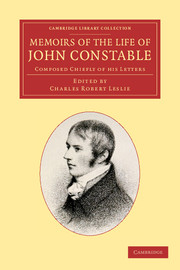
First published in 1843 and reissued here in its expanded second edition of 1845, this biography represents an early and informed portrait of the prolific landscape artist and draughtsman John Constable (1776–1837). An upbringing in the East Anglian countryside and his first sighting of a painting by Claude Lorrain inspired his lifelong dedication to capturing scenes from nature, reflected in early works such as Dedham Vale (1802) and in his mature masterpieces, notably The Hay Wain (1821). Prepared by Charles Robert Leslie (1794–1859), a close friend and fellow member of the Royal Academy, this work is based principally on his collection of Constable's letters and papers, drawing also on friends' accounts of the artist. Illuminating his relationship with Maria Bicknell and the influence of early mentor Sir George Beaumont, the book details the development of Constable's career, revealing the nature of his opinions and anxieties.
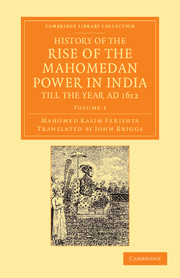
The Persian chronicler Ferishta (1560–1620) composed his great work, published in this four-volume English translation in 1829, at the court of Bijapur - where he spent most of his life - under the patronage of King Ibrahim Adil Shah II. It covers Muslim India from around 975 to 1612 and is notable for its balance, despite Ferishta's close involvement with some of the events and people he records. In the translator's preface, East India Company officer John Briggs (1785–1875) highlights the danger of misconceptions about the people of India and the importance of religious policy in the success or failure of her various governments. Volume 1 includes introductory matter, a chapter on pre-Muslim India, histories of the Ghaznavid kings of Lahore, and information on the rulers of Delhi. Also included is Briggs' valuable comparative chronology of events in Europe and India.
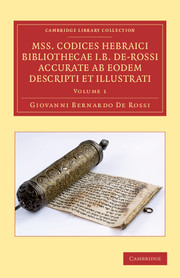
Published in 1803, this is the first part of a three-volume descriptive catalogue of the Hebrew codices in the personal library of Giovanni Bernardo De Rossi (1742–1831), professor of oriental languages at the University of Parma. Each codex is numbered and its contents briefly described in Latin. Volume 1 includes an introduction (in Latin) and descriptions of codices 1–346 from a total of 1,377. De Rossi was an important collector of manuscripts and incunabula, and an authority on Hebrew typography and textual variants. The manuscripts described in this catalogue were obtained as a result of his exhaustive researches into variant readings of the Old Testament, the results of which he published in Variae lectiones veteris testamenti (1784–8). He also produced groundbreaking studies of printed Hebrew texts, and a catalogue of Jewish anti-Christian polemics, Bibliotheca judaica antichristiana (also reissued in this series).
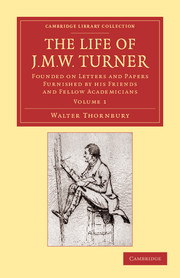
This pioneering two-volume biography, first published in 1862, explores the genius of the groundbreaking Romantic landscape and historical painter J. M. W. Turner (1775–1851). As both journalist and historian, author Walter Thornbury (1828–76) has a light touch, yet he draws on a wide range of correspondence, sketchbooks, watercolours and etchings to give a detailed picture of Turner's artistic development and connections, and his increasingly eccentric character. Volume 1 traces the artist's progress from humble cockney beginnings, through youthful friendship and rivalry with Thomas Girtin and a stint as a drawing-master, to his establishment as a Royal Academician at the heart of the nineteenth-century art world. Thornbury sees Turner from all angles, covering his travels at home and abroad, his watercolour and printmaking techniques, his love of sea and sky and colour gradations, and even his fraught monetary dealings. The author also fully contextualises great works like Ulysses Deriding Polythemus and The Fighting Temeraire.
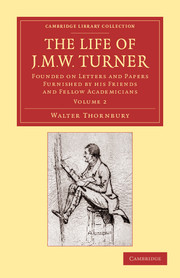
This pioneering two-volume biography, first published in 1862, explores the genius of the groundbreaking Romantic landscape and historical painter J. M. W. Turner (1775–1851). As both journalist and historian, author Walter Thornbury (1828–76) has a light touch, yet he draws on a wide range of correspondence, sketchbooks, watercolours and etchings to give a detailed picture of Turner's artistic development and connections, and his increasingly eccentric character. Volume 2 fills out the record by detailing the artist's relationships with patrons such as Lord Egremont of Petworth House, and such fellow Royal Academicians as the sculptor Sir Francis Chantrey. Among the topics covered here are Turner's love of poetry, dealings with buyers, miserliness (or otherwise), the tailing off of his powers, and his final mysterious metamorphosis into 'Admiral Booth'. Advised by Ruskin not to try to 'mask the dark side' of his subject, Thornbury presents a rounded but still admiring picture of his hero.
Joined by seven eminent natural scientists, including Karl von Scherzer (1821–1903), the Austrian naval expedition of 1857–9 was remarkable for its globe-spanning scale. During the course of the voyage, the naturalists collected an abundance of samples which contributed to several scientific discoveries, including the isolation of cocaine in its pure form. Some of the investigations also revolutionised knowledge in such fields as geology, oceanography, hydrography and geomagnetism, and are still being studied by modern-day researchers. Prepared by Scherzer and first published in English in 1861–3, this is a compelling three-volume account of the mission, remaining relevant to scholars interested in naval exploration and the history of science. Volume 3 includes notes on Sydney, Auckland, Tahiti, the coastal cities of South and Central America, and the journey back to Europe, as well as reflections by the author on the achievements of the expedition.
The Persian chronicler Ferishta (1560–1620) composed his great work, published in this four-volume English translation in 1829, at the court of Bijapur - where he spent most of his life - under the patronage of King Ibrahim Adil Shah II. It covers Muslim India from around 975 to 1612 and is notable for its balance, despite Ferishta's close involvement with some of the events and people he records. Valuable additions to the text made by the translator, East India Company officer John Briggs (1785–1875), include genealogical tables and notes, as well as a comparative chronology of events in Europe and India. Volume 3 continues with coverage of the five Deccan sultanate states from 1518. This includes Briggs' own valuable account of the history of the kings of Golkonda and a chronology of the Portuguese wars in India. The coverage of the Adil Shahi dynasty of Bijapur in the sixteenth century notably draws on Ferishta's first-hand knowledge.
Joined by seven eminent natural scientists, including Karl von Scherzer (1821–1903), the Austrian naval expedition of 1857–9 was remarkable for its globe-spanning scale. During the course of the voyage, the naturalists collected an abundance of samples which contributed to several scientific discoveries, including the isolation of cocaine in its pure form. Some of the investigations also revolutionised knowledge in such fields as geology, oceanography, hydrography and geomagnetism, and are still being studied by modern-day researchers. Prepared by Scherzer and first published in English in 1861–3, this is a compelling three-volume account of the mission, remaining relevant to scholars interested in naval exploration and the history of science. Volume 2 covers the leg from India to Australia, with notes on the Nicobar Islands, Singapore, Java, Manila, Hong Kong, Shanghai, and Pacific archipelagos.
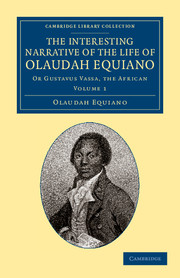
Nigerian-born Olaudah Equiano (c.1745–97), also known as Gustavus Vassa, was sold into slavery as a child and endured the horrors of the transatlantic slave ships. He later worked on board Royal Navy vessels, receiving an education and converting to Christianity. Buying his freedom in 1766, he embarked on several voyages before settling in London, where he became involved in the causes of anti-slavery and the welfare of former slaves. Published in 1789, this successful two-volume autobiography boosted the abolitionist cause, providing a first-hand account of the experience of Africans on both sides of the Atlantic. An important document in the history of slavery and immigration, it remains a classic work of black writing. Volume 1 begins with Equiano's background and kidnapping, and the Atlantic crossing. He recounts his adventures in the Royal Navy during the Seven Years' War, and subsequent experiences of merchant trading in the Americas.
'Next to the Bible, In Memoriam is my comfort.' Queen Victoria's reliance, after the death of Prince Albert, on this poem by Alfred Tennyson (1809–92), Poet Laureate from 1850, epitomises its place at the heart of Victorian public and private life. The most famous poem of its age and an instant bestseller, In Memoriam was an elegy for Arthur Henry Hallam, Tennyson's closest friend, who had died young in Vienna in 1833. Its distinctive iambic tetrameter stanzas - begun days after the news reached Tennyson, and reworked for the next seventeen years - explore the nature of grief, religious consolation, and profound anxieties about man's relationship with nature, articulating the quintessential Victorian emotions of mourning and troubled faith. This reissue is of the third edition, published in 1850, the same year as the first.
Published between 1828 and 1840, Napier's History of the War in the Peninsula was a tremendously influential, if controversial, work. Napier had been actively involved in the campaigns, turning to history in peacetime, in part to refute Southey's account of Sir John Moore. The first volume had a mixed reception, getting both high praise and bitter criticism from participants in the wars. He published several works rebutting his critics while producing the later volumes. Because of his obvious lack of impartiality, modern military historians treat the work with caution, but it remains widely read in the many editions and abridgements subsequently produced. Volume 2 covers the period from the beginning of 1809 to the British retreat back to Portugal after the Battle of Talavera in July. Significant events include the departure of Napoleon to France, and Wellesley's return to Portugal as commander of the Anglo-Portuguese forces.
In her third novel, reissued here in its first edition of 1861, George Eliot (1819–80) charts the life of the cataleptic, miserly weaver Silas Marner. Arriving in insular Raveloe after a wrongful expulsion from his Calvinist community in the north, Silas is a foreign and outcast figure, left alone to accumulate a useless fortune through his loom in the dawn of the new industrial age. His unhappy life is rendered unrecognisable when his fortune is stolen and he adopts a child. Eliot's first two novels, Adam Bede and Mill on the Floss, had dealt with tragedy and the injustices faced by fallen women. With its happy ending and suffusion of fairy-tale elements, Silas Marner marks a turning point in her career. Alongside this development, however, the novel continues to raise Eliot's characteristic questions about social inequalities, the effects of extreme religion, and the worth of human experience.
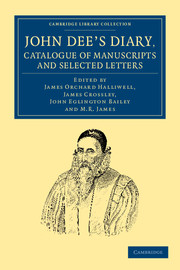
John Dee (1527–1608), popularly remembered as an alchemist and spiritualist, was an enthusiastic scholar specialising in mathematics and astronomy, and collected manuscripts, early printed books and scientific instruments. Despite meeting Elizabeth I in person, he never progressed in the Church, and died in poverty. The four selections from his writings reissued here show Dee painstakingly listing his books before a journey to Europe, and appealing to the Queen for help when, after a catastrophic burglary at his library and the destruction of his laboratory equipment, his pay also failed to arrive. J. O. Halliwell (1842) reproduces the full text of Dee's diaries with an index; James Crossley (1851) transcribes Dee's appeals to the Queen; Bailey's book (1880), of which only 20 copies were printed, contains a full commentary on the last five years of the diaries; and M. R. James (1920) researches the fate of Dee's books over the centuries.