A collection of out-of-copyright and rare books from the Cambridge University Library and other world-class institutions that have been digitally scanned, made available online, and reprinted in paperback.
To save content items to your account,
please confirm that you agree to abide by our usage policies.
If this is the first time you use this feature, you will be asked to authorise Cambridge Core to connect with your account.
Find out more about saving content to .
To save content items to your Kindle, first ensure no-reply@cambridge.org
is added to your Approved Personal Document E-mail List under your Personal Document Settings
on the Manage Your Content and Devices page of your Amazon account. Then enter the ‘name’ part
of your Kindle email address below.
Find out more about saving to your Kindle.
Note you can select to save to either the @free.kindle.com or @kindle.com variations.
‘@free.kindle.com’ emails are free but can only be saved to your device when it is connected to wi-fi.
‘@kindle.com’ emails can be delivered even when you are not connected to wi-fi, but note that service fees apply.
Sir David Wilkie (1785–1841) is often called the first truly international British artist. This three-volume biography, published in 1843, two years after Wilkie's sudden death while on a tour of the Mediterranean, and containing extracts from his journals and letters, remains an indispensable source for his life and works. Born in Scotland, Wilkie became a student at the Royal Academy in 1805, and in the following years the uncompromising realism of his scenes from rural life made his name known and attracted royal patronage: he was appointed 'the King's Limner in Scotland' by George IV. This work was compiled by his friend, the poet and critic Allan Cunningham (1784–1842), who himself died shortly after correcting the proofs: it was seen through the press by his son. Volume 1 traces Wilkie's life from his childhood, through student days, to his visit to Sir Walter Scott at Abbotsford 1817.
William Marshall (1745–1818), an experienced farmer and land agent, published this work in 1795, and early in 1796 produced a second edition (reissued here), 'with large additions'. The two-volume work was intended as a practical guide for the owners or managers of large estates on how to establish and maintain timber plantations, both for their financial value and also as important decorative elements in the landscaping of the surroundings of the owner's house. The work covers the practical issues of planting, propagating and transplanting, and discusses the choice of trees for different commercial purposes, and the planning and maintenance of hedgerows, as well as ornamental buildings. Volume 2 begins with an account of the Linnaean system of plant classification and its sexual basis, and supplies both an alphabetical list of trees and shrubs in their Latin Linnaean classes, and an index of plants under their English names.
George Petrie (1790–1866) grew up in Dublin, where he trained as an artist. He became fascinated by Irish antiquities and travelled around the country studying ancient sites while working for the Ordnance Survey of Ireland and the Royal Irish Academy. He won awards for his publications on art and architecture, including the influential The Ecclesiastical Architecture of Ireland, Anterior to the Anglo-Norman Invasion (1845), which is also reissued in this series. This collection of Irish-language inscriptions was edited after Petrie's death by Margaret Stokes (1832–1900), the archaeologist daughter of his friend William Stokes, and published in two volumes between 1872 and 1878. Volume 1 is devoted to the important early medieval monastery at Clonmacnoise. It opens with an essay on the historical background, and contains drawings of over 170 inscriptions connected with the monastery. Each is accompanied by notes on its subject, date, script, decoration and linguistic features.
The tale of the ill-fated HMS Wager gripped the public's imagination, feeding its taste for dramatic accounts of survival against the odds. Part of George Anson's squadron that had been sent to harass Spanish ships in the Pacific, she was wrecked after rounding Cape Horn in 1741. The majority of the survivors, led by ship's gunner John Bulkeley, mutinied against their irascible and unpredictable captain and chose to make their own way home in what would become one of the most hazardous journeys ever recorded. Their journey took them over 2,000 miles in an open boat through ferocious seas, enduring starvation and extreme privation. Two years after the disaster, the thirty remaining men arrived back in England. Bulkeley and ship's carpenter John Cummins published this account in 1743. Also reissued in this series is the 1768 account of John Byron, who had been midshipman aboard the Wager.
When this work was published, its original author had been dead for fifty years. As the title page explains, the work of Joseph Ames (1687–1759) was considerably augmented by William Herbert (1718–95), and then 'greatly enlarged, with copious notes, and illustrated with appropriate engravings' by Thomas Frognall Dibdin (1776–1847), several of whose other works are also reissued in this series. Ames' history of printing, based on his own collection, was published in 1749, as an aid to booksellers in identifying old works (and modern forgeries). Herbert, a printseller and bibliophile, acquired Ames' own interleaved copy of the work and intended to enlarge it, but died having completed only three of six proposed volumes. His working copies then passed to Dibdin, who eventually published this four-volume edition between 1810 and 1819. Volume 2 considers the lives and work of printers including Wynken de Worde and Richard Pynson.
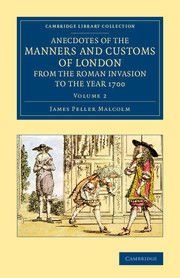
Born in Philadelphia, James Peller Malcolm (1767–1815) travelled to London in 1787, remaining there until his death. Initially hoping for a career as a landscape painter, he became well known for his engravings, which appeared in the Gentleman's Magazine from 1792, and for his books on history that made extensive use of original local records. First published in 1808, Anecdotes gives a typically personal and often light-hearted account of the history and customs of Malcolm's adopted city. Illustrated with his engravings, the work ranges from considering the diet and dress of the ancient Britons to suggesting that the Great Fire of London was state-sanctioned to rid the city of plague. This is the 1811 second edition of a valuable and often entertaining insight into English social history. Volume 1, concerned with 'society', considers the lives of the earliest Britons, English diet over the ages, and the origins of English character and customs.
These 'opinions and reflections of Napoleon … in his own words' were published in two volumes in 1822 (the year after the ex-emperor's death). Little is known about the early life and medical training of their author, Barry O'Meara (1770?–1836), but he happened to be on HMS Bellerophon when Napoleon came on board to surrender in August 1815. His medical experience and ability to speak Italian caused Bonaparte to ask him to act as his personal physician in his exile, and O'Meara obtained official permission to do so. However, relations between Napoleon's household and the governor of the island, Sir Hudson Lowe, deteriorated, and O'Meara was consequently required to leave in 1818. This fascinating and controversial work, which went into five editions, describes Napoleon's exile and records his opinions, but is also a polemic against Lowe's allegedly harsh treatment of his prisoner, later strongly denied by other witnesses.
Employed early in his career by Sir Joseph Banks, the botanist John Lindley (1799–1865) is best known for his recommendation that Kew Gardens should become a national botanical institution, and for saving the Royal Horticultural Society from financial disaster. As an author, he is best remembered for his various works on taxonomy and classification. This work, one of his most famous, was first published in 1846; reissued here is the revised third edition of 1847. Lindley describes his motive as being 'to make his countrymen acquainted with the progress of Systematic Botany abroad' given that the 'superficial and useless system of Linnaeus' was now consigned to history. The work, nonetheless an important milestone in the development of plant taxonomy, gives an overview of the various classification systems used since that of John Ray, and goes on to define the vegetable kingdom in terms of classes and 'alliances' of plants.
These 'opinions and reflections of Napoleon … in his own words' were published in two volumes in 1822 (the year after the ex-emperor's death). Little is known about the early life and medical training of their author, Barry O'Meara (1770?–1836), but he happened to be on HMS Bellerophon when Napoleon came on board to surrender in August 1815. His medical experience and ability to speak Italian caused Bonaparte to ask him to act as his personal physician in his exile, and O'Meara obtained official permission to do so. However, relations between Napoleon's household and the governor of the island, Sir Hudson Lowe, deteriorated, and O'Meara was consequently required to leave in 1818. This fascinating and controversial work, which went into five editions, describes Napoleon's exile and records his opinions, but is also a polemic against Lowe's allegedly harsh treatment of his prisoner, later strongly denied by other witnesses.
In 1876 the South Kensington Museum held a major international exhibition of scientific instruments and equipment, both historical and contemporary. Many of the items eventually formed the basis of collections now held at London's Science Museum. In May 1876, organisers arranged a series of conferences at which leading British and European scientists explained and demonstrated some of the items on display. The purpose was to emphasise the exhibition's goal not merely to preserve archaic treasures (such as Galileo's telescopes or Janssen's microscope) but to juxtapose them with current technology and so inspire future scientific developments. Volume 1 of the proceedings is devoted to physics and mechanics. The contributors include William Thomson (Baron Kelvin), John Tyndall, Francis Galton, James Clerk Maxwell, J. A. Froude and Thomas Stevenson, all of whom have other works reissued in the Cambridge Library Collection, which also includes the full catalogue of the exhibition itself.
This useful topographical dictionary was compiled by Samuel Ball Platner (1863–1921) of Western Reserve University in collaboration with Thomas Ashby (1874–1931), the third director of the British School of Archaeology at Rome. Sadly, Platner died before the work was completed, and Ashby eventually published it in 1929. The bulk of the work is an alphabetical list of the buildings, streets and geographical features in ancient Rome mentioned by ancient authors and/or discovered by more recent exploration and excavation of the ruins, with details about literary and historical references, and about the original and any surviving structure. There is also a chronological index to those monuments and other buildings that are dateable, and a large map (downloadable from the web at www.cambridge.org/9781108083249). With listings from 'Acca Larentia' to 'Zater(…nses)', the work is an invaluable tool in the exploration of Rome, whether by the scholar, student, or visitor.
The botanist Robert Brown (1773–1858) is regarded as one of the most significant figures in the advancement of plant science in the nineteenth century. After studying at Aberdeen and Edinburgh, he made the acquaintance of Sir Joseph Banks via William Withering, and in 1801 was appointed as naturalist on Matthew Flinders' expedition to Australia. Brown made extensive collections of animals and minerals, but his 3,400 plant specimens from Australia, Tasmania and Timor were the foundation of his work for the rest of his life, as an active member of the Linnean Society, as Banks's librarian, and as an under-librarian in the British Museum. This two-volume collection of his 'miscellaneous botanical works', edited by John J. Bennett, Brown's assistant at the British Museum, was published in 1866–7. It has not been possible to reissue the accompanying quarto volume of plates. Volume 2 contains 'Systematic Memoirs' and 'Contributions to Systematic Works'.
Born in Philadelphia, James Peller Malcolm (1767–1815) travelled to London in 1787, remaining there until his death. Initially hoping for a career as a landscape painter, he became well known for his engravings, which appeared in the Gentleman's Magazine from 1792, and for his books on history that made extensive use of original local records. First published in 1808, Anecdotes gives a typically personal and often light-hearted account of the history and customs of Malcolm's adopted city. Illustrated with his engravings, the work ranges from considering the diet and dress of the ancient Britons to suggesting that the Great Fire of London was state-sanctioned to rid the city of plague. This is the 1811 second edition of a valuable and often entertaining insight into English social history. Volume 2 covers religion and superstitions, and commenting on fashions the author believes that by 1463 'the gentlemen had surpassed the softer sex in the oddities of their habits'.
This four-volume work by Gustav Friedrich Waagen (1794–1868), edited and translated by Lady Eastlake (1809–93), was published between 1854 and 1857. As Waagen explains in his preface, he had previously published an account of his experiences on his first visit to Britain in 1835, but this new and longer work was addressed primarily to a British audience. It also differs in that the earlier work was more of a general travelogue, whereas these volumes provide a more detailed catalogue - albeit in epistolary form - of works of art in public and private collections. Waagen was crucial to the adoption in Britain of the new approach to art history pioneered by German scholars, and his work is still consulted on matters of provenance. Volume 4 is a supplement describing more works in the British Museum and National Gallery, as well as private collections including that of the Prince Consort.
This four-volume work by Gustav Friedrich Waagen (1794–1868), edited and translated by Lady Eastlake (1809–93), was published between 1854 and 1857. As Waagen explains in his preface to the first volume, he had previously published an account of his experiences on his first visit to Britain in 1835, but this new and longer work was addressed primarily to a British audience. It also differs in that the earlier work was more of a general travelogue, whereas these volumes, after an introductory essay, provide a more detailed catalogue - albeit in epistolary form - of works of art in public and private collections. Waagen was crucial to the adoption in Britain of the new approach to art history pioneered by German scholars, and his work is still consulted on matters of provenance and quality. Volume 3 describes collections in stately homes, museums and public galleries outside London.
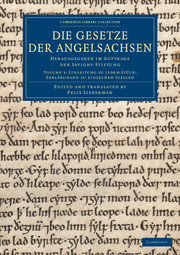
This edition of the laws promulgated by successive Anglo-Saxon rulers over a period of five centuries was published in three volumes between 1903 and 1916 by the German historian Felix Lieberman (1851–1925), and is still regarded as authoritative. This unique body of early medieval legal writing, unparalleled in other Germanic languages, provides valuable source material for scholars of Old English and of legal history, and Lieberman's thorough engagement with the manuscripts has never been surpassed. Volume 3 provides introductions to each set of laws presented in Volume 1, and detailed line-by-line explanatory notes that complement the dictionary and glossary of terms found in Volume 2. Frederick Attenborough's The Laws of the Early English Kings (1922), providing a modern English translation of early Anglo-Saxon laws, is also reissued in this series.
This edition of the laws promulgated by successive Anglo-Saxon rulers over a period of five centuries was published in three volumes between 1903 and 1916 by the German historian Felix Lieberman (1851–1925), and is still regarded as authoritative. This unique body of early medieval legal writing, unparalleled in other Germanic languages, provides valuable source material for scholars of Old English and of legal history, and Lieberman's thorough engagement with the manuscripts has never been surpassed. His preface explains that owing to factors such as the extreme variability of Old English orthography, and the existence of both Latin and Old English versions of the same material, a traditional edition using just one base manuscript with a critical apparatus would have been too unwieldy. Volume 1 introduces the manuscripts, and gives several parallel versions of each text in Old English and Latin with a facing translation into modern German. Frederick Attenborough's The Laws of the Early English Kings (1922) is also reissued in this series.
The writer and translator Anne Plumptre (1760–1818) and her sister Annabella, also a writer, divided their time between Norwich and London, where they moved in radical and dissenting circles. Anne also travelled abroad, publishing this three-volume description of three years' residence in France in 1810. (Her 1817 volume on Ireland is also reissued in this series.) Like many other Britons, Plumptre took the opportunity of the Peace of Amiens to visit post-revolutionary France, and she stayed in the country until hostilities recommenced in 1805. Sympathetic to the revolution, she intended to examine for herself the state of the country and its people, and compare her first-hand impressions (especially of Napoleon) with the generally hostile information about France then currently available in Britain. Volume 3 describes Plumptre's travels through western France on her way home, and ends with a long section on the character and deeds of Napoleon.
In 1868, Jean Moura took up the post of Administrator of the French protectorate of Cambodia, established the previous year by invitation of the country's rulers who wanted freedom from Thai control. Apart from a short break in 1870, Moura stayed in his post at Phnom Penh until 1879. The foreword describes Moura's determined efforts to find out about every aspect of Cambodian history and culture, and explains how on his return to France he prepared this two-volume, illustrated reference work. Published in 1883, it was announced as the first serious study of Cambodia, indispensable to those wishing to seek their fortune in this most beautiful of French colonies. Volume 2 focuses on the royal chronicles of Cambodia, and on the country's ancient sites and antiquities, their architecture and decoration, before discussing contemporary architecture, visual arts, poetry, music and drama. The book ends with an appendix of recently deciphered Cambodian inscriptions.
Published between 1862 and 1932, and reissued here in multiple parts, this monumental calendar of documents remains an essential starting point for the serious study of Tudor history. An experienced editor of historical texts, John Sherren Brewer (1809–79) had no prior training in the history of the period, yet he brought to the project the necessary industriousness and an impeccable command of Latin. Four volumes appeared before his death, whereupon James Gairdner (1828–1912), his former assistant, took up the editorial reins. Continuing Brewer's method of ordering chronologically all available documents from 1509 to 1547, and reproducing some passages while paraphrasing or omitting others, Gairdner brought the project to its conclusion, aided himself by R. H. Brodie (1859–1943) in preparing the later volumes. Part 1 of Volume 3 (1867) covers the period from January 1519 to June 1521.