A collection of out-of-copyright and rare books from the Cambridge University Library and other world-class institutions that have been digitally scanned, made available online, and reprinted in paperback.
To save content items to your account,
please confirm that you agree to abide by our usage policies.
If this is the first time you use this feature, you will be asked to authorise Cambridge Core to connect with your account.
Find out more about saving content to .
To save content items to your Kindle, first ensure no-reply@cambridge.org
is added to your Approved Personal Document E-mail List under your Personal Document Settings
on the Manage Your Content and Devices page of your Amazon account. Then enter the ‘name’ part
of your Kindle email address below.
Find out more about saving to your Kindle.
Note you can select to save to either the @free.kindle.com or @kindle.com variations.
‘@free.kindle.com’ emails are free but can only be saved to your device when it is connected to wi-fi.
‘@kindle.com’ emails can be delivered even when you are not connected to wi-fi, but note that service fees apply.
Sir Richard Owen (1804–92) coined the term 'Dinosauria' in 1842 for the remains of three animals named from the Middle Jurassic and Early Cretaceous rocks of southern England: Megalosaurus, Iguanodon and Hylaeosaurus. In his monograph on the Wealden and Purbeck Reptilia (published in five parts with nine supplements in 1853–79) he confirms the distinctiveness of this newly recognised group, building on earlier work by Gideon Mantell and others. Owen also reviewed the other reptiles then known from these Early Cretaceous faunas, including turtles, crocodiles and lizards. This work initiated major interest in the earliest Cretaceous Purbeck Limestone Group fauna, which remains one of the most diverse small reptile faunas known from the Mesozoic, as well as consolidating the international importance of the Wealden Group in dinosaur studies. The monograph remains a benchmark for many of the species described, particularly the crocodiles and turtles.
This publication released to a wider audience the work on Assyrian inscriptions of Sir Henry Rawlinson (1810–95), who had begun his career in the East India Company in Persia and Afghanistan, where his exceptional linguistic skills were recognised. He had been studying the monumental, trilingual (in Old Persian, Elamite and Babylonian) Behistun inscription of Darius the Great since 1836, and, building on the earlier research of Georg Friedrich Grotefend, delivered a summary of his progress in decipherment to the Royal Asiatic Society early in 1850. He intended to follow it up with a longer book, but was anxious to gain credit for primacy (which was questioned at the time and still remains controversial), and so published this short work in March 1850. It states Rawlinson's theories, and offers a linguistic and archaeological background to his work, along with his interpretation of king lists and other inscriptions.
The most accomplished female painter of her age, Élisabeth Vigée-Lebrun (1755–1842) is best remembered for her many portraits of Queen Marie Antoinette of France. Her two-volume autobiography was published in France in 1835–7, and this English version (of which the translator is unknown) in 1879. It begins with a series of letters to a Russian friend, Princess Kourakin, describing her family and early life, her artistic training, and her rise to the position of portraitist to the queen. The letters end with the Revolution and Vigée-Lebrun's flight abroad: the 'souvenirs' which follow describe her years of exile and her eventual return to France. Throughout her life, she supported herself and her family by her painting. Volume 2 recounts her extended stay in Russia, where she painted many of the aristocracy, a brief return to Paris, a visit to England, and her final return to France.
The nephew of William Smith, John Phillips (1800–1874) was also an influential geologist. Professor of Geology at Oxford, and in part founder of the Oxford University Museum, he notably proposed the three main eras: the Palaeozoic, Mesozoic and Cenozoic. Originally published between 1865 and 1870, this monograph was the first to attempt a review of British belemnites, and was influenced in part by the author's youthful studies of the Yorkshire Jurassic. During the mid-nineteenth century there were many developments in the study of this important fossil group, with the discovery of soft parts, and documentation of diverse faunas across Europe. Phillips' work complemented these advances. Though he died before completing the Cretaceous section, the monograph covers many of the most important species (though, as was common at the time, restricted to the genus Belemnites in the broad sense). It remains a starting point for any study of British belemnites.
This two-volume biography of William Wordsworth (1770–1850) was published in 1851 by his nephew, Christopher (1807–85), a scholar who later became bishop of Lincoln. The introductory chapter argues against the presentation of a 'life', or a critical assessment of Wordsworth's works. The poet felt strongly that the life was in the works, and that they should 'plead their own cause before the tribune of Posterity'. Nevertheless, an elucidation of the facts of Wordsworth's life would - precisely because his poems are so personal - help the reader to understand his verse; and to be best understood, it should be studied chronologically, for which a 'biographical commentary' would be essential. Christopher Wordsworth, having agreed to undertake this task, asked his uncle for a 'brief sketch of the most prominent circumstances of his life'; the remainder of Volume 1 takes the biography up to 1810.
The Scottish doctor Henry Faulds (1843–1930) is best remembered for his role in the history of fingerprinting. His strong religious faith had first led him to missionary work in India and then, from 1874, in Japan. He worked there as a surgeon in the mission hospital at Tsukiji, near Tokyo, where he also established a medical school and a school for the blind. It was his discovery of the impressions of thumbprints on ancient Japanese pottery which led to his development of a fingerprinting system and his championing of it as a forensic tool. The present work, part-travelogue, part-journal, was first published in 1885. It remains an engaging account of Japanese life, customs, geography and natural history, interwoven with discussions of topics such as education, language, and the future of the country. There are characterful line drawings throughout. Faulds' Dactylography (1912) is also reissued in the Cambridge Library Collection.
The Danish plant scientist Wilhelm Johannsen (1857–1927) is remembered for his experimental work on plant heredity, and as a founding figure of modern genetics. The terms 'gene', 'genotype' and 'phenotype' were first used by him. The results of his studies on beans supported theories advanced during the 1890s by the Dutch botanist Hugo de Vries, who had unknowingly replicated the work of Gregor Mendel, published in English translation in 1902 (also reissued in this series) by William Bateson. Johannsen's proposal that changes in heredity resulted from sudden mutations rather than from slow processes of natural selection was seen at the time as a threat to Darwinian theory, though later research showed otherwise. This influential book, first published in 1909 (with later editions in 1913 and 1926), is a revised, expanded German translation of a 1905 Danish book by Johannsen, itself based on a journal article originally published in 1903.
During his five years in the 1730s as rector of St John's parish on the Caribbean island of Nevis, William Smith collected a number of remarkable seashells, which he presented to the Woodwardian Museum of Fossils at the University of Cambridge nine years after his return to England. When the incumbent Woodwardian Professor, Charles Mason, asked Smith for 'some account' of the Nevis shells, Smith wrote him a series of eleven undated letters, published as this book in 1745, containing observations on the island's flora and fauna, and details relating to the neighbouring islands. Mason and Smith became friends, and the content of the letters gradually diverged from pure recollection to larger digressions on subjects as varied as cryptography, diseases common to slaves, tarantulas, and the Great Wall of China. The result is an idiosyncratic snapshot of the mind of an educated and slightly eccentric cleric in eighteenth-century England.
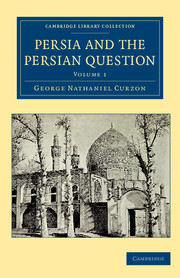
Following his election to Parliament, George Nathaniel Curzon (1859–1925) embarked on extensive travels and research in Asia, spending several months in Persia in 1889–90. Later viceroy of India, Curzon believed that growing Russian influence in Asia threatened Britain's interests, and that Persia was an important buffer state. Highly regarded upon publication in 1892, this illustrated two-volume work is a mix of history, geography, travel narrative, and social and political analysis. Intended to educate readers at home as to Persia's strategic significance, the work reflects its author's staunch support for British imperialism. Volume 1 describes Curzon's journey to Tehran, offering observations on the situation in the provinces which bordered Russian-controlled territory. Curzon then gives an overview of Persian institutions, including the monarchy, government, and the army. His Problems of the Far East (1894) is also reissued in this series.
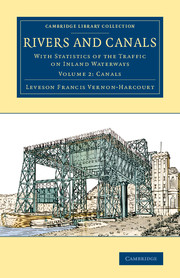
Leveson Francis Vernon-Harcourt (1839–1907) drew on a distinguished career in canal and river engineering for this illustrated two-volume survey, here reissued in its enlarged 1896 second edition. Having started as an assistant to the civil engineer John Hawkshaw, Vernon-Harcourt was appointed resident engineer in 1866 for new works on London's East and West India docks. Later, as a consulting engineer, he specialised in the design and construction of harbours, docks, canals and river works, and he was elected professor of civil engineering at University College London in 1882. This publication covers the design and construction of tidal and flood defences, canals, locks, and irrigation works. Volume 2 covers canal engineering, discussing the design and construction of canals and their associated works such as locks and lifts. Vernon-Harcourt also discusses ship canals and irrigation works. His Harbours and Docks (1885) is also reissued in this series.
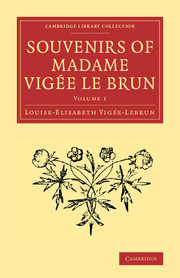
The most accomplished female painter of her age, Élisabeth Vigée-Lebrun (1755–1842) is best remembered for her many portraits of Queen Marie Antoinette of France. Her two-volume autobiography was published in France in 1835–7, and this English version (of which the translator is unknown) in 1879. It begins with a series of ten letters to a Russian friend, Princess Kourakin, describing her family and early life, her artistic training, and her rise to the position of portraitist to the queen. The letters end with the Revolution and Vigée-Lebrun's flight abroad: the 'souvenirs' which follow describe her years of exile and her eventual return to France. Throughout her life, she supported herself and her family by her painting. Volume 1 ends with her staying in Austria, after a tour of the cities of Italy, during which she studied art as well as participating in the life of high society.
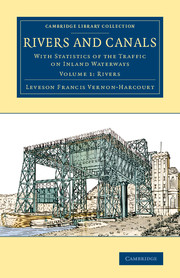
Leveson Francis Vernon-Harcourt (1839–1907) drew on a distinguished career in canal and river engineering for this illustrated two-volume survey, here reissued in its enlarged 1896 second edition. Having started as an assistant to the civil engineer John Hawkshaw, Vernon-Harcourt was appointed resident engineer in 1866 for new works on London's East and West India docks. Later, as a consulting engineer, he specialised in the design and construction of harbours, docks, canals and river works, and he was elected professor of civil engineering at University College London in 1882. This publication covers the design and construction of tidal and flood defences, canals, locks, and irrigation works. Volume 1 covers the physical characteristics of rivers and estuaries, and the control of their flow through dredging and works such as weirs and breakwaters. Vernon-Harcourt also discusses the design of flood defences. His Harbours and Docks (1885) is also reissued in this series.
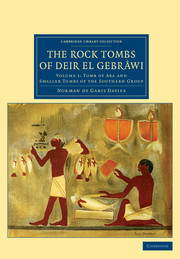
While working as a Congregational minister in England, Norman de Garis Davies (1865–1941) developed an interest in Egyptology. In 1897 he joined Flinders Petrie's excavations at Dendera as a copyist of inscriptions and sculptures. He did further work for the Egypt Exploration Fund, producing many volumes of archaeological surveys, which won him the Leibniz medal of the Prussian Academy of Sciences. From 1907 he worked for New York's Metropolitan Museum of Art, together with his wife Nina. Highly illustrated, this two-volume 1902 publication covers the tombs of the important Old Kingdom necropolis at Deir el-Gabrawi, where many of the governors of the Upper Egyptian 12th nome were buried. Volume 1 covers the southern group of tombs, including that of the nomarch Aba. Davies reproduces the tomb art and hieroglyphic inscriptions, as well as providing archaeological plans. His Rock Tombs of Sheikh Saïd (1901) is also reissued in this series.
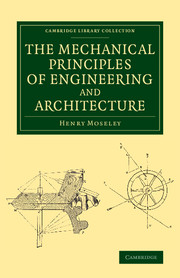
Seventh wrangler in the Cambridge mathematical tripos in 1826, Henry Moseley (1801–72) was adept at applying mathematical analysis to a wide variety of problems. Appointed professor of natural and experimental philosophy and astronomy at London's newly established King's College in 1831, he was instrumental in creating the institution's department of engineering and applied science. This 1843 textbook is based on the lectures in statics, dynamics and structures that he gave to students of engineering and architecture. Moseley draws on the latest continental work in mechanics, and the treatment of problems is mathematically sophisticated. Starting with basic statics and dynamics, Moseley covers topics of interest to both civil and military engineers, with sections on the theory of machines and on the stability of walls, arches and other structures. Notably, the American edition of this work was adopted as a textbook by the United States Military Academy at West Point.
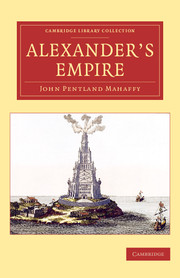
The classical scholar J. P. Mahaffy (1839–1919) is known equally for his work on Greek texts and Egyptian papyri (his edition of The Flinders Petrie Papyri is reissued in the Cambridge Library Collection). He graduated from Trinity College, Dublin, and spent the rest of his working life there, ultimately as provost from 1914 until his death. In this illustrated 1887 work, Mahaffy describes Alexander's extraordinary conquest of territories in Europe, Africa and Asia, the collapse of his empire after his death, and the later subjugation of the successor kingdoms to the power of Rome. With his American collaborator Arthur Gilman (1837–1909), Mahaffy discusses Alexander's place in history before giving a close account of his career and death. The successor dynasties, and dominant rulers such as Demetrius II and Pyrrhus, their feuds and their attempted resistance to the rise of Rome, are depicted in an engaging and dramatic narrative.
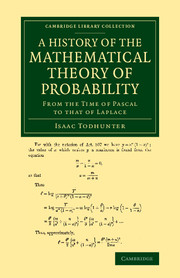
Throughout his early life, Isaac Todhunter (1820–84) excelled as a student of mathematics, gaining a scholarship at the University of London and numerous awards during his time at St John's College, Cambridge. Taking up fellowship of the college in 1849, he became widely known for both his educational texts and his historical accounts of various branches of mathematics. The present work, first published in 1865, describes the rise of probability theory as a recognised subject, beginning with a discussion of the famous 'problem of points', as considered by the likes of the Chevalier de Méré, Blaise Pascal and Pierre de Fermat during the latter half of the seventeenth century. Subsequently, the application of advanced methods that had been developed in classical areas of mathematics led to rapid progress in probability theory. Todhunter traces this growth, closing with a thorough account of Pierre-Simon Laplace's far-reaching work in the area.
The American archaeologist James H. Breasted (1865–1935) published this history in 1906. His intention was to create a one-volume work which would be suitable for the increasing number of tourists visiting the Nile valley, for those interested in the rise of Greek and Roman civilisation, and for students of the Old Testament. Drawing on Breasted's own four-volume Records of Egypt, which contains fresh readings and translations of almost all of the ancient Egyptian historical inscriptions available at the time, the book follows the conventional chronology from 'earliest Egypt' to the Old Kingdom and the Middle Kingdom, characterised as a 'feudal age', the intermediate period of the Hyksos, and the New Kingdom, described here as 'the Empire'. The account ends with 'the Decadence', invasions by Libyans and Nubians, and the Persian conquest after the battle of Pelusium in 525 BCE. The book contains nearly 200 photographs and drawings.
The agrarian interests of politician William Hillier Onslow (1853–1911), fourth earl of Onslow, led to his briefly becoming a cabinet minister as president of the Board of Agriculture and Fisheries in 1903–5, but he became convinced that the government of the day took no real interest in farming and food - to the extent that in 1914, sixty per cent of British food was imported. He had already decided that English landowners should, at a time of agricultural depression, help the labourers on their estates by making allotments of land available to them, and he published this work in 1886, in the hope of achieving a voluntary extension of the allotment system. It provides a historical context, examines in detail the current situation, and discusses the pros and cons of voluntary versus compulsory ceding of land, while providing insights into the development of the allotment movement.
A central figure in the early years of the French Revolution, Nicolas de Condorcet (1743–94) was active as a mathematician, philosopher, politician and economist. He argued for the values of the Enlightenment, from religious toleration to the abolition of slavery, believing that society could be improved by the application of rational thought. In this essay, first published in 1785, Condorcet analyses mathematically the process of making majority decisions, and seeks methods to improve the likelihood of their success. The work was largely forgotten in the nineteenth century, while those who did comment on it tended to find the arguments obscure. In the second half of the twentieth century, however, it was rediscovered as a foundational work in the theory of voting and societal preferences. Condorcet presents several significant results, among which Condorcet's paradox (the non-transitivity of majority preferences) is now seen as the direct ancestor of Arrow's paradox.
Following his election to Parliament and extensive travels through Asia, George Nathaniel Curzon (1859–1925) published in 1894 this consideration of the present state of Japan, Korea and China within a changing international landscape. Later viceroy of India, Curzon was fascinated by the rich cultural heritage of the Far East, yet he remained a staunch supporter of British imperialism. He explains that the book's purpose is to delve deeper into political, social and economic conditions, rather than present a travel narrative of 'temples, tea-houses and bric-à-brac'. After devoting a substantial section to each country, Curzon closes with 'The Prospect', exploring what he envisages for the future of the whole region. The favourable reception of this title and his 1892 work, Persia and the Persian Question (also reissued in the Cambridge Library Collection), highlighted Curzon's diligently acquired knowledge of Asian affairs and how they affected Britain's imperial interests.