Genuinely broad in scope, each handbook in this series provides a complete state-of-the-field overview of a major sub-discipline within language study, law, education and psychological science research.
To save content items to your account,
please confirm that you agree to abide by our usage policies.
If this is the first time you use this feature, you will be asked to authorise Cambridge Core to connect with your account.
Find out more about saving content to .
To save content items to your Kindle, first ensure no-reply@cambridge.org
is added to your Approved Personal Document E-mail List under your Personal Document Settings
on the Manage Your Content and Devices page of your Amazon account. Then enter the ‘name’ part
of your Kindle email address below.
Find out more about saving to your Kindle.
Note you can select to save to either the @free.kindle.com or @kindle.com variations.
‘@free.kindle.com’ emails are free but can only be saved to your device when it is connected to wi-fi.
‘@kindle.com’ emails can be delivered even when you are not connected to wi-fi, but note that service fees apply.
from
29
-
An Interactive Perspective on Topic Constructions in Mandarin
Edited by
Chu-Ren Huang, The Hong Kong Polytechnic University,Yen-Hwei Lin, Michigan State University,I-Hsuan Chen, University of California, Berkeley,Yu-Yin Hsu, The Hong Kong Polytechnic University
Edited by
Chu-Ren Huang, The Hong Kong Polytechnic University,Yen-Hwei Lin, Michigan State University,I-Hsuan Chen, University of California, Berkeley,Yu-Yin Hsu, The Hong Kong Polytechnic University
Edited by
Chu-Ren Huang, The Hong Kong Polytechnic University,Yen-Hwei Lin, Michigan State University,I-Hsuan Chen, University of California, Berkeley,Yu-Yin Hsu, The Hong Kong Polytechnic University
The question of what canonical word order Chinese has is not a controversial issue at the present time; most of the studies within the last 30 years assume that the canonical word order of Modern Chinese is SVO. However, during the 1970s and 80s there was a lively debate on Chinese word order concerning its historical development as well as its status in Modern Chinese. This chapter reviews the arguments for and against SVO as the canonical word order in Chinese. Arguments for SVO originated as reactions against two claims: Chinese is in the process of becoming an SOV language, and Modern Chinese is an SOV language. A wide range of arguments have been brought forth to argue against the two claims, including historical development, grammar internal considerations, typological features, and discourse analysis.
Edited by
Chu-Ren Huang, The Hong Kong Polytechnic University,Yen-Hwei Lin, Michigan State University,I-Hsuan Chen, University of California, Berkeley,Yu-Yin Hsu, The Hong Kong Polytechnic University
This chapter shows that treating the Chinese classifier system as a lexicalized semantic system based on shared ontology predicts both the agreement patterns that motivate the structure-based accounts, and the semantic selection patterns that motivate the cognition-based accounts. In the chapter, different perspectives toward classifiers are introduced including a cognition-based account (predicting a strong correlation with perception that is also robust and without exceptions but allows some fuzzy, overlapping classifications) and a structure-based account (predicting a strongly binary classification and a robust grammaticality judgement). Controversial issues regarding Chinese classifiers, such as the distinction between classifiers and measure words, the agreement between a classifier and its head noun, and the nature of 的 DE insertion, are explicated to show the pros and cons of various approaches. The authors demonstrate that Chinese classifiers are coherently organized in a ontology-driven lexical-semantic system. Major unresolved issues in the Mandarin classifiers system are closely examined at the end of the chapter.
Edited by
Chu-Ren Huang, The Hong Kong Polytechnic University,Yen-Hwei Lin, Michigan State University,I-Hsuan Chen, University of California, Berkeley,Yu-Yin Hsu, The Hong Kong Polytechnic University
Edited by
Chu-Ren Huang, The Hong Kong Polytechnic University,Yen-Hwei Lin, Michigan State University,I-Hsuan Chen, University of California, Berkeley,Yu-Yin Hsu, The Hong Kong Polytechnic University
Edited by
Chu-Ren Huang, The Hong Kong Polytechnic University,Yen-Hwei Lin, Michigan State University,I-Hsuan Chen, University of California, Berkeley,Yu-Yin Hsu, The Hong Kong Polytechnic University
Words pose a theoretical challenge in Chinese, but words pose a challenge in any language. Even though Chinese is written with monosyllabic, monomorphemic characters and no overt word boundaries, there is as much evidence here as there is in English or any other language for a level between the morpheme and the phrase, interfacing between the lexicon and the grammar. Yet their interface role makes words dynamic things, subject to distinct and often conflicting constraints from processing, semantics, phonology, morphology, and syntax. To emphasize the universality of this situation, the chapter starts with a quick look at the dynamic nature of English words before turning to focus on Chinese words, which a wide variety of data reveal as surprisingly English-like, including a strong preference for disyllabicity. The chapter ends by sketching a formalism that may help capture the universal yet dynamic nature of wordhood, showing how it helps account for some of the Chinese facts.
Edited by
Chu-Ren Huang, The Hong Kong Polytechnic University,Yen-Hwei Lin, Michigan State University,I-Hsuan Chen, University of California, Berkeley,Yu-Yin Hsu, The Hong Kong Polytechnic University
This article compares the presence of some functional categories which are at play in English or in French to their absence in Mandarin. It shows that rather than being ‘absent’ these categories are inactive, due to the analyticity of the language. For instance, Mandarin ‘lacks’ (i) subject–verb agreement, (ii) plural markers on nouns, (iii) a complementizer as a head of a clause in subject or in object position, and (iv) verb gapping.
Edited by
Chu-Ren Huang, The Hong Kong Polytechnic University,Yen-Hwei Lin, Michigan State University,I-Hsuan Chen, University of California, Berkeley,Yu-Yin Hsu, The Hong Kong Polytechnic University
This chapter provides an overview of scholarship on Chinese sentence-final particles (SFPs) from sociolinguistic and discourse perspectives. The chapter begins with a brief introduction to the typological and areal features associated with SFPs, followed by discussions of studies of this linguistic category in data-based empirical research as well as in descriptive grammars. The goal of the overview is to identify the main strands of theoretical underpinnings as well as to outline the major methodological approaches. The chapter concludes with a discussion of future research directions.
Edited by
Chu-Ren Huang, The Hong Kong Polytechnic University,Yen-Hwei Lin, Michigan State University,I-Hsuan Chen, University of California, Berkeley,Yu-Yin Hsu, The Hong Kong Polytechnic University
In this chapter, we discuss the Mandarin syllable and recent innovations in its study. The focus will be on the segmentation of the syllable into phonological units, an area of research that features a proposal for the combination of segments into phonological units for almost every permutation possible. At the core of the new work in this area is the combined use of network science and psycholinguistic experimentation. We review exploratory work modeling the lexicon according to phonological networks, wherein words are the nodes of the network and the networks' edges are identified through the addition deletion or substitution of a single segment or lexical tone. We argue that lexical access viewed in light of syllable segmentation modelled through phonological networks sees the lexicon as multiple concurrent networks that, when given the demands of a specific task, activate connections most fit for the goals of the task.
Edited by
Chu-Ren Huang, The Hong Kong Polytechnic University,Yen-Hwei Lin, Michigan State University,I-Hsuan Chen, University of California, Berkeley,Yu-Yin Hsu, The Hong Kong Polytechnic University
Sentence-final particles are normally assumed to occur in the CP domain, i.e., the domain of the complementizer phrase. Their exact syntactic position varies given the heterogeneity of these elements. The position of these particles usually depends on how they are categorized semantically, and also on how they conform to different syntactic principles. Several distinctive and often competing approaches are addressed here. This chapter also discusses those 'sentence-final particles' that are found in the lower domains and revisits the question of whether some, if not all, elements that are said to belong to the category of sentence-final particles should be construed as non-CP elements.
Edited by
Chu-Ren Huang, The Hong Kong Polytechnic University,Yen-Hwei Lin, Michigan State University,I-Hsuan Chen, University of California, Berkeley,Yu-Yin Hsu, The Hong Kong Polytechnic University
The primary goal of this chapter is to present the state of the art on Chinese intonation research, with a focus on how tone and intonation interact. To this end, the general functions and forms of intonation observed in (Mandarin) Chinese are first introduced. This is followed by a detailed discussion of the multiplexing of the f0 channel for tone and intonation in varieties of Chinese as well as the different proposals posited for intonation modeling. The secondary goal of this chapter is to highlight open issues and suggest potential points for future research on intonation in Chinese.
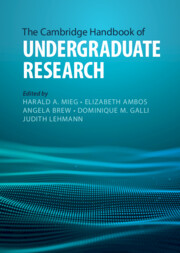
Undergraduate Research (UR) can be defined as an investigation into a specific topic within a discipline by an undergraduate student that makes an original contribution to the field. It has become a major consideration among research universities around the world, in order to advance both academic teaching and research productivity. Edited by an international team of world authorities in UR, this Handbook is the first truly comprehensive and systematic account of undergraduate research, which brings together different international approaches, with attention to both theory and practice. It is split into sections covering different countries, disciplines, and methodologies. It also provides an overview of current research and theoretical perspectives on undergraduate research as well as future developmental prospects of UR. Written in an engaging style, yet wide-ranging in its scope, it is essential reading for anyone wishing to broaden their understanding of how undergraduate research is implemented worldwide.
This chapter retains a safe working distance from the usual hype surrounding AI as well as from theories seeking to replicate human intelligence or intention. Taking into account the current state of the art, it explores whether a difference in the degree to which AI can augment or optimize human performance in the contracting process necessitates an adaptation of the law.
The EU Artificial Intelligence Act proposal is based on a risk-oriented approach. While AI systems that pose an unacceptable risk will be banned, high-risk AI systems will be subject to strict obligations before they can be put on the market. Most of the provisions deal with high-risk systems, setting out obligations on providers, users and other participants across the AI value chain. At the heart of the proposal is the notion of co-regulation through standardization based on the New Legislative Framework. Accordingly, this chapter provides a critical analysis of the proposal, with particular focus on how the co-regulation, standardization and certification system envisaged contributes to European governance of AI and addresses the manifold ethical and legal concerns of (high-risk) AI systems.
The case for population-level approaches to reduce the stigma associated with mental illness is based on the need for cultural change, whether the culture is within organizations, communities, or families. As such, stigma is a multi-level phenomenon requiring intervention at these many levels. In this chapter we present the case for stigma reduction efforts at the population level; present some considerations for such efforts in terms of methods and content; and describe some recent population-level anti-stigma programs, with results of evaluation where available.
Mental health stigma has proven to be resilient against many intervention approaches. For example, previous interventions incorporating strategies like psychoeducation, cognitive restructuring, and motivational interviewing have shown inconsistent results (Mittal et al., 2012), prompting researchers and clinicians to search for novel approaches to stigma reduction. Mindfulness and self-compassion, two constructs rooted in the positive psychology movement, have been linked to lower levels of stigma endorsement, suggesting that interventions using these strategies could be beneficial in reducing stigma. Additionally, mindfulness and self-compassion interventions might reduce the deleterious effects of mental health stigma on related outcomes, given the link between these constructs and shame, self-worth, and psychological help-seeking. This chapter outlines the theoretical connection between mindfulness, self-compassion, and mental health stigma; summarizes the extant literature linking mindfulness and self-compassion activities to stigma reduction; and discusses areas for future research and intervention development.