To save content items to your account,
please confirm that you agree to abide by our usage policies.
If this is the first time you use this feature, you will be asked to authorise Cambridge Core to connect with your account.
Find out more about saving content to .
To save content items to your Kindle, first ensure no-reply@cambridge.org
is added to your Approved Personal Document E-mail List under your Personal Document Settings
on the Manage Your Content and Devices page of your Amazon account. Then enter the ‘name’ part
of your Kindle email address below.
Find out more about saving to your Kindle.
Note you can select to save to either the @free.kindle.com or @kindle.com variations.
‘@free.kindle.com’ emails are free but can only be saved to your device when it is connected to wi-fi.
‘@kindle.com’ emails can be delivered even when you are not connected to wi-fi, but note that service fees apply.
In the past quarter of a century, or longer, popular cultures and musics both popular and 'new' have become concerned, rather than with futurity, with their own pasts, in a world where, after Fukuyama's 'end of history' or Berardi's 'cancellation of the future', the idea of fundamental historical change has seemed increasingly incredible. This Element is a critical study of music in what Fisher calls 'nostalgia mode', a flattened, high-gloss reproduction of a music indistinguishable from that which already exists, save for its technical perfection, and of hauntological musics critical of this stance, which deploy the music of the past not in reassuring fashion, but to stress that, in 'unwounded' history, they would not still be here. Although normally treated separately, this paradigm applies not only to popular music but also to new music, which has historically claimed the music of the future as its privileged territory.
'What does it mean to follow a ghost?' Posing this question in Specters of Marx (1993), Jacques Derrida introduces the philosophical concept of 'hauntology' and the 'medium of the media' through the Shakespearian trope that time is 'out of joint'. Replete with ghostly crackles, hiss, pops and static, analogue media occupied a pivotal role in experimental music and praxis in the twentieth century, particularly during the 1960s, when composers such as John Cage and Luigi Nono systematically exploited the affordances of records and tape in composition and performance. Exploring hauntology's ghostly interplay with music and technology, this Element considers lost futures, past usage and future implications for hauntological music from the late 1930s to the twenty-first century.
Discourses about rhythmic skill and feel have often been associated with forms of non-Western, and especially African and Afro-diasporic identity and heritage. How can we rethink rhythmic skill for the contemporary world where concepts of heritage and belonging are attaining new meanings across cultural and geographical borders? This Element addresses this question through the case study of modern flamenco guitar, an instrumental practice that has achieved daunting levels of rhythmic sophistication and has been flourishing across the globe for decades, even before flamenco was inscribed into UNESCO's list of Intangible Cultural Heritage in 2010. Drawing on examples from local guitar traditions in Jerez de la Frontera and Morón de la Frontera and from an online guitar contest launched during the Covid-19 pandemic, this Element explores how rhythm can shape new ways of understanding and performing heritage in the global and digital age.
This Element offers a critical analysis of the history of Elliott Carter's String Quartet No. 1 and the composer's rise to public acclaim, not through the study of the work itself but through intriguing and captivating narratives that surround this quartet and their socio-cultural-political context, which led Carter to become one of the most dominant voices in the post-1945 American music scene. Carter's road to success was meticulously paved by powerful institutions and individuals, including critics, scholars, festival and radio programming directors, and the US government, for whom, in the context of the Cold War, Carter was chosen to represent an exemplary American triumphant story. The author argues that it is not the quartet itself that contributed to Carter's reception and legacy, but the inextricable narratives that we associate with this work.
This Element contributes to the interdisciplinary study of mariachi, especially in the United States, by focusing on two areas that have yet to receive substantive academic attention: philanthropy and museum studies. In 2011, UNESCO included mariachi music on its list of expressions of intangible cultural heritage. While it is undoubtedly true that mariachi is in many ways intangible, this downplays expressions of its rich material culture and the work of scholars to research mariachi history beyond an emphasis on musical performance. The first section considers mariachi collecting and philanthropy in the US, especially the efforts of Edward E. Marsh and Chris Strachwitz. The second section examines the first major mariachi history museum/exhibit in the US, managed by the Mariachi Scholarship Foundation and housed at Southwestern College in California. Finally, some open areas for research are proposed and appendices concerning mariachi studies in the US are provided.
This Element examines the factors that drove the stylistic heterogeneity of Chen Yi and Zhou Long after the Cultural Revolution. Known as 'New Wave' composers, they entered the Central Conservatory of Music once the Cultural Revolution ended and attained international recognition for their modernisms after their early careers in America. Scholars have often treated their early music as contingent outcomes of that cultural and political moment. This Element proposes instead that unique personal factors shaped their modernisms despite their shared experiences of the Cultural Revolution and educations at the Central Conservatory and Columbia University. Through interviews on six stages of their development, the Element examines and explains the reasons for their stylistic divergence.
As one of only a few pieces not primarily inspired by Messiaen's Catholic faith, but by human love as described in the romance of Tristan and Isolde and elsewhere, the Turangalîla-symphonie is contextualized in Messiaen's oeuvre and as a genre piece. Using previously untranslated information from Messiaen's own description of the work in his Traité, close analysis of the music seeks to demystify some of the complex innovations he made to his musical language, especially in the areas of rhythm and orchestration. This Element pays special attention to the fragmentary and elusive program which is explained with reference to Messiaen's fascination with surrealism at this time. Information is included on the commission and composition of the piece, its premiere by the Boston Symphony Orchestra conducted by Leonard Bernstein, its revision by Messiaen in 1990, and its reception history in both live and recorded performances.
Video game music is a significant site of queerness where normative demands are questioned, suspended or loosened. Games resist hegemonic musical logics, challenge musical value systems and use music to complicate essentialist notions of identity. This Element proposes three areas of queerness, each representing different relationships between 'queer design' and 'queer engagement', ranging fromunintentionally resistive to explicit engagement with identity. First, this Element examines musical structures that provide queer temporal alternatives to normative linear development, and interactive systems that reframe the power relationship between musical material and listener. Second, it considers 'retro' or 'chiptune' timbres that queer notions of technological progress to be improvements, rejecting chrononormativity. Finally, the Element discusses music that queers the self/other binary of identity. Games present ways of listening to, engaging with and understanding music that provide opportunities to challenge inherited assumptions and reductive or monolithic values, practices and identities.
This collection of essays addresses technical developments in telecommunications and sound recording that have guided the direction of musical aesthetics in the post-1950 era. Such information is readily available online but may appear counterintuitive to many who find its priorities difficult to grasp from a musical perspective. The author hopes to draw attention to the place of ideas of communication and flight in western tradition. This Element begins with Varèse and his 'noble noise', traverses the arrival of Information Theory and its influence, examples of early computer music, and ends with a defence of the sublime logic of Stockhausen's singing helicopters and tornados.
This Element introduces the notion of curatorial composing to account for certain musical practices that emerged from the 1960s as the founding concepts of music as an art – instituted in the modern era – were systematically dismantled. It raises the key question of how musical value and authority might be produced without recourse to an external principle, origin, transcendental framework, or other foundation. It argues that these practices do not dismiss the issue of value or simply relativise it but shift the paradigm to a curatorial concern for composing public encounters and staging events. The Element shows that Lydia Goehr's elaboration of the work-concept provides a framework that was transformed by John Cage in his work from 0'00” (1962) onwards. The Element then introduces Heiner Goebbels' practice and focus on his role as Artistic Director of the Ruhrtriennale (2012–14), which it argues was an extension of his curatorial composing.
Many twentieth and twenty-first century composers have written music with rhythmic structures that must be understood through a framework distinct from even, periodic meter, which has been a salient musical feature of Western classical music for centuries. This Element's analytical system outlines structure and phrasing in sections of music without even perceptible meter. Instead of entrainment to meter, Bryan Hayslett theorizes that listeners perceive rhythm in similar ways to how they perceive the rhythm of language. With gesture as the smallest organizational grouping unit, his analytical system combines Fred Lerdahl and Ray Jackendoff's generative theory of tonal music with Bruce Hayes's metrical stress theory from linguistics. The listener perceives the shape of a gesture according to the structure of its constituents, and larger-level phrasing is perceived through the hierarchical relationship of gestures. After developing a set of rules, the author provides analyses that outline temporal structure according to perceptual prominence.
The Boston Pops Orchestra was the first orchestra of its kind in the USA: founded in 1885 from the ranks of the Boston Symphony Orchestra, its remit was to offer concerts of light symphonic music. Over the years, and in particular during the fifty-year tenure of its most famous conductor, Arthur Fiedler, the Pops established itself as the premier US orchestra specialising in bridging the fields of 'art music' and 'popular music'. When the Hollywood composer John Williams was assigned the conductorship of the orchestra in 1980, he energetically advocated for the inclusion of film-music repertoire, changing Fiedler's approach significantly. This Element offers a historical survey of the pioneering agency that the Boston Pops had under Williams's tenure in the legitimisation of film music as a viable repertoire for concert programmes. The case study is complemented with more general discussions on the aesthetic of film music in concert.
Along with twentieth-century developments in playing techniques, technologies, and concepts of musical sound, the notations employed by composers have also changed. Composers of what Umberto Eco calls 'open works' often employ intentionally ambiguous music notations. These open notations ask the performer to play a radical and active role in co-creating the musical work. Scores that feature open notations have been part of the Western classical music landscape since the mid-twentieth century, and continue to have a vibrant community of practitioners today. In this Element, Tristan McKay considers intersections of ambiguity, authority, and identity in works with open notations. He develops a semiotic approach to open notation analysis and puts it into practice with in-depth analyses of openly notated works by Earle Brown, Will Redman, and Leah Asher.
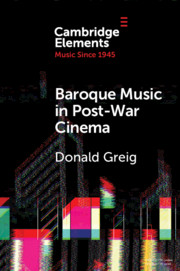
Studies of pre-existing music in narrative cinema often focus on a single film, composer or director. The approach here adopts a wider perspective, placing a specific musical repertoire - baroque music - in the context of its reception to explore its mobilisation in post-war cinema. It shows how various revivals have shaped musical fashion, and how cinema has drawn on resultant popularity and in turn contributed to it. Close analyses of various films raise issues of baroque musical style and form to question why eighteenth-century music remains an exception to dominant film-music discourses. Account is taken of changing modern performance practice and its manifestation in cinema, particularly in the biopic. This question of the reimagining of baroque repertoire leads to consideration of pastiches and parodies to which cinema has been particularly drawn, and subsequently to the role that neobaroque music has played in more recent films.
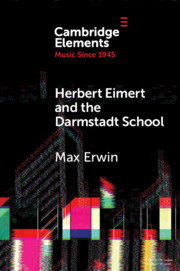
After 1951, the discourse surrounding both the Darmstadt courses in particular and European New Music more broadly shifted away from a dodecaphonic vocabulary in favour of concepts such as 'punctual music', 'post-Webern music', and 'static music', all collected under the newly-christened unity of the Darmstadt School. This study proposes a genealogy of the Darmstadt School through the institutional influence and writings of Herbert Eimert. It demonstrates that Eimert's understanding of music history - whereby technical procedures are universalised as the acme of historical progress - was adopted as the institutional discourse of New Music in Europe, and remains central to both textbook and critical scholarly accounts which attempt to make sense of the avant-garde after World War II.
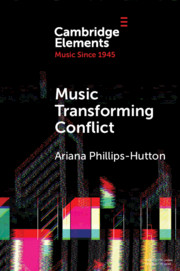
Teach the world to sing, and all will be in perfect harmony - or so the songs tell us. Music is widely believed to unify and bring peace, but the focus on music as a vehicle for fostering empathy and reconciliation between opposing groups threatens to overly simplify our narratives of how interpersonal conflict might be transformed. This Element offers a critique of empathy's ethical imperative of radical openness and positions the acknowledgement of moral responsibility as a fundamental component of music's capacity to transform conflict. Through case studies of music and conflict transformation in Australia and Canada, Music Transforming Conflict assesses the complementary roles of musically mediated empathy and guilt in post-conflict societies and argues that a consideration of musical and moral implication as part of studies on music and conflict offers a powerful tool for understanding music's potential to contribute to societal change.
Recommend this
Email your librarian or administrator to recommend adding this to your organisation's collection.