To save content items to your account,
please confirm that you agree to abide by our usage policies.
If this is the first time you use this feature, you will be asked to authorise Cambridge Core to connect with your account.
Find out more about saving content to .
To save content items to your Kindle, first ensure no-reply@cambridge.org
is added to your Approved Personal Document E-mail List under your Personal Document Settings
on the Manage Your Content and Devices page of your Amazon account. Then enter the ‘name’ part
of your Kindle email address below.
Find out more about saving to your Kindle.
Note you can select to save to either the @free.kindle.com or @kindle.com variations.
‘@free.kindle.com’ emails are free but can only be saved to your device when it is connected to wi-fi.
‘@kindle.com’ emails can be delivered even when you are not connected to wi-fi, but note that service fees apply.
The previous three chapters examined the epic repertoire of Uttarakhand in order to provide details of indoor musical practice. In addition, the stories that were discussed provided texts and themes that could be fruitfully mined for perspectives on caste hierarchy and ideologies associated with instruments. The huṙkī drum and the voice of the performer were the primary components of the aural phenomenon of story singing. An overarching framework for the discussion of the stories, as well as the creative practices undertaken in their construction, was appropriately provided by theories of oral tradition.
In contrast, this chapter shifts focus away from the huṙkī, and moves to a consideration of outdoor drums; namely the ḍhol and the damauṅ. Nonetheless, the discussion remains concerned with practices of oral tradition, particularly related to how ‘drum knowledge’ is vocalized in particular ways. Consequently, I seek to focus on the way drummers use syllabic recitation as a means to signify repertoire items and thereby oralize a practice of drumming. The implications of this oralization are considered within the broader context of drumming in other areas of South Asian practice.
I have always been somewhat uncomfortable in describing and notating the drum syllables used by village drummers in Garhwal. On the one hand, when I became aware that some drummers used syllables to describe repertoire, it appeared logical to use these syllables in some way to notate and visually represent the drum patterns that I was listening to. On the other hand – though syllables represented an emic approach to drum stroke conceptualization – they never quite provided the direct link between sound and physical action that I was looking and listening for. Identifying particular vocalized syllables in relation to specific striking points on the drumheads was always more problematic than I had imagined it should be.
In an old book on the history of Garhwal written by Harikrishna Raturi, the author presents extensive lists of the various caste names of families in Garhwal. The book was originally published in 1928 during the days of the Garhwali Raja and would seem to present a first-hand account of practices from that time. Within his list of untouchable castes, Raturi (1988 [1928]: 90) lists ‘aṭpahariyā’ and describes these as: ‘nakarāchīs [players of the naqqara drums] who used to sound out the eight times of day on the naubat in the naubatkhānā of the court', Very few present-day musicians play these kinds of drums though drummers regularly refer back to a shared memory of court drumming. Raturi's statement is significant because it is one of the few sources from the time that mentions musical activity in the Garhwali rājā's court.
As the previous chapter illustrates, musical instruments as well as their combinations within specific ensembles are frequently associated with political power and military conquest. While instruments may hold a variety of symbolic meanings in different contexts, their use as sonic expressions of power may be heard in numerous musical traditions throughout the world. The adoption of the bagpipe into village-level musical practice as well as that of the Garhwal and Gorkha Regiments of the Indian Army enmeshes a complex history of imperial power within local sonic expressions of regional identity.
The first king of the Kanturis was Raja Ajaybitha, then Gajebitha, then king Sujana Deb, then Amar Deb, then King Pithaura, then King Prithipal. King Pithima Deb was the father of Dhama Deb whose mother was Muladeyi.
With these words, Bhag Chand, a huṙkiyā (drummer) from the village of Naugaon in Pauri district of Uttarakhand, began to sing the pawāṙā (heroic epic) of ‘Bijula Naik’. I had organized a performance of this specific story in April of 2004 at my own house and a small group of about five people had joined us for the occasion. This chapter explores the dynamics of that performance by focusing on the story of Bijula Naik as well as the performative elements of Bhag Chand's singing and drumming. The sonic realm of a pawāṙā draws one into the world of the characters and transports one regularly between the natural world of the event and the supernatural world of the story.
Bijula Naik is the illicit son of Dhama Deb and Chhamuna Patra, he being the king of the Kanturis, and she being a low caste dancer. Though the story does not provide the details of the illicit affair, the disparity between their castes as well as Chhamuna Patra’s status as a dancer in the king’s court provides an underlying tension that continues throughout the story. To begin the story’s performance, it was essential for Bhag Chand to acknowledge the presence of the world of gods through naming them in advance of his story. His skills as a ritual specialist would be essential in controlling any devtās (deities) who might join us for the performance.
BEFORE plunging into the main theme of this chapter viz. the relative positions of fate and human endeavour as presented in the scriptures, we shall once again probe into the nature of fate itself. Life for the toiling masses in anciént India, as everywhere else, was hard and bitter. The Aryans came as a nomadic pastoral people; cattle was their base of subsistence, roots and fruits supplemented their food, as did hunting. When they had virtually subjugated an urban agricultural and trading people their ethos first clashed with, then was overwhelmed by it and finally it assimilated some part of the subjugated people. What was this ethos? We have no records of the indigenous non-or pre-Aryan peoples. Our sole source is first the Ṛgveda Saṃhitā and then the slow and steady changes ushered in the Yajurveda, the Brāhmanas and finally the Atharva Saṃhitā. These changes can to some extent be ascribed to the miscegenation and the cultural amalgamation of the two peoples. Whatever other differences they may have had, the fact that life was difficult and fraught with many dangers persists throughout. Even when the invaders had learned to cultivate and to make houses with kiln-burnt bricks, nature posed many problems for them—there were floods, droughts, locusts, bad feuds, harvests, plagues, epidemics among men and cattle, earthquakes, forestfires, tempests, etc. Many were the threats to life and property for these early settlers here. Chance, the unapprehended, was thus taken for fate which was behind such insecurity and was responsible for such accidents.
BOTH rebirth and karman stem from death, the trauma and uncertainty associated with death. The excavation of prehistoric burial sites bring to light man's worries and concerns regarding death, his attempts to offer comforts to the departed soul. Life can never accept death, the negation of life. “Man has always reacted to death. He did not accept it, convinced as he was that it did not belong to the original plan of human life. So we find several myths explaining how death came into the world.” One reaction to man's spiritual rejection of death was application of magic for prolonging life, necromancy, attempts at rejuvenation through pseudo-chemistry etc. Underneath such endeavours is the belief that death is extraneous to the schema of life. Man held that the ultimacy of the termination of life in death was unacceptable. Also the appearance of the departed in dreams assured him that the essential man i.e. the spirit lived on, despite the death of the body. Hence the universal belief in an existence of after-life: in heaven, paradise, purgatory, hell, an astral body or the spirit form. “The care taken over the disposal of the dead indicates a deeply held conviction that provided the appropriate steps are taken, death could be regarded as a transitional slate… The oldest astronomical texts now known are found on the lids of wooden coffins dating from the Ninth Dynasty (c 2150 B.C.). They are called ‘diagonal star clocks’ or diagonal calendars and they give the names of the stars associated with the respective decans.”
IT was in the middle of the first millennium B.C. that rebirth came to be associated with karman: a man was reborn according to what he did in his life on earth. This association had many facets. In the first phase rebirth had reference only to the future, but with karman it was a two-ended position: a man's past karman determines his present station and his present station decides how he will fare in the future. Now, with the Jātakas a man could be born as a God or as subhuman being, a sondergötter-a yakṣa, piśāca, gandharva, kinnara, rākṣasa, nāga, any animal, bird, serpent, insect, aquatic or atmospheric creature. “Sin and piety in this life result in birth in hateful or covetable stations (in the next).” As tree-spirits and river-spirits they could, to some extent, be identified with aspects of nature. The scope and possibility of rebirth thus widened to illimitability. Secondly, now there appeared a pseudological chain of causality: certain karmans yielded certain results. Thirdly, divine intervention and the role of the supernatural in controlling the course of a man's life was admitted. Fourthly, now fate became a myriad-named divinity. We shall deal with most of these aspects in the following chapters, but karman opened up a large vista which rebirth by itself could never do.
OF the two major formative ideas viz. rebirth and karman which constituted the core or basis of fatalism in India, the first to appear was rebirth. And, interestingly enough, at its inception it was not recurring births, but recurring deaths. And even more strangely, this conceptual chapter opens not for man but for the Gods and has an element of teleology inherent in the episode. The Śiatnpatha Brāhmana broaches the subject: “Now indeed the Gods were at first mortal, only when they gained the year did they become immortal.” “Through the sacrifices the Gods became immortal. Death was scared: ‘what shall be my share?’ They reassured him, ‘From now on none shall be immortal in the body… They who know this or do this holy work come to life again, when they have died; and coming to life, they come to immortal life. But those who do not perform this act come to life again and again.” “If one does not offer these oblations then one gets (i.e. meets) death in the different worlds.” More concretely this age knew one form of death, namely hunger. Hunger is a living death, “by death, by hunger was everything pervaded, hunger is death.”
So we have a few basic tenets regarding rebirth: (1) it first threatened the Gods and when Death was alarmed at the prospect of losing his share of food viz. the victims of death, (2) the Gods laid down two principles (a) the gaining of the year and (b) the performance of certain sacrifices, by which (3) they became immortal with a solemn assurance to death that ‘from now on none shall be immortal in the body.’ Needless to say, this applies to men alone because the Gods had already attained immortality. So men could perform sacrifices and gain immortality after they had died at least once.
AS the person concerned can himself attempt to deflect the verdicts of fate through vows, charity, meditation, pilgrimage etc. similarly others also can act on his behalf with the same end in view. Sacrifices in Vedic times were sometimes performed by an officiating priest on behalf of his client who wanted a son (putreṣṭi) or overlordship (aśvamedha or rājasūya) or the destruction of his enemies (various abhicāra performances). This trend continued even when sacrifices gradually went out of vogue and in their place came the pūjās. The Little Tradition which had occupied itself with such mundane needs of the society, resorted to sympathetic magic and sought to deflect the adverse moves of fate.
Among such vicarious or indirect deflective measures the ones of first importance were curse and boons. Boons could be awarded (1) by a God to a God, (2) by a God to men and by (3) men to men while curses belong to these three categories as also to a fourth (4) by a man to a God. Boons or blessings can be deserved and undeserved. In the Rāmāyaṇa, Vaiśravana received the boon of overlordship from Brahman. Rāvaṇa, the ten-headed monster received a boon, from the reluctant Brahman only after he had severed his ten heads one by one and offered them to the God; he was blessed with being invincible to birds, serpents, daityas, demons and monsters.
BOETHIUSIN of the fifth century wrote his De Consolations Philosophiae in prison under a death sentence. He wrote a fictitious dialogue between himself and dame Philosophia. The philosophy taught him that “the transient affairs of our life stem from the stability of divine nature and its lasting simplicity. Providence is at the centre of all events. But when we seek to realize God's will in the changing scheme of things we are pushed to the concept of fate, for, fate it is which controls these. Fate allocates to every individual thing its special time and place.” God has an infallible foreknowledge of everything which frustrates man's freedom of action. Divine prescience is determined by eternity as an inherent quality. His philosophy consoles him in a manner which reconciles providence with fate. But ultimately this reconciliation is not achieved in theology or metaphysics. Yet man yearns for prescience about his future.
Fatalism stems from man's total ignorance and apprehension regarding what befalls him. Man would give much to ‘know’ his course of life in this and the subsequent ones. Since there is no solution to this, since the veil falls not only between the present and the future but also between the past and the present, man has at all times and in all climes sought for signs which would warn him and teach him to anticipate and prepare for what is coming. There are ways which man has invented to have foreknowledge of coming events. One of these is dreams. And their interpretation.
IN 1981 I attended a conference on religion in Winnipeg, Canada. My paper was on Fatalism in Ancient India. In the course of my discourse, I had mentioned that the theories of Karman and rebirth were two of the most vicious ever invented by man. I was attacked vehemently by all and sundry; I realized that fatalism with which these theories were intrinsically linked was a vested interest, or, the apathy and passivity it produced were. It was then that I resolved to work on this theme. It took me many years and a few trips abroad as to use foreign libraries on the relevent matter, however slowly and surely the ideas emerged.
The Spalding Fund made it possible for me to use the Oxford and Cambridge libraries twice, the Maison des Sciences de l'homme at Paris kindly assisted me to use the French libraries twice. I am also grateful for the B.M. Barua Senior Research Fellowship at the Asiatic Society for making it possible to work on and complete the book.
Scholars here and abroad have helped me in my study and preparation of the work. Of them, I am most grateful to Professor B. N. Mukherji who unstintedly gave me his time to discuss certain facts and also lent me books out of his personal library. Dr Tapodhir Bhattacharya gave his time and energy to go over the manuscript and give it a shape.
Scholars here and abroad have helped me in my study and preparation of the work. Of them, I am most grateful to Professor B. N. Mukherji who unstintedly gave me his time to discuss certain facts and also lent me books out of his personal library. Dr Tapodhir Bhattacharya gave his time and energy to go over the manuscript and give it a shape. I feel a deep debt of gratitude to him. Dr Shyama Prasad De, as always, helped me arrange the unwieldly manuscript, revise the typescript and arrange alphabetically the bibliography. Sri Dibakar Karmoker, despite his ill health and other pressing duties, kindly typed out such a difficult manuscript. I am grateful to them all.
A ritual act which aims at establishment or exoneration of imputed guilt is the ordeal, ‘satyakriyā’, the act of truth. It is an indirect appeal to fate or the invisible agencies which act and control human destiny. When falsely accused, a person sometimes appealed to the elements in nature and to supernatural powers to bear witness to his or her innocence. “Forms of ordeal and the whole theory of the oath as well as its practice up to the latest stages of civilization depend on the principle of the conditional curse often embodied in symbolic action. An oath may be regarded as essentially a conditional self-imprecation, a curse by which a person calls down upon himself some evil in the event of what he says being untrue. All the resources of symbolic magic are drawn upon in the multitudinous examples of this principle… The oath carries with it the punishment for perjury. In ancient states all laws were accompanied by a curse upon the transgressor… Law gradually takes over the function of the curse, as a form of retribution.” In India the ordeal is first met with in the Ṛgveda where a person calls death upon himself if he is a monster as his enemy apparently accuses him of being. Now he calls upon the supernatural agencies which are in charge of life and death to prove his innocence (i.e. he is a man and not a monster) and if he truly is a monster as the accuser says, may death be visited on him that same day. How does he expect this to happen? He has an innate faith in some sort of cosmic justice operative in the world, in a fate whose visitations are morally balanced. Hence this oath.
WHAT happens to the man who dies? Christian theology as expressed in the lexicon says that eschatology means the four last things: death, judgment, heaven and hell. Of these, Brahmanism does not have a judgment per se. In this chapter we shall look at the fate of the dead man which in brahmanical terms has many more alternatives than the lexical meaning of eschatology in English. A man may go to heaven or hell temporarily and then shift to the other place according to the length of time he has earned himself in either place through his karman on earth. He can attain liberation: mokssa or nirvāṇa; he can be reborn in a human, subhuman or inanimate state. He can become a disembodied spirit—good or bad and hover in the upper or lower regions doing good or harm to men according to the nature of the spirit. He can also hover in an astral body. It is clear that these post-mortal fates are mutually exclusive but can be experienced successively or in different births.
The most usual and frequent fate of the dead soul is rebirth. But man's first inkling of the ancient man's belief regarding post-mortal existence is born out of excavations. The gravegoods, especially for the affluent—servants, wives, necessary and luxury items, coaches or chariots and draft animals— prove beyond doubt that man then believed in (1) the existence of the departed soul in some form after death, (2) its capacity to enjoy the good things of life and, conversely, to suffer from lack of these items, (3) some fear or obligation felt by the survivors to serve the departed kinsman which prompted the provisions. Clearly the soul’s departure to heaven or hell or liberation or movement in an astral form was not visualized as a long-term possibility—hence the gravegoods.
FATALISM, the belief that fate is an unseen, incalculable and uncontrollable power which controls human affairs, is ubiquitous and a very old belief. In Vedic times, says Klostermeier, “It was apparently a fairly marginal existence which was possible under the given circumstances; survival was precarious and threatened by famine, disease, enemy and wild animals. Every catastrophe was necessarily attributed to a break in the powercircuit that connected the devas with the world of men.” Yet in India, the earliest texts, known as the early Vedic literature, the Sarphitās and Brāhman, do not have any trace of fatalism. Life was more exposed to dangers and unforeseen calamities of nature than it was half a millennium later, but the tone that pervades this literature is that the Gods in heaven control human life and man can always placate them with laudatory, hymns, delicious oblations and libations in sacrifices. Generally, the Gods were benign and well-meaning, life was very much worth living as long as possible, nature was beautiful and bountiful and life was a joyous affair. Slowly but steadily with the inflow of plenty in agricultural production, cattle tending, resumption of maritime trade via the Middle East to the Graceo-Roman world, wealth increased. “The total complex indicates that the people of the PGW culture at the site had developed iron technology from the very beginning. They were also able to mine iron ore in a considerable quantity which enabled them to produce tools and implements in abundance.
THE concept of fate is ubiquitous although it bears many names in different countries and ages possibly with subtle shades of difference in the connotation of each. Ancient India knew it as Daiva, Bhāgya, Niyati, Kāla, Vidhi, Vidhāna, Vidhilipi, Diṣṭa Bhāgadheya, Bhavitavya (tā), Krtārita, Acintya, Adṛṣṭa, Yadṛcchā and Bhāvī. The Atharvaveda equates Kāla with Rohita. In Daṇḍin's Daśakumāracarita the Maskarins of the Ājīvika school call a fortune-teller, maskarin or kārtāntika.
Early Sumerian literature calls fate Me or Mu; in Akkadian mythology Shimtu stood for fate. At the end of the second millennium B.C. the Mesopotamian epic; Enutna Elish mentions the ‘tablets of destiny’ which it calls Tup Shimati or Dup Shimati. Babylon has a name for the natural order. ‘Ma'at’, Egypt knows destiny as Hathor Shai Rennet who is a partial personification of destiny. The owner of the ‘tablets of destiny’, and hence, the final arbiter of fate was the foremost God in the pantheon. The God Anzu stole these tablets; this act disturbed the balance and harmony of the universe which was restored when the tablets were recovered. Enlil of Nippur was the arbiter of destiny for a time; later, when Marduk usurped the pre-eminent position, he possessed the tablets of fate. In Assyria the national God Ashur inherited the traits of the supreme God and automatically became the arbiter of human destiny.
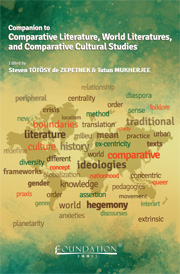
The collected volume Companion to Comparative Literature, World Literatures, and Comparative Cultural Studies - edited by Steven Totosy de Zepetnek (Purdue University) and Tutun Mukherjee (University of Hyderabad) is intended to address the current situation of scholarship in the discipline of comparative literature and the fields of world literature and comparative cultural studies in a global context. While the discipline of comparative literature in the West appears to be losing ground in its institutional presence, in other parts of the world including Asia and Latin America, as well as in "peripheral" European countries such as Spain, Portugal, Poland, Greece, Macedonia, etc., the discipline is flourishing both in scholarship and in its institutional structure and pedagogical vitality. The field of world literatures is gaining renewed interest in US-American scholarship while the field of comparative cultural studies is a new area of study pursued by scholars who are committed to the intellectual trajectories of comparative literature - minus Eurocentrism and the nation approach - and cultural studies. 36 articles of around 6000 words each are presented in thematic groups in this volume: Part 1: Theories of Comparative Literature, World Literatures, and Comparative Cultural Studies; Part 2: Comparative Literature in World Languages (including the histories of the discipline in various countries); Part 3: Examples of New Work in Comparative Literature, World Literatures, and Comparative Cultural Studies; Part 4 is a Multilingual Bibliography of Books in Comparative Literature, World Literatures, and Comparative Cultural Studies (also available online in open access at http://docs.lib.purdue.edu/clcweblibrary/comparativeliteraturebooks). The volume is intended for students and faculty in the humanities and social sciences, as well as a general readership.
Nepal has a long history of political struggle and popular uprisings have often threatened the existing regimes of this landlocked, predominantly Hindu state. In 1996, radical Maoists launched what would become the protracted armed struggle, known as The People's War, with the aim of replacing the parliamentary system and the constitutional monarchy with a people's republic. Thousands of people died and even more were injured over the next ten years in bitter fighting which ravaged the country and shocked the world. The gruesome murder of King Birendra, his wife and seven other royal family members in 2001 prompted more international concern about the future of Nepal. The violence eventually came to an end in 2005-2006 when the demand for a Constituent Assembly election was agreed upon. The election was finally held on 10 April 2008, marking one of the most significant events in Nepal's political history because it abolished the country's 239-year-old monarchy and established a multiparty democratic republic.This book, penned by the former Chief Election Commissioner of Nepal, narrates the country's transformation from a kingdom to a multiparty democratic republic holding Constituent Assembly election. It also discusses the roles of national and international organizations, including the United Nations, in the ongoing peace process of Nepal.