To save content items to your account,
please confirm that you agree to abide by our usage policies.
If this is the first time you use this feature, you will be asked to authorise Cambridge Core to connect with your account.
Find out more about saving content to .
To save content items to your Kindle, first ensure no-reply@cambridge.org
is added to your Approved Personal Document E-mail List under your Personal Document Settings
on the Manage Your Content and Devices page of your Amazon account. Then enter the ‘name’ part
of your Kindle email address below.
Find out more about saving to your Kindle.
Note you can select to save to either the @free.kindle.com or @kindle.com variations.
‘@free.kindle.com’ emails are free but can only be saved to your device when it is connected to wi-fi.
‘@kindle.com’ emails can be delivered even when you are not connected to wi-fi, but note that service fees apply.
13-1 Write down three sentences in English about your life. Now do the same thing in Spanish. Which verb tenses did you use in these sentences? Do you think these are the verb tenses you use most often? Are there other verb tenses that you are familiar with but do not use often? Which ones are these?
13-2 Which sentence do you prefer: I'll go to the game this weekend or I'm going to the game this weekend? Can you think of a context where the one you didn't prefer sounds better to you? Now try these sentences: I ate the last apple. I have eaten the last apple. Which sounds more natural to you? Do they mean the same thing?
Students of Spanish often want to know why there are so many verb tenses in Spanish. To arrive at an answer to this question, as for so many other questions about Modern Spanish, we will begin by looking at Latin. Whereas Latin had only ten verb tenses, six in the indicative and four in the subjunctive, Spanish has fourteen verb tenses, ten in the indicative and four in the subjunctive. Of the ten Latin tenses, four were kept, two were lost, and four were repurposed. In Spanish ten new tenses were created. This chapter outlines these changes and then focuses in particular on the new future and conditional forms, like cantaré and cantaría, and the compound tenses, like he cantado and había cantado. We will see how these tenses were created and then look at the competition in Modern Spanish between two future forms, cantaré and voy a cantar, and two past tense forms, the preterit canté and the present perfect he cantado.
What Is a Verb Tense?
Speakers of English and Spanish find it useful to indicate the time of an event, whether past, present, or future, by the tense of the verb they choose. In its most basic definition a verb tense is a verb form that indicates time. The word tense comes to English from Old French tens (Modern French temps), meaning ‘time’ from TEMPUS ‘stretch of time,’ which becomes tiempo in Spanish.
1-1 Certain questions about the Spanish language have probably come to mind since you began speaking it, like the question in this chapter's title. As an example, here are two questions you might have about English: Why is mice the plural of mouse, but houses is the plural of house? Why do similar words in English and Spanish have different meanings, like embarrassed and embarazada? Please write down two questions – or as many as you can think of – about the Spanish language. Be sure they are questions that really interest you.
In order to start you on the path to learning about the history of Spanish, this chapter presents some interesting questions about the Spanish language that you will be able to answer after learning about its history. One such question, explored in this chapter, is why the noun arte can be eithermasculine or feminine in Spanish, as in el arte abstracto, where it is masculine, and las bellas artes, where it is feminine. The answer to this question illustrates how understanding its history can increase your understanding of Spanish today.
Why Study the History of Spanish?
If you are interested in learning about the history of the Spanish language, then it is likely that you have developed some proficiency in Spanish. You may have studied it in a classroom or on your own, or you may have grown up speaking Spanish with your family or in your community. Your ability to communicate in Spanish means that you have an understanding of how Spanish is spoken today by a particular group of people in a particular place. You know, for example, that the letters ue are pronounced [we] and that this diphthong occurs in duermo but not dormimos. You also know that the letters ch are pronounced [tʃ] and that this sound occurs in the noun noche but not in the adjective nocturno. You know the different forms for nouns, like the plural tamales and the singular tamal; pronoun forms, like sin mí and conmigo; and irregular verb forms like soy, quepo, pongo, and tuve. You also know that the words fábrica and carpeta have different meanings from English fabric and carpet. Your knowledge of Spanish as it is spoken now allows you to use the language and to describe how you use it.
4-1 Do any of your non-Spanish-speaking friends ever use Spanish words when speaking English? They might say Adios, amigos or use food terms like salsa and burrito. Make a list of at least three Spanish words that English speakers use. Think of different aspects of culture like food, music, dance, art, literature, clothing, and housing that these words could come from. Why would someone prefer a Spanish word when speaking English? Now switch the languages around and give three examples of English words used by Spanish speakers. Why do you think Spanish speakers borrowed these words from English?
In this chapter, you will learn about four major moments of language contact in the history of Spanish. The first moment is the arrival of Romans in the Iberian Peninsula, which puts speakers of Latin in contact with speakers of Basque, Iberian, Celtic, and other languages. A second moment of contact is the arrival of Germanic tribes in the Iberian Peninsula, who encounter the speakers of Latin who had settled there. A third moment of contact is the arrival of Arabic speakers in the Iberian Peninsula. The fourth and final moment of contact is the arrival of Spanish speakers in the Americas, who encounter speakers of indigenous Amerindian languages. For each moment of contact, we will consider its effects on the sounds and words of Spanish. We will see that we can identify borrowed words and place names with a higher degree of certainty than borrowed sounds.
What Is Language Contact?
Language contact can be defined quite simply as “the use of more than one language in the same place at the same time … [where] at least some people use more than one language” (Thomason 2001: 1). Thus, language contact occurs when speakers of different languages occupy the same territory, as was the case for example when the Romans arrived in the Iberian Peninsula in 218 BC. In these situations, speakers need to communicate with speakers of another language and so they accommodate their speech by learning the other language to a greater or lesser degree.
10-1 Have you noticed that English speakers sometimes say the data are important while others say the data is important? What is the difference in these two sentences and why do speakers prefer one over the other?
10-2 Conjugate the verb to shine: Today I shine, Yesterday I ____, I have ____. Now do the same with to show, to slay, and to weave. For each verb say whether you used regular forms, like Today I play, Yesterday I played, I have played, or irregular forms, like Today I begin, Yesterday I began, I have begun.
This Chapter Begins With An Overview Of The Grammatical Categories And Functions In Use In Spanish Today And The Forms Used To Express Them. This Is Followed By A Look At The Processes That Have Led To Changes In These Functions And Forms. You Will Learn How Speakers Create New Forms From Existing Elements And Also How They Reshape Existing Forms Through Analogy.
What Are Morphemes and Paradigms?
We have seen in Chapters 6–9 on phonological changes how speakers change their language by changing their pronunciation of certain sounds. In this chapter and the next four, Chapters 10–14, we will consider morphological changes in the history of Spanish, the ways in which speakers change the forms they use. The key to understanding morphology is first to realize that the forms in Spanish, like those of other languages, are organized into patterns or paradigms (los paradigmas). The next step is to learn to analyze these patterns. Therefore, the best way to understand morphology is to become a “pattern-seeking device” that learns to detect and analyze patterns in the forms in Spanish that express grammatical functions.
One paradigm that you are no doubt familiar with is a verb conjugation, such as the conjugation of the present indicative of the verbs dormir and cantar:
When we compare these two paradigms, we can see that certain forms are associated with certain functions. It is easy to see that the stem of the verb, duerm- or dorm- for dormir and cant- for cantar, indicates the meaning of the verb, its lexical content, whether ‘sleep’ or ‘sing,’ and that the verb endings indicate grammatical person, such as the first person singular -o of duermo and canto.
6-1 Why does the word fiesta have a different first vowel from festivo ‘festive’? Why don't they both have the same vowel, as in fiesta/*fiestivo or *festa/ festivo? (The asterisk before *fiestivo and *festa indicates that these forms are unattested.) Can you think of a linguistic reason for the difference in vowels in these pairs of words? In order to answer this question, find at least three other pairs of Spanish words related in meaning where one has a diphthong (un diptongo), a vowel plus a semi-vowel in the same syllable like /je/ or /we/, and the other has a single vowel or monophthong (un monoptongo) like /e/ or /o/. A good way to find these words is to think of Spanish words with a diphthong and then to look for related words without a diphthong. What do the words with a diphthong have in common?
In this chapter, you will learn how Spanish vowels evolved from Latin. Latin had the same five vowels as Spanish, /i/, /e/, /a/, /o/, and /u/, but there was a long and short version of each of these vowels. Vowel length in Latin determined whether a vowel was stressed or unstressed and this in turn determined its result in Spanish. Knowing the vowel changes in the history of Spanish will allow you to determine the Spanish result or reflex (reflejo) for a Latin word, since these changes are for the most part regular, by which we mean that the same vowels change in the same ways. For example, both of the Latin short mid open vowels, Ĕ and Ŏ, diphthongize to [je] and [we] in Spanish when they are stressed. This regularity is especially remarkable since speakers make no conscious effort to change sounds in a particular way.
Where Do the Sounds in Spanish Come from?
The modern varieties of Spanish come from the continuous development of speech varieties going back to Latin and then to the Italic branch of the Indo- European family of languages and ultimately to Proto-Indo-European, as mentioned in Chapter 4. Thus, the sounds that make up Spanish today have a long backstory, but it is typical to begin our discussion of their history with Latin, the oldest language variety in this line of continuous development for which we have ample documentation.
14-1 Which verb form do you use? I have drank/drunk/drunken some water. Which form of the adjective do you use? I saw a drunk/drunken sailor. Now try another verb: The horses have treaded/trodden the ground. I have treaded/trodden water. And another adjective: The formerly downtreaded/downtrodden nation made remarkable progress. What do you observe about the relationship between the past participle and the adjective?
14-2 In Spanish, do you say he imprimido la tarea or he impreso la tarea? Ask a few native Spanish speakers what they think about both forms. Why do you think there are two forms?
Chapter 13 considered the organization of verb tenses from Latin to Spanish and the origins of the new Spanish tenses, the future and conditional and the compound tenses. This chapter focuses on the forms of these verbs. We will see that the sound changes in the history of the Spanish language, presented in Chapters 6–9, sometimes lead to regular verb forms in Spanish, but sometimes lead instead to irregular verb forms. In addition to sound changes, analogy is also at work, so that speakers sometimes change one verb form by analogy to another, just as they changed the form of certain nouns through analogy, such as NURUM to nuera. You will learn how speakers created regular and irregular verb forms and how they made many of these regular again through analogy.
Why Are There So Many Irregular Verbs in Spanish?
We consider a verb to be irregular when its stem is not the same throughout its paradigm, in other words, when it shows stem allomorphy. Thus, a verb like dormir is irregular because it has two stems in the present, duerm- and dorm- and a third stem in the preterit durm-. The verb, cantar, on the other hand, is regular because it has the stem cant- in all persons and tenses. We will see in this chapter that many irregular stems resulted from regular sound changes. You will recall that regular sound changes produced the two present tense stems of dormir: duerm- when Latin /o/ was tonic, as in duermo, and dorm- when it was initial, as in dormimos.
2-1 Give an example of a time when someone corrected your use of your native language. He or she might have said, for example, “don't say me and him went to the store, say he and I.” What was his or her reason for correcting you?
2-2 Now recall a time when you corrected someone else's use of his or her native language. What did you say? Why?
2-3 If you are not a native speaker of Spanish, recount an incident where someone corrected your use of Spanish or, if you are a native speaker of Spanish, when someone corrected your use of a language that is not your native language. What did he or she say? Why?
Chapter 1 provided a diachronic explanation for the modern forms el arte and las artes while at the same time illustrating how linguists approach the task of arriving at this type of explanation. In this chapter, we will take a closer look at a linguist's approach to the study of language. The most fundamental principle of linguists is that all linguistic varieties of a language are equally valid. Following this principle will enable you to learn to think linguistically so that you can analyze what you read and hear in Spanish, or any language, and ultimately find answers to the questions you may have about the languages you encounter in your daily life.
Does a Linguist Tell a Cat How to Meow?
A fundamental principle of any linguistic analysis is that linguists do not make value judgments (juicios de valor) about language. This means that linguists do not consider what native speakers say to be good or bad or correct or incorrect. In fact, linguists do not even use these words. A linguist listens to everything a native speaker says without judging. Let's take the example of ain't in English. You have no doubt heard that it is wrong or incorrect to say ain't. But this idea does not come from a linguist. It comes instead from a grammarian whose goal is to develop a prescriptive grammar (una gramática prescriptiva) of the language that tells native speakers how they should speak. A linguist's job, on the other hand, is to describe what native speakers say, and eventually to analyze and explain it in a descriptive grammar (una gramática descriptiva).
This book is a user-friendly introduction to the history of the Spanish language. It is written for “students,” whether enrolled in a course or not, who are curious about the Spanish language. We hope that understanding the evolution of Spanish will help satisfy your curiosity and that it will at the same time inspire you to continue asking questions while observing and analyzing the use of language all around you. If you teach the Spanish language, we hope this book will make it possible for you to answer many of your students’ questions about Spanish so that you can satisfy and foster their curiosity as well.
The most user-friendly feature of the book is its style. We have written it as if we were sitting down with you chatting about these topics. Other features include the lead-in questions at the beginning of each chapter to help you reflect on your own use of language and relate it to the chapter's topics. The text of each chapter is organized so that you can learn concepts step by step. We present all the background information you need to understand these concepts, so that you do not need any prior knowledge of Latin or linguistics or even a high degree of proficiency in Spanish. Within the chapters you will find textboxes that offer deeper explanations, additional information, or controversies on certain points. Each chapter ends with a summary to help you review its main points. Following the text of the chapter you will find a variety of activities to help you engage further with the concepts. Some of these help you review and reinforce what you have learned, whereas others provide new material to expand your understanding. We are delighted that you have decided to take this first step toward learning how Spanish has evolved. We would love to hear from you about your journey. Please feel free to email us if you have questions, suggestions, or fan mail.
15-1 In English, you can say The dog ran after the cat only with the words in this order. How can you say this in Spanish? Is it possible to change the order of the words in Spanish? Why is this so?
15-2 Do you say quiero mi gato or quiero a mi gato with the personal a before gato? Why?
15-3 What is the difference in meaning between Juan cerró la ventana and La ventana se cerró? Who is doing the action in each of these sentences? Why does one sentence use a reflexive marker se and the other one doesn't?
15-4 What is the difference in meaning between la puerta es cerrada and la puerta está cerrada? Why do you think Spanish has two verbs for ‘to be’?
This chapter looks at the history of grammatical structures in Spanish that are quite different from English structures. By examining the origin of these structures and their evolution in Spanish, you will understand more clearly the grammar of Modern Spanish. This chapter begins by briefly examining how changes in the Latin case system contributed to changes in word order in Spanish. It then considers several other syntactic changes, including personal a, the order of clitic pronouns, the expansion of the use of reflexives, and finally the functions of the verbs ser and estar.
Changes in Word Order
We saw in Chapter 11 that the words in a Latin sentence, such as AMICA VIDET AMICUM ‘The (female) friend sees the (male) friend,’ could have numerous possible orders, because case endings indicated the grammatical functions of nouns and other nominal elements. However, word order in Latin was not completely free. The preferred order was subject-object-verb (SOV), as in AMICA AMICUM VIDET, literally ‘The (female) friend the (male) friend sees.’ Variations of this order were based on subtle differences of meaning, as they are today in Spanish (Ledgeway 2012: 59). As a result of the loss of the case system, word order and prepositions became the principal means in Spanish of indicating these grammatical functions and the language gradually shifted to the preferred subject-verb-object (SVO) word order that we mentioned in Chapter 11, although also with some flexibility.
8-1 For the following words, what would their reflexes have been in Spanish if the tonic vowel had undergone regular sound changes? What are the Modern Spanish reflexes instead? How are they different? What might account for this?
a. VĬTREUM and MŬLTUM; *LACTEM and ALTĔRUM
c. MATĚRIAM and NŎVIUM
d. CASTĔLLUM and *CŎLŎBRAM
This chapter presents special changes in the tonic vowel that differ from the regular changes you studied in Chapter 6. You will see that all of these changes are brought about through the raising effect of a yod or another sound in the word. This illustrates the important principle that sounds sometimes change differently depending on the other sounds around them.
What Are the Special Tonic Vowel Changes?
The three parts of the Lead-in question illustrate three types of special vowel changes. The first is vowel raising (la cerrazón vocálica). We see this raising in the evolution of the tonic vowels /i/ and /u/ in VĬTREUM > vidrio ‘glass’ and MŬLTUM > mucho and also /a/ in *LACTEM > leche and ALTĔRUM > otro. You will recall from Chapter 6 that the short tonic vowels lowered by one degree so that we would expect the reflexes *vedrio and *mocho, just like PĬLUM > pelo and CŬPPAM > copa. The vowel /a/, already an open vowel, normally remains unchanged, as in LACUM > lago. When it raises, it can become fronted to /e/, as in leche, or it can become backed to /o/, as in otro. In all these examples, because the vowel is higher than the expected result, we call this raising.
The second exceptional change is the lack of diphthongization (la falta de diptongación) that results from vowel raising in words with a tonic short /e/ and /o/, like MATĚRIAM > madera and NŎVIUM > novio. If the tonic vowels had diphthongized in these words the way they did in SĚPTEM > siete and NŎVEM > nueve, the results would be *madiera and *nuevio.
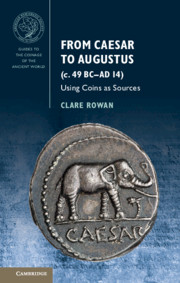
This unique book provides the student of Roman history with an accessible and detailed introduction to Roman and provincial coinage in the late Republic and early Empire in the context of current historical themes and debates. Almost two hundred different coins are illustrated at double life size, with each described in detail, and technical Latin and numismatic terms are explained. Chapters are arranged chronologically, allowing students to quickly identify material relevant to Julius Caesar, the second triumvirate, the relationship between Antony and Cleopatra, and the Principate of Augustus. Iconography, archaeological contexts, and the economy are clearly presented. A diverse array of material is brought together in a single volume to challenge and enhance our understanding of the transition from Republic to Empire.