To save content items to your account,
please confirm that you agree to abide by our usage policies.
If this is the first time you use this feature, you will be asked to authorise Cambridge Core to connect with your account.
Find out more about saving content to .
To save content items to your Kindle, first ensure no-reply@cambridge.org
is added to your Approved Personal Document E-mail List under your Personal Document Settings
on the Manage Your Content and Devices page of your Amazon account. Then enter the ‘name’ part
of your Kindle email address below.
Find out more about saving to your Kindle.
Note you can select to save to either the @free.kindle.com or @kindle.com variations.
‘@free.kindle.com’ emails are free but can only be saved to your device when it is connected to wi-fi.
‘@kindle.com’ emails can be delivered even when you are not connected to wi-fi, but note that service fees apply.
Bullying is not a new problem for teachers, principals and the school community in general to deal with. However, the advent of smart devices and their widespread availability has seen the rise of a new dimension in bullying – that of online, or cyber, bullying. The ‘Digital Education Revolution’ program that was launched by the federal government in 2007 saw laptops being provided to high school students. Electronic devices are now anaccepted study tool, with many schools having a ‘bring your own device’ policy while others charge a levy and provide devices to students. So students have the tools and justification to access devices, both at school and after hours, in order to complete their homework and study.
Schools, just like any other workplaces, are not exempt from the risk of accidents; in fact, schools are environments in which there are a range of possible hazards as well as risks that need to be considered to ensure the safety of staff, students, volunteers, parents and contractors working onsite (Queensland Government, Department of Education, 2019a). It should be remembered that schools and teachers are also responsible for the safety of staff and students during sports and swimming carnivals, school excursions and other activities that are school events but not held on the school grounds. Risk assessments and duty of care also come under the banner of WHS.
Professional regulation occurs in, and for, many professions in Australia. Similar to the legal and engineering professions, regulation in the education profession is a key factor in the development and maintenance of appropriate standards for members of the profession. There are a number of professional bodies, one in each state and territory in Australia, that exist to manage registration of members of the teaching profession (i.e. school teachers). In addition to this, they ensure that members fulfil a number of requirements to continue to be part of, and practise in, the profession in their jurisdiction. Refer to Table 10.1 in Chapter 10 for the names of each of these state and territory professional bodies, established to ensure the apposite professional standing of teachers in the community. In this chapter we first explore professional regulation in general and then consider the multidimensional approach to regulation that is at work at a number of levels in the various jurisdictions in Australia. We proceed to elucidate teacher registration by exploring what teachers have to do to initially become registered and remain registered, and conclude by examining why there is a need for professional regulation in the first instance.
Schools are the keepers of personal and sensitive data which is provided at the time of enrolment and entrusted to the school. As the student progresses through his or her academic years, further information and performance data are collected and stored in order to best gauge the position of the student and provide support. Some of this information is for administrative purposes while other data is collected to track achievement or bring attention to a particular area of need. With the convenience and space available for online and cloud storage of student data, teachers have an increased responsibility towards protecting personal information. This information can typically include names, addresses, religious affiliations, nationality, date of birth, behavioural notes and medical information. Photographs, video clips, and online and hard-copy documents used in schools also fit the criteria of personal information (Australian Law Reform Commission, ). Personal information is not limited to students as it can also apply to staff, volunteers, contractors, parents and others who are connected to the school.
Statute law imposes on parents, and persons acting in the capacity of a parent, an obligation to compel their children between prescribed ages to attend a government or approved non-government school. This will generally mean that students are required to attend school between age six and the completion of Year 10 or turning 17 (whichever comes first). There is generally a requirement for youth to undertake full-time training, paid work or a combination of both through to the age of 17 – see, for example, Education Act 1990 (NSW) s 21B; Education and Training Reform Act 2006 (Vic) s 2.1.1; Education (General Provisions) Act 2006 (Qld) ss 4(1)(b), 9. (There is also the option of home education, with a parent needing to be registered to provide this to his or her child, but this, of course, is not relevant to this chapter.)
The Fair Work Act 2009 (Cth) also prohibits discrimination in employment based on a protected attribute such as ‘race, colour, sex, sexual orientation, age, physical or mental disability, marital status, family or carer’s responsibilities, pregnancy, religion, political opinion, national extraction or social origin’ (s 351(1)). The discrimination on the basis of religion may be permissible in faith-based non-government schools and is discussed further in this chapter.
Ethics can be considered from a variety of theories or understandings. For the purposes of this chapter we will consider ethics from the viewpoint of the individual teacher, in addition to the professional expectations of teachers to behave in a right and proper manner that are externally imposed. This dual perspective will be used when considering actions and decision making undertaken with fellow teachers, school administration or leaders in a teacher’s school, and most importantly, when interacting with students entrusted into a teacher’s care or with their parents/caregivers.
The act of teaching generally takes place in relative isolation. Other professions are most often conducted in the presence of others with similar, and often identical, interests in a given outcome. Professional examples include medicine, law and architecture. The act of teaching is different because it usually involves a direct relationship with a class and this takes place in the absence of other members of the profession.
This introduction is designed to give readers an overview of or a refresher on the basics of Australia’s legal system. While many readers will be familiar with these basics, others might not be so this material has been included to inform the specific discussion of law that follows in this book’s substantive chapters.
Duty of care in an educational context is concerned with the safety and wellbeing of students. It is a term we hear all the time in schools. It is imperative to have a clear understanding and working knowledge of when and where the duty is owed and where it is not. Duty of care is part of the tort of negligence where typically a student becomes injured on school grounds or at a school event and his or her family wants to seek a remedy. This is usually in the form of financial compensation for the loss suffered and for any ongoing treatment costs. The circumstances in which a plaintiff is likely to proceed and win a case in the tort of negligence is now well established in law. This chapter discusses the duty of care and how it operates in schools. The discussion covers the defences used by schools to reduce or avoid their responsibility in such matters. The second half of the chapter outlines several of the significant judicial cases in school law, highlighting what they have decided about the liability and legal position of schools and school authorities.
Sometimes life does not go to plan. The breakdown of any family unit and the reality of parents separating can be heartbreaking for everyone involved, particularly children (Relationships Australia, ). In Australia there are a significant number of children living in separated families and moving regularly between the two homes as a part of their normal routine. The Australian Institute of Family Studies reported that in 2017, 47.1 per cent of divorces involved children under 18 years of age (Australian Institute of Family Studies, ).
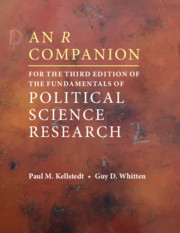
An R Companion for the Third Edition of The Fundamentals of Political Science Research offers students a chance to delve into the world of R using real political data sets and statistical analysis techniques directly from Paul M. Kellstedt and Guy D. Whitten's best-selling textbook. Built in parallel with the main text, this workbook teaches students to apply the techniques they learn in each chapter by reproducing the analyses and results from each lesson using R. Students will also learn to create all of the tables and figures found in the textbook, leading to an even greater mastery of the core material. This accessible, informative, and engaging companion walks through the use of R step-by-step, using command lines and screenshots to demonstrate proper use of the software. With the help of these guides, students will become comfortable creating, editing, and using data sets in R to produce original statistical analyses for evaluating causal claims. End-of-chapter exercises encourage this innovation by asking students to formulate and evaluate their own hypotheses.