To save content items to your account,
please confirm that you agree to abide by our usage policies.
If this is the first time you use this feature, you will be asked to authorise Cambridge Core to connect with your account.
Find out more about saving content to .
To save content items to your Kindle, first ensure no-reply@cambridge.org
is added to your Approved Personal Document E-mail List under your Personal Document Settings
on the Manage Your Content and Devices page of your Amazon account. Then enter the ‘name’ part
of your Kindle email address below.
Find out more about saving to your Kindle.
Note you can select to save to either the @free.kindle.com or @kindle.com variations.
‘@free.kindle.com’ emails are free but can only be saved to your device when it is connected to wi-fi.
‘@kindle.com’ emails can be delivered even when you are not connected to wi-fi, but note that service fees apply.
States must not only abstain from violating the rights of individuals under their jurisdiction by ensuring that State agents do not commit such infringements. They must also intervene where acts committed by private parties, whether individuals, groups, or legal persons, threaten to violate those rights. Where there are indications that an individual is at risk of having his/her rights violated, or where a situation exists which gives rise to such a risk, preventive measures must be taken in order to ensure, to the fullest extent possible, that these risks do not materialize. And when the measures they adopt fail, and violations are caused by the conduct of non-State actors, State authorities may not remain passive: they are under an obligation to provide effective remedies to the individual whose rights have been violated in order to ensure that he/she will be compensated, and in certain cases that the wrongdoer will be sanctioned through administrative or criminal penalties.
It is one of the purposes of the United Nations to ‘promot[e] and encourag[e] respect for human rights and for fundamental freedoms for all without distinction as to race, sex, language, or religion’ (Article 1, para. 3 of the UN Charter; see also Article 55(c), in chapter IX on international economic and social co-operation). The Universal Declaration on Human Rights (UDHR) reflects this emphasis on the prohibition of discrimination by stating that ‘[a]ll human beings are born free and equal in dignity and rights’ (Art. 1, first sentence), and by providing: ‘Everyone is entitled to all the rights and freedoms set forth in this Declaration, without distinction of any kind, such as race, colour, sex, language, religion, political or other opinion, national or social origin, property, birth or other status’ (Article 2, first para.). Article 7 of the UDHR, which extends the scope of the requirement of non-discrimination beyond the enjoyment of the rights listed in the Declaration, also clearly imposes a positive obligation in this regard on the Member States of the United Nations: ‘All are equal before the law and are entitled without any discrimination to equal protection of the law. All are entitled to equal protection against any discrimination in violation of this Declaration and against any incitement to such discrimination.’ In addition, a number of rights of the UDHR refer to equal treatment among its different components: for example, Article 10 states that everyone ‘is entitled in full equality to a fair and public hearing by an independent and impartial tribunal, in the determination of his rights and obligations and of any criminal charge against him’; under Article 16, men and women ‘are entitled to equal rights as to marriage, during marriage and at its dissolution’; the participatory rights listed in Article 21 include the right of everyone to ‘equal access to public service in his country’ and to ‘universal and equal suffrage’; Article 26, para. 2 mentions the right of everyone, without any discrimination, to equal pay for equal work.
The United Nations Charter-based system of human rights monitoring went through major changes in 2006–7. Acting under Article 68 of the UN Charter, the Economic and Social Council (Ecosoc) established the Commission on Human Rights as an intergovernmental body initially composed of eighteen Member States. The membership of the Commission on Human Rights was gradually expanded to fifty-three members in 2006 to take account of the more diverse membership of the United Nations. The Commission was assisted in its work by the UN Sub-Commission for the Promotion and Protection of Human Rights, until 1999 called the Sub-Commission on Prevention of Discrimination and Protection of Minorities. Despite major achievements, the system thus developed was considered to be overpoliticized and to lack credibility due, in particular, to the selective approach to the human rights records of governments. In its place, it was decided in 2005 to establish a Human Rights Council as a subsidiary organ of the UN General Assembly, whereas the former Commission on Human Rights was one of a number of subsidiary bodies of the Ecosoc.
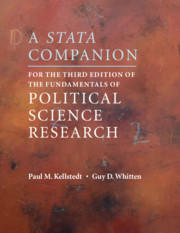
A Stata Companion for the Third Edition of The Fundamentals of Political Science Research offers students a chance to delve into the world of Stata using real political data sets and statistical analysis techniques directly from Paul M. Kellstedt and Guy D. Whitten's best-selling textbook. Built in parallel with the main text, this workbook teaches students to apply the techniques they learn in each chapter by reproducing the analyses and results from each lesson using Stata. Students will also learn to create all of the tables and figures found in the textbook, leading to an even greater mastery of the core material. This accessible, informative, and engaging companion walks through the use of Stata step-by-step, using command lines and screenshots to demonstrate proper use of the software. With the help of these guides, students will become comfortable creating, editing, and using data sets in Stata to produce original statistical analyses for evaluating causal claims. End-of-chapter exercises encourage this innovation by asking students to formulate and evaluate their own hypotheses.
First published in 2002, this book offers an authoritative and accessible introduction to the New Testament and early Christian literature for all students of the Bible and the origins of Christianity. Delbert Burkett focuses on the New Testament, but also looks at a wealth of non-biblical writing to examine the history, religion and literature of Christianity in the years from 30 CE to 150 CE. The book is organized systematically with questions for in-class discussion and written assignments, step-by-step reading guides on individual works, special box features, charts, maps and numerous illustrations designed to facilitate student use. An appendix containing translations of primary texts allows instant access to the writings outside the canon. For this new edition, Burkett has reorganized and rewritten many chapters, and has also incorporated revisions throughout the text, bringing it up to date with current scholarship. This volume is designed for use as the primary textbook for one and two-semester courses on the New Testament and Early Christianity.
The second edition of this award-winning textbook provides an accessible and engaging introduction to the field of lesbian, gay, bisexual, transgender, intersex, and queer psychology. Comprehensive in scope and international in outlook, it offers an integrated overview of key topical areas, from history and context, identities and fluidity, families and relationships, to health and wellbeing. The second edition has been extensively revised to address substantial developments and emerging areas, such as people born with intersex variations, transgender and non-binary genders, intersectionality, and gender-diverse children. It also includes new pedagogical features to support learning and to facilitate discussion and reflection, with feature boxes throughout that explain important concepts, provide concise overviews of cutting-edge research, and offer first-person narratives that bring topics to life. This pioneering textbook is an essential resource for undergraduate courses on sex, gender, and sexuality in psychology and related disciplines, such as sociology, health studies, social work, education, and counselling.
Of all the prominent environmental issues of the past few decades, global climate change is the most serious and the most difficult to manage. It is the most serious because of the severity and breadth of harms it is likely to bring. Many aspects of human society and well-being – where we live, our health and productivity, how we build, how we move around, how we earn our livings, and what we do for recreation – depend on a relatively benign and narrow range of climate conditions, even though this dependence is lessened and less visible in modern industrial societies. Dependence on climate can be seen in the economic harms and human suffering caused by the climate variations of the past century, such as the “El Niño” cycle and the multi-year droughts that occur in western North America every few decades, and in the climate disruptions that have become more visible over the past two decades. Climate changes projected for the next several decades are substantially larger than those observed now or over the past century, and their human impacts are likely to be correspondingly greater. Moreover, climate does not just affect people directly: It also affects all other environmental processes, including many whose links to climate might not be obvious. Large or rapid changes in climate will intensify other environmental issues such as air quality, water availability and quality, endangered ecosystems and biodiversity, and threats to coastal zones, wetlands, and the stratospheric ozone layer.