To save content items to your account,
please confirm that you agree to abide by our usage policies.
If this is the first time you use this feature, you will be asked to authorise Cambridge Core to connect with your account.
Find out more about saving content to .
To save content items to your Kindle, first ensure no-reply@cambridge.org
is added to your Approved Personal Document E-mail List under your Personal Document Settings
on the Manage Your Content and Devices page of your Amazon account. Then enter the ‘name’ part
of your Kindle email address below.
Find out more about saving to your Kindle.
Note you can select to save to either the @free.kindle.com or @kindle.com variations.
‘@free.kindle.com’ emails are free but can only be saved to your device when it is connected to wi-fi.
‘@kindle.com’ emails can be delivered even when you are not connected to wi-fi, but note that service fees apply.
This essay examines the oracular responses of the oracle of Dodona portrayed in fifth-century BCE Attic tragedies. This analysis explores the wording of the oracular answers, characterized by extreme conciseness and clarity, and the topic of the queries, on household security, family matters, and final journeys. The evidence from the lead tablets at Dodona corroborates this focus, showing that while the oracle addressed various concerns, a significant number of private queries dealt with family, health, marriage, and travel. Additionally, the responses from Dodona were brief and straightforward, in contrast to the cryptic nature of Apollo’s oracles at Delphi.
Religion is central to Seamus Heaney’s work. Alongside his preoccupations with Catholic and Celtic belief, ancient Greek and Roman religions are significant in Heaney’s methodological palette, in which ‘low intensity’ allusions to aspects of religious culture can inform operations of poetry and ritual. Greek and Roman culture provides Heaney with a repository of spirit-guide figures, symbolic characters such as Heracles and Tiresias, forms and tropes, including funerary rituals, burial, pilgrimage, and katabasis, and entire works which the poet reimagined, such as Sophocles’s Philoctetes and Euripides’s Antigone, in which civic and religious duties intersect in ways germane to the poet’s reflections on his own time.
Ancient audiences ascribed personal religious views to individual playwrights – a fact that confirms ‘personal religion’ as a meaningful category in the study of ancient Greek society in general and the theatre in particular. Aeschylus was especially devoted to Demeter; Sophocles was exceptionally pious; Euripides was hell-bent to show that there were no gods. The oeuvres of these playwrights inspired such inferences, to be sure, but other factors mattered too. Comedies staged the tragic poets as characters and ascribed various religious views to them. Face-to-face encounters with the playwrights gave rise to anecdotes and recollections, which no doubt circulated orally but were also occasionally written down. All this meant that the playwrights could build on their public personae and assume that audiences would recognize characteristic concerns in their plays. We uncover a dynamic set of interactions in which the poet shaped his plays but was also shaped by how audiences received them. We show that we should not construct an opposition between personal and polis religion: The religious views ascribed to the tragedians were personal and communally owned.
Aristotle defines hybris as a way of mistreating (dishonouring) others. But he also emphasises its psychology, in ways that chime very well with the understanding of the concept in earlier literary sources. As well as indicating a failure to show other people the respect they deserve, hybris is a way of thinking too much of oneself. This affects one’s estimation of the role that luck plays in all human endeavour: the classic Aristotelian case is that of the rich, ‘lucky fools’ who think that their material good fortune is a sign that they excel in all respects; but ancient hybristai in general tend to develop the belief that they are invulnerable to the vagaries of fortune. In this way, hybris regularly entails a failure to deal adequately with risk. At the same time, it bears a relation to the myth of meritocracy, by which the fortunate convince themselves that their success is deserved.
Aeschylus’ Persae is an important antecedent for the account of Xerxes’ Hellenic campaign in the Histories, serving as both a source of phrases, images, and themes and a poetic foil for Herodotean inquiry. The tragedian’s presence is palpable in the staging of the king’s decision to attack Greece, although Herodotus shifts the causal emphasis from Xerxes’ personal flaws to coercive political and religious forces. Herodotus’ insistence on the contingency of Greek victory at Salamis marks a telling departure from Aeschylus’ vision of the battle as a great Panhellenic victory, vouchsafed by the gods and undisturbed by the conflicting interests of the poleis allied against Xerxes. In their presentation of Greco-Persian conflict both Aeschylus and Herodotus partially deconstruct the polarity between Hellenes and Persians, encouraging their respective audiences to look beyond cultural differences to common human traits that shaped the course of events before, during, and after the Persian invasion.
Extant Greek tragedy contains several instances of choral division, scenes when the chorus appears either to split into individual performers (as in Aeschylus’ Agamemnon) or, more commonly, to divide into small groups (semichoruses). As these scenes involve the (always temporary) disintegration of tragedy’s emblematic collective, a collective that is customarily conceived of as a unified group, this chapter frames such scenes in terms of fragmentation. These various states of fragmentation illustrate not only the way in which tragedians play with the chorus’ ability to slide towards and away from uniform collectivity but also the assumptions about wholeness which have implicitly informed critical and editorial approaches to both tragedy and the chorus. In addition to examining these divisions in tragedy, the chapter analyses similar divisions in satyr play, comedy and Rhesus, the only surviving example of fourth-century tragedy, demonstrating how the divisions of the comic and satyric choruses are more readily accepted by critics.
The Ketton Mosaic depicts the duel between Achilles and Hector, the dragging of Hector’s body and its ransom. Despite initial associations with the Iliad in the press, this article demonstrates that the Ketton mosaic does not illustrate scenes from Homer but an alternative variant of the narrative which originated with Aeschylus and remained popular in Late Antiquity. The composition also reveals its debt to a pattern repertoire shared by artists working in media such as painted pottery, coin dies and silverware, which had been circulating in the ancient Mediterranean for many centuries. Through its textual and visual allusions, the Ketton mosaic makes a strong case for the engagement of fourth-century Roman Britain with the cultural currency of the wider empire.
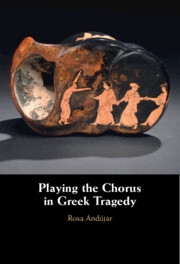
Modern audiences see the chorus as an emblematic yet static element of ancient Greek drama, whose reflective songs puncture the action. This is the first book to look beyond these odes to the group's complex and varied roles as actors and physical performers. It argues that the chorus' flexibility and interactive nature has been occluded by the desire from Aristotle onwards to assign the group a single formal role. It presents four choreographies that ancient playwrights employed across tragedy, satyr play, and comedy: fragmentation, augmentation, interruption, and interactivity. By illustrating how the chorus was split, augmented, interrupted, and placed in dialogue, this book shows how dramatists experimented with the chorus' configuration and continual presence. The multiple self-reflexive ways in which ancient dramatists staged the group confirms that the chorus was not only a nimble dramatic instrument, but also a laboratory for experimenting with a range of dramatic possibilities.
Chapter 2 contextualises the mēchanē within the broader picture of rich visual theologies that existed both on the tragic stage and within the context of the Great Dionysia. The mēchanē should be interpreted alongside actors playing gods, statues depicting gods, and altars denoting sacred places. The plurality of visual theologies in the theatre and in the festival context parallels broader cultural norms in ancient Greece. This is important, on the one hand, to understand how the machine existed within broader religious and cultural expectations. On the other hand, putting the mēchanē and mechanical epiphany among other, contemporary strategies also helps to demonstrate the deus ex machina’s unique material, theatrical and theological characteristics.
This article offers principles to be followed when editing οὔκουν and οὐκοῦν. The distinction between these words is supported by the ancient grammarians, but manuscript readings oscillate to such a degree that modern editors often do not trust them. The most common principles thus far available are those established by Kühner–Gerth and Denniston. Some are so subjective, however, that editors do not always agree on the accentuation of a non-negligible number of instances. This article takes into account the pragmatic contexts in which the particle is used in Attic drama to effect a distinction by applying a conversation analytic methodology to their interpretation. All instances appearing in the extant plays of Aeschylus, Sophocles, Euripides and Aristophanes have been analysed.
I have reserved for discussion here certain passages containing more than a single interaction. Not all combinations are significant, though. The significant combinations in the Greek corpus are of several kinds, of which the best attested and conceptually simplest comprises those instances with a broadly or cumulatively preparatory effect in favour of the vehicle.
Examination of the foundation traditions of Magnesia on the Maeander, an Aeolian polis of western Anatolia, and the various Aeolian mythic traditions attached to this city located within Caria.
This chapter examines some of the specific methodological challenges of reading dramatic fragments intertextually. It also explores some broader aspects of intertextuality, literary culture, readership, orality, and memory in relation to Greek drama in general. It begins by noting the tendency of commentators and critics to use the formula ‘cf.’ when identifying any sort of similarity between fragmentary texts (or between fragmentary texts and extant ones). But ‘cf.’ on its own is inadequate as an interpretative strategy. This chapter investigates what types of textual relationship are actually being signified by ‘cf.’, and whether it is always possible to know for certain. It also asks to what extent the poor state of the evidence hampers our understanding of textual relations between fragmentary plays, and it raises the problem of how to discern which text is responding to which. These questions are addressed by looking in detail at a number of case studies from works by Aeschylus, Phrynichus, Glaucus, Ion, Sophocles, Euripides, and Aristophanes.
The investigation of Aeolian foundation myths continues in this chapter, with examination of traditions of the founding of Boeotian Thebes. Ancestral Indo-European tradition is again evident, as is an Anatolian stratum, one which foregrounds technological expertise of Asian origin.
Further investigation of sacralized warrior relationships, focusing on that of the epíkouroi ‘allies’ as they appear in the Linear B tablets and also in Homeric epic, where the term typically identifies Anatolian allies. In those few instances in the Iliad in which the epic poet uses epíkouros to characterize Greek alliances, the poet does so within a certain Aeolian framing – cataloguing Aeolian contingents participating in the siege of Troy and, inversely, describing the search for Achaean allies to offer warrior aid in an epic assault on a great Aeolian city.
Evocations of Classical Greece and Rome pervade Robert Lowell’s entire oeuvre. His fascination with Latin literature in particular shaped his own poetry. The density and involved syntax of Virgil and Propertius are echoed in the crabbed and tortured involutions of Lowell’s earlier poetry. His confessional verse is in part a response to Catullan frankness. His view of America as declining from republic into empire was colored by the historiography of Suetonius and Tacitus, in whose portraits of imperial tyrants Lowell found a frame for depicting the darker elements of his own character. He essayed many (usually very free) translations or versions of Greek and Roman poems, often with autobiographical inflections. A number of “original” poems can be shown to have originated as translations from Catullus, Virgil, Propertius, or Horace. In contrast with his almost obsessive engagement with Roman literature, Lowell’s engagement with Greek was less extensive, often mediated through later European literature, and (notably in his versions of Aeschylus) less vivid.
Aristophanes’ Frogs was first performed at the Lenaea festival of 405 in competition with Plato's Cleophon and Phrynichus’ Muses. This paper argues that Frogs contains a series of agonistic jokes against Phrynichus, most of which have gone unnoticed because he shares his name with a tragic poet and a politician; Aristophanes plays with the ambiguity of the name Phrynichus to mock his Lenaean rival by comparing him unfavourably with his namesakes. Aristophanes ultimately claims that his comedy is superior to that of Phrynichus because he is more successful than his rival in appropriating and redeploying other comedians’ material.
Chapter five demonstrates how the ambition to preserve the past in song and stone leads to the hope of securing a stable sense of the future in the poetry of Pindar and the tragedies of Aeschylus. Here we see how the mere image of writing becomes a vehicle in epinician and tragic poetry not only for imagining systems of memorialization and justice, but also for questioning the systems thus imagined.
This article offers a new interpretation of the wave which, in the finale of Euripides’ Iphigenia Taurica, prevents the Greek ship from leaving the Taurian land, thus making it necessary for the goddess Athena to intervene. My contention is that the wave is the predictable consequence of the sacrilege which the Greeks are committing by stealing Artemis’ cult statue from the Taurian temple. Therefore, we can detect in IT the same religious offence–punishment–compensation structure that can be found in Aeschylus’ Eumenides. However, unlike in Aeschylus’ tragedy, in IT Athena's final decrees compensate only the goddess Artemis and not the human characters: after deeply suffering as instruments of the divine will, not even in the future will they be allowed to fulfil their desires. Thus, we may say that a supernatural ‘wave’ prevents humans from leaving in accordance with their will.
The Oresteia is permeated with depictions of the afterlife, which have never been examined together. In this book Amit Shilo analyses their intertwined and conflicting implications. He argues for a 'poetics of multiplicity' and 'poetics of the beyond' that inform the ongoing debates over justice, fate, ethics, and politics in the trilogy. The book presents novel, textually-grounded readings of Cassandra's fate, Clytemnestra's ghost scene, mourning ritual, hero cult, and punishment by Hades. It offers a fresh perspective on the political thought of the trilogy by contrasting the ethical focus of the Erinyes and Hades with Athena's insistence on divine unity and warfare. Shedding new light on the trilogy as a whole, this book is crucial reading for students and scholars of classical literature and religion. This title is available as open access on Cambridge Core.