To save content items to your account,
please confirm that you agree to abide by our usage policies.
If this is the first time you use this feature, you will be asked to authorise Cambridge Core to connect with your account.
Find out more about saving content to .
To save content items to your Kindle, first ensure no-reply@cambridge.org
is added to your Approved Personal Document E-mail List under your Personal Document Settings
on the Manage Your Content and Devices page of your Amazon account. Then enter the ‘name’ part
of your Kindle email address below.
Find out more about saving to your Kindle.
Note you can select to save to either the @free.kindle.com or @kindle.com variations.
‘@free.kindle.com’ emails are free but can only be saved to your device when it is connected to wi-fi.
‘@kindle.com’ emails can be delivered even when you are not connected to wi-fi, but note that service fees apply.
During the economic crisis and geopolitical turmoil in seventeenth-century Europe, Catholic missionaries observed similar chaos in China and its rapid recovery under the Qing dynasty in the mid seventeenth century. The Jesuits gained exclusive access to the Qing court. They translated classic Confucian texts into European languages and began publishing books on the history, economy, technology, politics, and other aspects of the Chinese Empire. To secure support from the Church and European rulers for their missionary efforts, the Jesuits presented an idealized image of China, claiming that classical Confucian texts reflected a belief in a monotheistic God. They argued that China’s continuous adherence to ancient teachings, in contrast to Europe’s degeneration from antiquity, brought Chinese civilization closer to the pure morality of God. Jesuit writings on China provoked attacks from other Catholic orders, who persuaded the Church that the Chinese were godless and idolatrous. Although the Jesuits were cornered in the Church, their writings became popular and intensified Sinophilia outside the Church.
The traditional view that Chinese empires relied primarily on rituals and ceremonies while neglecting the role of law has been increasingly challenged. Archaeologically discovered sources show that sophisticated laws with meticulous procedures constituted the backbone of early Chinese empires. The Qin and Han dynasties were more “Legalist” than their counterpart in the West, the Roman Empire. This book revives the stories of the main operators within the imperial bureaucracy – technical bureaucrats (law implementers) and convict laborers – whose histories had been forgotten for nearly two millennia.Leveraging methodological innovations from the digital humanities, I have collected data on a large number of officials who were criminalized and later re-employed in officialdom. This discovery enables me to propose a new framework for examining Confucian criticism of law and legal practice in early China. The biographical database also transforms linear storytelling into multidimensional narratives and helps identify Confucian social networks otherwise hidden in current literature.
Stephen Angle and Marina Svensson assert that prior to the mid-nineteenth century, there was not a Chinese word that translates the concept of “rights.” They hold that even though the classical and postclassical Chinese talked about “privileges and powers,” they didn’t have ideas of rights that correspond to the modern Western senses: namely, those that correspond to duties, protect the individual person, or provide “antimajoritarian trumps on the general interest.” Even though rights talk was also relatively new to the West then, Angle and Svensson claim that rights were founded on the historical Western understanding of persons as autonomous individuals. In contrast, they hold that the Chinese view persons as always already bound up in roles and relationships which, instead of developing into rights that correlate with duties as in the West, remains as talk about “reciprocal responsibilities” in their theorizing about ethics and politics.
This article presents additional data to better understand the history of intercultural communication between the Yenisei people and the Han Chinese. Although the mysterious history and isolated culture of the ancient Kirghiz (Chinese Xiajiasi 黠戛斯) tribes at the Yenisei River Basin are little known to the world, ancient Chinese books and the artefacts with Chinese characters, unearthed in the Yenisei region, present a vivid picture of the Yenisei people’s foreign exchange history. This article approaches the Yenisei–Chinese cultural interaction from the perspective of the Yenisei Turk-Runic language and the date of the E77 inscription. The research material for this study is the E77 Yenisei inscription that is engraved on a Tang Dynasty bronze mirror called the Sanlejing 三樂鏡 (Lobed Mirror of Three Delights). The authors’ interpretations of the local Runic language on the E77 Yenisei inscription reveal Yenisei people’s knowledge about the Chinese iconic figure of Confucius, which blends into the Tibetan Bon religion as Kong tse or Kong tshe. Therefore, this article confirms the culture contact between the Yenisei and Han Chinese people during the Tang Dynasty.
Although no comparable preoccupation with freedom developed in any other part of the world, each region had its own experiences of it. This was true of Africa, but the difficult conditions of survival promoted a reliance on other values, such as courage, honor, and loyalty. The widespread presence of slavery, only rarely as harsh as in the West, and sometimes entered into voluntarily to ward off some crisis, impeded the diffusion of liberty as a value for society as a whole. Islamic society was pervaded by an egalitarian spirit based on the universal submission of everyone to God, but political rule was absolute once established, and only justice, not liberty, set limits to what rulers could do. Formally an empire, Mughal India displayed many forms of local independence, but those who exercised local authority regarded themselves as channels of sovereign power rather than as barriers to it. In China imperial authority was formally absolute but in practice people enjoyed much freedom of action, even against state officials. As in India, however, these limits on imperial authority were not conceived as liberties, chiefly because the state was regarded as essential to providing the moral order on which stable civilized life depended.
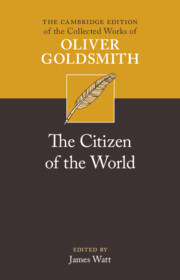
The Citizen of the World is a highly readable yet deceptively sophisticated text, using the popular eighteenth-century device of the imaginary observer. Its main narrator, the Chinese philosopher Lien Chi Altangi, draws on traditional ideas of Confucian wisdom as he tries (and sometimes fails) to come to terms with the commercial modernity and spectacle of imperial London. Goldsmith explores a moment of economic and social transformation in Britain and at the same time engages with the ramifications of a global conflict, the Seven Years' War (1756–63). He also uses his travelling Chinese narrator as a way of indirectly addressing his own predicament as an Irish exile in London. This edition provides a reliable, authoritative text, records the history of its production, and includes an introduction and explanatory notes which situate this enormously rich work within the political debates and cultural conflicts of its time, illuminating its allusiveness and intellectual ambition.
This article explores the commentaries on Analects 3.5 and related texts in light of Confucius’ other discussions of the Yi Di. It also speculates on the ways readings of these texts have been shaped by the historical-cultural contexts of the scholars who have interpreted them over the years. Finally, it questions whether there might be a relationship between Analects 3.5 and the pericopes that make up the rest of chapter 3.
The textual history of the Analects (論語) has long been based on narratives according to which disciples of Confucius (tr. 551–479 bce) recorded his sayings after his death. During the Western Han (206 bce–9 ce), three textual traditions of the Analects circulated: the Lu 魯, the Qi 齊, and the “old script” (古文). The Lu Analects in 20 chapters would eventually become the only one transmitted. Early textual losses have been offset in the last decades by recoveries of several ancient manuscripts. In this paper, we examine two manuscripts produced around 300 bce with a close connection to the Analects: the Anhui University *Zhongni said (仲尼曰) and the Wangjiazui *Kongzi said (孔子曰). Their dating makes them of particular importance to cast new light on traditional narratives. By looking at parallels and linguistic evidence of these manuscripts, we argue that *Zhongni said and *Kongzi said confirm the existence by ca. 300 bce of a tradition of collecting sayings attributed to Confucius. We define these manuscripts as “Analects-like materials,” which are characterized as lists of sayings, with little to no context, attributed to Confucius. This label separates them from Warring States narratives about the figure of Confucius.
This chapter explores the connection between ethics and mindful leadership in education by situating the discussion within the tradition of moral and ethical leadership. Drawing on virtue ethics, the concept of virtuous mindful leadership is proposed. This leadership construct refers to the present-moment attention to self, people, and events that reflects the leader’s moral character. This form of leadership transcends a leader’s obligation to adhere to moral rules or ensure good outcomes to the leader’s ethics, conduct, and role-modeling. A virtuous, mindful leader contributes to human flourishing by helping others to achieve eudaemonic well-being. In educational administration, such a leader creates and sustains a school culture of authentic mindfulness, promotes social justice education, and supports mindful collaboration with staff.
This chapter explores the concept of virtue (de) in Confucianism and Daoism, which are the two prominent indigenous traditions in ancient China. It is argued that virtue, from an ancient Chinese paradigm, is essentially about moral excellence and influence. In the Confucian traditions, virtue is manifested in the exaltation of moral goodness and ethical charisma of exemplary persons. In the Daoist traditions, virtue is encapsulated in the emptying of one’s heart-mind and in noncoercive action. Chinese ethics in the ancient past stress the utmost importance of (inter)personal cultivation of virtues and role-modeling. School leaders, teachers, students, and other educational stakeholders should develop themselves and others morally so as to collectively achieve dao (the Way), which is a shared vision of human excellence.
Catholic education faces a number of serious challenges including cultural and political disrespect for, and hostility towards religion in general and Catholicism in particular, and lack of knowledge of, and commitment to, Catholic beliefs and values among Catholic educational administrators, school managers, teachers, and other staff, as well as the diminishing percentage of even nominally Catholic staff. I set these matters within the context of broader challenges surrounding Catholic education, deriving from three cultural movements: the reformation, the emergence of liberalism, and the scientific revolution, which undermined the synthesis of scripture, theology, and speculative and practical philosophy achieved in the high middle-ages. I propose in response a creative critique showing that what is of authentic value in modernity can be accommodated within the traditional synthesis. I also connect that tradition with strands of eastern philosophy suggesting that the movement of people, ideas, and traditions from Eastern cultures into historically Western societies provides an opportunity for further synthesis of a wisdom-based approach to education.
Empirical virtue researchers have not generally relied on robust virtue theory. Without a unifying theory of virtue, scientific studies have developed without guidance, and the result is a patchwork of relatively disconnected studies of specific virtues based on ad hoc assumptions about those virtues. Therefore, this chapter presents an ecumenical, realistic virtue theory as a conceptual foundation for empirical research in virtue science. It suggests that moral virtues are (1) acquired traits that are (2) manifested in behavior, (3) steered by knowledge, and (4) fully motivated. The virtue theory presented is inspired by philosophic work (primarily Aristotle and Confucius), but it does not engage in the contentious debates active in philosophical approaches to virtue, leaving aside the debates about the nature and importance of ideal human virtue and focusing on the ordinary virtues that are often ascribed to people who are morally good. We also discuss the important role of culture in virtue definition. Finally, we outline the four components of virtue: (1) behavior, (2) cognition, (3) emotion/motivation, and (4) practical wisdom.
Psychology’s past in Eastern civilizations were an inherent part of the religious and moral philosophies. In an overview of those non-Western traditions in psychology, points of interaction between East and West occurred in Persia, which served as a crossroad between India and the Arab world. Ancient Indian culture followed the traditions of Buddhism and Hinduism. The writings of the Vedas, especially the Upanishads, provided the foundation for Hindu philosophy. In China, imported Buddhism taught that self-denial and proper thinking were necessary to achieve well-being. However, the older philosophical movement of Confucianism offered a stronger basis for Chinese intellectual progress. Both Buddhism and Confucianism were exported to Japan, where they were transposed into Japanese philosophies to support nationalistic aspirations. Two Middle Eastern cultures, Egyptian and Hebrew, are important as predecessors for the ancient Greeks whose philosophical formulations would provide the foundations for the emergence of psychology. Egyptian achievements in art and architecture left us a legacy, especially expressed in astronomy and medicine. The Jewish foundation of monotheism and law, along with an understanding of the person as a unity of spirit and matter, interfaced with the Greek culture that was to dominate the Mediterranean world.
This chapter discusses how culture affects economic development. Based on historical, political, and economic reasons, China today has a strongly pro-economic growth culture. Historically, the Confucian culture of frugality, hard-working, and respecting the family is conducive to economic productivity. Politically, the authoritarian political system has shaped a population that is relatively more obedient and deferent to authority – traits that contribute to efficiency for low-skilled work such as manufactu¬ring. Economically, decades of poverty under Mao’s rule made people extremely motivated to work hard to make money. All these factors fueled China’s high economic growth. The chapter also draws attention to the fact that Mao had left an indelible imprint on today’s business leaders in China, a unique and important phenomenon that the international business community should be aware of. It also shows that a “Mao plus Deng” effect – Mao’s lawlessness and Deng’s call to get rich – is the root cause of property rights violations and especially the persistent problems of product safety and counterfeit goods in China.
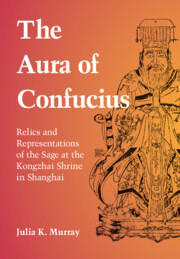
The Aura of Confucius is a ground-breaking study that reconstructs the remarkable history of Kongzhai, a shrine founded on the belief that Confucius' descendants buried the sage's robe and cap a millennium after his death and far from his home in Qufu, Shandong. Improbably located on the outskirts of modern Shanghai, Kongzhai featured architecture, visual images, and physical artifacts that created a 'Little Queli,' a surrogate for the temple, cemetery, and Kong descendants' mansion in Qufu. Centered on the Tomb of the Robe and Cap, with a Sage Hall noteworthy for displaying sculptural icons and not just inscribed tablets, Kongzhai attracted scholarly pilgrims who came to experience Confucius's beneficent aura. Although Kongzhai gained recognition from the Kangxi emperor, its fortunes declined with modernization, and it was finally destroyed during the Cultural Revolution. Unlike other sites, Kongzhai has not been rebuilt and its history is officially forgotten, despite the Confucian revival in contemporary China.
Chapter 5 evaluates the role of education in China’s rapid growth. In 1980, China was one of the poorest countries in the world, but the average years of schooling of its adult population was already near that of a middle-income country. This relatively high educational level was an advantage for China’s economic development. However, this advantage all but disappeared by 2005. China’s greatest advantage turns out to be in the quality rather than quantity of education. According to the cognitive skills index produced by Eric Hanushek and his coauthors, who use it as a measure of a country’s educational quality, China ranks the best among all developing nations. This factor alone may explain a very significant 4 percentage point difference in GDP per capita growth between China and developing countries such as Peru and South Africa. It is shown that China’s advantage in the quality of schooling is not due to more investment in education by the government. Instead, it is the traditional Confucian culture that has made people in China and other East Asian economies influenced by the culture value of education more than people in most other developing countries.
This article develops Brecht’s anti-metaphysical and materialist ethics through a close reading of “The Great Method,” a short text from his Me-ti that, in just three sentences, articulates a code of conduct for the revolutionary struggle. This article tries to show that even though “The Great Method” is based on the dialectics of Hegel, Marx, and Lenin, it also reflects Brecht’s interest in classical Chinese thought, in particular the Taoist notion of a subject’s full immersion in the situation requiring an ethical decision (Zhuangzi) and the assumption of an “efficacy that stems from disposition” (François Jullien), which, for example, underpins Brecht’s insistence on linguistic precision and use of modelbooks. This article also emphasizes the central role of production for Brecht’s ethics: “The Great Method” aims to unleash the human potential for productivity in all its forms, beyond capitalism, but is less interested in the production of things than in the production of change in things.
This article examines Confucius’ ideas of moral peace (an 安) and moral pleasure (le 樂) in the Analects. It argues that an and le are two correlated aspects of a self-cultivated state of being (jing-jie 境界) that is grounded on practising benevolence or human-heartedness (ren 仁) and on following the Way (dao 道). The state of an-le involves not only one's reason (i.e., knowing ren and dao) and one's will (i.e., willing ren and dao), but also one's love or ‘emotional liking’ (hào 好) with respect to the practice of ren and dao. It is a state that resembles Kant's idea of intellectual contentment but, pace Philip Ivanhoe's recent interpretation of Confucius, it is different from Aristotle's concepts of pleasure and eudaimonia.
This chapter examines depictions of violence in the early period of Chinese history up to the second century BCE. Violence is widely present in works of history, literature and intellectual history from the period. What is distinctive about the Chinese case is the negative tone of most of these depictions. Early sources show violence, including martial violence, in at best equivocal and often unfavourable ways. This chapter explores depictions in classic texts such as the Book of Songs, which contains poems that pass over battle to deplore the loss and separation that war entailed. Prose descriptions of violence, whether in the Book of Documents or in bronze vessel inscriptions, tend to record fighting, its aftermath and the victors’ rewards without much celebration. Thinkers including Confucius and Mozi explicitly criticise violence, especially warfare. Sunzi, famous for his Art of War, considers the strategy and tactics of its topic, yet decries fighting as inferior to other methods of achieving victory. Even the proposals of Shang Yang, who is commonly seen as a proponent of government through force, have considerable non-coercive elements to them. Just one form of violence, namely revenge, gets much positive attention, and that comes relatively late.
This chapter examines some relations between religious experience and religious practice, with attention to Buddha, Confucius, Krishna, Moses, Paul, and Muhammad.