To save content items to your account,
please confirm that you agree to abide by our usage policies.
If this is the first time you use this feature, you will be asked to authorise Cambridge Core to connect with your account.
Find out more about saving content to .
To save content items to your Kindle, first ensure no-reply@cambridge.org
is added to your Approved Personal Document E-mail List under your Personal Document Settings
on the Manage Your Content and Devices page of your Amazon account. Then enter the ‘name’ part
of your Kindle email address below.
Find out more about saving to your Kindle.
Note you can select to save to either the @free.kindle.com or @kindle.com variations.
‘@free.kindle.com’ emails are free but can only be saved to your device when it is connected to wi-fi.
‘@kindle.com’ emails can be delivered even when you are not connected to wi-fi, but note that service fees apply.
Chapter 1 considers the evolving significance of a putative ideal of religious uniformity for the makeup of political institutions in late antiquity. It suggests that we have the chronology of the Christianisation of late ancient bureaucracies back to front. It was only when those elites became predominantly Christian that religious uniformity within the state became a feasible goal for individual regimes. In that sense, for the Christianisation of the Roman state, the conversion of the Roman aristocracy only represents the beginning of the story. This chapter thus pursues the question of religious uniformity further into late antiquity, by considering the developing understanding of what was required to ensure an appropriately (orthodox) Christian state in the fifth and sixth centuries. It argues that requirements for (orthodox) Christian administrators were not simply an axiomatic assumption of late (and post-)Roman regimes, but a product of shifts in institutional norms and wider cultural assumptions across the fourth to sixth centuries.
Although emperor for over thirty years (306-337), Constantine always shared imperial rule with colleagues, first fellow Tetrarchs, then his sons. During his reign he traveled thousands of miles along the northern and eastern frontiers. But he still relied on senators and municipal notables as administrators. Cities flourished, and traditional cults were still common. Inscriptions provide the most revealing evidence about provinces, cities (including Rome), senators, local notables, and cults.
After defeating Licinius in 324, Constantine ruled as senior emperor with his sons and a nephew as junior emperors. In the eastern provinces dedications honored the emperors. At Orcistus in Phrygia a famous set of inscriptions commemorated Constantine’s patronage. Dedications celebrated the emperor’s support in the new capital of Constantinople, as well as at Ephesus, Antioch, and Athens. At Aksum in Ethiopia inscriptions celebrated the victories of king Ezana.
At Rome dedications honored Maxentius, a usurping emperor. But after Constantine’s victory in 312, dedications and statues of Constantine honored his assistance. One prominent commemorative monument was the famous Arch of Constantine. Other dedications celebrated Helena, Constantine’s mother, as well as prominent senators and their careers in the imperial administration. In catacombs and cemeteries many epitaphs remembered Christians, and Constantine funded the construction of the Church of St. Peter.
Constantine patronized new construction in cities in the western provinces. Inscriptions celebrated the renewal of the forum at Arles and imperial assistance at Lepcis Magna in North Africa. Dedications also exposed the working of the imperial administration, in particular the roles and the number of praetorian prefects.
In western provinces inscriptions described Constantine as the son of deified Constantius I and a descendant of Maximian, his father-in-law. Dedications mapped Constantine’s expanding jurisdiction, from Gaul and Spain into Italy and North Africa, then into the Balkan provinces. In particular, cities in North Africa honored him with dedications and statues. One new title was “greatest”; but the use of the Christian chi-rho monogram was limited.
Throughout Italy cities erected dedications and statues honoring Constantine and his family. Dedications also honored the many senators and wealthy municipal notables who were patrons and benefactors for their hometowns. At Hispellum a famous inscription memorialized imperial support for the construction of a new temple honoring Constantine’s imperial dynasty.
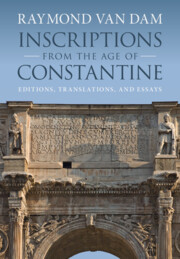
The reign of Constantine, Roman emperor from 306 to 337, was one of the most important periods in world history. Although literary texts often represented him as the first Christian emperor, the inscriptions engraved on monuments, statue bases, and milestones offer alternative perspectives. Inscriptions highlight the influence of the other emperors, the prominence of senators at Rome, the civic traditions for praising benefactors in provincial cities, the logistics of the economy, and the abiding importance of traditional cults. This book includes the Greek and Latin texts of over 800 inscriptions from the early fourth century, with translations and critical annotations. An extended Introduction and almost 200 short essays provide context by explaining the issues and problems, correlating the literary texts, and comparing the legends and images of coins. Without the emperor as the constant focus, the Age of Constantine becomes all the more fascinating.
The expansion of the Roman Empire into the Mediterranean in the early second century BCE represented a gradual diminution of the independence and autonomy of the Greek cities. At the same time, processes internal to the poleis were moving them in a more elitist direction, as the “big benefactors,” ultrawealthy men who bestowed ever-greater favors on their cities, moved toward monopolizing participation in civic magistracies. The council and other political bodies became off-limits to citizens who were not among the euergetistic elite. Still, democratic institutions and ideas of the previous period persisted, especially in the popular assembly. Christianity, the centralization of administrative power in the Roman Empire under Constantine, and various crises combined to deprive the cities of the last vestiges of dēmokratia in the fourth century CE, when popular assemblies largely disappear from the poleis.
This chapter examines the early development of Constantine’s religious imagery following his victory at the Battle of the Milvian Bridge in 312 ce. It argues that Constantine’s administration swiftly began portraying the civil war against Maxentius as a religious conflict, with Constantine defeating Satan through the aid of the archangel Michael. The chapter highlights the apocalyptic nature of this imagery, emphasizing Michael’s role not only as a heavenly warrior but also as a herald of the end times and Christ’s millennial reign. Scholars have overlooked both the early emergence of this imagery and Michael’s significance within it. While the imperial court may have believed in this narrative, its promotion in the aftermath of civil war suggests that not all Christians in Constantine’s new territories necessarily welcomed their new emperor.
This chapter examines the transition of pagan architecture and religious practices in Late Antiquity, focusing on the treatment of Roman temples under Christian emperors. Drawing on legal texts, literature, inscriptions and archaeological findings, it evaluates whether temples were preserved, repurposed or destroyed. Challenging the common assumption of widespread temple destruction, it argues that such actions were neither systematic nor state-enforced. Instead, the chapter presents a nuanced perspective, demonstrating that many temples remained intact and were gradually adapted for secular or Christian purposes. Archaeological evidence suggests that abandonment and natural decay played a greater role in their decline than deliberate demolition. It also highlights how Christian emperors often sought to suppress pagan rituals while preserving architectural heritage, with legal measures typically prohibiting sacrifices rather than mandating temple destruction. By emphasising regional variations in temple transformations and critically assessing sources that exaggerate instances of destruction, the chapter challenges traditional narratives, offering a more complex understanding of religious and architectural change in Late Antiquity.
This chapter shows how late-antique emperors and bureaucrats looked to the jurists to understand how Classical Roman law worked, and thus built an entirely new legal system in order to put their ideas into practice. I first discuss how post-Severan emperors represented themselves in rescripts as explaining a settled and sovereign law, rather than making new law themselves. I then consider innovations in the indexing of imperial rescripts, which combined rescripts of multiple emperors into new collections organized by subject matter; these collections treated rescripts as legal documents, rather than nonsystematic interventions from an absolute ruler. I then consider how the massive expansions in imperial staffing and bureaucracy that mark the late-antique period, as well as an increase in the frequency and systematicity of legal education, could lead to regularized adjudicative outcomes that better tracked the dictates of juristic law. I finally contrast the treatment of juristic texts and resccripts in the Codex Theodosianus, showing how that text implicitly elevates jurists over emperors and how that elevation flows from broader changes in legal culture of the period.
Despite the well-known weakening of the Roman guardianship of women by the early Principate, its final disappearance from Roman law has remained a mystery. In modern scholarship, the proposed dates for the abolishment of tutela have ranged from the late third century to the early fifth, or to the claim that it just fell out of use without ever being formally abrogated. This article combines legal and papyrological sources to show that we can in fact establish the time when tutela was abolished in the reign of Constantine. It further places the disappearance of the guardianship in the broader context of the historical development of Roman law and the legal independence of women in the Roman world.
By the late fifth century, Armenian writers had developed a local historiography including the idea of righteous kingship linked to and assisted by the new institution of the Christian episcopacy.This essay considers the Letter of Macarius and the royal establishment of Christianity from the perspective of several early Armenian historians.
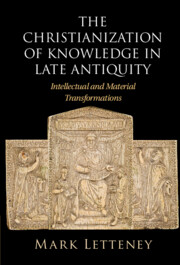
The Christianization of Knowledge in Late Antiquity: Intellectual and Material Transformations traces the beginning of Late Antiquity from a new angle. Shifting the focus away from the Christianization of people or the transformation of institutions, Mark Letteney interrogates the creation of novel and durable structures of knowledge across the Roman scholarly landscape, and the embedding of those changes in manuscript witnesses. Letteney explores scholarly productions ranging from juristic writings and legal compendia to theological tractates, military handbooks, historical accounts, miscellanies, grammatical treatises, and the Palestinian Talmud. He demonstrates how imperial Christianity inflected the production of truth far beyond the domain of theology — and how intellectual tools forged in the fires of doctrinal controversy shed their theological baggage and came to undergird the great intellectual productions of the Theodosian Age, and their material expressions. Letteney's volume offers new insights and a new approach to answering the perennial question: What does it mean for Rome to become Christian? This title is also available as Open Access on Cambridge Core.
It is known that various members of Constantine's family, of his own generation and the generation before, were Christian. It is often taken for granted that Constantine encouraged or required their Christian faith. However, in fact there is only evidence for Constantine's influence on the faith of his mother Helena. This paper examines the evidence for Christianity in the imperial family before Constantine became publicly Christian, and suggests that some of these women may even have been Christian independently of Constantine's influence.
This book rethinks the Christianisation of the late Roman empire as a crisis of knowledge, pointing to competitive cultural re-assessment as a major driving force in the making of the Constantinian and post-Constantinian state. Emperor Julian's writings are re-assessed as key to accessing the rise and consolidation of a Christian politics of interpretation that relied on exegesis as a self-legitimising device to secure control over Roman history via claims to Christianity's control of paideia. This reconstruction infuses Julian's reaction with contextual significance. His literary and political project emerges as a response to contemporary reconfigurations of Christian hermeneutics as controlling the meaning of Rome's culture and history. At the same time, understanding Julian as a participant in a larger debate re-qualifies all fourth-century political and episcopal discourse as a long knock-on effect reacting to the imperial mobilisation of Christian debates over the link between power and culture.
Chapter 4 concludes the analysis of Julian’s reckoning with Constantine’s propaganda. It focuses on Julian’s strategy to disavow the public persona of the first emperor who had promoted the association between Christian sovereignty and ideals of philosophical leadership. The first section considers the efforts of Constantine’s propaganda to use the events of his (Constantine’s) life to prove that Roman history was guided by Christian providence. The engagement with autobiography in Julian’s final writings appears in this light as the culmination of his response to Christianity’s claims of intellectual dominance over Greco-Roman culture. The second section reconstructs Julian’s joint attempts to project his life as the token of his superior understanding of providential history (Against Heraclius) and to mobilise past Roman history as a source of counter-exempla disproving Constantine’s claims (The Caesars). In the process, Julian repurposed a fundamental element of Constantine’s propaganda – imperial iconography – to his advantage (Caesars; Misopogon).