To save content items to your account,
please confirm that you agree to abide by our usage policies.
If this is the first time you use this feature, you will be asked to authorise Cambridge Core to connect with your account.
Find out more about saving content to .
To save content items to your Kindle, first ensure no-reply@cambridge.org
is added to your Approved Personal Document E-mail List under your Personal Document Settings
on the Manage Your Content and Devices page of your Amazon account. Then enter the ‘name’ part
of your Kindle email address below.
Find out more about saving to your Kindle.
Note you can select to save to either the @free.kindle.com or @kindle.com variations.
‘@free.kindle.com’ emails are free but can only be saved to your device when it is connected to wi-fi.
‘@kindle.com’ emails can be delivered even when you are not connected to wi-fi, but note that service fees apply.
This chapter begins by examining the emergence of Kant’s conception of the highest good in his pre-critical engagement with Stoicism and Epicureanism. His critiques of these schools and concomitant endorsement of Christianity anticipate both his later notion of heteronomy and an enduring commitment to the constitutive inadequacy of the human or finite will. The chapter then turns to explaining the nature of Kantian theodicy as an attempt, undertaken solely from the perspective of the autonomous subject, to show that and not just how rational criteria are instantiated. Since the content of Kantian theodicy is the idea of the highest good, we need to understand both why Kant thinks we need to hope for its realisation and the nature of this need, especially given his contention that the very reality of the moral law depends upon the possibility of the highest good. Seeing how the need for the highest good arises from the condition of finite autonomous beings allows us to understand the existential motivation behind Kantian theodicy. But it also alow us to identify a first path opened up, but not taken, by Kant towards rendering the content and possibility of autonomy dependent on the actual conditions of its development and exercise.
This chapter examines the three foundational strands that shaped early Christianity and, in turn, western thought: Judaism, Hellenistic philosophy, and Roman culture. It begins with Judaism, emphasizing its monotheism, prophetic self-criticism, and teleological view of history – features that deeply influenced Christian theology. The Book of Isaiah is central, offering themes of justice, suffering, and messianic hope later interpreted as prefiguring Christ. The chapter then turns to Hellenistic philosophy – especially, Stoicism, Skepticism, and Epicureanism – which informed Christian ideas about the soul, virtue, and the good life. These schools stressed moral discipline and the pursuit of wisdom, values that Christianity absorbed and reinterpreted theologically. The Roman contribution centered on imperial power, civic virtue, and especially the Latin language, which became Christianity’s primary medium in the West. Roman thinkers like Cicero and Virgil helped transmit Greek ideas, emphasizing duty, eloquence, and destiny. These strands – Jewish, Greek, and Roman – were not seamlessly integrated, but their dynamic interaction laid the groundwork for a western intellectual tradition rooted in moral inquiry, historical depth, and a universalizing spiritual vision.
Post-Hellenistic authors took some Hippocratic ideas and terminology to build their own theories about the different forms of losing consciousness, and about the relationship between body and soul. Also, they presented a clearer distinction between the two forms of total loss of consciousness (to the extent that they described a new disease, where the body was primarily affected but not the soul). Celsus’ description of fainting suggests that his idea of soul was influenced by Epicurean corpuscular theories with a rational and an irrational component. Aretaeus, in his turn, was majorly concerned with the mechanisms that produced fainting, where he included a tangle of ideas that included loss of heat, loss of tension, affection in the blood or in the heart, and sometimes, the separation of the soul. However, his idea of psuchê was rather erratic, and his way of organizing mental capacities was not consistent throughout the treatise.
It is common to read that the concept of rights did not exist in ancient times. The most influential proponent of this thesis in the past half-century or so may be Alasdair MacIntyre but he is hardly alone. In a more recent discussion, Tom Campbell says this: “Rights (as distinct from the more general ideas of right and wrong) were unknown to the Ancient Greeks and Romans, although the idea developed in the course of medieval theorizing concerning Roman law.” A slightly more nuanced view is put forward by William Sweet: “The history of the ‘discourse’ of human rights is fairly well known. While the existence of ‘natural rights’ is implied in works of antiquity, it is only in the Middle Ages that we begin to see an acknowledgment of rights as distinct from ‘the right.’”
Tusculans 1 offers a multi-faceted refutation of the proposition ‘death is an evil’, accomplished in part through a detailed doxography of a wide range of philosophers of different schools. This survey is far from a jumble of contradictory views, however: Cicero avoids dogmatic insistence on the arguments of any single school and has instead crafted a minimally sectarian protreptic designed to convince readers of any philosophical persuasion that death is not an evil, an approach whose origin he traces back to Socrates’ reflections on death in Plato’s Apology. Furthermore, I argue that this approach amounts to a direct challenge to Cicero’s philosophical rivals, a group of Epicurean authors writing in Latin – including, I speculate, Lucretius – whom Cicero had criticiaed in several prefaces for their narrow-minded dogmatism. In Book 1 Cicero therefore tackles a topic of perennial interest, illustrates how philosophy can and should be written, and attempts to marginalise his Epicurean opponents.
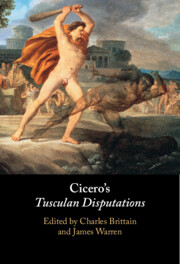
Cicero composed the Tusculan Disputations in the summer of 45 BC at a time of great personal and political turmoil. He was grieving for the death of his daughter Tullia earlier that year, while Caesar's defeat of Pompey's forces at Munda and return to Rome as dictator was causing him great fears and concerns for himself, his friends and the Republic itself. This collection of new essays offers a holistic critical commentary on this important work. World-leading experts consider its historical and philosophical context and the central arguments and themes of each of the five books, which include the treatment of the fear of death, the value of pain, the Stoic account of the emotions and the thesis that virtue is sufficient for happiness. Each chapter pays close attention to Cicero's own method of philosophy, and the role of rhetoric and persuasion in pursuing his inquiries.
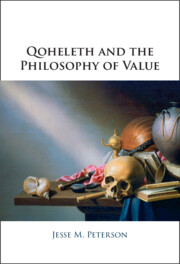
The book of Ecclesiastes is the Bible's problem child. Its probing doubts, dark ruminations, self-reflexive dialogues, and unflinching observations have simultaneously puzzled and fascinated readers for over two millennia. Some read the book's message as hopelessly pessimistic, while others regard the text as too contradictory to bear any consistent message at all. In this study, Jesse Peterson offers a coherent portrait of the book and its author—the early Jewish sage known as Qoheleth—by examining both through a philosophical lens. Drawing from relevant contemporary philosophical literature on meaning in life, death, well-being, and enjoyment, Peterson outlines a clear and compelling portrait of Qoheleth and his philosophical assumptions about what is good and bad in the human experience. As Peterson argues, Qoheleth's grievances concerning the pursuit of meaning in life are paired with a genuine affirmation of life's value and the possibility of a joy-filled existence.
The last major chapter of the book reflects on the question of ‘happiness’ as discussed by Popper, Hayek, and Neurath, but also presents a case study of how Neurath not only theorized on such matters but also sought to make a practical difference by collaboration in planning projects. He became a consultant for the redevelopment of Bilston, a small town blighted by the legacy of the Industrial Revolution. In discussion with town councillors and architects, he steered plans by taking into account the needs of residents, seeking to represent those whose voice was generally not heard. This finally led to Neurath being interviewed in the mainstream media, marking acceptance and respect for Neurath in British culture. He did not want to use his broad learning to set himself apart as an intellectual but instead to articulate the needs of ordinary people.
Hume’s ‘four essays on happiness’ are distinctive in Hume’s oeuvre, and not merely in the 1741 volume of Essays, Moral and Political in which they appeared. They are written in the style of philosophical monologues, with Hume ‘personating’ a representative of each of the main, late Hellenistic philosophical sects in turn. Each such representative, however, engages critically with the philosophical positions staked out by his rivals and antagonists. The ultimate question each of the philosophical sects seeks to answer is: what is the true end (summum bonum) of human life, and where is true contentment to be found? Scholars have tended to be preoccupied with the question of which sect best articulates Hume’s own underlying philosophical commitments. This chapter argues that such an approach is mistaken, because Hume dismissed the quest for the summum bonum altogether. Hume presented all the late Hellenistic philosophical sects as capturing something important about human life, and about the purpose of philosophical activity. Yet ancient moral philosophers had ultimately failed to develop the ‘science of man’ that Hume took to be the greatest achievement of modern philosophy. The four essays, then, reveal Hume’s keen – and lifelong – interest in the history of moral philosophy, and his attentiveness to the distinctive (and superior) character of modern approaches to the discipline.
The second chapter places Walter Pater, the widely acknowledged founder of British aestheticism, in conversation with mathematician and philosopher W. K. Clifford in order to illuminate the overlapping development of aestheticism and evolutionism in the 1860s and 1870s. Around the same time that Pater made the case for “art for art’s sake,” Clifford laid out a sweeping secular humanism that reaffirmed an anthropocentric and pseudo-religious view of the cosmos. Clifford’s optimistic reinterpretation of evolutionary science, this chapter argues, reinforced and drew on Pater’s contemporary conception of the aesthetic temperament: a discriminating, tasteful personality capable of transforming, in Pater’s words, the “ghastly spectacle of the endless material universe” into the “delightful consciousness of an ever-widening kinship and sympathy.” The chapter concludes with an analysis of the work of Mathilde Blind, who synthesized Clifford’s and Pater’s ideas in a poetic oeuvre that sought to inculcate readers into reverent ways of experiencing an otherwise atheistic world.
Ancient writers, including philosophers such as Aristotle, often depict friendship as a source of pleasure; by contrast, in his Laelius de amicitia, Cicero describes such relationships as sweet and delightful, but never connects them with uoluptas, which for him is a largely negative term reserved for Epicurean doctrine. This paper argues that there is more to this pointed use of language than Cicero’s well-known dislike of Epicureanism. Considering first the Latin philosophical vocabulary of pleasure and then the vexed question of what exactly qualifies as pleasure according to the Epicurean system, the paper makes the case that Cicero believed (probably correctly) that the pleasures of friendship as conceived of by himself and many ordinary language-users would not in fact qualify as instances of Epicurean uoluptas. If, as Epicurus appears to have held, all pleasures are either bodily or mental, and all mental pleasures are derived from bodily ones, then many activities experienced as pleasurable in and of themselves—including many traditional elements of friendship—are not in fact Epicurean pleasures.
This article contributes to our understanding of women in the Epicurean school. Focussing on the second- and first-century b.c.e. philosophers Zeno of Sidon and Philodemus of Gadara, it examines some neglected textual evidence and argues that a misogynist position can be traced back to Zeno. While Epicureanism contains many progressive ideas on women and early Epicureans admitted women in their communities, Zeno was much more dismissive of women than other Epicureans. This points to a significant doctrinal development in the Epicurean school.
Verse epitaphs are our main and very abundant source for responses to individual deaths. We can almost never know exactly whose attitudes or values they express, but we can assume that they embody attitudes and values that it was acceptable to express publicly. Many at all dates seek merely to commemorate the dead person or convey grief, but, from about 400 bce onwards, others adopt a position on the fate of the dead person, though often hedged with a cautious ‘if’. Very many possibilities emerge: they range from a plain denial that anything survives death, via claims that the dead person is now (e.g.) in the aither/in the home of the blessed/on Olympos/with the heroes, to, very rarely, declarations that s/he is now actually a god. Strangely enough, support for such claims is never sought in the fact of the dead person being an initiate in a cult that promised advantage in the afterlife. In all this we see not so much individual choices as the range of options available for individuals to believe in. But we must also suspect that belief in the more optimistic options can seldom have been as firm as in a society where such options were authoritatively endorsed and alternatives not publicly countenanced.
From the outset, food and the essay have shared a kinship, given that one of the original senses of the word ‘essai’ meant the ritual of tasting the French king’s food and drink. From metaphor to content, food has permeated the essay form; in turn, the essay became the vehicle for the emerging field of gastronomy. This chapter constellates several important moments of interaction between literal and literary taste, consumption and appetite, cultural criticism and culinary knowledge in essays by Michel Montaigne, Alexandre-Balthazar-Laurent Grimod de La Reynière, Jean-Anthelme Brillat-Savarin, William Kitchiner, Launcelot Sturgeon, Charles Lamb, William Makepeace Thackeray, and Elizabeth Robins Pennell. As cosmopolitan practices of discretionary dining became more widespread, these gastronomic essayistic writers often satirised the burgeoning bourgeoisie and their cultural milieu. Given its flexibility, the essay remains paramount to food writing, in its many forms and genres.
Ancient literary-historical narratives commonly envisage developments in poetry and music in terms either of gradual technical progress, or of decadence and hyper-sophistication. This chapter argues that Lucretius strikingly combines these two perspectives in the concluding paragraphs of the culture-history at the end of De Rerum Natura 5: the invention of carmina as songs (5.1379–1411) is associated with simple pleasures, emphatically unsurpassed by later refinements in technique which are linked in turn to the insatiable and destructive desire for novelty and luxury; whereas carmina as (epic?) poems are mentioned amongst the refinements listed in the book’s closing lines as steps on the way to a ‘peak’ (cacumen) of artistic and cultural progress (5.1448–1457). The dual narrative adumbrated here may be linked in turn with the dichotomy between text as written artefact and poem as disembodied ‘song’, which has been a focus of attention in recent scholarship on Latin poetry: both models of textuality, like the conflicting models of cultural development that shape the finale to Book 5, are important to Lucretius’ poetics and his Epicurean didaxis. Lucretius’ poem thus exemplifies the manifold ways in which literary-historical narratives may be determined by the discursive demands of the text in question.
In ‘Doing Things with Concepts in Sextus Empiricus’, Richard Bett examines Sextus’ terminology in connection to his use of such strategies and highlights their inventiveness and sophistication. On the one hand, Sextus appears to agree with his dogmatic opponents insofar as he says that we need to get our concepts clear before investigating any topic. On the other hand, he often raises objections against dogmatic concepts, arguing, for instance, that they are inherently inconsistent and therefore there are no objects corresponding to such concepts or, alternatively, that even if we accept these concepts, there exists nothing real corresponding to them. It is not clear whether or how these two lines of approach can be coherently combined. Nonetheless, Sextus frequently runs the two together, and Bett enquires into his reasons for doing so. An important upshot of this study is that it leads us to consider what kinds of concepts and what sort of reflection about concepts are available to a sceptic of Sextus’ variety.
Cicero often challenged Epicureanism on the grounds of inconsistency. Cicero personifies the charge through his character Torquatus, who defends Epicureanism in De finibus 1–2. Cicero highlights the discrepancies among Torquatus’ beliefs and between them and his behaviour. Torquatus holds that the senses incontestably verify the tenets of Epicureanism, and that logic is superfluous. Yet he is sensitive to the fact that Epicurus’ teachings are not intuitive and require a fair amount of logical argumentation in its defence. Therefore, he defends his school against Cicero's criticisms. But by engaging in a defence of the system, Torquatus has already spoken against his commitment to the obviousness of Epicureanism and his disavowal of logic.
This article uncovers the intellectual traditions behind Dio Chrysostom's Oration 20: On Anachôrêsis. The examination reveals a variety of subtexts and traditions with which Dio engages, and shows that at its core the text inspects three types of lives promoted by three philosophical schools: Epicurean, Stoic and Peripatetic. They are never referred to directly, however, which raises questions concerning Dio's strategy of not acknowledging the sources of the ideas with which he engages. The article also develops our understanding of anachôrêsis and the controversies surrounding it in pagan antiquity.
This chapter gives an account of the origins of our present understanding of the natural/supernatural divide, showing how the terminology of the ‘supernatural’ first emerged in the Middle Ages and gradually assumed its modern form between the seventeenth and nineteenth centuries. The attendant ‘isms’—naturalism and supernaturalism—arrive at the end of this period, during the 1800s. The original context for the naturalism/supernaturalism distinction was neither science nor philosophy, but the sphere of biblical criticism. From there it was imported into a scientific context. The nineteenth century also witnessed attempts to reconstruct the history of science with a view to arguing for a long-standing alliance between naturalism and science. A more accurate portrayal of the relevant history shows, to the contrary, that ‘science’ had been consistently aligned with theistic assumptions about the regularities of nature. These regularities were formalised as laws of nature in the seventeenth century, at which time they were understood as divinely authored imperatives to which nature necessarily conformed. In the nineteenth century, what had originally been understood as expressions of the divine will were simply redescribed in purely naturalistic terms by advocates of naturalism. Ironically, they were now claimed to represent evidence against theistic readings of nature.