To save content items to your account,
please confirm that you agree to abide by our usage policies.
If this is the first time you use this feature, you will be asked to authorise Cambridge Core to connect with your account.
Find out more about saving content to .
To save content items to your Kindle, first ensure no-reply@cambridge.org
is added to your Approved Personal Document E-mail List under your Personal Document Settings
on the Manage Your Content and Devices page of your Amazon account. Then enter the ‘name’ part
of your Kindle email address below.
Find out more about saving to your Kindle.
Note you can select to save to either the @free.kindle.com or @kindle.com variations.
‘@free.kindle.com’ emails are free but can only be saved to your device when it is connected to wi-fi.
‘@kindle.com’ emails can be delivered even when you are not connected to wi-fi, but note that service fees apply.
The following chapter describes the varieties of English found in Canada’s eastern Maritime Provinces (Nova Scotia, New Brunswick and Prince Edward Island), which arose from a unique mix of American Loyalist, British, Scottish, Irish, French and German settlers. These varieties have been traditionally stigmatised for their divergence from inland Canadian norms, though this is changing as younger speakers in the region conform to more prestige varieties further west. Conversely, some traditional speech features, like the use of ingressive pulmonic articulation with the discourse particle yeah↓, are being recycled by those same young people to signal both local solidarity and resistance to hegemonic discourses surrounding vernacularity. This chapter draws on original research, linguistic descriptions of the region and its English varieties, as well as comedic performances/metalinguistic commentary in both popular and social media.
This chapter offers a broad overview of violence during the Revolutionary War. As an eighteenth-century war, it had elements common to all conflicts during this period, such as plunder, rape, and the impressment of supplies. But the Revolution also had several unique features that heightened violence. As a war of independence, it created questions of legitimacy between combatants, because the conflict pitted British regulars, Loyalists, and Revolutionaries against one another. Each side in the war also had many layers of command, including regular soldiers, militia, and Indigenous warriors, making cohesion and restraint more difficult. Lastly, African Americans and Native Americans were central actors in the war, and racial difference loosened limitations on violence. All together, these factors created a volatile situation in which violence thrived. The Revolutionary War was a fundamentally violent event that disrupted lives, the social order, causing pain, suffering, and trauma.
Why did the British war effort in the South fail so badly, and therefore lead to the British loss of the American mainland colonies? The British tried to solve the political problem of reunification through military means, which was always a poor fit. Further, the British continuously underrated their allies and did not use them effectively. These mistakes doomed the British war effort in the South. The region dissolved into a brutal civil war fought through guerrilla means. Neither side could win complete victory. Mistakes compounded, making British victory impossible.
The forced migration of French-speaking Acadians, Wabanaki tribes, and Loyalist refugees have rarely been considered in relationship with one another. Yet their principal movements centered on the Northeastern Borderlands of North America (bounded by Nova Scotia, Maine, and Quebec), and their interconnected movements spiked from the 1750s to the 1830s. This comparative assessment shows that while each of these coerced mobilities had distinctive qualities, large-scale population movement was the most basic foundation of colonialismss. Acadian, Loyalist, and Wabanaki movements shaped one another and were often associated with violence and trauma. At the same time, mobility offered opportunities and could nurture resilience. The legacies of forced migration in the Northeastern Borderlands during an early period of sustained warfare persist today, especially in the legal cases, artwork, and collective memory of Wabanaki people, who still live in their traditional homeland.
Loyalists, those who opposed the rebellion that created the United States, remain poorly understood in large part because of the teleological implications of framing the American Revolution as the inaugurating event of the Age of Atlantic Revolutions. This essay shows loyalists as reasonable people who carefully assessed the specific colonial circumstances where each lived. The trajectory of three individuals, in particular, highlights the diversity of loyalism and that it drew support from all corners of colonial society. These three are the Mohawk diplomat Mary Brant, the slave-owning Georgia soldier William Martin Johnson, and the formerly enslaved Thomas Peters, who served with the British Army for the duration of the war. All three left the United States due to their ardent loyalism, dying, respectively, in Upper Canada, Jamaica, and Sierra Leone. Prioritizing loyalists highlights the violence of the rebel movement and showcases the War of American Independence as a civil war. In place of a familiar patriot and US-nationalist interpretation, recovering loyalism as a good idea emphasizes loyalists in their colonial context, assesses the transformative impact of war, and follows their diaspora throughout the British Atlantic and, especially, to British North America.
This chapter discusses the two main counter-frames that challenge the loyalist frame about deserters presented in Chapter 8. The main challenge comes from the deserters themselves, who refused to be labelled as traitors and do not want to be identified as ex-combatants, in addition to fearing being hunted down by both loyalists and FARC dissidents. The secondary challenge arises from the government, which continues to place all ex-combatants into the same category of desmovilizado and whose neglect of the collective economic projects promised in the peace agreement is creating mass abandonment of the protected reincorporation zones – thus dismantling the FARC hierarchy and putting the group’s stated revolution project into further jeopardy.
This chapter outlines the archetypical framing contest found in many conflicts: that of terrorist versus revolutionary. While this contest is hardly novel, the ways in which combatants navigate these contests and their corresponding identities, and how such contests affect disengagement decisions and reintegration experiences, is not well understood. This chapter starts by going back to Mari, the FARC loyalist who introduced the book. Mari discusses her anger around how women have been framed by the government – as prostitutes, bad mothers, and manipulated victims. She and many other FARC combatants claim that these stories are made up by government informants and infiltrators, weaving a picture in which any woman who claims they were abused in FARC ranks is painted as a lying traitor.
This chapter examines the identity construction and related stigmatization within the framing contest of desmovilizados (deserters) versus reincorporados (loyalists). While this contest is primarily amongst groups of ex-combatants themselves, the government also plays a role not only by encouraging desertion, but also by contesting both sides, grouping all ex-combatants under the same criminal label, and discrediting any frame constructed by combatants and/or ex-combatants. While this contest is much less structured and the frames emerged more organically – particularly as the deserters do not have a clear leadership constructing a strategic frame for them, nor a clearly defined audience – it was still having a powerful influence on reintegration experiences. In this last contest, which overlaps with all the others, language and labelling are key, as these components both create stigma and help ex-combatants fight against it.
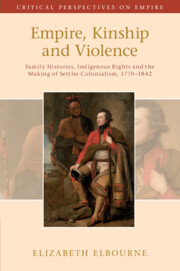
Empire, Kinship and Violence traces the history of three linked imperial families in Britain and across contested colonial borderlands from 1770 to 1842. Elizabeth Elbourne tracks the Haudenosaunee Brants of northeastern North America from the American Revolution to exile in Canada; the Bannisters, a British family of colonial administrators, whistleblowers and entrepreneurs who operated across Australia, Canada and southern Africa; and the Buxtons, a family of British abolitionists who publicized information about what might now be termed genocide towards Indigenous peoples while also pioneering humanitarian colonialism. By recounting the conflicts that these interlinked families were involved in she tells a larger story about the development of British and American settler colonialism and the betrayal of Indigenous peoples. Through an analysis of the changing politics of kinship and violence, Elizabeth Elbourne sheds new light on transnational debates about issues such as Indigenous sovereignty claims, British subjecthood, violence, land rights and cultural assimilation.
Focusing on the decades leading up to the Declaration of Independence, chapter 5 presents historical arguments in favor and against independence. Selections from Patriots and Loyalists show that both the liberal social contract and the republican political contract could be levered in support of either position. Based on the political contract between ruler and ruled, Jonathan Mayhew argued that the people as a whole has a duty to rebel when the ruler becomes tyrannical. Daniel Leonard, in turn, opposed the Parliament’s oppression of the colonies from a liberal perspective, contending that men enter civil society to protect their property and that taxation without representation violated the principles of the social contract. After the First Continental Congress, however, Leonard changed to the Loyalist side and excerpts from his later writings reveal the use of republican arguments about virtual representation to argue against independence. Jonathan Boucher, again, argued based on the Locke’s theory that a right of resistance is incompatible with the duty to submit to majority decision. Other authors in this chapter include Daniel Dulaney, John Adams, Thomas Paine, and Peter Oliver.
Recommend this
Email your librarian or administrator to recommend adding this to your organisation's collection.