To save content items to your account,
please confirm that you agree to abide by our usage policies.
If this is the first time you use this feature, you will be asked to authorise Cambridge Core to connect with your account.
Find out more about saving content to .
To save content items to your Kindle, first ensure no-reply@cambridge.org
is added to your Approved Personal Document E-mail List under your Personal Document Settings
on the Manage Your Content and Devices page of your Amazon account. Then enter the ‘name’ part
of your Kindle email address below.
Find out more about saving to your Kindle.
Note you can select to save to either the @free.kindle.com or @kindle.com variations.
‘@free.kindle.com’ emails are free but can only be saved to your device when it is connected to wi-fi.
‘@kindle.com’ emails can be delivered even when you are not connected to wi-fi, but note that service fees apply.
This chapter begins by outlining the past trends and the present trajectory of employment-related dispute resolution at international organizations. Second, the historic evolution of the statutory basis of administrative tribunals at the United Nations is analysed, suggesting that Member State governance organs are prepared to revise procedures, but are reluctant to address the transparency of employment law at international organizations. Third, and in conclusion – extending this book’s emphasis on concisely and clearly introducing the law – the incorporation of general legal principles of international administrative law into the Statutes of international administrative tribunals is proposed.
This chapter examines the imbrication of late eighteenth- to early nineteenth-century discourses on race and class, and thus of the formations of colonialism and capitalism, both within and beyond England as center of global empire and capital. It performs readings of this imbrication in John Clare’s protestations against land enclosure in Northamptonshire in the Romantic period, and it shows how this nexus in Clare anticipates Palestinian protestations against the dispossession of ancestral land since 1948. In doing so, it juxtaposes resonant moments in connected histories of modernity and modernization that inform the history of global capitalism, which still enacts in many ways the racial antagonisms in Marx’s theory of primitive accumulation.
This chapter continues the discussion of how English came to function as the language of African self-expression in the twentieth century and was ultimately liberated from its colonial legacies. The chapter starts by exploring the so-called language question, a long-running debate on the status and function of the English language in the making of African letters, which has perhaps been the most divisive issue among African writers in the second half of the twentieth century. The debate was not simply a feud on language use but the expression of a deep anxiety about what it has meant to produce a literature of decolonization in the language of the former colonizer. The second part of the chapter provides an account of the evolution and transformation of English in Africa among different social groups including the slave traders of Calabar, Creole elites in West Africa, and the elites produced by the colonial schools and university colleges that produced the first generation of African writers.
The critical study of African literature has had a troubled relationship with different schools of European poststructuralism in general and postcolonial theory in particular. This chapter starts with a critique of the theoretical retreat from modernity that has been a signature gesture of poststructuralism and postcolonial theory since the 1990s. Poststructuralist theory attracted many critics of postcolonial literature at the end of the twentieth century because of its rejection of the universal theories of reason, history, and the human subject associated with modernity. What was the implication of this poststructuralist turn in the criticism of an Africa literary tradition that was bound up with the experience and expectation of modernity? The chapter discusses the tension between the experience and discourse of modernity, postcolonial criticism, and a set of African texts that complicated both modernist and postmodernist discourses. A central concern in this chapter is what happens when we read canonical African literary texts themselves as forms of theoretical intervention.
This chapter explores the European Union’s ongoing efforts to simplify and modernize company law to enhance legal clarity, reduce administrative burdens and support cross-border business activity. It examines key initiatives such as the Company Law Package, digitalization of company processes and the reduction of formalities for corporate operations. The chapter evaluates how these reforms aim to improve competitiveness, foster innovation and align company law with the needs of modern businesses. Challenges related to implementation, legal coherence and Member State diversity are also discussed. Overall, the chapter highlights the shift towards a more efficient, accessible and future-oriented company law framework in the EU.
In the 1900 Paris Exposition Universelle, W. E. B. Du Bois deployed imperially charged terminologies such as “progress,” “nation,” and “civilization,” entangled with racism-imbued linear-progressive historiography. Rather than discounting Du Bois’s usage of these terms as a passive internalization of the imperial episteme, we regard Du Bois’s adoption of these terms (and curation in the exhibition more broadly) as a fruitful avenue for us to consider the methodological, theoretical, and public-sociological implications of using imperially entangled terms. Centering Du Bois’ embeddedness in collaborative epistemic communities and his socio-political context, we read his work for the Paris Exhibition of 1900 as a strategic response to the double crisis of social science and post-Reconstruction Black America. We argue that Du Bois subverted and dislocated the concepts of “progress,” “crisis,” and “nation” from their contemporary decontextualized usage to address grounded problems facing Black people in the United States and undertook this redefinition through his dialogic interactions with Black American and Pan-African activists of his time. With a plethora of images, statistics, books written by Black authors, photographs, and cultural artifacts, he provided a narrative of social development that challenged racial stereotypes and the developmental model favored by empire-states. Today, historical social sciences are also undergoing institutional and epistemological crises. Building on Du Bois’s subversive exhibit and adopting the conceptual framework of “reverse tutelage,” we argue that contemporary historical social scientists should also approach conceptual development and global linkages by being grounded in communities of resistance to grasp and recover radical potentialities.
More than half a century ago Clifford Leech published a useful essay called 'On editing one's first play', intended to 'save newly commissioned editors from a sense of frustration and an expense of time' by providing 'some guiding-lines'. The intervening years have seen massive changes in attitudes towards editing and in the technical expertise required. Neither editor nor reader can any longer be assumed to be white, male and Christian, or trained in the classics and the Bible. Editing is now recognized as a crucial intersection between critical and textual theory. Yet the skills required are not usually taught in graduate schools, and many competent scholars are uncomfortable answering such questions as 'what do editors actually do when they edit an early modern play?' This Element focuses both on the practical steps of editing (e.g. choosing a base text, modernizing, emending, etc.) and the theoretical premises underlying editorial decisions.
At the core of nationalism, the nation has always been defined and celebrated as a fundamentally cultural community. This pioneering cultural history shows how artists and intellectuals since the days of Napoleon have celebrated and taken inspiration from an idealized nationality, and how this in turn has informed and influenced social and political nationalism. The book brings together tell-tale examples from across the entire European continent, from Dublin and Barcelona to Istanbul and Helsinki, and from cultural fields that include literature, painting, music, sports, world fairs and cinema as well as intellectual history. Charismatic Nations offers unique insights into how the unobtrusive soft power of nationally-inspired culture interacts with nationalism as a hard-edged political agenda. It demonstrates how, thanks to its pervasive cultural and 'unpolitical' presence, nationalism can shape-shift between romantic insurgency and nativist populism. This title is also available as Open Access on Cambridge Core.
China’s rapid economic development exerts significant political effects. Modernization theory posits, with an optimistic outlook, that sustained economic growth will foster increasing public demands for political liberalization and democratization. Empirical findings presented in this chapter reveal that a majority of Chinese citizens report heightened satisfaction with their civil liberties and political rights following improvements in their overall well-being. Specifically, life satisfaction in the economic sphere demonstrates a positive spillover effect on satisfaction with civic and political rights. Furthermore, life satisfaction across economic, social, and individual dimensions positively influences the political realm, resulting in inflated satisfaction regarding limited civil and political rights.
The international debate of the shifting bases of philanthropy suggested by modernization theory has been ongoing since the beginning of the twenty-first century, yet empirical evidence remains lacking from the perspective of philanthropic motivation. The society and philanthropy of China have undergone tremendous transformation since the launch of Reform and Opening Up in 1978, providing an ideal context for testing the assumption of the shifting bases of philanthropy. Through investigating the motivation structure of collectivism and individualism behind individual giving in contemporary China, this study rejects the assumption drawing on the data from the China Labor-force Dynamics Survey (CLDS). This study helps deepen the understanding of culture’s roles during modernization. It also has important implications for how charitable giving can be effectively promoted both inside and outside of the context of China.
Most theories of cross-national variation in charitable giving have been tested only on samples of countries of Western European culture; this paper applies these theories to 114 countries, including 93 non-Western countries, using data from the Gallup World Poll. It finds strong support for economic and political theories of cross-national variation in charitable giving and partial support for religious and cultural theories. Theories effectively predict variation in giving in middle income non-Western countries but poorly predict variation in low-income non-Western countries. This suggests that economic development, not cultural or religious differences, separate non-Western countries from Western ones in patterns of giving behavior.
European social enterprises’ participation in the public procurement process is low, even if the European public procurement law allows using special provisions for these entities. Encouraging the participation of social enterprises in the public procurement process is an important part of the effort to modernize the EU social policy. This paper demonstrates that, despite the great importance of social enterprises for the European economy, strategies on the access of social enterprises to the EU’s public procurement market are less known by the employees of the public contracting authorities in EU Member States.
We use recent theories of the politics of economic development and of economic interdependence and war to construct an analytic narrative of the events covered in this volume. We trace the end of China’s hegemony, and the instability that attended it, to the different policies the region’s states chose toward commerce, development, and reform. States that pursued modernization gained wealth and power relative to those that did not. These choices had fateful consequences for the regional balance of power and encouraged modernized upstarts to overthrow the traditional order. A more dynamic order arose as great powers competed to impose a new hegemony or at least a new stability, forming coalitions with the region’s other states and offering new ideologies to legitimize their rule. While existing theories shed light on the evolution of East Asian order, our consideration also reveals important gaps in explanation that merit further investigation.
Building on research into US government archives, Pahlavi propaganda texts, Islamist sermons, and print media from US allies, including Iran’s common comparand, Türkiye, this chapter demonstrates how State Department officials, CIA researchers, and public intellectuals used representations of Empress Farah to link beauty to modernization theory and mobilized comparative critiques of both on aesthetic grounds. Examining these depictions alongside the Empress’s own views on her appearance and political role offers new insights into the gendered limits of nation-branding and soft power.
Opening with observations about public anxieties around the effects of rapid social change on children, this chapter offers a model of child socialization developed within psychological anthropology that provides more nuanced ways of thinking about how children are shaped by particular social and cultural contexts and children’s active participation in them. Drawing from experientially close, child-centered ethnographies, this chapter challenges dichotomous understandings of social change that flatten the rich variability and connectedness of societies and obscure the complex historical trajectories and emergent dynamics that shape such variability and connectedness. Alternatively, Chapin and Xu argue that all human communities must contend with the often-conflicted processes of fostering both individuality and sociality in children’s development in locally appropriate ways. The final section of the chapter challenges the view of children as passive recipients of socialization processes, arguing instead that children are agents who actively contribute to processes of social change.
This chapter continues the story of Sofia’s water supply, beginning with the political turmoil that marred urban fabrics and economies across the Ottoman Balkans from the 1790s to the 1820s and ending in 1912 when, after a long series of failed attempts, post-Ottoman Sofia received its first modern water supply system. I emphasize the similarity in the predicaments that shaped the Ottoman and Bulgarian policies in the fields of urban planning, underground infrastructures, and natural resource management. I explain how a series of extreme human-made and natural phenomena, including banditry, war, and intensified seismicity limited the capabilities of the Ottoman authorities to accomplish their modernizing intentions. In post-Ottoman Bulgaria, the modernization of urban fabrics was seen as a statement of the superiority of the nation-state over its former imperial master. However, in a series of attempts to meet the water needs of the national capital’s constantly expanding population, the post-Ottoman authorities found themselves continually unable to come up with solutions superior to the water supply practices of their predecessors. The chapter argues that throughout the long nineteenth century Sofia’s water supply functioned within the bounds of the system established by the Ottomans.
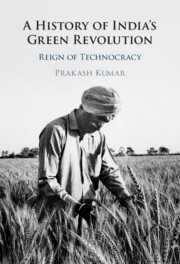
There is a certain flip-flop mentality at play when it comes to assessing the green revolution. In many popular accounts, in reflections by scientists, or in policy discourses, the green revolution often comes across as all good or all bad. In the context of the prevailing charged debate around the subject, it may be better to assess the green revolution with a historical contextualization that highlights the contingencies and pitfalls of agrarian transformation. Its history reveals that HYVs are no magic wand that can transform agrarian lives for the better anywhere, anytime. A historical analysis also implores us to not to criticize the green revolution for not solving every problem of poverty and underdevelopment.
In the mid-1960s, India's 'green revolution' saw the embrace of more productive agricultural practices and high yielding variety seeds, bringing the country out of food scarcity. Although lauded as a success of the Cold War fight against hunger, the green revolution has also faced criticisms for causing ecological degradation and socio-economic inequality. This book contextualizes the 'green revolution' to show the contingencies and pitfalls of agrarian transformation. Prakash Kumar unpacks its contested history, tracing agricultural modernization in India from colonial-era crop development, to land and tenure reforms, community development, and the expansion of arable lands. He also examines the involvement of the colonial state, post-colonial elites, and American modernizers. Over time, all of these efforts came under the spell of technocracy, an unyielding belief in the power of technology to solve social and economic underdevelopment which, Kumar argues, best explains what caused the green revolution.
This chapter examines the way in which the Holocaust has been brought into conversation with understandings of the modern world, with a strong focus on historical and sociological accounts (though recognizing the place of the Holocaust in postmodern literary and critical theory.) It shows the multiple ways in which concepts of modernization, modernity, and the modern have been deployed, be it to establish the Holocaust’s paradigmatic or normative character, or the reverse. It illustrates the paradoxical character of efforts to highlight the Holocaust’s distinctiveness while harnessing it to a pervasive and generic “modernity.”
With the Cold War’s epicenter shifting from Europe to the Third World, the Eisenhower administration’s foreign policy concerns of containing the Soviet bloc were tied to questions of socioeconomic development. Besides “trade and aid,” the appeal of this shift rested on the apparent complementarity between ideas of rural modernization and the practices of agrarian democracy. “Community development” referred to a series of projects initiated by the Ford Foundation and postcolonial governments toward this cultural-political end. This article examines the contested meanings, practices, and outcomes of such a project in East Pakistan (present-day Bangladesh). Drawing on the project’s archives and published sources, it addresses how and why a disjuncture between the political-societal aspirations of decolonization and the hardening Manicheanism of Cold War competition came to characterize the contested trajectory of this project. As its proponents and detractors negotiated competing expectations, inter-regional tensions, and geostrategic interests, this disjuncture gave way to a developmental ideology envisioned around the technocratic nodes of population control and food production. Consequently, the supposed complementarity between “agrarian democracy” and modernization was relegated to the margins of developmental thinking, even as growing rural unrest and Cold War realpolitik propelled its need for legitimizing new claims on political power. The prism of community development enables a novel analysis of the conjunctural dynamics of mid-twentieth-century decolonization and the contingencies of Cold War politics of agrarian modernization.