To save content items to your account,
please confirm that you agree to abide by our usage policies.
If this is the first time you use this feature, you will be asked to authorise Cambridge Core to connect with your account.
Find out more about saving content to .
To save content items to your Kindle, first ensure no-reply@cambridge.org
is added to your Approved Personal Document E-mail List under your Personal Document Settings
on the Manage Your Content and Devices page of your Amazon account. Then enter the ‘name’ part
of your Kindle email address below.
Find out more about saving to your Kindle.
Note you can select to save to either the @free.kindle.com or @kindle.com variations.
‘@free.kindle.com’ emails are free but can only be saved to your device when it is connected to wi-fi.
‘@kindle.com’ emails can be delivered even when you are not connected to wi-fi, but note that service fees apply.
The purpose of this article is to depict three ideal type models of how the youth is represented along the steps of the recruitment ladder: a. The ‘equality’ model with equal representation along the whole recruitment process, from electorate to government; b. The ‘pyramid’ model, where the higher up in the political hierarchy, the fewer young people are represented; c. The ‘hourglass’ model, where young people are better represented among voters, elected representatives, and ministers, but make up a smaller share of party/youth wing members, potential candidates, and candidates. The application of these models to the most likely to be equal Danish case reveals the fit to the hourglass model. Even if well represented in parliament, the youth is less likely to vote and enrol in a party, hence, they are missing in some of the established institutions of parliamentary democracy.
Which parties represented in the European Parliament (EP) are able to extract regular donations from their MEPs' salaries and, if they extract donations, how great are they? In the literature on party finances, there has been a lack of attention paid to the use of salaries of elected representatives as a source of funding. This is surprising given that the national headquarters of many parties in Europe regularly collect ‘party taxes’: a fixed (and often significant) share of their elected representatives' salaries. In filling this gap, this article theoretically specifies two sets of party characteristics that account for the presence of a taxing rule and the level of the tax, respectively. The presence of a tax depends on the basic ‘acceptability’ of such an internal obligation that rests on a mutually beneficial financial exchange between parties' campaign finance contributions to their MEPs and MEPs' salary donations to their parties. The level of the tax, in contrast, depends on the level of intra‐organisational compliance costs and parties' capacity to cope with these costs. Three factors are relevant to this second stage: MEPs' ideological position, the size of the parliamentary group and party control over candidate nomination. The framework is tested through a selection model applied to a unique dataset covering the taxing practices in parties across the European Union Member States.
This chapter draws on the original cross-national dataset of counterrevolutions to examine global patterns and historical trends in counterrevolutionary emergence and success. It begins with a series of statistical analyses that support core elements of the theory. Counterrevolutions are much less likely to topple radical-violent revolutions than moderate-unarmed ones – a finding that holds across two different measures of these types. Subsequent analyses shed light on the mechanisms behind this relationship: loyal armies and powerful foreign sponsors are key to defeating counterrevolution, whereas robust parties matter less. Next, the chapter shows that counterrevolutions are most likely to emerge following revolutions with medium levels of violence, which leave the old regime with both the capacity and interest to launch a challenge. Further, there is little support for four alternative explanations, particularly when it comes to counterrevolutionary success. Next, the chapter evaluates how key events during the post-revolutionary transition (like land reforms and elections) affect the likelihood of counterrevolution. It concludes with an exploration of the decline in counterrevolution since 1900 (followed by an uptick in the last decade), which it traces to a combination of the changing nature of revolution and shifts in the distribution of global power.
Few, if any, political thinkers of the eighteenth century dealt as thoroughly and extensively with the concept of political party as David Hume. This chapter considers Hume’s various essays that treated the phenomenon of party between 1741 and 1758. In his first essays on party, he showed how both the Whig-Tory and Court-Country alignments were integral to British party politics, with the former dividing the political nation along dynastic and religious lines and the latter being a natural expression of the workings of the mixed constitution and inter-parliamentary conflict. In this way, he sought to transcend the arguments of the Court Whig ministry and the Country party opposition alike. Writing a new set of essays in the wake of the Jacobite rising of 1745, Hume turned to the parties’ ideological systems, as he tried to show that neither the Whig system of the ‘original contract’ nor the Tory system of passive obedience held water if philosophically probed, but that they could both have salutary consequences. While critical, Hume continued to give a fair hearing to both parties in his final essay on the subject, ‘Of the Coalition of Parties’ (1758). Though he ultimately wrote in favour of the Glorious Revolution and the Hanoverian Succession, this chapter concludes that Hume may have approximated the ideal of non-partisanship as far as was possible in a divided society.
This paper looks not at workers’ struggles, which had their ups and downs over the last two hundred years, but specifically at the revolutionary socialist movement, which aims to eliminate capitalism. While there have been contributions to the vision of a classless, stateless society by utopian socialists and anarchists, the paper concentrates on Karl Marx and Frederick Engels and their legacy. It identifies three bifurcation points in this particular revolutionary socialist tradition where a substantial part of the movement abandoned democracy, internationalism, or both, and argues that this has had a disastrous effect on the movement and needs to be reversed.
Superficially, the period of Conservative rule since 2010 has been one of electoral stability. The Conservatives emerged as the largest party in four general elections in a row. As a result, the party has retained the reins of power for fourteen years. This represents the second longest period of government tenure for any one party in post-war British politics. Yet, in truth, it has been a period of unprecedented electoral instability and political change. Two of the four elections produced a hung parliament, an outcome that had only occurred once before in the post-war period, while a third only produced a small overall majority. After the first of these hung parliaments, in 2010, Britain was governed by a coalition for the first time since 1945, while in the second such parliament, between 2017 and 2019, a minority government entered into a ‘confidence and supply’ agreement with the Northern Irish Democratic Unionists. The right of prime ministers to call an election at a time of their own choosing was taken away, only to result in parliamentary tussles that, in the event, failed to stop two prime ministers from eventually holding an election well before the parliamentary term was due to come to an end.
During the 1960s, Cuba attempted to provide leadership to the Latin American Left, and to the region’s numerous Cuban-inspired guerrilla movements in particular. In the process, Cuban leaders departed from Marxist–Leninist orthodoxy, garnering harsh criticism from their Soviet and Chinese allies. Yet Cuba found a steadfast supporter of its controversial positions in North Korea. This support can in large part be explained by the parallels between Cuban and North Korean ideas about revolution in the Third World. Most significantly, both parties embraced a radical reconceptualization of the role of the Marxist–Leninist vanguard party. This new doctrine appealed primarily to younger Latin American militants frustrated with the old communist and social–democratic organizations. It was appealing because it captured the sense of urgency created by the Cuban Revolution of 1959 and provided a path of immediate revolutionary action. The impact of the Cuban/North Korean concept of the party went beyond polemics and theoretical debates. It had a tangible influence on strategies and tactics employed by revolutionary movements in Colombia, Peru, Brazil, Puerto Rico, El Salvador, Mexico, and Bolivia, as they took up arms in the 1960s and 1970s.
This chapter examines how a state becomes a party to a treaty, including signature, initialling and ratification, where applicable. Whether a state can participate in a multilateral treaty depends on the terms of the treaty. The practice of the Council of Europe is examined. Signature may express consent to be bound but often signature will be subject to ratification. Ratification is the international act whereby a state establishes on the international plane its consent to be bound. It is to be distinguished from the domestic process which enables a state to ratify. Advice is given on the form and content of an instrument of ratification. A state may also consent to be bound by acceptance, approval or accession. Accession is primarily the means by which a state may become a party if it is unable to sign the treaty. The chapter also examines rights and obligations prior to entry into force, the possibility of withdrawing consent to be bound, and the ways in which treaties might be developed.
Previous studies had no consensus on whether a ‘mandate-divide’ exists between district and party-list legislators under the mixed-member system. I argued that previous studies ignored the role of the party. This article aims to explore the legislative consequences of the 2005 electoral reform and the role of parties in Taiwan. I analyzed the roll-call votes, considering abstention and absence as potential defection, along with interviews. The data cover from the fifth to eighth Legislative Yuan, two periods each before and after the electoral reform. The findings show that district legislators tended to defect from the party line than list proportional representation (PR) members in pre- and post-reform periods. However, district legislators only tended to be absent from the voting than list PR members after the electoral reform. Mandate-divide was present throughout the period, but differences were more salient before the reform. Besides, evidence stressing the influence of parties was revealed in the interviews. Party leaders enforce various punishments to enforce party discipline. The role of party became more important after the electoral reform. District legislators have higher absence rate after the electoral reform because they need to engage more in constituency service or avoid expressing their position on controversial issues. The ruling party tends to sanction the absence when they have majority in parliament.
Authoritarian regimes vary with respect to regime–opposition relations, along a continuum of more open to more closed, focusing on the degree of competition the regime permits during elections. The particular political opportunity structure facing any individual opposition group varies according to the strategies that the regime uses in dealing with that particular group: inclusion, co-optation, or exclusion. The microfoundations of both party formation and political mobilization do not operate in isolation or in the same way as they do in established democracies, but in fact interact with the effects of the political opportunity structure that existed during the prior authoritarian era. An examination of the common competing explanations for party formation and political mobilization show that, while each explanation arguably does play a role in shaping these outcomes, they are limited in their comparative utility and frequently fail to explain the actual variation observed in these cases. Instead, mechanisms link the structure of state–opposition relations and the political opportunity structure facing different groups to their relative decisions around party formation as well as to the tactics and effectiveness of political mobilization in founding elections. Finally, the common causes of opposition group dissolution interact with the opportunity structure of the authoritarian era.
Chapter 5 expands the tracing of the theorized causal mechanisms beyond Egypt to see how far these mechanisms travel and if they operate in the same way across other cases of founding elections. Each case comparison begins with an analysis of the processes of party formation, linking the political opportunity structure of the authoritarian era to the contours of the ideological landscape and the strategic incentives facing different groups at this juncture. Each case then examines the evidence for the mechanisms linking the authoritarian era political opportunity structure to the organizational and persuasive resources available to each political group and their ability to use different mobilization tactics. As in Egypt, opposition groups that were excluded from electoral participation possess similar organizational and symbolic resources and thus are able to use more effective voter mobilization tactics than other political groups, resulting in their electoral success. The accounts find evidence for this causal chain in Tunisia, Poland, Czechoslovakia, and Zambia, but the mechanism operates differently in the case of Brazil, offering useful insight into the scope conditions under which the mechanisms theorized in the Egypt case operate elsewhere.
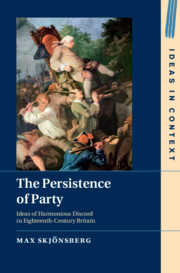
Political parties are taken for granted today, but how was the idea of party viewed in the eighteenth century, when core components of modern, representative politics were trialled? From Bolingbroke to Burke, political thinkers regarded party as a fundamental concept of politics, especially in the parliamentary system of Great Britain. The paradox of party was best formulated by David Hume: while parties often threatened the total dissolution of the government, they were also the source of life and vigour in modern politics. In the eighteenth century, party was usually understood as a set of flexible and evolving principles, associated with names and traditions, which categorised and managed political actors, voters, and commentators. Max Skjönsberg thus demonstrates that the idea of party as ideological unity is not purely a nineteenth- or twentieth-century phenomenon but can be traced to the eighteenth century.
It has been nearly two centuries since an American presidential election has evoked a crisis of confidence like that following the election of 2016. Not since the election of Andrew Jackson in 1828 has there been such a public display of anxiety concerning the methods by which we choose our chief executive. As in the contest of 1828 pitting the Democrat Jackson against his Federalist opponent John Quincy Adams, the presidential nominating process of 2016 produced a contest between a celebrity populist, widely seen as unqualified by experience or temperament, and a highly experienced and competent but deeply uninspiring political insider who had been anointed by establishment elites.
National convention delegates are chosen through a bewildering array of procedures that vary from state to state. Because states, for the most part, determine not only whether parties hold a primary or caucus, but also which voters are eligible to participate, delegates arrive at the national convention having been selected by very different constituencies that have very different policy ideas and very different levels of commitment to their respective parties.
The result is that neither the Republican Party nor the Democratic Party is able to express a clear ideological message through its presidential nominations. Presidential candidates seeking to win delegates in different state elections must appeal to the electorate in each state—and the state electorates differ greatly because the state-imposed voter eligibility rules differ greatly from state to state. As a result, candidates who articulate a clear and consistent message will draw different levels of support from the primary electorate in the various states, even when their messages appeal to similar proportions of party members and non-party members in each state.
This article draws on the authoritarian institutions literature to explain the role of dominant parties in constraining the ability of autocrats to reshuffle cabinet ministers. Dominant party leaders are constrained in their ability to frequently reshuffle ministers by the need to maintain credible power-sharing commitments with party elites. These constraints also produce distinct temporal patterns of instability where large reshuffles occur following elections. Conversely, personalist leaders face fewer power-sharing constraints and engage in more extensive cabinet reshuffles at more arbitrary intervals. Military leaders face complex constraints that depend on whether officers or civilians occupy cabinet posts and the extent to which leaders are dependent upon civilian ministers for regime performance and popular support. Empirical analyses using data on the cabinets of ninety-four authoritarian leaders from thirty-seven African countries between 1976 and 2010 support the theoretical expectations for dominant party and personalist leaders, but are inconclusive for military leaders.
How important have Thai parties and intraparty factions been in Thailand's fast-evolving democracy? What role do they play today, especially since the enactment of the latest constitution? What has accounted for the fragmentation in Thailand's party systems and coalitions? How did Thai democracy allow for the rise to power of Thaksin Shinawatra? This article analyzes these questions, presents a theory of Thai coalition behavior, and offers some predictions for Thailand's democratic future.
The postwar electoral dominance of the Liberal Democratic Party (LDP) was founded on (1) strong incumbency advantage, which insulated its legislators from declining party popularity, and (2) the malapportionment of districts, which overvalued the electoral clout of the party's rural base. The LDP's demise in 2009 was due to the reversal of both factors, each of which was related to electoral reforms in the 1990s. First, I demonstrate that elections are becoming more “nationalized,” due to the growing weight that voters attach to the attractiveness of party leaders. Past performance has become a poorer predictor of incumbent reelection, giving way to large partisan swings that are increasingly correlated across districts. Second, malapportionment was reduced by almost half in 1994, meaning that rural votes are now worth fewer seats. As a result, parties that can attract swing voters nationally are better positioned for victory than those with a narrow regional base.
Thailand's on-going political crisis began with agitation against the Thaksin Shinawatra-led government, saw a military coup and a spate of street-based protest and violence. Drawing on Marx and Weber and using the categories of class, status and party, it is argued that Thailand has reached a political turning point. Subaltern challenges to the hierarchical institutions of military, monarchy and bureaucracy appear to have resulted in political patterns of the past being set on a new trajectory. The social forces that congregate around old ideas associated with status honour – hierarchy, social closure and inequality, ‘Thai-style democracy’ and privilege – are challenged by those championing equality, access, voting and populism. While the balance of forces would suggest that an historical turning point has been achieved, reaction and unexpected outcomes remain possible.
While there is a growing literature on the factors linked to the power held by leaders in state legislatures, the complexity of leadership power as a concept makes assessing it difficult. The author demonstrates that measures of formal leadership power derived from the written rules are uncorrelated with survey measures capturing legislators' own assessments of their leader's strength. These differences have practical importance, with each type of measure yielding different substantive findings in models predicting leadership power.
Recommend this
Email your librarian or administrator to recommend adding this to your organisation's collection.