To save content items to your account,
please confirm that you agree to abide by our usage policies.
If this is the first time you use this feature, you will be asked to authorise Cambridge Core to connect with your account.
Find out more about saving content to .
To save content items to your Kindle, first ensure no-reply@cambridge.org
is added to your Approved Personal Document E-mail List under your Personal Document Settings
on the Manage Your Content and Devices page of your Amazon account. Then enter the ‘name’ part
of your Kindle email address below.
Find out more about saving to your Kindle.
Note you can select to save to either the @free.kindle.com or @kindle.com variations.
‘@free.kindle.com’ emails are free but can only be saved to your device when it is connected to wi-fi.
‘@kindle.com’ emails can be delivered even when you are not connected to wi-fi, but note that service fees apply.
Chapter 3 focuses on a small number of letters from Keats to his poet-friend John Hamilton Reynolds written in the first few months of their friendship, in late 1817 and early 1818. As aspiring young poets, Reynolds and Keats developed a close, competitive-collaborative friendship in which the exchange of letters played an important part. The chapter examines the ways in which some of the main tenets of Keats’s conceptual or theoretical sense of both letter-writing and literary criticism arose out of the interchange of letters with a poet with whom he actively collaborated. Through a reading of Keats’s commentary on the power of Shakespeare’s poems and plays, the chapter argues that letter-writing is intrinsically collaborative, and that in his letters to Reynolds, Keats also emphasizes the collaborative or corresponding quality of both literature and literary criticism.
Akin to Aristotle’s attempt in the Poetics to lay out the various conditions of artistically rendered human action that make for the most gripping treatments, Hegel develops a poetics of action that attempts to articulate what makes for the most beautiful artistic presentations of action. This chapter focuses on this “poetics of action,” and it is argued that the key to understanding Hegel’s aesthetic privileging of heroic action in his poetics lies in the peculiar ontology of the artwork itself: that is, it is argued that the decisive, transformative events that are the focus of scenes of heroic action in effect provide art with that express content that most readily fits with the artwork’s own deeper nature as such a transformative event in its own right. The chapter explores various of Hegel’s specific aesthetic judgments about dramatic settings, characters, narrative structure, and the role of ethics in art, in each case arguing that the basis of these judgments is oriented both in terms of the heroic and in terms of what enables the character of a transformative event to become most manifest.
The introduction outlines the key themes of the book and offers brief summaries of individual chapters. It offers a brief overview of Keats’s letters and a summary of their publication history, their reception, and their place in his public reputation. The chapter proposes that Keats’s letters can be considered as a body of work in its own right, and that literary criticism needs to develop an epistolary poetics to enable and support a formal critical reading of his correspondence.
This chapter posits that domesticity played a central role in Ginsberg’s life and work. Although images of mobility recur in his work, reflections on his childhood home and his adult apartment life recur as well. The first section of the chapter interprets Ginsberg’s needs for both travel and a homelife as a nexus rather than a binary opposition. The second section provides an account of his discordant childhood home, a midlife pivot in his sense of the domestic, and the varying circumstances of his apartment existence in the East Village of Manhattan. The final section analyzes the role that home, neighborhood, and his “Jewish-enough” identity played in his poems, including “Manhattan May Day Midnight,” “Fourth Floor, Dawn, Up All Night Writing Letters,” and “My Kitchen in New York.” In Ginsberg's later poems, home is an arena of presentness and a harbor of writing.
This chapter explores the many ways Mexico became central in Ginsberg’s poetic evolution. Inspired by the example of his mentor, William S. Burroughs, Ginsberg visited several archaeological sites in Mexico such as Palenque, which inspired one of his most successful early poems, “Siesta in Xbalba.” Ginsberg traveled widely throughout the country and continued the mystical quest which began with his experience of “cosmic consciousness” in Harlem in 1948 as he read the poetry of William Blake. In poems such as “Paterson,” Ginsberg wrote that he “would rather go mad, gone down the dark road to Mexico, heroin dripping/in my veins,/eyes and ears full of marijuana, /eating the god Peyote…” than endure his life in America. Ginsberg read widely in the history of culture of Mexico, and his poems as well as his journals reveal the profound effect Mexico would have on his life and work.
Allen Ginsberg read, reread, and approached the work of Walt Whitman throughout his life. How should we understand the overtly acknowledged relationship between these two poets? This chapter suggests that at the same time as one can trace the references Ginsberg makes to Whitman in his poems, compare and contrast the focus of each, or consider the parallels between the poetics of the two, we can also understand (the sometimes unsavory) Whitman in the (sometimes unsavory) Ginsberg canon as a screen onto which Ginsberg projected his ideas of his own literary ethos and significance.
The Conclusion formulates the ethical role that I attribute to multi-scalar poetics in the context of an accelerating ecological crisis. I argue that narrative fiction can enable response-ability towards multiple scales of life and scale-bound perspectives. I expand the concept of scalar irony, which I defend here as an eco-political mode of attention that fiction enables for the reader. Returning to the question of analogy, I argue against the temptation to hierarchise non-analogical tropes above analogical ones, and propose that literature’s power lies in its capacity to turn all tropes into sites of epistemic and ethical negotiation.
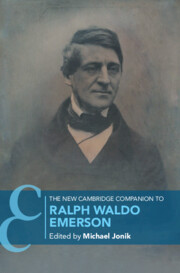
After sketching two indicative moments from Emerson’s 1867 westward lecturing trip – his visit to the Santee Sioux in Minnesota and his visit to a group of Hegelian philosophers in St. Louis – this Introduction to the New Cambridge Companion to Ralph Waldo Emerson gives an overview of the volume contributors’ main thematic emphases. These are Emerson in relation to his contemporary moment; his religious and spiritual development; transatlantic Romanticism; nature, the environment, and climate; ethics and self-reliance; political resistance and slavery; race, US imperialism, and Asia; aesthetics, poetry, philosophy, and experimentalism; and his late style and legacy. While many readers of Emerson are most familiar with the iconic picture of him as the Sage of Concord, this introduction paints a picture of a transitional and transnational Emerson who tirelessly lectured across the United States throughout his lifetime, who can be placed in his contemporaneous transatlantic currents of Romantic literature, religion, philosophy, or science, and who nonetheless looks forward to modernist poetic, aesthetic, or musical innovations.
The Introduction observes that a significant strand of twenty-first-century fiction is attempting to connect the human to other-than-human scales. I suggest that this fiction performs epistemic and ethical work because it foregrounds relations of biological and ecological interdependence. I situate my study in the context of scale theory and outline the eco-political and symbiopolitical stakes of scalar rhetoric. I then highlight the different ways in which multi-scalar poetics stimulate ontological and ethical questioning, produce new conceptions of self, agency, and environment, and ultimately enable ecological response-ability. Scale-switching, I argue, is not only a significant writing practice but a necessary reading methodology. I then introduce the three main devices analysed in the book: critical synecdoche, ontological metalepsis, and scalar irony.
Ethics, for Emerson, begins in perceiving the “wonderful congruity which subsists between man and the world” such that ethics, in thinking and in living, is a matter of being “allied to all.” In this view, the “infinitude of the private man” – often yoked to the concept of “self-reliance” – names a metaphysical and ontological fact at the heart of Emerson’s ethics: human existence within a web of interconnections. This chapter draws widely from Emerson’s oeuvre to show how he unites “severe science with a poetic vision,” seeing and seeking to express how “Our life is consentaneous and far-related.” His work teaches us to see kinships between ethics, aesthetics, religion, science, and politics, and to consider ethics a practice of observing the intimacies in which we exist and in which the ethical question “How shall I live?” begins living in us.
While Emerson's place in American literary history has remained secure, the New Cambridge Companion to Ralph Waldo Emerson draws on a wealth of recent Emerson scholarship which has highlighted his contemporary relevance for questions of philosophy and politics, ecology and science, poetics and aesthetics, or identity and race, and connects these to the key formal and interpretive issues at stake in understanding his work. The volume's contributors engage the full breadth of Emerson's writing, developing novel approaches to canonical works like Nature, the essays 'Self-Reliance' 'Experience,' or to his poetry and journals, and bringing critical attention to his lectures and to the long-overlooked texts of his later period. This New Cambridge Companion to Ralph Waldo Emerson thus both bears witness to the new Emersons that have emerged in the past decades, and draws a new circle in Emerson's reception.
Moving from Illmatic to Young Stoner Life, this chapter listens closely to rap flow – the complex metrical pulse that runs through its verses. Drawing on lyrical examples from rappers like MC Lyte and Missy Elliott, it lays out a series of core technical effects (such as pauses, overflows, and triplets) before turning to the question of how MCs have grappled with the challenge of recording their flows on the page. Discussing the obstacles that face any attempt to apply traditional print poetic scansion to hip-hop, the chapter moves on to the innovative ways that rappers like Rakim and Young Thug have approached their notepads – making use of 16x4 grids, unorthodox punctuation, and abstract shapes. It closes with a discussion of so-called mumble rap and the ethics of close listening, pointing to the controversial use of rap lyrics in the recent YSL court case.
This chapter examines the transformative work of Danielle Dumile, the masked rapper who went by the stage name DOOM (among other aliases), and who was known for his complex lyricism and innovative personae. Adrian Matejka considers the MC’s use of persona through the dual lenses of hip-hop and poetry, highlighting the ways in which DOOM’s lyrics borrow from and enhance these twinned literary traditions. Drawing parallels between DOOM’s innovative lyricism and the tradition of persona poetry, Matejka considers how contemporary poets – particularly Black American poets – adopt various masks to explore history, culture, and identity. This longer tradition is related back to DOOM, whose layered personae subverted mainstream rap in the early 2000s. Matejka frames the rapper’s work as an enduring testament to persona’s power in mythmaking and cultural commentary.
This article examines the semiotics of epistemic politics surrounding climate change denial on Tangier Island, Virginia, a shrinking inhabited island in the Chesapeake Bay, USA. Using long-term ethnographic field research, the paper analyzes how islanders’ professed disbelief in climate change functions not as ignorance but as political and poetic positioning. Denial is treated as a symbolic act, not reducible to misinformation or scientific illiteracy, but shaped by classed and embodied relations with state knowledge regimes, media discourses, and environmental governance. Drawing on Peirce’s pragmatism and Jakobson’s poetics, the article frames climate denial as both an imposed stereotype from without and an identification strategy from within, connected to multiply indexed relationships. To that end, the article advances a semiotic approach to climate politics that centers affect, professed belief (creed) and epistemic stratification.
Pablo Neruda’s Nobel lecture “To the Splendid City” was a summary of his poetic practice as well as a consummate presentation of his literary persona to the world stage. Although highly conscious of the political context of his utterance, and hugely laudatory of the recently elected socialist Allende administration, Neruda devoted most of his lecture to evoking the breadth and beauty of the Chilean landscape and the creativity and the imagination of the Chilean people. Evoking the panoramic and eulogistic register of Canto general, Neruda proffered a buoyant and empathetic vision of his homeland, even though some aspects of his approach might seem insufficiently critical to a twenty-first-century literary sensibility. Neruda used the platform of his lecture to give a convincing statement of his identity as a Latin American writer.
This chapter examines a literary critical ‘methodological moment’ from the middle of the nineteenth century to modernism. It argues that the re-emergence of the scientific method in this period was key to the normal scientific study of poetry. By returning to a series of forgotten critical debates about the relevance of the scientific method to the study of poetry, the chapter demonstrates how the nineteenth-century revival of method introduced a technical vocabulary into twentieth-century poetics, an epistemologically and politically charged discourse that centred on concepts of method, hypothesis and scientific law. The second half of this chapter goes on to examine published and unpublished poetry by George Oppen to show how he offered a new way of conceptualising the relationship between poetry and the scientific method. It suggests that Oppen turned to mathematics and set theory to create a new nominalist method that could create rather than explain. However, it is also argued that Oppen’s employment of the mathematical method actually ends up illustrating the epistemological power of poetic artifice: its ability to create the sights and sounds of the invisible but not inexistent multitude that Oppen’s poetry sought to bring into being.
This chapter reads the criticism of I. A. Richards in relation to the tradition of scientific reading sketched in this book, positioning him as a theoretician of linguistic exactitude. Far from Empsonian ‘ambiguity’, Richards’s overall investment in the striving for linguistic clarity reconfigures how we should view his place in the history of the discipline. If close reading is a practice that today prizes ambiguity, contradiction and the play of the signifier, then Richards sits awkwardly as its founder – and, towards the end of his career, Richards would even wonder out loud whether a literary criticism based on exactitude could help facilitate a one-world liberal government. The chapter ends by returning to the question of artifice and the knowledge it can produce, focussing on the Cambridge-based poet Veronica Forrest-Thomson, who sought to reconfigure Richards’s concept of a linguistic instrument through her verse practice. Reading her poetry and criticism from the 1970s, the chapter shows how Forrest-Thomson localises the idea of poetry as a unique linguistic instrument in her conception of poetic artifice, which she sees as a form of knowing irreducible to scientific explanation.
This chapter shows how Laura Riding’s poetry was responding to a now-unrecognisable scientific regime of reading that prioritised exactitude over ambiguity. For her, this regime was brought about by the emergence of a new kind of literary critic, one she scathingly referred to as a bureaucratic ‘expert’. In response, her verse aimed to develop a superior form of exactitude, which she hoped would provide a poetics of literal truth. However, this chapter suggests that if Riding’s poetry does evince a truth-content, then it is not in its supposed exactitude but rather in how its artifice demonstrates a thinking precisely in excess of the forms of rational knowing that sought to determine it. In Riding’s own poetry – and this despite her best intentions – it is precisely what she would call its graphic and sonorous ‘freakishness’ that displayed the truth-content of that which scientific modernity consigned to the unknowable. This chapter thus reads Riding as an unchosen path for the history of poetics, one devoted to thinking about poetry’s singular truth-content in an era devoted to scientific specialisation and professionalisation.
This chapter introduces the varied, intense, committed, unruly and, above all else, deeply political attempts to fashion a definitive scientific account of poetic production from 1880 to the present. It shows how, when one casts their eye back on nineteenth- and twentieth-century disciplinary history, criticism was not just written by literary critics. It was also an activity undertaken by scientists – by mathematicians, physicists, psychologists, statisticians, public rationalists, early computer scientists, educationalists and other generalist intellectuals seduced by the power of scientific rationality. This chapter then rehearses the major arguments of the book, noting, first, how professionalised literary criticism was shaped by this search for a science of verse. Second, it outlines how a series of modern poets, from Laura Riding to Veronica Forrest-Thomson, theorised how their poetry could produce a form of knowledge removed from the hegemony of scientific rationality. To do this, the chapter outlines a theory of the epistemology and political power of poetic artifice.
The Coda shows how the post-Enlightenment desire for a science of verse has been fundamental to contemporary machine learning technologies. It also reflects on the historical development, ideological commitments and epistemological foundations of the normal scientific study of poetry, both at its inception and in its enduring legacies, inquiring into what is at stake when techno-scientific reason attempts to exert its full domination over the poetic imagination, into how the nineteenth-century dream of a science of verse has shaped contemporary scientific exploration. It does so via the often-overlooked mid-century poet and scientific critic Josephine Miles.