To save content items to your account,
please confirm that you agree to abide by our usage policies.
If this is the first time you use this feature, you will be asked to authorise Cambridge Core to connect with your account.
Find out more about saving content to .
To save content items to your Kindle, first ensure no-reply@cambridge.org
is added to your Approved Personal Document E-mail List under your Personal Document Settings
on the Manage Your Content and Devices page of your Amazon account. Then enter the ‘name’ part
of your Kindle email address below.
Find out more about saving to your Kindle.
Note you can select to save to either the @free.kindle.com or @kindle.com variations.
‘@free.kindle.com’ emails are free but can only be saved to your device when it is connected to wi-fi.
‘@kindle.com’ emails can be delivered even when you are not connected to wi-fi, but note that service fees apply.
This chapter examines how Sophoclean tragedy approaches and conceptualises the relationship between divine and mortal. It demonstrates that Sophocles builds on the early Greek theological, philosophical and literary tradition outlined in Chapter 1, but steers his own, distinctive course. It argues that Sophocles’ tragedies deploy ideas and beliefs about humans and gods in three, closely interconnected ways: in the explicitly theological and philosophical discourse uttered by characters and choruses; in the trajectories and experiences of individual characters on the stage; and in the broader, religious and ethical patterns that underlie these trajectories, which are occasionally and partially revealed to audiences. As part of its attempt to foreground the close interrelation of dramatic structure, form and content, the chapter devotes considerable space to a new interpretation of dramatic irony. This general discussion relies on readings of four Sophoclean plays, Oedipus Tyrannus, Ajax, Philoctetes and Oedipus at Colonus, as well as on brief comparative analyses of some Aeschylean and Euripidean examples.
This chapter introduces the main argument and themes of the book, and positions it within earlier and existing scholarship on archaic and classical Greek literature, religion and philosophy. Particular points of focus include the relationship between Greek tragedy, ritual and theology, and influential mid-twentieth-century research on Sophocles (the ’classics’ of Sophoclean scholarship). The chapter also discusses ancient biographical traditions surrounding Sophocles’ religiosity and piety.
Edited by
Rosa Andújar, Barnard College, Columbia University,Elena Giusti, University of Cambridge,Jackie Murray, State University of New York, Buffalo
This chapter examines the various ways in which ancient tragic and comic playwrights constructed race on their stages. Inspired by Geraldine Heng’s articulation of race in the premodern past as an ‘essentialised difference’, I explore essentialised conceptions of ethnicity and descent featured in various plays and how these intersected with broader cultural and political discourses around identity in fifth-century Athens. I trace the discourses of alterity and inferiority that feature in various tragic plots centred on interactions between Greeks and barbarians from Aeschylus’ Suppliants to Euripides’ Medea, as well as notions of superiority that foreground the various myths of Athenian autochthony staged across the fifth-century BCE, most prominently in Euripides’ Erechtheus and Ion.
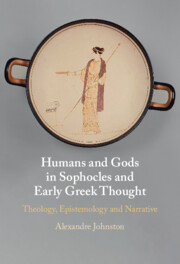
This book proposes that Sophoclean tragedy is a distinctive form of religious discourse concerned with exploring the relationship between humans and gods. Building on recent scholarship that has begun to reintegrate literature within the study of Greek religion after decades of neglect, Alexandre Johnston positions Sophocles' seven extant plays within a vibrant tradition of early Greek theology, literature and philosophy that cuts across modern disciplinary boundaries. Blending an overarching thematic approach with detailed analysis of key case studies, he argues that tragedies such as Antigone and Electra were at once poetic works and religious artefacts that engaged profoundly with contemporary intellectual culture. Through their narrative structure and performance, these tragedies allow spectators privileged insights into the workings of an obscure, unstable world dominated by inscrutable gods, offering distinctive, sometimes radical visions of the divine and its impact on the existence of mortals.
This article provides a new reading of Sophocles’ Philoctetes in light of its metatheatrical relevance, by focusing on the prominent theme of Odysseus’ deception in selected scenes: from the prologue to the False Merchant’s scene and Heracles’ speech at the end of the tragedy. This article reveals how the unfolding of the plot appears to rely on two different levels of knowledge, namely that of the informed audience on the one hand, and the limited knowledge of the characters on stage on the other. What scholars have so far read as inconsistencies within the play can be explained with Sophocles’ portrayal of Odysseus as an internal ‘director’, who supposedly takes on different roles to accomplish his own plan while simultaneously promoting the development of the plot.
This essay examines the oracular responses of the oracle of Dodona portrayed in fifth-century BCE Attic tragedies. This analysis explores the wording of the oracular answers, characterized by extreme conciseness and clarity, and the topic of the queries, on household security, family matters, and final journeys. The evidence from the lead tablets at Dodona corroborates this focus, showing that while the oracle addressed various concerns, a significant number of private queries dealt with family, health, marriage, and travel. Additionally, the responses from Dodona were brief and straightforward, in contrast to the cryptic nature of Apollo’s oracles at Delphi.
This article traces how changes in the depiction of atimia (loss of honour/citizen rights) in Athenian tragedy provide crucial information for understanding how the actual punishment evolved in the fifth century. Scholarship on the term has long agreed that the archaic personal form of atimia differed from the legal version of the fourth century, but has failed to explain why and when that change occurred. The tragedians’ discussion of atimia reveals when the punishment took on its legal aspects and how its scope expanded after the restoration of democracy at Athens, when the Four Hundred were declared traitors and atimoi.
Ancient audiences ascribed personal religious views to individual playwrights – a fact that confirms ‘personal religion’ as a meaningful category in the study of ancient Greek society in general and the theatre in particular. Aeschylus was especially devoted to Demeter; Sophocles was exceptionally pious; Euripides was hell-bent to show that there were no gods. The oeuvres of these playwrights inspired such inferences, to be sure, but other factors mattered too. Comedies staged the tragic poets as characters and ascribed various religious views to them. Face-to-face encounters with the playwrights gave rise to anecdotes and recollections, which no doubt circulated orally but were also occasionally written down. All this meant that the playwrights could build on their public personae and assume that audiences would recognize characteristic concerns in their plays. We uncover a dynamic set of interactions in which the poet shaped his plays but was also shaped by how audiences received them. We show that we should not construct an opposition between personal and polis religion: The religious views ascribed to the tragedians were personal and communally owned.
Extant Greek tragedy contains several instances of choral division, scenes when the chorus appears either to split into individual performers (as in Aeschylus’ Agamemnon) or, more commonly, to divide into small groups (semichoruses). As these scenes involve the (always temporary) disintegration of tragedy’s emblematic collective, a collective that is customarily conceived of as a unified group, this chapter frames such scenes in terms of fragmentation. These various states of fragmentation illustrate not only the way in which tragedians play with the chorus’ ability to slide towards and away from uniform collectivity but also the assumptions about wholeness which have implicitly informed critical and editorial approaches to both tragedy and the chorus. In addition to examining these divisions in tragedy, the chapter analyses similar divisions in satyr play, comedy and Rhesus, the only surviving example of fourth-century tragedy, demonstrating how the divisions of the comic and satyric choruses are more readily accepted by critics.
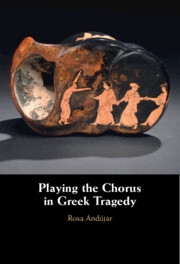
Modern audiences see the chorus as an emblematic yet static element of ancient Greek drama, whose reflective songs puncture the action. This is the first book to look beyond these odes to the group's complex and varied roles as actors and physical performers. It argues that the chorus' flexibility and interactive nature has been occluded by the desire from Aristotle onwards to assign the group a single formal role. It presents four choreographies that ancient playwrights employed across tragedy, satyr play, and comedy: fragmentation, augmentation, interruption, and interactivity. By illustrating how the chorus was split, augmented, interrupted, and placed in dialogue, this book shows how dramatists experimented with the chorus' configuration and continual presence. The multiple self-reflexive ways in which ancient dramatists staged the group confirms that the chorus was not only a nimble dramatic instrument, but also a laboratory for experimenting with a range of dramatic possibilities.
This chapter offers in-depth case studies to display how playwrights both used and innovated with mechanical epiphany. Six ancient tragedies are discussed, grouped in thematic pairs. Euripides’ Helen and Bacchae, are taken together as plays that use the deus ex machina to comment on divine form. While the mēchanē in the Helen confirms divine form in a play otherwise full of illusion; the mēchanē in the Bacchae is presented as yet another epiphanic mode of the mimetically inclined patron god of theatre, Dionysus. Sophocles’ Philoctetes and Euripides’ Heracles use the mēchanē to explore issues of space, movement, and the connectedness of divine and mortal. Finally, Euripides’ Orestes and Medea both make use of the mēchanē to question divine epiphany by bringing to the fore issues of ontological boundaries between human and divine.
This article offers principles to be followed when editing οὔκουν and οὐκοῦν. The distinction between these words is supported by the ancient grammarians, but manuscript readings oscillate to such a degree that modern editors often do not trust them. The most common principles thus far available are those established by Kühner–Gerth and Denniston. Some are so subjective, however, that editors do not always agree on the accentuation of a non-negligible number of instances. This article takes into account the pragmatic contexts in which the particle is used in Attic drama to effect a distinction by applying a conversation analytic methodology to their interpretation. All instances appearing in the extant plays of Aeschylus, Sophocles, Euripides and Aristophanes have been analysed.
This article supports Livineius’ deletion of τϵ καὶ ϕλέγϵι in Soph. Aj. 714 πάνθ’ ὁ μέγας χρόνος μαραίνϵι by means of a comparative examination of tragic quotations in Stobaeus’ Anthology, where Aj. 714 is quoted without τϵ καὶ ϕλέγϵι (1.8.24).
This chapter examines some of the specific methodological challenges of reading dramatic fragments intertextually. It also explores some broader aspects of intertextuality, literary culture, readership, orality, and memory in relation to Greek drama in general. It begins by noting the tendency of commentators and critics to use the formula ‘cf.’ when identifying any sort of similarity between fragmentary texts (or between fragmentary texts and extant ones). But ‘cf.’ on its own is inadequate as an interpretative strategy. This chapter investigates what types of textual relationship are actually being signified by ‘cf.’, and whether it is always possible to know for certain. It also asks to what extent the poor state of the evidence hampers our understanding of textual relations between fragmentary plays, and it raises the problem of how to discern which text is responding to which. These questions are addressed by looking in detail at a number of case studies from works by Aeschylus, Phrynichus, Glaucus, Ion, Sophocles, Euripides, and Aristophanes.
This chapter considers how we might approach the intertextual relationship between two highly fragmentary texts, in this case Sophocles’ Judgement, a satyr play that dramatised the Judgement of Paris, and the epic Cypria in which that mythological episode featured. The exiguous textual remains of both works are taken as a prompt to consider intertextuality in its broader sense, namely the interrelationship of texts in ways that go beyond direct verbal allusion. The framework of possible worlds is employed to conceptualise the relationship between satyr drama and the world of epic and tragedy on which it draws, suggesting that the latter may be thought of as an actual world on which the alternative world of the former is predicated. Using this as a model of intertextuality allows us to examine the movements of the satyric plot as it opens up and closes down possibilities for radically alternative outcomes. In this reading of Judgement, we see Sophocles engaging with both the Cypria and that epic’s own intertextual network, with the satyrs acting paradoxically as both disruptors of the mythical tradition and a force that supports the story reaching its traditional conclusion.
This chapter considers some aspects of the intertextual and intervisual dynamics of Euripides’ Cyclops with particular reference to the cave represented by the skēnē. The particular links of the Cyclops to Sophocles’ Philoctetes are used to explore a network of allusive possibilities in both plays going back to Homer’s ‘Cave of the Nymphs’ in Odyssey 13 and embracing the lost Philoctetes plays of Aeschylus and Euripides. The powerful mediating role of Homer’s cave is seen to be transferred to the caves of drama as the boundary between the seen and the unseen, between the past, present, and future, and as a strongly suggestive marker of the difference between epic narrative and dramatic representation. As the Homeric cave had separate entrances for mortals and gods, so did the Athenian stage. In exploring some of the richness of ‘intertextual allusion’ in fifth-century drama, the chapter also contributes to the appreciation of the differences in allusive practice between tragedy, comedy, and satyr play and of how poets acknowledged and exploited those differences.
This article argues that Andocides’ speech On His Return (Andocides 2) makes use of themes drawn from tragedy, including a near-quotation from Sophocles, in order to present the orator as deserving of pity and forgiveness. This neglected speech is therefore an ingenious work of rhetoric in its creation of ēthos and evocation of pathos. Moreover, it is a key document for the development of religious argumentation in the Athenian courts, and for the early reception of Sophocles. This also affects our interpretation of the two extant speeches from Andocides’ later trial in ca. 400, Against Andocides ([Lysias] 6) and On the Mysteries (Andocides 1), which both develop similar tragic themes in new directions.
According to Aristotle, character or ethos in tragedy is ’that which reveals what the moral choice is like’. This kind of ethos is what this book explores in Sophocles, by examining five tragedies in which moral choice is central to the course of the drama. These choices are made within the context of traditional Greek morality, which, amongst other things, expected one to help one’s friends and harm one’s enemies. Closely allied to these principles is the conception of justice as retaliation. This nexus of principles provides a pervasive ethical background to most of Greek literature and is of special significance for tragedy.
Greek popular thought is pervaded by the assumption that one should help one’s friends and harm one’s enemies. These fundamental principles surface continually from Homer onwards and survive well into the Roman period, and indeed to the present day, especially in international relations. They are firmly based on observation of human nature, which yields the conclusion that most human beings do in fact desire to help their friends and harm their enemies, and derive satisfaction from such behaviour. Thus Xenophon’s Socrates can count benefiting friends and defeating enemies as one of the things which bring the ’greatest pleasures’.
This chapter introduces the human as a question. It revolves around the figure of the Theban Sphinx and her interaction with Oedipus and traces her presence from the ancient world into the works of Sigmund Freud. The chapter invokes the Sphinx as a presence that both prompts and challenges the way we think the human. Oedipus’ troubled humanity stands at the intersection between his success in solving the Sphinx’s riddle and his apparent failure to understand how her words apply to his own existence. As such, the Sphinx’ intervention at Thebes exposes a deep-seated vulnerability at the core of the human condition – a vulnerability springing from the fact that while the riddle can be solved with the powers of reasoning, the human as a riddle remains enigmatic and beyond the application of logos.