To save content items to your account,
please confirm that you agree to abide by our usage policies.
If this is the first time you use this feature, you will be asked to authorise Cambridge Core to connect with your account.
Find out more about saving content to .
To save content items to your Kindle, first ensure no-reply@cambridge.org
is added to your Approved Personal Document E-mail List under your Personal Document Settings
on the Manage Your Content and Devices page of your Amazon account. Then enter the ‘name’ part
of your Kindle email address below.
Find out more about saving to your Kindle.
Note you can select to save to either the @free.kindle.com or @kindle.com variations.
‘@free.kindle.com’ emails are free but can only be saved to your device when it is connected to wi-fi.
‘@kindle.com’ emails can be delivered even when you are not connected to wi-fi, but note that service fees apply.
This chapter examines a rarely discussed novel published by the Cuban writer in 1933. It focuses on his representation of black ñáñigos or abakuás, a brotherhood created by enslaved people in the early nineteenth century in Cuba, and which has survived to this day. It analyzes the novel within the context of anthropological and criminological paradigms that characterized the late nineteenth and early twentieth centuries. It argues that Carpentier deliberately eroticizes Afro-Cubans, especially their religious practitioners, to emphasize their perceived sexual freedom in the face of Western/North American/bourgeois modernization. To support this view, the article relies on insights gleaned from Carpentier’s letters to his mother, his reception of Michel Leiris and Georges Bataille’s ideas on non-Western societies and a little-known chronicle that he published in France.
This essay reassesses Alejo Carpentier’s concept of lo real maravilloso americano [the American marvelous real] by comparing it to analogous notions developed earlier in the works of his Cuban fellow José Lezama Lima, showing how both authors respond to the widespread circulation of French surrealism in the Caribbean between the 1930s and 1940s. In doing so, I deconstruct Carpentier’s claims that his concept of the marvelous real was developed in response to the sense of awe he experienced during his visit to Haiti in 1943, instead viewing it as part of a broader endeavor simultaneously undertaken by several Caribbean writers and intellectuals, particularly in the Francophone islands, who reappropriated surrealist ideas in the context of their own critique of Western thought and an effort to reclaim the islands’ African heritage as part of their struggle for political and cultural autonomy.
This chapter maps aesthetic modernism across Europe as a whole, showing its key generational clusters in their multiple transnational circuits of influence and exchange. It focuses on the major literary modernists and the avant-garde movements of Dada and Surrealism. It finds coherence in a range of shared thematics: outsiderliness; journeying; formal innovation; abandonment of narrative causality and linear time; estrangement and alienation; subjectivity and the unconscious; assertive and experimental sexualities. The gendered dynamics of insistent masculinity and women’s effacement again reappears. The collective generational esprit of the aesthetic modernists is carefully demonstrated via the various regional circuits: Scandinavian; northwest European; Balkan; Soviet-centered; German-speaking central-European. Cinematic modernism was a particular instance, emanating from Moscow across Berlin to Paris. Using Piscator and Brecht within a larger argument about Weimar Berlin, the chapter concludes by identifying a distinctive left modernism.
During the First World War, musical aesthetics in France changed decisively from fin de siècle Symbolism to Modernism. The style quotidien, articulated by Jean Cocteau in his polemic Le coq et l’arlequin, and exemplified by Satie’s concise mélodies, celebrated everyday musical materials, including popular music, and transformed them in a manner analogous to the cubism of Picasso and the surrealism of Apollinaire. Avant-garde composers such as Tailleferre and and Poulenc, both of whom were members of the composers’ collective ‘Les Six’, responded enthusiastically to these new aesthetic currents. Poulenc in particular extended these post-war developments into a body of mélodies that have become part of the international repertory. This chapter begins with a survey of works by some of Poulenc’s contemporaries. It concludes with a discussion of Poulenc’s place as a composer of mélodies and song cycles such as Banalités, Fiançailles pour rire, and most importantly, Tel jour telle nuit.
This chapter traces the ways in which Surrealist concepts and textual features were engaged by and absorbed into Australian poetry. It begins with Surrealism’s early reception in the 1930s, followed by the response of writers associated with Angry Penguins, and the work of Ern Malley. It then considers the re-emergence of interest in Surrealism in the ‘generation of ’68’, particularly in the writing of Jas H. Duke, Philip Hammial and John Jenkins. The chapter concludes by analysing the Surrealist ‘automatic effect’ in selected contemporary poets.
Between the turn of the twentieth century and the outbreak of the Second World War, avant-garde theatre artists challenged traditional norms through experimentation and radical innovation. Blurring the boundaries separating drama, theatre, and performance, these artists employed deliberate provocations and welcomed the audience’s displeasure. In subject matter, the theatrical avant-garde was equally pathbreaking, addressing a number of issues crucial to early twentieth-century modernity: war and revolution, gender roles, technology, rationality and the subconscious, futurity and the new, and the role of art in a rapidly transforming world. Futurism, Dadaism, and surrealism – three of the leading avant-garde movements – incorporated new materials and activities; brought theatre into dialogue with cabaret, variety show performance, circus, and the art of declamation; and dramatically redefined the actor’s role. Their innovations inspired contemporary experiments in non-realist staging, environmental theatre, performance art, and immersive performance.
This paper considers what anti-colonial surrealist praxis can provide those of us interested in the nexus of aesthetics and world politics. Thinking beyond the commonly held notion of surrealism as a European cultural movement, I engage with the writings of 20th-century anti-colonial surrealists, namely, Suzanne Césaire, Aimé Césaire, and René Ménil. In doing so, I argue that anti-colonial surrealism is beyond a movement, a selection of methods, a genre or a set of ideas. Instead, I aim to position anti-colonial surrealist praxis as an epistemology that allows us to move beyond the limitations of representation, both by surfacing historical intimacies (rather than gaps) between content and form, while also questioning the demarcation between art and politics. I illustrate my argument’s resonance in the contemporary political moment through an engagement with aesthetic interventions produced by Sai, an artist exiled from contemporary Myanmar. Sai’s absurdist creative interventions and material drawn from in-depth interviews and ethnographic observations allow me to demonstrate the political possibilities of an ‘anti-colonial surrealist praxis’ approach, in its conception of aesthetics as co-constitutive, rather than only representative, of the political.
In Boulez’s artistic framework, the principle of negation serves as a pivotal ideological and compositional foundation, symbolising a generational reset and a radical departure for new music. This chapter delves into Pierre Boulez’s utilisation of poetry and the singing voice as foundational elements in his pursuit of the negational principle. Focused on his concept of ‘reforming’, I examine Boulez’s vocal compositions based on selected poems by René Char, Henri Michaux, Stéphane Mallarmé and E. E. Cummings. Within these compositions, Boulez skilfully juxtaposes traditional elements with serialism, using the serial language to neutralise and negate the established norms. The ‘centre and absence’ principle takes centre stage, serving as Boulez’s fundamental approach to implementing deconstructive processes. This analysis proposes a novel interpretation, presenting this principle as a dynamic force governing the dramatic trajectory of vocal compositions beyond its role as a mere structural device.
This article explores surrealism as an overlooked critical resource for International Relations theory (IR) and argues that surrealism’s legacy for international theorizing lies in its capacity to provoke radical reimaginings of the political status quo and to offer engagements with catastrophes that are not grounded in end time. Tracing the movement’s intellectual genealogy beyond its artistic origins, this article draws on key surrealist texts, particularly those of its founder, André Breton (1896–1966), to emphasise surrealism’s value as a sophisticated intellectual response to the horrors of the early and mid-twentieth century: nationalism, industrial warfare, rationalism, imperialism, and totalitarianism. The article offers two main contributions. First, its historico-political reading of surrealism enables a reinterpretation of the long-standing debate between realism and utopianism in IR. Highlighting important intersections between surrealism and international theory – most notably classical realism – it shows that the surrealist stress on the imagination as a radical, transformative force offers a stark reminder to contemporary IR theory of the necessity of utopian thinking. Second, the article claims that the surrealist foregrounding of myths opens imaginative pathways for confronting the Anthropocene, providing a crucial counterpoint to contemporary IR scholarship that predominantly frames planetary challenges through narratives of imminent collapse.
This paper examines the materialization of trauma as both a narrative and embodied phenomenon in Hassan Bani Ameri's 2006 novel, Gonjeshkha Behesht ra Mifahmand, using contemporary narrative and trauma theory. The postmodernist narrative, told from the perspective of a photojournalist, reconstructs events surrounding the death of a celebrated Iran-Iraq War commander. I argue that traumatic truths resist full integration into conventional frameworks of understanding, evident in the novel's non-linear, fragmented narrative and its shift from visual realism to confessional surrealism in an ending that challenges traditional storytelling and historical documentation. By vividly simulating the sensory processing of traumatic memories, the novel emphasizes the material reality of trauma that demands to be seen, heard, and physically felt, thus negating celebratory institutional narratives around the culture of war and martyrdom.
This chapter details and expands current research on Messiaen’s response to, engagement with, and inculcation of Surrealism in his music. In particular it examines the poetic and ethnological context of Messiaen’s work, and also introduces a discussion of the occult and psychoanalytical trauma as Surrealist contexts for Messiaen’s work in the late 1940s.
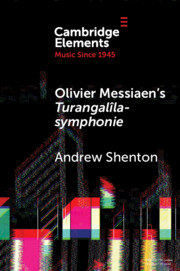
As one of only a few pieces not primarily inspired by Messiaen's Catholic faith, but by human love as described in the romance of Tristan and Isolde and elsewhere, the Turangalîla-symphonie is contextualized in Messiaen's oeuvre and as a genre piece. Using previously untranslated information from Messiaen's own description of the work in his Traité, close analysis of the music seeks to demystify some of the complex innovations he made to his musical language, especially in the areas of rhythm and orchestration. This Element pays special attention to the fragmentary and elusive program which is explained with reference to Messiaen's fascination with surrealism at this time. Information is included on the commission and composition of the piece, its premiere by the Boston Symphony Orchestra conducted by Leonard Bernstein, its revision by Messiaen in 1990, and its reception history in both live and recorded performances.
The purpose of statues in public spaces has recently become a matter of controversy. Using a 1937 quotation from the artist Paul Nash and the surrealist leader André Breton, this paper explores the circumstances in which a statue is read as appropriately – ‘in its right mind’ in their terms – situated in public space. In doing so, it draws primarily on examples from Britain, Europe and North America during the rapid expansion in the number of statues in public space from the eighteenth century onwards. The rightmindedness of a statue is shown as primarily determined not by the subject of the statue itself, or by its reception among the public, but by ways in which public authorities and local elites authorise the use of public space. Yet these authorities’ understanding of the fit between a statue and public space can vary over time. Shifts in the political context often prompt changes to where statues are seen as appropriately located. However, picking up on Nash/Breton's phrase, to place a statue in ‘a state of surrealism’ involves more than mere relocation. This is shown to require additional disruption to a statue's artistic language and/or spatial syntax.
Scholars have canonically understood Surrealism as having arrived in the Americas in two principal waves: the first involved the interwar discovery of a largely French avant-garde movement by poets, little magazines, and art-world figures in the US and Latin America; the second describes the influx of European “exiles” who crossed the Atlantic as war refugees during World War II. Surrealism was not, however, a solely Parisian or European movement that washed up on American shores. This chapter proposes instead that “Surrealism” designates a multifarious set of poetic and artistic practices invented by and within the Americas, in exchange with European and non-European arts and ideas. The chapter traces some of the refractions and reverberations of Surrealism throughout the Americas, offering a survey of American surrealisms – from Buenos Aires to Fort de France, from Mexico City to Chicago, from Lima to New York City – that disclose a complex set of intercultural reflections and negotiations among modernist poets, artists, and thinkers.
This essay traces the anti-Bildungsroman tradition under the influence of surrealism, in Georges Bataille’s Story of the Eye (1928) and Kathy Acker’s Great Expectations (1982). While Acker inherits Bataille’s fascination with violence and transgression, these themes are formally developed through the prism of punk and feminist conceptual art and performance. The recent resurgence of critical interest in Acker’s work prompts us to further consider her relationship to surrealism and the modernist avant-garde. While Acker’s homage to Bataille in the early novels signals a brazen ’theft’ of the male avant-garde tradition for feminist subversive ends, Great Expectations experiments with form and language in order to evacuate the Bildungsroman of its bourgeois (gendered) claims to moral authority and insight. While extreme experience in Bataille’s literary work holds out the promise of an affirmation of sorts, the excoriating emotional masochism of Acker’s characters tilts towards nihilism. And yet both Bataille and Acker draw on the Bildungsroman even as they decondition the humanist subject that lies at its very core, straining at the limits of language to represent the vertiginous intensity of affective life and the dissolution of desire into abjection.
Unica Zürn’s narratives exemplify the post-1945 afterlife of surrealist narrative forms, which persist as mutations ruptured by historical trauma, marked by and constitutive of the fractured, damaged temporalities of subjective and historical experience. Joao Ribas has commented on how Zürn’s drawings exploit a ’repertoire of surrealist techniques’ (Dark Spring, 21); her writings similarly adapt many familiar surrealist narrative-aesthetic traits and practices to explore specific German post-war and post-Shoah contexts, deploying strategies of automatism, prolepsis, cryptographic and other phantasmagorical techniques, fairytale, literary, cinematic and other allusions, alongside formally experimental, densely polysemic, and allegorically autobiographical structures. Adapting the extensive archival resources provided by surrealist techniques enabled Zürn to produce narratives focused on representing and navigating the damaged durational temporalities of traumatic experience, encountered as simultaneously subjective (and thus rooted in problematically autobiographical narratives) and social (and thus grounded in shattering historical events and their disastrous psychological impacts). The essay examines key works to explore her insistent linguistic registering of trauma through a poetics of the fragment – a remnant of shattered language, and a preoccupation she inherited from her involvement with Alexander Camaro and the post-war Berlin surrealist group Der Badewanne and its aesthetics of constrained recycling as a response to the post-war scarcity of art materials – in which meaning is encrypted, demanding decoding by the reader.
This essay explores attitudes towards childhood in the surrealist novel but does so not via the familiar lens of psychoanalysis but via the concept of ’nostalgia’ as theorized by Svetlana Boym in her book The Future of Nostalgia (2001). Taking two contrasting examples of surrealist writing on childhood – Giorgio de Chirico’s seminal Hebdomeros (1929) on the one hand and Michel Leiris’s autobiographical novels Manhood (1939) and Scratches (1948) on the other – it is argued that, in both cases, Boym’s concept of ’reflective nostalgia’ (as opposed to ’restorative nostalgia’) provides a useful tool of analysis. However, the melancholic tone of de Chirico’s writing – with its stylistic debts to Lautréamont and Nietzsche – has a regressive dimension, and lacks the self-reflexivity specified in Boym’s account of a critically incisive ’reflective’ nostalgia. By contrast, Leiris’s more robust exploration of his male sexuality, along with the ’anthropological’ tenor of his analysis of the linguistic and material universe of childhood, fits more productively with Boym’s conception of a positive role for nostalgia within modernism.
This chapter focuses on the role of the surrealists and their friends in the reception of Anglo-American SF in France. It gives special attention to the opinions of the Parisian surrealists Gérard Legrand and Robert Benayoun, both of whom took a selective approach to the new writing by authors such as Raymond Bradbury, Fredric Brown, and Lewis Padgett. Two important novels, The Dreaming Jewels (1950) by Theodore Sturgeon and I Am Legend (1954) by Richard Matheson, illustrate the themes and issues explored by SF that held the attention of the surrealists. In the latter part of the chapter, I turn around the enquiry to look less at the surrealists’ interest in SF and more that held by SF writers in surrealism. J.G. Ballard’s fascination with surrealism from the 1960s has long been recognized and was acknowledged by the author himself. Ballard’s stories of that decade serve as a further case study to explore the survival or broadening of surrealist themes into SF and asks why a movement frequently associated with a Benjaminian notion of the ’outmoded’ could play such a significant role in a genre that pitched its content so emphatically in the future.
This chapter presents a reading of René Daumal’s novel Mount Analogue: A Novel of Symbolically Authentic Non-Euclidean Adventures in Mountain Climbing (1952) in the context of its relations with Alfred Jarry’s ’pataphysical or ’neo-scientific novel’ Exploits and Opinions of Doctor Faustroll, Pataphysician (1911). Like that of many surrealists, Daumal’s humour was nurtured in adolescence on Jarry’s idiosyncratic, absurdist, and blackly comic Umour. Mount Analogue is Daumal’s most sustained expression of such humour. The novel, unfinished at the time of the author’s death in 1944, tells of the narrator Theodore’s encounter with Père Sogol, an expert climber and non-Euclidean navigator (i.e. spiritual guide), who leads a small group of novices on a quest to scale an unclimbable mountain. With much intertextual wit, Daumal weaves together his own peculiar mixture of Jarryesque scientific satire, the spiritual mythos of René Guénon, and the Gurdjieffean teachings of Alexandre de Salzmann into an ecological morality tale and Rabelasian adventure story. The chapter situates Mount Analogue within Daumal’s concern with what he and the other members of the Grand Jeu called “experimental metaphysics” – a lived, experiential foray into situations which pushed the limits of rational and conventionally scientific understanding of life.
Guillaume Apollinaire is without doubt the most prolific French poet of the Great War. In addition to his major poetry collection, Calligrammes (1918), he wrote and published plays, stories, journalism, and criticism during the conflict. His writing is nothing if not wide ranging.He considered poetry a spiritual activity and an escape from the traditional classification of genre. He also believed there was no boundary between art and life – the two are inextricably linked – and, further, that art and life transform one another.This porous nature, not without its ambivalences and paradoxes, constitutes a major key to the interpretation of his work. The diversity and originality of his oeuvre, the trajectory of the author and the importance of his legacy help to explain how and why he became a poet of war in France, a country that ignored the tradition of 'war poets' that had developed in Great Britain.