To save content items to your account,
please confirm that you agree to abide by our usage policies.
If this is the first time you use this feature, you will be asked to authorise Cambridge Core to connect with your account.
Find out more about saving content to .
To save content items to your Kindle, first ensure no-reply@cambridge.org
is added to your Approved Personal Document E-mail List under your Personal Document Settings
on the Manage Your Content and Devices page of your Amazon account. Then enter the ‘name’ part
of your Kindle email address below.
Find out more about saving to your Kindle.
Note you can select to save to either the @free.kindle.com or @kindle.com variations.
‘@free.kindle.com’ emails are free but can only be saved to your device when it is connected to wi-fi.
‘@kindle.com’ emails can be delivered even when you are not connected to wi-fi, but note that service fees apply.
The case of Prof. İştar Gözaydın is one of the most visible and tragicomic examples for academics who have been victimized in Turkey by the Justice and Development Party (AKP) government. Gözaydın was not the first one and perhaps will not be the last because the authoritarian mindset that encapsulates the academics and scholars started long before the foundation of AKP, despite the fact that it was deepened and broadened by it. This article aims to explain the intense recrimination of academics by a repressive and hegemonic political power in Turkey in the second decade of the 2000s. It also tries to shed light on the essential weakness of the authoritarian strong state practices on the face of academic freedom.
Academic freedom is intrinsically linked to the rule of law and fundamental rights, most notably, the freedom of sciences and free speech in general. Academic freedom has been constitutionally embedded in Hungary since the democratic transition. After a series of laws and policies eliminating government criticism and effective checks on those in power for many years, on 4 April 2017 the Hungarian Parliament finally targeted academic freedom as well, and in this vein, adopted a modification to the Act on National Higher Education. The thinly veiled objective behind the legislation is to force Budapest-based and US-accredited Central European University (CEU) out of the country. CEU was founded by Mr George Soros, public enemy number one in the eyes of the rulers of today’s Hungary. The election campaign before the 2018 parliamentary elections is framed around a government initiative entitled “Stop Soros”, harassing organizations receiving Soros money. CEU and Soros-funded NGOs represent everything the government fights against or is suspicious of, such as the rule of law, fundamental rights, multiculturalism, tolerance, accountable government, transparency, justice, equality, liberal democracy, and open society. The modification of the Act on National Higher Education fits into a broader picture of a state in constitutional capture, where fundamental rights in general are in jeopardy. This article explains the broader problem of rule of law backsliding; it assesses the controversial law curbing academic freedom, highlights its bias nature targeting CEU and CEU only, and draws up future scenarios in light of possible national and international responses.
This article analyses a case involving the dismissal of a tenured faculty member at Hiroshima City University of Japan. The university dismissed a Korean woman associate professor after filing a criminal complaint against her, leading to a house raid, her arrest and media coverage. After 11 days of detention, the Hiroshima Prosecutor’s Office decided not to indict her because they could not find criminal intent on her part. With the suspicion of the university’s fabrication of her criminality looming large, she was dismissed within a few hours of her release. The university’s attempt to purge a critical foreign faculty member from the university campus, faculty housing and the country of Japan was an almost complete success until the case became an international controversy with counter-media exposure and the formation of a transnational support network. This case reveals a volatile mixture of race- and gender-based discrimination, administrative incompetence and politicised financial subsidy as a backdrop to violations of human rights and academic freedom. The present article shows that the rights’ violations in this case are closely connected to rising nationalism, the politicisation of educational subsidy and ideological human agencies with a set of professional agendas.
This article aims to provide an overview of the general development of Chinese political science and a critical analysis of the problems and challenges faced by Chinese scholars. The development of Chinese political science is characterised by institutionalisation, professionalisation, and internationalisation on the one hand, and tensions between Westernisation and indigenisation, scientification and methodological pluralism, and the “ivory tower” and political relevance, on the other. The debate centres on contending beliefs on the nature of political knowledge and ways to convert understanding of Chinese politics into knowledge and shows a serious tension and conflict between scientific, universalistic, and positivist traditions on the one hand and particularistic, historical, and contextual traditions on the other hand. We argue that a “glocalisation” approach might be adopted to integrate “globalisation” and “localisation” of Chinese political studies by exploring the reciprocal influences of the two aspects, being methodologically both “scientific” and “pluralistic”, and balancing between scholarship and public relevance. We hope to help Western academics learn about achievements and struggles in the study of political science in China, and also to push Chinese political science to engage more with the rest of the world.
The Academic Freedom in Constitutions dataset is a new resource that empirically maps constitutional guarantees of the freedom of science, of academic freedom, and of university autonomy in 203 countries, spanning the period from 1789 to 2022. While the topic of academic freedom has been gaining increasing prominence in political and legal research over the past decade, it is so far largely absent from the comparative constitutional literature. However, its global codification process holds interesting insights for the study of international norm diffusion, both with respect to its functional connection to higher education development and its distinct constitutional genealogies. The paper first introduces the dataset and explains how it is different from previous coding efforts, before discussing its significance and potential contributions to the comparative legal literature, political science, and other research.
Governments are increasingly targeting academic institutions such as the Central European University in Hungary, Boğaziçi University in Turkey, or CIDE in Mexico. These attacks represent the most visible symptoms of the deterioration of academic freedom. What is the cause of this trend? We argue that populism, being a thin ideology that polarizes the public sphere into virtuous citizens and a corrupt elite while emphasizing the will of the people, has made universities and academics natural targets for leaders who seek to impose a narrative in which only they possess the truth and represent the will of the people. Universities are characterized not only by a pluralism of ideas but also possess an elitist character: these attributes are in direct conflict with the values and vision of populist leaders. To support this argument, we present a global statistical analysis correlating the degree of populism exhibited by executive leaders with the extent of academic freedoms between 2000 and 2021, based on data from the Global Populism Database and V-Dem, and we illustrate our arguments with an in-depth analysis of the case of CIDE in Mexico.
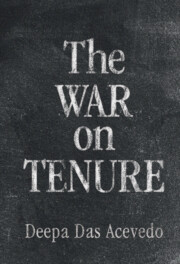
As academia increasingly comes under attack in the United States, The War on Tenure steps in to demystify what professors do and to explain the importance of tenure for their work. Deepa Das Acevedo takes readers on a backstage tour of tenure-stream academia to reveal hidden dynamics and obstacles. She challenges the common belief that tenure is only important for the protection of academic freedom. Instead, she argues that the security and autonomy provided by tenure are also essential to the performance of work that students, administrators, parents, politicians, and taxpayers value. Going further, Das Acevedo shows that tenure exists on a spectrum of comparable employment contracts, and she debunks the notion that tenure warps the incentives of professors. Ultimately, The War on Tenure demonstrates that the job security tenure provides is not nearly as unusual, undesirable, or unwarranted as critics claim.
Chapter 16 picks up where Chapter 6 left off in the history of tenure by explaining how tenure became a dominant industry practice. It draws on educational history to show that, even if tenure’s now-familiar form was articulated by faculty via the AAUP, tenure’s adoption across American academia was largely spurred by university leaders who saw it as a valuable recruitment and retention tool for an increasingly professionalized workforce.
Chapter 12 tackles the first of several myths regarding tenure’s effects on individual faculty incentives, namely, that tenure promotes undesirable iconoclasm. The chapter uses available research linking tenure with intellectual and pedagogical risk-taking as well as industry knowledge regarding how newly tenured professors actually behave to show that the “post-tenure renegade” is more assumption than fact.
The recent wave of executive orders and other actions at the federal level has received a great deal of attention in recent months. Receiving relatively less attention, however, has been ongoing efforts at the state level over the past couple of years to exercise more control over higher education. The present brief reviews recent state legislation impacting higher education with a particular focus on the recently enacted Ohio Senate Bill 1, as an illustrative example. We suggest that these state legislative efforts pose a threat to academic freedom through attacks on diversity, equity, and inclusion (DEI), curricular control, tenure, and faculty unionization. We provide an overview of these state legislative efforts and implications for I-O psychologists, particularly those in academia.
This essay examines academic freedom in Chile under the 1980s Pinochet military dictatorship. While much has been written on the topic, the literature is fragmented and difficult to access owing to the diverse range of stakeholders involved. Historians have tended to explore single cases, actors, and institutions to highlight struggles with the Chilean dictatorship. Bringing their stories together and assessing them collectively, however, sheds new light on this episode of academic freedom. It captures collaboration among students, faculty, and the public across multiple settings that has not yet been adequately explored by existing literature. Through an analysis of secondary and primary sources—including monographs, journal articles, government reports, newspaper articles, and Spanish-language publications—this essay traces a collaborative turn during the dictatorship that occurred separately among students, faculty, and the public as well as between those groups. It thus offers insight into the Chilean experience during the 1980s and the cooperative efforts to protect academic freedom.
How do academics interested in the study of legal topics that implicate the state relate to and deal with pressures that shape the space available to conduct research? This article examines the nature and impact of such pressures on Asia-focused public law scholars who must contend with a more diverse socio-political environment than the liberal democratic setting in which questions of academic freedom are typically explored. We find that the Asia-centric academy is affected by a wide range of constraints that notably extends beyond intra-institutional demands to those put in place by the state. This article also highlights how the scholarly agenda as set in and by the Global North may reduce the room for Asia-centric research to engage in theory-building and concept formation and explores how Asia-centric scholars can assert agency in the face of pressures. We conclude by emphasising the need for greater self-reflectivity within the legal academy.
Signaling by politicians, bureaucrats, and educational administrators plays a key role in curbing academic freedom in Japan by highlighting taboo subjects and funding priorities. Structural constraints on autonomy, however, represent the most insidious threat to academic freedom. Neoliberal reforms enacted in Japan over the past two decades have compromised academic freedom and undermined university autonomy. Overall, under the pretext of reform, higher education has become more rigidly hierarchical while there is a chronic lack of diversity that fosters narrow groupthink. On Prime Minister Abe Shinzo's watch, online harassment of academics surged while prominent revisionists targeted scholars over interpretations of wartime history.
This article examines the status of academic freedom in Hong Kong in light of the increasing securitization of higher education since the implementation of the National Security Law (NSL) in 2020. It provides an analytical framework to comprehend the changing landscape of academic freedom in Hong Kong, highlighting the impact of the NSL and the conflict between the necessity of political control on securitized campuses and the demand for international, free, and high-quality universities to make Hong Kong a global hub for higher education. The article concludes by asserting that the NSL has reshaped and will continue to impact academic freedom and university autonomy concerning core security issues, but there is still a possibility to establish a defendable space for genuine academic freedom in classrooms.
Today is a time of retrogression in sustaining rights-protecting democracies, and of high levels of distrust in institutions. Of particular concern are threats to the institutions, including universities and the press, that help provide the information base for successful democracies. Attacks on universities, and university faculties, are rising. In Poland over the last four years, a world-renowned constitutional law theorist, Wojciech Sadurski, has been subject to civil and criminal prosecutions for defamation of the governing party. In Hungary, the Central European University (CEU) was ejected by the government, and had to partly relocate to Vienna, and other attacks on academic freedom followed. Faculty members in a number of countries have needed to relocate to other countries for their own safety.
Liberal democracies and illiberal regimes alike recognize academic freedom as a norm that enables scientific progress. This article investigates the extent to which the globalization of academic freedom has been the result of a global diffusion process in addition to national developments, such as modernization and democratization. Academic freedom spread as part of a wider liberal script after World War II. The empirical analysis shows, however, that the codification of academic freedom at the international and regional level has been slower compared with other parts of the liberal script. To the extent that academic freedom has emerged as a global norm, it has happened through decentralized diffusion processes driven by higher education institutions and civil society networks. Different views on meaning, scope and emphasis made international and regional institutions norm takers rather than norm shapers. They only started to systematically institutionalize academic freedom into the liberal script when networks of scholars and higher education institutions mobilized internationally amidst increasing contestations of their academic freedom since the turn of the millennium.
Like other regions of the world, academic freedom is on the decline in Africa. While there are some generic factors accounting for this phenomenon worldwide, others are fundamentally unique to the African context. These are related principally to the subject matter of coloniality of higher education on the continent. This study addresses these matters by, among others, discussing the origins of the university in pre-modern Africa and the place of academic freedom in it. This development is followed by the emergence of university education in Europe through the application of the liberal script and which contributed to the sidelining and eventual general demise of higher education institutions with their roots in pre-modern Africa. The work contends that while one may trace the origins of the university/academic freedom to Africa, academic freedom as it stands today is shaped by the liberal script with hardly any reference to the root of higher education in Africa. Therefore, the meaning, understanding and application of academic freedom do not reflect the realities of higher education in Africa. This work proposes the adoption of a relative universalist approach, as opposed to the liberal approach, which is clothed with universality, but in reality, it is a reflection of a European idea of academic freedom. This approach is considered necessary to reflect the African reality of academic freedom which will help to identify effective advocacy tools to promote and protect academic freedom in Africa and thereby make academic freedom more meaningful for application in the region.
This article traces how the ‘freedom indispensable for scientific research’ was introduced into the International Covenant on Economic, Social and Cultural Rights (ICESCR). The review of the drafting history covers ICESCR Article 15.3 and that of its precursor, Article 27 in the Universal Declaration of Human Rights (UDHR). It pays particular attention to arguments presented during negotiations over the UDHR (adopted in 1948), as well as over the ICESCR (adopted in 1966), and it reflects on observable norm entrepreneurship. Following the end of the Cold War, details on the right to science and the status of higher education personnel were further elaborated in soft law, notably in the form of two General Comments and two UNESCO Recommendations. These specifications and the earlier traveaux préparatoires reveal a multifaceted and rich debate about science, development, dignity and freedom at the United Nations, including positions that span variations of a liberal science script as well as persistent illiberal contestations.
This article highlights the challenges of external reactions to authoritarian higher education governance in certain Central and Eastern European countries, especially Hungary and Poland. It interprets the political change in these countries as an authoritarian cultural backlash, which is not just a legal or political problem, but a kind of post-fascist cultural revolution contesting the liberal script. First, the article explains the framework of authoritarian policing in academia based on the more general works of Bob Altemeyer and Zeev Sternhell. Second, it tries to answer the question: What tools could counter these tendencies from the perspective of the European Union? As the article interprets the rise of authoritarianism as a phenomenon rooted in the cultural deficit of the countries concerned, it argues that a programme for a democratic and pluralist cultural counter-revolution should be implemented. However, no nation can be democratized solely by external actors, and the basics of democratic thinking should be developed from the grassroots level. If the crisis in academia is rooted in a value-crisis within the societies concerned, then measures countering this phenomenon should also include promoting Enlightened pluralism at all levels of these societies.