To save content items to your account,
please confirm that you agree to abide by our usage policies.
If this is the first time you use this feature, you will be asked to authorise Cambridge Core to connect with your account.
Find out more about saving content to .
To save content items to your Kindle, first ensure no-reply@cambridge.org
is added to your Approved Personal Document E-mail List under your Personal Document Settings
on the Manage Your Content and Devices page of your Amazon account. Then enter the ‘name’ part
of your Kindle email address below.
Find out more about saving to your Kindle.
Note you can select to save to either the @free.kindle.com or @kindle.com variations.
‘@free.kindle.com’ emails are free but can only be saved to your device when it is connected to wi-fi.
‘@kindle.com’ emails can be delivered even when you are not connected to wi-fi, but note that service fees apply.
The efforts among dozens of editors to reprint and thus circulate compositions by Black poets in anthologies across the decades constitute an extraordinary ongoing saga in the production of African American literature. Without collections bringing together large groups of Black poets in the pages of individual books, the view of an interconnected Black literary tradition may have been far more difficult to realize. Further, the presence of Black poets in primarily white anthologies diversified the racial and cultural hegemony of those collections and extended the readership of African American writers.
This chapter traces the history and legacy of Furious Flower, conceived as a conference on Black poetry and poetics in 1994 and continuing to this day as an academic and cultural center housed at James Madison University. While such institutionality may find itself, at times, at odds with the most radical parts of the African American poetic tradition, it is nevertheless a fundamental way to establish historically marginalized writing in the literary consciousness of a nation. This chapter examines the shape and the substance of Furious Flower’s dedication to archival recording while also looking at the organization’s attempt to chart a poetic landscape for African American poetry after the Black Arts Movement, in an era that has seen explosive growth in the production of poetic work but, precisely due to that growth, is increasingly hard to describe as a unified “tradition.” The chapter identifies how, through its dedication to audiovisual material, Furious Flower has turned scores of deeply ephemeral events into something that can be experienced across time and space, repeatedly, for the sake of research, teaching, community-building, and history-telling.
Poetry and poethood have long been intertwined with floral imagery starting with the ancient Greek idea of poems as flowers (anthoi), with the anthology (anthologia), the garland (stephanos), and, later the florilegium, being a gathering or collection of poets’ or writers’ finest flowers. Victorian poetry is an efflorescence of such ideas, its book titles frequently designating verse collections by one or more poets as a sheaf, posy, bouquet, nosegay, or as an idyllic garden retreat. Botanical images and metaphors of seeds, flowers, leaves, and shoots regularly occur as markers of the poet’s vocation, especially in prefatory poems and poetic dedications, while the lyric poem is often identified as a flower and a floral gift. Drawing on a large range of poetic examples, this chapter includes discussion of poems by Alfred Tennyson, Elizabeth Barrett-Browning, Mark André Raffalovich, Thomas Hardy, Eugene Lee-Hamilton, A. E. Housman, and Michael Field.
Anthologies play an essential role in shaping literary history. This anthology reveals women's poetic activity and production across the three nations of Ireland, Scotland, and Wales from 1400 to 1800, overturning the long-standing and widespread bias in favour of English writers that has historically shaped both scholarly and popular understanding of this period's female poetic canon. Prioritising texts that have never before been published or translated, readers are introduced to an extraordinary array of women's voices. From countesses to servant maids, from erotic verse to religious poetry, women's immense poetic output across four centuries, multiple vernaculars, and national traditions is richly demonstrated. Featuring translations and glosses of texts in Irish, Ulster Scots, Scots, Scottish Gaelic, and Welsh, alongside informative headnotes on each poet, this collection makes the work of women poets available like never before. This title is also available as Open Access on Cambridge Core.
In this introduction, we describe the purpose for this book by addressing the question of why we should care about stories. We discuss how stories form "sticky" narratives that readers might more readily remember as they engage in a wide array of resources regarding career searching. We also discuss how the inspiration for this book – Studs Terkel’s Working (1974) – leads us to offer another perspective of work: specifically, the modern experience of starting a new job. We end with an overview of what to expect in the book and how to read it.
This chapter examines what happens when we decolonize the materiality of the nineteenth-century Hispano-American anthology, when we move away from the anthology as a book form with colonial publishers, titles, sections, bylines, and expand it to centralize the (formerly) colonized and their ephemera, that is, Hispano-American editors, readers, and writers as well the Spanish-language newspapers they edited, read, and wrote for. What do these perspectives teach us about the emergence of what we now call a Latinx people and literary tradition? Mirroring the instability of the region following the US–Mexico War and the ontological uncertainty of its readers, newspapers like the Los Angeles-based El Clamor Público represent the formation of a pre-Latinx literary tradition. The newspaper’s editor and proprietor, Francisco P. Ramírez gave expression to what I call a Hispano-American borderlands anthology of poetry before there was a formalized creation of a Latinx poetic tradition in the United States.
Although the first anthology of Mexican poetry dates from 1833, Alejandro Higashi argued in his seminal volume PM-XXI-360 that the primary role of the anthology in Mexico changed in 1966. Traditionally a genre that presents a selection of previous work shaped by a certain notion of taste, the anthology took on an overtly prescriptive role with the first edition of Poesía en movimiento, edited by Octavio Paz, Alí Chumacero, José Emilio Pacheco, and Homero Aridjis. This text has remained in print ever since, and has privileged a practice of “demanding poetry” that has been taken up by later anthologies. The chapter also discusses the “cloning lab” of the anthology and how this phenomenon can be discerned in the profusion of anthologies published since the 1980s.
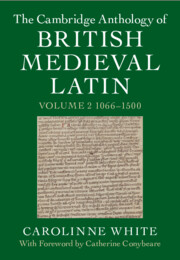
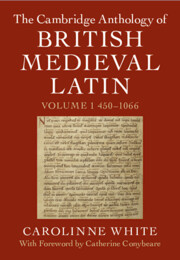
This anthology presents in two volumes a series of Latin texts (with English translation) produced in Britain during the period AD 450-1500. Excerpts are taken from Bede and other historians, from the letters of women written from their monasteries, from famous documents such as Domesday Book and Magna Carta, and from accounts and legal documents, all revealing the lives of individuals at home and on their travels across Britain and beyond. It offers an insight into Latin writings on many subjects, showing the important role of Latin in the multilingual society of medieval Britain, in which Latin was the primary language of written communication and record and also developed, particularly after the Norman Conquest, through mutual influence with English and French. The thorough introductions to each volume provide a broad overview of the linguistic and cultural background, while the individual texts are placed in their social, historical and linguistic context.
This anthology presents in two volumes a series of Latin texts (with English translation) produced in Britain during the period AD 450–1500. Excerpts are taken from Bede and other historians, from the letters of women written from their monasteries, from famous documents such as Domesday Book and Magna Carta, and from accounts and legal documents, all revealing the lives of individuals at home and on their travels across Britain and beyond. It offers an insight into Latin writings on many subjects, showing the important role of Latin in the multilingual society of medieval Britain, in which Latin was the primary language of written communication and record and also developed, particularly after the Norman Conquest, through mutual influence with English and French. The thorough introductions to each volume provide a broad overview of the linguistic and cultural background, while the individual texts are placed in their social, historical and linguistic context.
The modern discipline of New Testament Studies has subjected the various components of the New Testament to close scrutiny, yet it persistently fails to ask critical questions about the New Testament considered as a whole. In its familiar twenty-seven book form, the New Testament may be seen as a fourth-century anthology of early Christian writings based on earlier collections or sub-collections (the fourfold gospel, the Pauline letter collection), yet innovative in establishing a sharply defined boundary between included and excluded texts. An analysis of contributions to this journal over a recent five-year period demonstrates the pervasive influence of this fourth-century construct in determining the scope and priorities of (so-called) ‘mainstream’ scholarship. Greater attention to the contingencies of canon-formation will enable us to locate the texts that came to form the New Testament within a wider early Christian literary landscape.
This chapter traces the transformation of the Persian poetic classics from a living textual corpus into a pantheon of heritage objects for the use of national literary institutions. Its focus is on the creation of national literatures for the Soviet eastern republics of Tajikistan, Uzbekistan, and Azerbaijan from their establishment until the late Stalin period, but it shows how those literatures coevolved with Iranian and Turkish national canons, and with cosmopolitan and international post-Persianate canons. In its readings of the major classical poets Rudaki, Firdawsi, Khayyam, Nizami, Nava’i, and Bidil in modern anthologies, commentaries, and theatrical adaptations, the chapter emphasizes the asynchronous intervention of the classical poets themselves in their reception. The creation of these national literatures was a successful contestation of the representative authority of Western orientalists by national scholars, writers, and cultural officials, which would be widely imitated by postcolonial state cultural bureaucracies during the Cold War. The chapter’s central episodes are a series of anthologies published in Istanbul and Moscow in the early 1920s for Turcophone readerships; the founding Tajik anthology composed by Sadr al-Din ‘Ayni; the attack on the canon mounted by Central Asian radical folklorist–critics; and the Stalinist jubilees for classical Persianate poets.
Historically condemned for their commercial exploitation of poesy, and threat to authorial autonomy, the literary anthology was nevertheless one of the signal forms of literary modernism, in the US and beyond. It was at once a salient means for circulating and preserving verse and a genre in its own right. Although the little magazine has been the more attractive genre of study – both for the form’s closer proximity to collaborative literary production and for their amenability to digital scholarly methods – the anthology often had a symbiotic relationship to little magazines in the modernist period, and has endured as a form for aesthetic and political self-identification, speculative interpellation, preservation, and reclamation, as well as being a mode of reaching audiences beyond the “field of restricted production.” This chapter traces the US career of the anthology from Des Imagistes to An “Objectivists” Anthology, emphasizing the genre’s key importance for Black American writing.
Collecting and collector culture remain important aspects in the contemporary graphic novel, sustaining a relationship to the past that is tangible in material objects. While the representation of collectors is well known, this chapter charts a somewhat different aspect of collectors and the archives they assemble: it is less interested in graphic novelists as collectors than in their indebtedness to previous collections and the new uses they invent for them. This chapter attends to an earlier moment in the history of comics, one that precisely framed collecting as part of a media-historical conversation and in a context of changing ideas about cultural value, preservation, reproduction, and access, studying its long-term implications for understanding the archival impulse in the graphic novel today.
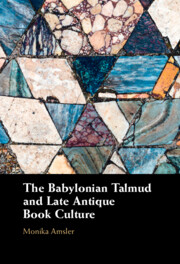
In this book, Monika Amsler explores the historical contexts in which the Babylonian Talmud was formed in an effort to determine whether it was the result of oral transmission. Scholars have posited that the rulings and stories we find in the Talmud were passed on from one generation to the next, each generation adding their opinions and interpretations of a given subject. Yet, such an oral formation process is unheard of in late antiquity. Moreover, the model exoticizes the Talmud and disregards the intellectual world of Sassanid Persia. Rather than taking the Talmud's discursive structure as a sign for orality, Amsler interrogates the intellectual and material prerequisites of composers of such complex works, and their education and methods of large-scale data management. She also traces and highlights the marks that their working methods inevitably left in the text. Detailing how intellectual innovation was generated, Amsler's book also sheds new light on the content of the Talmud. This title is also available as Open Access on Cambridge Core.
Chapter 5 looks at passages of carpe diem within longer texts, such as satires of Horace and Juvenal, Petronius’ Satyrica and Vergil’s Georgics. As carpe diem poems are read and re-read, they become independent textual objects: they can be inserted just about anywhere but never lose their lyric splendour. Thus, Vergil applies the carpe diem motif to a context as humble as cattle-breeding, while both Seneca and Samuel Johnson ignore the context and treat this section as vatic wisdom. This chapter analyses how such excerpts relate to Latin satire, which bastardised other texts, to late antique anthologising, medieval florilegia, and early modern commonplace-books. The chapter also proposes a new model for understanding textual allusions and intertexts in classical literature. Finally, the chapter argues that clichés are important features of classical culture that are worthy of close study.
Within the Chester Beatty Library, Dublin, is a small, but especially interesting anthology of Persian poetry. Although the manuscript's colophon is missing, the stylistic evidence of its badly damaged illustrations and illuminations indicates that it was produced in Shiraz in the 1430s or 1440s. The discussion considers two unusual features of the manuscript, the first of which is that seven folios of a type of paper, generally thought to be of Chinese manufacture, are included among its 171 folios of otherwise Islamic paper. As is typical of this so-called Chinese paper, the folios are coloured—in this case an olive green—and one is decorated with a gold painted design of what appears to be an immature fruit of some sort, along with lobed leaves on a curling vine. Equally intriguing are the scenes and patterns, painted exclusively in gold, that fill the margins of the folios throughout the manuscript. No other such margins are known in any other contemporary manuscript.
In his chapter on Proverbs, Christopher Ansberry provides a refreshing introductory approach to the book, not least because he starts with the history of interpretation rather than letting thematic concerns dominate. He identifies five patterns within the history of the book’s interpretation, including a focus on character formation, debates about the nature of its ‘wisdom’ and place in the canon, interest in its reception via matters of date and authorship, the discovery of comparative ancient Near Eastern material, and current, expanding interdisciplinary approaches to the book. A section on the fundamental nature of the book takes on matters of form, genre, poetic features, and the idea of a ‘collection’, whilst granting admiration rather than suspicion to the complexities of the book’s sayings. Likewise, the structure of Proverbs, though containing many parts, comes together into a coherent whole, an ‘anthology’, to which each piece contributes. Ansberry concludes by proposing four ‘dominant’ themes in the book: the fear of the Lord; wisdom; moral order and created order; retribution and reward.
This part of the book considers how to study the work of a poet. It uses the poets Emily Brontë and Srinivas Rayaprol as case studies to illustrate how to build up a picture of a poet’s career, how to get to grips with their central interests and their ways of addressing them, and how to develop a response to a writer in the context of the broader critical debate around their work.