To save content items to your account,
please confirm that you agree to abide by our usage policies.
If this is the first time you use this feature, you will be asked to authorise Cambridge Core to connect with your account.
Find out more about saving content to .
To save content items to your Kindle, first ensure no-reply@cambridge.org
is added to your Approved Personal Document E-mail List under your Personal Document Settings
on the Manage Your Content and Devices page of your Amazon account. Then enter the ‘name’ part
of your Kindle email address below.
Find out more about saving to your Kindle.
Note you can select to save to either the @free.kindle.com or @kindle.com variations.
‘@free.kindle.com’ emails are free but can only be saved to your device when it is connected to wi-fi.
‘@kindle.com’ emails can be delivered even when you are not connected to wi-fi, but note that service fees apply.
The immigration debate is a major source of political conflict, yet little is known about how citizens themselves perceive it. This paper uses a survey experiment with open-ended questions to examine which arguments respondents attribute to their opponents, which they consider the strongest for the opposing side, and how both compare to the arguments opponents actually use. The study is conducted in Norway, a low-polarization, consensus-oriented context where relatively accurate and charitable interpretations of opponents’ reasoning might be expected. Still, the findings show that while many recognize legitimate arguments on the other side, they attribute considerably weaker arguments to their opponents. Text analysis reveals that their preferred counterarguments resemble opponents’ own more closely than those they attribute to them. This suggests that mutual understanding in the immigration debate is obstructed less by a failure to appreciate opponents’ arguments than a systematic misrepresentation of them.
In this chapter it will be focused on the topic about why and how Béla Bartók’s music was an important compositional point of reference for Elizabeth Maconchy, especially for her string quartets. The reception of Bartók’s music signalled her interest in the ‘ultra modern’ music of her time, something which was hardly the norm. Maconchy absorbed Bartók’s tendency towards objectivity and constructivism (in the sense of a constructive compositional practice consisting of short and concise elements), which he developed around 1926, when he explicitly distanced himself from the conventions, style and diction of nineteenth-century music, claiming that his music became more simple and more contrapuntal. Maconchy followed exactly this path, as, especially in her string quartets, she developed the monothematic technique, imitation and variation, and the contrapuntal combination of linear parts – similar to a conversation – in which four voices repeatedly recite almost the same arguments.
This chapter introduces the volume, states the argument, identifies the academic discourse(s) that the argument intervenes upon, and lays out the structure of the study. It opens with an inciting incident of examining the Plaza de tres culuras in modern-day Mexico and linked to its past as a birthing ground of colonial education. The narrative of the Colegio de Santa Cruz Tlatelolco emerges as a clear example of places that have housed multiple visions of learning over the centuries. Key topics and themes enter the readers’ minds: Historian Robert Ricard and spiritual conquest discourse, Bernardino de Sahagún and the student-documentarians of the Colegio, Indigenous sense of place as tied to family courtyards, and architecture as an archive for learning environments. The historiography begins with a call to action relating to ethnohistory, art history, education studies, and Spanish colonialism, noting key arguments my predecessors posed and connecting the study to the latest findings of my peers. Highlights include an advocacy for ethnohistory that bridges disciplines and focuses on linguistics to understand local art, religion, and education. The concept of the “learningscape” and how to approach visions of learning studies is a central takeaway, and readers discover the problematic rhetoric of Western terminologies surrounding “tequitqui” art.
This chapter further situates my Kantian account of thought experiments among competing views. I identify problems for contemporary accounts and contrast epistemological questions (How do thought experiments justify?), which guide most of the current scholarship, with Kant’s emphasis on cognition [Erkenntnis] (What makes concepts meaningful?). I note that metaphilosophical questions on the relationship between conceivability and possibility are not relevant for thought experiments if they are an apparatus for cognition, which is neutral toward the truth or actuality of the objects of cognition. Contemporary accounts that begin with Kuhn’s epistemological question differ on what the basis of knowledge might be. Leading approaches appeal to logic, stored knowledge, and intellectual intuition. I will briefly sketch here some of the basic approaches.
This chapter provides an overview of empirical support for Construction Grammar in the form of behavioral evidence, that is, information derived from the behavior of language users on certain tasks, typically through controlled experiments. Three types of evidence are discussed in particular: (i) evidence from language comprehension tasks that syntactic patternsconvey meaning independently of individual lexical items, (ii) evidence that constructions prime each other both in form and in meaning, and (iii) evidence that grammar consists of a network of related constructions of varying degrees of generality. Many of the cited studies come from the psycholinguistic literature, and even though they were originally not necessarily framed in terms of constructions, their findings are largely in line with the constructional approach. Throughout the discussion, it will be shown how these findings provide evidence for some of the core tenets of Construction Grammar.
This chapter presents an overview of some of the central concepts of constructional syntax. Focusing on key insights from Berkeley Construction Grammar and Cognitive Construction Grammar, it discusses how construction entries of different types from the inventory of constructions interact with each other to license constructs. This chapter also outlines a novel methodology for discovering constructions in a corpus that allows for a systematic way of compiling construction entries that are relevant for research in Construction Grammar and constructicography.
The Literary Club, often simply known as ‘The Club’, was founded by Samuel Johnson and Joshua Reynolds in 1764. The Club has been understood as the epitome of a strain of Enlightenment clubbability, modelled on earlier eighteenth-century ideals of conversation and channelling them into a new form of argument-as-sport. However, Goldsmith’s experiences of being often ridiculed at meetings can help counterbalance heroic accounts of the club by foregrounding a tendency to cruelty in this celebrated institution. This chapter provides a more balanced account of the Club than we are used to, one that insists on Goldsmith’s centrality to its activities, not only as a founding member and successful product of its cultural networking, but also as a figure who exposes the dual nature of the Club.
Chapter 8 summarizes the book as a whole and discusses theoretical implications. I briefly review the argument and the evidence provided to substantiate its claims. I then assess the implications of these findings for the comparative study of ethnoracial and identity politics and the interdisciplinary study of race in Brazil and Latin America. For comparative political scientists studying ethnic and identity politics, I emphasize how my argument highlights an alternative role for the state in these processes: as a set of actors responsible for shaping citizenship rights and subjective experiences, which in turn shape the subjectivities and identities that citizens bring into the political arena. For interdisciplinary scholars interested in Brazil and Latin America, I emphasize the dynamic nature of the state of racial politics in Brazil, and suggest that future studies move beyond the well-trod characterization of the Brazilian case as the go-to example of the absence of racial politics. I conclude the book with discussion of the challenges ahead for Brazil's racialized democracy.
The introductory chapter (Chapter 1) introduces the empirical and theoretical puzzles that motivate this project and presents a brief overview of the book as a whole. I present and motivate the empirical puzzle at the heart of the book and situate the reclassification reversal as a case of identity change and politicization. I then provide an overview of the central argument and mechanisms, and discuss alternative explanations tied to affirmative action and other prevailing explanations that do not adequately explain the puzzle. Next, I discuss the research design, methods, and positionality. I conclude the chapter with an outline of what is to come.
Chapter 3 details the argument to explain the reclassification reversal and elaborates the causal mechanisms. I begin by defining the concept of “political identity” as I use it throughout this work, distinguishing it from related concepts like social identity. I then argue that institutional change in national-level social policies brought about unprecedented access to education for lower-class citizens (who are likely candidates for reclassification) and show the evolution in educational access from the 1980s to the 2010s. At the individual level, greater education increased the exposure of individuals to racial hierarchies and inequalities, leading them to develop racialized political identities and choose blackness. I identify three main causal pathways: greater exposure to (1) information, (2) social contacts and networks, and (3) labor market experiences and discrimination. I conclude by summarizing the novelty of the hypothesis and the observable implications I test empirically in the chapters that follow.
A common view of the Gorgias is that Plato is portraying the limits of Socratic discussion. Interlocutors become hostile, little agreement seems reached, and conversation breaks down. Furthermore, non-rational forces, by which may be included pleasures, pains, epithumiai, and the pathos of eros, come to the fore at various points. These twin factors have led to a growing consensus that what is shown is that discussion is not effective with persons in whom non-rational forces are strong. This chapter questions this consensus, bolstering Socrates’ optimistic reply to Callicles, that if the same things are examined “often and better”, Callicles will be persuaded. It argues that dialogue is a normative practice, which exemplifies the virtues that constitute its subject matter; this enables greater appreciation of how it can play a role in shaping cognition and behaviour. If values are involved in the very operation of dialogue, then participants can become accustomed to the values that form the explicit content of discussion by learning to adhere correctly to its form. Seen as such, Socratic argument is not just determined by the desires of its participants (unlike rhetoric), but is capable of shaping them.
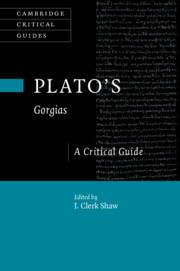
Plato's Gorgias depicts a conversation between Socrates and a number of guests, which centers on the question of how one should live. This "choice of lives" is presented both as a choice between philosophy and ordinary political rhetoric, and as a choice between justice and injustice. The essays in this Critical Guide offer detailed analyses of each of the main candidates in the choice of lives, and of how the advocates for these ways of life understand and argue with each other. Several essays also relate the Gorgias to the philosophical and political context of its time and place. Together, these features of the volume illuminate the interpretive issues in the Gorgias and enable readers to achieve a thorough understanding of the philosophical issues which the work raises.
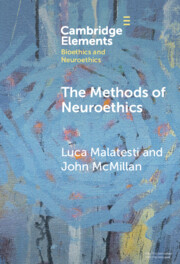
This Element offers a framework for exploring the methodological challenges of neuroethics. The aim is to provide a roadmap for the methodological assumptions, and related pitfalls, involved in the interdisciplinary investigation of the ethical and legal implications of neuroscientific research and technology. It illustrates these points via the debate about the ethical and legal responsibility of psychopaths. Argument and the conceptual analysis of normative concepts such as 'personhood' or 'human agency' is central to neuroethics. This Element discusses different approaches to establishing norms and principles that regulate the practices addressed by neuroethics and that involve the use of such concepts. How to characterize the psychological features central to neuroethics, such as autonomy, consent, moral understanding, moral motivation, and control is a methodological challenge. In addition, there are epistemic challenges when determining the validity of neuroscientific evidence.
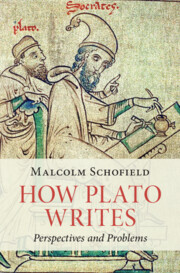
Plato is a philosophical writer of unusual and ingenious versatility. His works engage in argument but are also full of allegory, imagery, myth, paradox and intertextuality. He astutely characterises the participants whom he portrays in conversation. Sometimes he composes fictive dialogues in dramatic form while at other times he does so as narratives. In this book, world-renowned scholar Malcolm Schofield illustrates the variety of the literary resources that Plato deploys to achieve his philosophical purposes. He draws key passages for discussion particularly, but not only, from Republic and the less well-known Laws and also shows how reconstructing the original historical context of a dialogue and of its assumed readership is essential to understanding Plato's approach. The book will open the eyes of readers of all levels of expertise to Plato's masterly ability as a writer and how an understanding of this is crucial if we are to appreciate his philosophy.
The ability to respond critically to any text is a learnt ability which needs some innate ability before it can be developed. That is, critical thinking is a variegated talent, linked to intelligence and curiosity, which is hard-wired into the human brain but is not always fostered equally. We are all different according to aspects of biology, intelligence and personality. Likewise, we are all different according to our experience of being encouraged to use these natural abilities. Indeed, there is even some evidence that critical thinking is an ability that is only really developed at all after the teenage years. This idea is consistent with other theories of literacy, which state that there must be an inherent ability to decode language before it can be developed, and that any form of literacy is incremental. That means that each layer of literacy builds on previous levels, and that we must be cognitively ready for each stage. Critical literacy is, therefore, a higher level of literacy which builds on foundational forms of literacy. We need to be able to decode language systems at the semiotic, denotational and connotational levels in order to produce sense. Once we produce this meaning through textual reception, we can start to definitively question what we are being told, building on whatever latent critical ability we already have.
In this chapter, we look at the key written form through which undergraduate students in the Humanities practise participating in this scholarly dialogue: the academic essay. Even where different disciplines have unique requirements for how information is delivered in an essay, Humanities essays share broad features such as their overall structure, thesis-driven argument and evidence-based argumentation. If you can master these foundational aspects, you can readily adapt your writing to meet different disciplinary contexts. Moreover, these same skills can be used in other types of academic writing that are not essays but which foreground argument just like the essay. This chapter is organised into three parts. It begins by looking at the essay as a distinct genre with recognisable conventions that support participation in scholarly dialogue. Next, it reviews the important steps that precede essay writing: breaking down the question, planning your argument and structure, and project managing your essay. The chapter covers the essentials of essay writing: the introduction, body paragraphs and conclusions.
The second part concludes with a chapter on effective advocacy before the ICJ, by Samuel Wordsworth QC and Kate Parlett. It examines both written and oral advocacy before the Court, with the fundamental objective of the advocate in all cases being to persuade, making it essential to consider what will be of most utility to the judges when they come to reach a decision on the case. They also emphasise the significant role the advocate has to play in the pre-litigation stage and in early procedural exchanges: she or he must bear in mind that they have a dual function of presenting the best case for the client to the Court, while also persuading the client as to the most effective way in which to do that.
The purpose of this chapter is to offer a sketch of the relation between rhetoric and dialectic as Cicero sees it, and to identify a problem internal to his account. Cicero argues at length in the Tusculan Disputations in favor of the idea that the good and wise person does not experience any form of emotional disturbance. That being so, how can one who signs up to the idea that emotional disturbance is ideally to be eliminated then in good conscience recommend a practice – namely, rhetoric – one of whose principal objectives is to arouse the emotions? There looks to be a clash here between the objective of the philosopher and that of the orator. I explore Cicero’s resources for tackling this tension, and suggest how his conception of the relation between rhetoric and dialectic may thereby illuminate some distinctive aspects of his philosophical approach.
This overview chapter introduces philosophical tools that can be used to aid managers in making decisions in situations which go beyond simple cost/benefit analyses. Value terms such as right, wrong, fair, justice, beneficence, responsibility, eco-consciousness, and discrimination are discussed and illustrated using real-world examples. Starting with the world’s worst industrial disaster in Bhopal, India and the contemporary aftermath, it examines the complexities such situations present and assesses the usefulness of creating a theoretical framework that can lead to principled and defensible policies and actions. The challenges of exclusive self-interest and ethical relativism are examined, where morality simply echoes personal preference. Immediate profit maximization is compared to a more subtle long-term and more encompassing stakeholder approach. Reliance on the law is shown to be an insufficient ethical guide, while principle-based approaches that can be applied across a wide range of cases are more successful in working out what we should do in novel and difficult situations.
Pufendorf’s method comprised three distinguishable strains: a humanistic deployment of diverse sources, especially from classical antiquity; an eclectic demand to choose and fashion such materials anew; and a scientific insistence on observational evidence, systemic coherence, and procedural rigor. Each of these resisted disciplinary capture, authoritarian control, and subservience to extraneous, extra-philosophical interests – appealing instead to a rational and thus potentially universal audience. In Pufendorf the third strain became dominant and involved the others as auxiliary procedures. Like other early modern instances of “mathematical” or scientific method, it aspired – in principle, and within its characteristic domain of free, human action – to probative certitude and intellectual authority while remaining exposed to challenges and demands for articulation, thereby claiming the participatory assent of other, unbiased reasoners. Despite eschewing metaphysical foundations in favor of merely empirical supports, it claimed the peculiar force or authority animating explanatory and normative legality alike. It was, in short, rational and empirical at the same time, attempting to control the pull of these counter-tendencies toward more abstract, vacuous, and irreconcilable extremes. This aim was achieved by combining broadly prudential analyses of both human and divine intent, nourished by a realistic or pragmatic assessment of historical (actual and recorded) experience.