To save content items to your account,
please confirm that you agree to abide by our usage policies.
If this is the first time you use this feature, you will be asked to authorise Cambridge Core to connect with your account.
Find out more about saving content to .
To save content items to your Kindle, first ensure no-reply@cambridge.org
is added to your Approved Personal Document E-mail List under your Personal Document Settings
on the Manage Your Content and Devices page of your Amazon account. Then enter the ‘name’ part
of your Kindle email address below.
Find out more about saving to your Kindle.
Note you can select to save to either the @free.kindle.com or @kindle.com variations.
‘@free.kindle.com’ emails are free but can only be saved to your device when it is connected to wi-fi.
‘@kindle.com’ emails can be delivered even when you are not connected to wi-fi, but note that service fees apply.
It was a common assumption during the war that VAs and AAMWS servicewomen wanted to be nurses, and it was this desire that motivated them to join this service rather than take up one of the other available wartime opportunities. As Sheila Sibley confessed in 1943, before she began her work as an AAMWS, she was ‘dreaming dreams’ of becoming ‘an angel of mercy, the wounded man’s guide … the Rose of No-Man’s Land’. Sibley imagined that she would ‘float down the wards in my nifty blue uniform, and tender sighs would float right after this war’s Florence Nightingale’. Both Hitchcock and Sibley suggest there was some truth in the assumption that VAs and then AAMWS saw themselves as akin to, or aspired to be, nurses. Like Hitchcock, Sibley’s references show a clear association with the nurse in her understanding of the VAD and AAMWS. But Sibley admits that once she joined her first military hospital, she learnt the reality of the AAMWS’ work and conceded, ‘better leave that noble figure in my imagination.’
In this paper, the author asserts that the Johannesburg Art Gallery has also done remarkably well in preserving archival material in the field of black visual art. Such documents shed light on the operations of the visual art industry in South Africa before the democratic dispensation of 1994. He argues that heritage practitioners, artists, and scholars can immensely enhance their knowledge through study of these records. The author also thinks that it is crucial for this unique collection to be digitized for preservation and access.
The ecumenical synods of the Roman imperial period cannot be understood without understanding their forerunners, the Hellenistic artists’ associations. These were not organised on a pan-Mediterranean scale as the ecumenical synods were. Rather, they were regionally organised, reflecting the fragmented political world of the Hellenistic period. There were four major associations: the Athenian synod, the Isthmian-Nemean synod, mainly active on the Peloponnese and in Boeotia, the Ionian-Hellespontine synod in Asia Minor and the Egyptian synod connected to the Ptolemaic royal court. This chapter discusses their emergence in the third century bc and their involvement in festivals, politics and religion. In many respects their activities were a model for what would come later, for example their preoccupation with securing financial and honorific privileges for their members, their contribution to the organisation of festivals and their relations with political rulers such as Hellenistic kings and Roman generals.
This chapter bridges the gap between the disappearance of the Hellenistic artists’ associations in the first century bc and the emergence of the ecumenical synods at the end of that century. It begins with a discussion of the first attestations of the ecumenical synods. The ecumenical athletes’ association is first attested in a letter by Mark Antony from the 40s or 30s bc. The first clear evidence of the ecumenical synod of artists dates only from the reign of Claudius (AD 41-54), but there are indications that the artists were already banding together on a transregional scale in the 30s bc. Next, this chapter seeks to explain the emergence of the synods by looking at the broader context of Mediterranean integration. It argues that the synods’ emergence was connected to the development of an 'international' festival network, which was in turn made possible by the Roman unification of the Mediterranean. Moreover, it appears that the Roman takeover in the east created the right conditions for the establishment of associations that transcended the polis framework. Especially the province of Asia seems to have provided fertile soil for experimenting with new organisational forms.
This chapter investigates the development of the ecumenical synods in the first century ad, first discussing the xystic synod of athletes and then the thymelic synod of artists. After giving an overview of earlier scholarly opinions on their development, this chapter discusses the evidence from a new perspective. It argues, for instance, that there had been only one athletic synod all along, rather than two athletic synods that eventually merged. As for the thymelic synod of artists, it is clear that it was already fully formed and functional in the first century ad, which opposes the interpretation of some scholars who date its definitive formation about a century later. All in all, the sources indicate that the synods gradually strengthened and expanded their role in the festival world throughout the first century ad and that this evolution gained momentum in the reign of Claudius (AD 41–54).
This book opens with some introductory notes on the two ecumenical synods, marking the discrepancy between their importance in the festival world of the Principate and the obscurity they have fallen into in present-day scholarship. This is mainly due to the extremely fragmentary source material on their history and organisation. The ecumenical synods are mainly known from inscriptions, often heavily damaged, and papyri from Egypt. These diverse sources present us with a complex and often contradictory view. The most important documents for this study are decrees drawn up by the synods, their correspondence with emperors and membership certificates. A great variety in names and titles further complicates our understanding of the synods. Nevertheless, there are a number of basic elements that recur in the documents promulgated by the synods themselves, which are discussed briefly. The final part of the introduction sets out the structure of the book as well as the basic principles that form the core of the argumentation.
The first half of the second century ad was marked by an important event in the history of the ecumenical synods. They both acquired headquarters in Rome: the thymelic synod seemingly settled in a precinct on the Campus Martius and the xystic synod occupied a part of the great bath complex of Trajan on the Oppian hill. This chapter analyses the reasons for this shift and its consequences. The establishment of the Capitolia in ad 86 played a key role, as well as the desire of the synods to be closer to the imperial court. Furthermore, this chapter argues that the move to Rome strengthened centralising tendencies, as it had become easier to take central decisions for the whole agonistic circuit in close consultation with the emperor. Special attention in this chapter is given to the xystic synod’s headquarters, which is documented in a series of inscriptions found near the church of S. Pietro in Vincoli. Recent archaeological excavations on the Oppian hill have furthermore led to the conclusion that the synod was indeed settled in the bath-gymnasium complex of Trajan.
This chapter discusses the members of the ecumenical synods, beginning with the core members: the ‘athletes/artists who take part and win in sacred crown games’. Among these, several hierarchies are detectable: hierarchies based on agonistic victories (the more victories in sacred games, the better), on agonistic disciplines (some disciplines were regarded higher than others, e.g. kitharists were regarded higher than trumpeters and pankratiasts higher than runners) and on social background (not all competitors came from elite families). Next, the chapter proceeds to the members who offered competitive support: the so-called synagonistai of the thymelic synod took part in the performances but could not win prizes themselves; they were for instance secondary actors or choir members. In the xystic synod, the presence of trainers supporting individual athletes is documented. Finally there were other people who were not involved in the competitions themselves, such as support crews, administrative aides, family members of competitors and honorary members.
The conclusion comes back to the main findings of the different chapters. Taken as a whole, this book rehabilitates the ecumenical synods of competitors as prominent actors in the Graeco-Roman society. They shaped its socio-cultural life, reconciled Greek traditions with Roman rule and contributed to the remarkable cultural unification of the Mediterranean in that period.
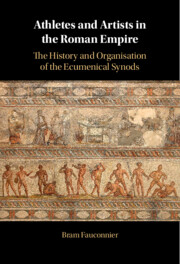
This is the first comprehensive study of the associations of athletes and artists in the Roman empire. The xystic synod of athletes and the thymelic synod of artists were the only ancient associations that operated on a pan-Mediterranean scale. They were active from southern Gaul to Syria and Egypt and were therefore styled 'ecumenical synods'. They played a key role in Greek festival culture during the imperial period: not only did they defend the professional interests of their members, they also contributed to the organisation of competitions and the maintenance of the festival network. Due to their cultural activities, their connections with the imperial court and their ramified social networks, they left a distinctive stamp on Greco-Roman elite culture during the Principate. Drawing on all available documentation, this book offers new insights into the history and workings of these remarkable associations.
A critical consensus has emerged that, rather than consolidating masculine power, DeLillo’s fiction unsettles it by exposing masculinity as a fragile social construct. Bearing in mind Philip Nel’s injection to consider DeLillo’s depiction of women as well as men, this chapter argues that DeLillo’s fiction not only undermines the central myths of white American manhood, but it also actively favours feminine forms of subjectivity and a feminine aesthetic. While DeLillo’s white men attempt to recover “true” selves that never existed, his women are fully aware of the ways in which the culture they inhabit both constructs and constitutes their subjectivity. More or less immune to the hankering for the real that haunts his men, DeLillo’s women, especially his women artists, tend instead to manipulate existing cultural codes in a fashion that permits them – paradoxically – some of the autonomy that his male characters seek. DeLillo’s recurrent engagement in his most recent fiction with the threat posed to women viewers of art demonstrates that his work remains committed to the scrutiny and critique of misogyny and masculinity in its most toxic manifestations.
Géricault’s preliminary sketch of a hanging was the most original of all his works in London, though it has been little discussed. Its depiction of the Cato Street executions still passes unrecognised. This chapter proves that these were indeed its subject. More widely, for the first time in art history it shows a hanging without making the execution stand for something other than itself – sharing kinship in this with Goya’s Third of May 1808 (though that work was unknown to Géricault). Géricault’s unflinching pity may anticipate our own.
How can arts managers, artists, and art market observers approach the study of economics? Accompanied by hand-drawn illustrations, wide-ranging case studies, and expansive discussion resources, this interdisciplinary microeconomics primer engages with complex – and, at turns, political – questions of value and resourcefulness with the artist or manager as the decision-maker and the gallery, museum or studio as 'the firm'. Whitaker arms the reader with analytic and creative tools that can be used in service to economic sustainability for artists and organizations. By exploring the complexities of economics in application to art, design and creative industries, this book offers ways to approach the larger world as an art project.
This chapter considers one particular piece of evidence for the perceived importance of artistic skill in the Greek world: the unrestricted mobility of artists. Skill is both a rare and portable commodity. High demand for skill may encourage travel, as artists are tempted by ever higher offers of pay in different locales. On the other hand, variable levels of demand may equally force artists to move in order to gain full employment. Crucially, the fact that Greek cities did not attempt to block the entry of foreign artists from hostile polities testifies to the widespread demand for skilled artists and the respect accorded to their craft.
Copyright embraces a vast range of authors and is intended to be neutral about the nature of authorship save for the requirement of originality. Nevertheless, the description author can be illusory and even unhelpful. Great visual arts masters have for centuries practised their art through the directed hand of others. Are they authors? Should conductors of music, stage directors or curators of art exhibitions be deemed authors? What would ‘the show’ be without them? And what of authorship in the modern computer age of the creation of works where the human hand is significantly or even completely removed? On the other hand, indigenous cultures typically eschew notions of private ownership and the individual as author. The age-old concept of authorship in copyright is open to serious reflection and review.
The chapter highlights issues raised by attempts to preserve street and graffiti art. It does so by exploring whether street and graffiti artists could successfully oppose the removal or destruction of their works by relying on the moral right of integrity; and whether the heritagisation of these forms of art could also be a valuable legal option to conserve them. Cases where artists have tried to protect their works, and local councils and communities have attempted to conserve street artworks, will also be analysed. The chapter concludes that a reasonable balance between the rights and interests of all stakeholders – artists, property owners and local communities – needs to be achieved, and that this is best undertaken by judges, or administrative bodies, equipped to grasp the specificity and complexity of each case.
In the four decades following the death of Tsar Nicholas I in 1855, long-repressed cultural energies broke loose across imperial Russia. The Great Reforms of Alexander II, which began in 1861 with the Emancipation of Russia’s serfs, introduced transformative changes in law, politics, society, the economy, and the army. Creative endeavor also stirred. Freedom was in the air, and artists and writers imagined it for themselves and for the nation. They developed new content and forms of expression and assumed greater control over their creative lives. By the end of the century, literature and the arts had rejected the unitary model of state-sponsored patronage and transitioned to become free professions, although funding from state and Church remained important. Simultaneously, print culture extended outward to a growing public. Part I treats the meta-theme of freedom and order by examining the how the Fools and rebellious heroes of tradition were modernized and harnessed to the topics of the day. Issues of inclusion and boundaries surfaced as lines between and among the legal estates blurred and civic participation broadened. Publics and audiences for the arts transformed, and expectations about the roles of artists and the arts changed accordingly.